Wet Spinning PEDOT:PSS Fibers: A Comprehensive Guide to Fabrication Methods, Optimization, and Biomedical Applications
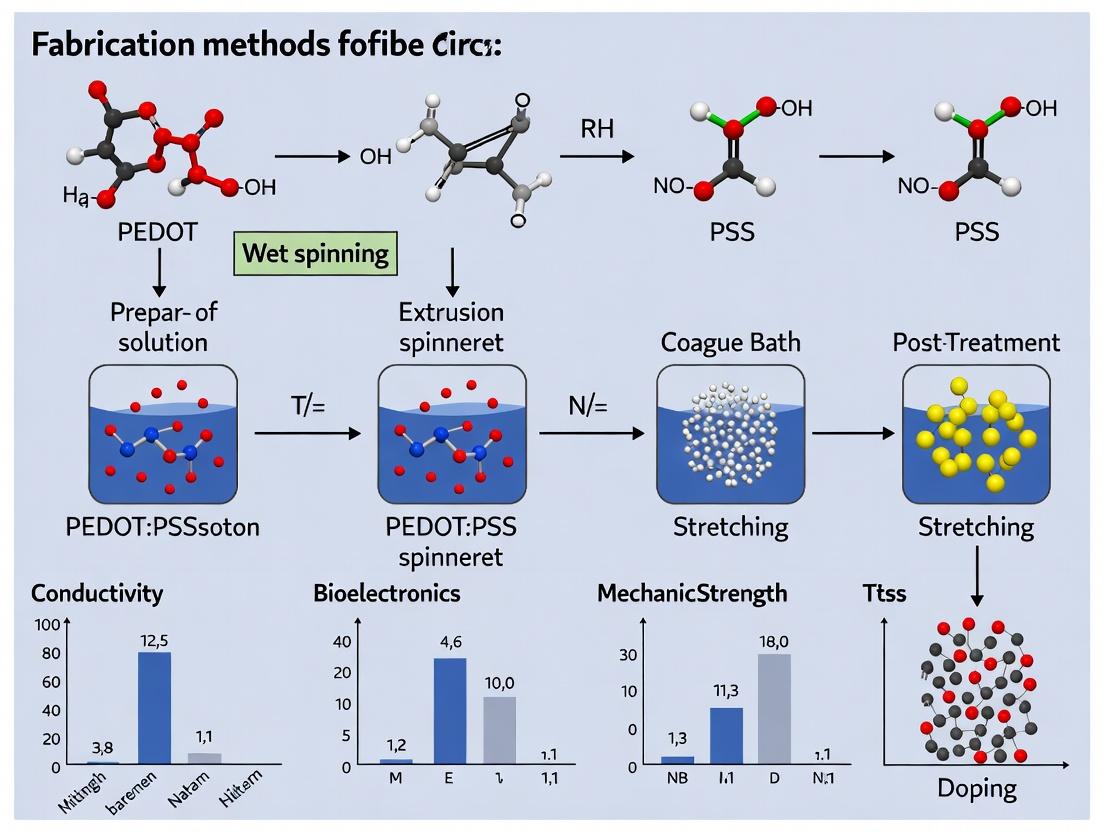
This article provides a detailed, up-to-date technical review of wet-spinning methodologies for fabricating PEDOT:PSS conductive fibers.
Wet Spinning PEDOT:PSS Fibers: A Comprehensive Guide to Fabrication Methods, Optimization, and Biomedical Applications
Abstract
This article provides a detailed, up-to-date technical review of wet-spinning methodologies for fabricating PEDOT:PSS conductive fibers. Tailored for researchers, scientists, and drug development professionals, it covers foundational chemistry and material science, step-by-step fabrication protocols, common troubleshooting and optimization strategies for mechanical and electrical performance, and methods for validating and comparing fiber properties. The review synthesizes current research to serve as a practical guide for developing next-generation neural interfaces, smart textiles, and advanced drug delivery systems.
Understanding PEDOT:PSS Chemistry and the Wet Spinning Principle for Fiber Fabrication
Chemical Structure and Composition
PEDOT:PSS is a polymer complex consisting of poly(3,4-ethylenedioxythiophene) (PEDOT), a conjugated polymer, and poly(styrene sulfonate) (PSS), a charge-balancing polyelectrolyte. PEDOT forms oxidized, positively charged chains (holes) that enable conduction. PSS provides counterions, ensures solubility in water, and acts as a colloidal stabilizer.
Table 1: Typical Composition and Properties of Commercial PEDOT:PSS Dispersions
| Property / Component | Clevios PH1000 | Clevios PH500 | Typical Range | Function/Note |
|---|---|---|---|---|
| PEDOT to PSS Ratio (by weight) | 1:2.5 | 1:6 | 1:1.5 to 1:20 | Lower ratio often yields higher conductivity. |
| Solid Content (%) | 1.0 - 1.3 | 1.0 - 1.3 | 0.3 - 3.0 | Total polymer weight in dispersion. |
| Conductivity (S/cm) - as supplied | < 1 | ~ 10⁻³ | 10⁻⁵ - 1 | Highly variable; requires secondary doping. |
| Conductivity (S/cm) - with DMSO | ~ 800 - 1000 | ~ 500 - 600 | Up to ~4000 | DMSO is a common conductivity enhancer. |
| Particle Size (nm) | 20 - 100 | 30 - 100 | 20 - 200 | Core-shell morphology (PEDOT-rich core, PSS-rich shell). |
| Viscosity (mPa·s) | 10 - 25 | 10 - 25 | 5 - 1000 | Critical parameter for fiber spinning. |
| pH | ~1.5 - 2.5 | ~1.5 - 2.5 | 1 - 3 | Highly acidic due to sulfonic acid groups. |
Conduction Mechanism
The conduction mechanism in PEDOT:PSS is governed by a complex interplay of electronic and ionic transport within a heterogeneous, phase-separated structure.
- Charge Transfer and Doping: PEDOT chains are p-doped by PSS⁻ ions, creating polarons and bipolarons (positive charge carriers) on the PEDOT backbone.
- Morphological Model: The system consists of PEDOT-rich nanocrystalline domains (high conductivity) embedded in an insulating PSS-rich matrix. Conduction occurs via:
- Intra-chain transport along conjugated PEDOT segments.
- Inter-chain hopping within PEDOT-rich grains.
- Inter-grain hopping/tunneling between PEDOT-rich domains.
- Secondary Doping Effect: Adding high-boiling-point polar solvents (e.g., DMSO, ethylene glycol) induces a conformational change. The PEDOT chains transition from a coiled to a linear, expanded-coil structure, facilitating better π-π stacking and phase separation. This reduces the insulating PSS barrier and creates more interconnected conductive pathways.
Title: PEDOT:PSS Conduction Enhancement Pathway
Intrinsic Properties
PEDOT:PSS exhibits a unique combination of properties that make it suitable for fiber-based applications, particularly in bioelectronics and flexible devices.
Table 2: Intrinsic Material Properties of PEDOT:PSS
| Property | Typical Value / Nature | Relevance to Wet-Spun Fibers |
|---|---|---|
| Electrical Conductivity | 0.1 - 4000 S/cm (tunable) | Defines fiber's performance as wire/electrode. |
| Ionic Conductivity | High (especially for K⁺, Na⁺) | Enables ion-to-electron transduction in biosensors. |
| Optical Transparency | > 80% (thin film, 100 nm) | For transparent or visually unobtrusive fibers. |
| Mechanical Flexibility | High (Young's Modulus: 1 - 4 GPa for films) | Essential for flexible, wearable fiber electronics. |
| Stretchability (as cast) | Low (2-5%) | Can be enhanced with additives (e.g., surfactants, polymers). |
| Thermal Stability | Stable up to ~200°C in air | Compatible with standard processing techniques. |
| Biocompatibility | Generally good; pH-dependent | Critical for implantable or tissue-contacting fibers. |
| Hydration-Dependent Swelling | Swells in aqueous environments | Affects dimensional stability and conductivity in vivo. |
| Work Function | ~5.0 - 5.2 eV | Matches HOMO of many organics; good electrode material. |
| Mixed Ionic/Electronic Conductor | Yes | Fundamental for organic electrochemical transistors (OECTs). |
Application Notes & Protocols for Wet Spinning Research
Context: This protocol outlines the preparation of a high-conductivity PEDOT:PSS dope solution and its wet-spinning into monofilament fibers for use in bioelectronic textiles.
Protocol 1: Preparation of Dope Solution for Wet Spinning
Objective: To formulate a stable, spinnable PEDOT:PSS dispersion with enhanced conductivity and tailored viscosity. Materials: See Scientist's Toolkit below. Procedure:
- Baseline Dispersion: Transfer 10 mL of commercial PEDOT:PSS dispersion (e.g., Clevios PH1000) to a 20 mL glass vial.
- Additive Mixing: Using a micropipette, add the conductivity enhancer (e.g., 5% v/v DMSO or 1% v/v EG). For mechanical plasticization, add the additive (e.g., 1% w/w GOPS or 3% v/v Zonyl) at this stage.
- Primary Mixing: Stir the mixture on a magnetic stir plate at 500 rpm for 30 minutes at room temperature (RT).
- Sonication: Sonicate the mixture using a probe sonicator (with ice bath) for 5 minutes at 30% amplitude (3-second pulse on, 2-second pulse off) to reduce aggregate size and improve homogeneity.
- Filtration: Filter the dope solution through a 5 μm hydrophilic PTFE syringe filter into a clean vial to remove any large aggregates that could clog the spinneret.
- Degassing: Place the filtered dope in a vacuum desiccator for 15-30 minutes to remove air bubbles, which can cause fiber breaks during spinning.
- Storage: Use immediately or store at 4°C for up to 72 hours. Allow to return to RT and mix gently before spinning.
Protocol 2: Basic Coagulation Bath Wet Spinning Setup
Objective: To extrude dope solution into a coagulation bath to form a solid PEDOT:PSS fiber. Materials: Syringe pump, single-hole spinneret (gauge 20-27G), coagulation bath solvent (e.g., isopropanol, acetone, or saturated (NH₄)₂SO₄ solution), winding drum, and wash baths. Procedure:
- Setup: Load the degassed dope into a gas-tight glass syringe. Attach the spinneret. Fill the coagulation bath (typically 50-100 mL) with the chosen solvent. Position the bath so the spinneret tip is immersed 1-2 cm below the surface.
- Extrusion: Start the syringe pump at a slow extrusion rate (e.g., 0.1 - 0.5 mL/hr). Observe the formation of a continuous filament from the spinneret tip.
- Coagulation & Drawing: Gently guide the nascent fiber through the bath (~10-30 cm path length). Apply a slight tensile draw by winding the fiber onto a drum at a speed 5-20% faster than the extrusion linear velocity to align polymer chains.
- Washing: Pass the fiber sequentially through two wash baths of deionized water (50 mL each) to remove residual solvent and PSS.
- Drying: Air-dry the fiber under tension at RT for 1 hour, followed by oven drying at 60°C for 2 hours.
- Post-Treatment (Optional): For higher conductivity, immerse the dried fiber in a 1M H₂SO₄ solution for 15 minutes, then rinse and dry again.
Title: Wet Spinning Protocol Workflow for PEDOT:PSS Fibers
The Scientist's Toolkit: Key Research Reagent Solutions
Table 3: Essential Materials for PEDOT:PSS Fiber Wet Spinning
| Item | Function / Purpose in Protocol |
|---|---|
| PEDOT:PSS Dispersion (Clevios PH1000) | The primary conductive polymer material. Provides the base for the dope solution. |
| Dimethyl Sulfoxide (DMSO) | Conductivity Enhancer. Induces morphological rearrangement, boosting conductivity by orders of magnitude. |
| Ethylene Glycol (EG) | Alternative conductivity enhancer and humectant. Can also improve stretchability. |
| (3-Glycidyloxypropyl)trimethoxysilane (GOPS) | Crosslinking Additive. Improves mechanical integrity and water stability of fibers via epoxy-sulfonate reactions. |
| Zonyl FS-300 (Fluorosurfactant) | Processing Additive. Improves wetting, reduces aggregation, and can enhance fiber flexibility. |
| Isopropanol (IPA) | Common Coagulation Bath Solvent. Miscible with water; rapidly extracts water from dope to precipitate fiber. |
| Acetone | Alternative Coagulation Bath Solvent. Faster coagulation rate than IPA, can yield different morphologies. |
| Sulfuric Acid (1M Solution) | Post-treatment Bath. Further removes PSS, densifies PEDOT structure, and "secondary dopes" the fiber. |
| Hydrophilic PTFE Syringe Filter (0.45-5 μm) | Filtration. Removes particulates and large aggregates to prevent spinneret clogging. |
| Single-Hole Spinneret (e.g., 22G Blunt Needle) | Extrusion Nozzle. Defines the initial diameter of the wet-spun fiber. |
Why Wet Spinning? Advantages Over Electrospinning, Melt Spinning, and Direct Writing.
Within the ongoing thesis on PEDOT:PSS-based fiber fabrication, this application note establishes a rigorous justification for the primary research focus on wet spinning. The fabrication of conductive polymer fibers, particularly for applications in bioelectronics, drug-eluting neural interfaces, and flexible sensors, demands a method that balances electrical performance, structural integrity, biocompatibility, and scalability. This document compares wet spinning against three prominent alternative fiber production techniques—electrospinning, melt spinning, and direct writing—through the specific lens of PEDOT:PSS processing requirements.
Table 1: Comparison of Fiber Fabrication Methods for PEDOT:PSS
| Parameter | Wet Spinning | Electrospinning | Melt Spinning | Direct Writing (e.g., Micro-Extrusion) |
|---|---|---|---|---|
| Core Principle | Coagulation of polymer solution in a non-solvent bath. | Elongation of polymer solution/jet by high electrostatic force. | Solidification of molten polymer upon cooling. | Computer-controlled deposition of ink or paste. |
| Fiber Diameter Range | 10 µm - 500+ µm | 100 nm - 10 µm | 10 µm - 500+ µm | 10 µm - 500+ µm |
| Porosity / Morphology | Dense, solid fibers; can be tuned to be microporous via coagulation bath chemistry. | Typically produces highly porous, non-woven mats of nanofibers. | Solid, dense fibers. | Solid, defined by nozzle diameter and rheology. |
| Throughput & Scalability | High; continuous multi-filament production is feasible. | Moderate; primarily produces 2D mats, limited 3D alignment control. | Very High; industry-standard for textiles. | Low to Moderate; serial process, speed vs. resolution trade-off. |
| Material Compatibility (PEDOT:PSS) | Excellent. Uses aqueous or solvent-based dispersions. Coagulation bath stabilizes PSS-rich shell, enhancing conductivity. | Challenging. Requires specific viscosity/conductivity. Often needs blending with spinnable polymers (e.g., PEO), diluting electrical properties. | Not Compatible. PEDOT:PSS decomposes before melting; not a thermoplastic. | Good. Requires formulation into a viscoelastic ink with appropriate rheological additives. |
| Key Advantage for PEDOT:PSS | Produces continuous, robust, and highly conductive pure PEDOT:PSS fibers. Precise control over microstructure. | Can produce nanofibrous mats with high surface area for cell interaction. | Not applicable. | Enables precise 3D patterning of fiber architectures (e.g., grids, scaffolds). |
| Key Limitation for PEDOT:PSS | Coagulation chemistry optimization is critical. Requires post-spinning drawing/annealing for optimal properties. | Difficult to produce pure, mechanically robust, continuous single fibers. | Not applicable. | Ink formulation complexity; post-processing (sintering, solvent removal) often needed. |
Table 2: Typical Wet Spinning Protocol Parameters for PEDOT:PSS Fibers
| Component | Typical Specification / Range | Function / Rationale |
|---|---|---|
| Spinning Dope | 0.5-3.0 wt% PEDOT:PSS in water, with 5-10% v/v co-solvent (e.g., DMSO, EG). | DMSO/EG enhances conductivity and solution stability. Higher concentrations increase fiber strength. |
| Coagulation Bath | Primary: Acetone, Isopropanol, or saturated aqueous (NH4)2SO4 solution. | Non-solvent induces phase separation and solidification of PEDOT:PSS. |
| Bath Additive | Secondary: 1-5% v/v Crosslinker (e.g., GOPS) or dopant (e.g., SA). | GOPS improves water stability; Sulfuric Acid (SA) post-dopes for higher conductivity. |
| Extrusion Rate | 0.1 - 1.0 mL/hr (Lab Scale) | Controls fiber diameter; matched with take-up speed. |
| Take-up Speed | 1 - 10 m/min | Determines fiber draw ratio, alignment, and final diameter. |
| Post-Treatment | Ethanol rinse, 60-140°C annealing for 10-60 min, mechanical drawing (optional). | Removes residual solvent/acid, enhances chain alignment and crystallinity, boosts conductivity. |
Experimental Protocols
Protocol 1: Standard Wet Spinning of PEDOT:PSS Fibers Objective: To fabricate continuous, conductive PEDOT:PSS fibers.
- Dope Preparation: Mix 1.0 wt% PEDOT:PSS aqueous dispersion with 6% v/v dimethyl sulfoxide (DMSO). Stir for 24 hours at room temperature. Filter through a 0.45 µm syringe filter.
- Coagulation Bath Setup: Fill a glass coagulation column (≥30 cm length) with acetone containing 1% v/v (3-Glycidyloxypropyl)trimethoxysilane (GOPS). Maintain bath at 25°C.
- Spinning Assembly: Load dope into a gas-tight syringe mounted on a syringe pump. Connect syringe to a blunt-ended spinneret (gauge: 22G-27G) via PTFE tubing.
- Fiber Extrusion & Coagulation: Immerse spinneret tip in the bath. Initiate syringe pump at 0.3 mL/hr. Allow the extruded jet to coagulate over the full bath length.
- Fiber Collection: Wind the nascent fiber onto a motorized take-up spool at 3 m/min. Maintain constant tension.
- Post-Processing: Rinse collected fibers in fresh ethanol for 1 hour. Anneal under tension at 120°C for 30 minutes in a vacuum oven.
Protocol 2: Conductivity Enhancement via Post-Doping Objective: To significantly increase the electrical conductivity of as-spun PEDOT:PSS fibers.
- Prepare a 96% v/v sulfuric acid (H2SO4) bath in a glass container.
- Immerse annealed fibers from Protocol 1 into the H2SO4 bath for 10-30 minutes at room temperature.
- Carefully remove fibers and rinse thoroughly in deionized water until the rinse water reaches neutral pH.
- Dry the fibers in a vacuum oven at 80°C for 1 hour.
- Expected Outcome: Conductivity can increase from ~200 S/cm (annealed only) to >2000 S/cm.
Visualization: Workflows and Relationships
Diagram 1: PEDOT:PSS Fiber Fabrication Method Decision Tree
Diagram 2: Wet Spinning Experimental Workflow for PEDOT:PSS
The Scientist's Toolkit: Key Research Reagent Solutions
Table 3: Essential Materials for PEDOT:PSS Wet Spinning
| Reagent / Material | Function in Wet Spinning | Example Specification / Note |
|---|---|---|
| PEDOT:PSS Dispersion | The primary conductive polymer. Provides the functional core of the fiber. | Heraeus Clevios PH1000 (1.0-1.3% solids). High conductivity grade. |
| Dimethyl Sulfoxide (DMSO) | Secondary dopant & co-solvent. Enhances conductivity by rearranging PEDOT:PSS morphology, improves spinability. | ≥99.9% purity, anhydrous. Typically added at 5-10% v/v to dope. |
| Coagulation Solvent (Acetone) | Primary non-solvent. Induces rapid phase separation, solidifying the polymer jet into a fiber. | HPLC or reagent grade. Low water content is critical for consistent results. |
| (3-Glycidyloxypropyl)trimethoxysilane (GOPS) | Crosslinking agent. Improves fiber's mechanical stability in aqueous/biological environments. | Added at 0.5-2% v/v directly to the coagulation bath. |
| Sulfuric Acid (H2SO4) | Post-treatment dopant. Dramatically increases conductivity via conformational change and secondary doping. | 95-98% concentration for post-doping bath. Requires extreme caution. |
| Spinneret | Defines the initial diameter of the extruded polymer jet. | Stainless steel blunt needle, 22G-27G (410-210 µm inner diameter). |
This document details the core components and protocols for a wet spinning line, contextualized within the fabrication of PEDOT:PSS-based conductive fibers. Wet spinning is the predominant method for producing continuous fibers from polymer solutions or dispersions, such as PEDOT:PSS, where the extruded dope is precipitated and solidified in a non-solvent coagulation bath. The optimization of the syringe pump, coagulation bath, and take-up system is critical for controlling fiber morphology, diameter, mechanical properties, and electrical conductivity.
Core Components: Function & Parameters
Syringe Pump
The syringe pump is responsible for the precise, steady extrusion of the polymer dope through a spinneret into the coagulation bath. For PEDOT:PSS, which is a viscous aqueous dispersion, consistent flow is essential to prevent diameter fluctuations and defects.
Key Parameters:
- Flow Rate (Q): Typically ranges from 0.1 to 10 mL/h for lab-scale spinning.
- Syringe Barrel Diameter: Determines the linear plunger speed for a given volumetric flow rate.
- Stepper Motor Resolution: Governs the precision and pulsation of the flow.
Coagulation Bath
The bath induces phase separation and solidification of the extruded dope. For PEDOT:PSS, common coagulants include organic solvents like isopropanol (IPA), acetone, or concentrated salt solutions, which extract water and promote PEDOT:PSS chain aggregation.
Key Parameters:
- Coagulant Chemistry: Determines precipitation kinetics and final fiber structure.
- Bath Temperature: Affects coagulation rate; often room temperature (20-25°C) but can be controlled.
- Bath Geometry & Path Length: Influences residence time and fiber drawing tension.
Take-up System
This system collects the solidified fiber, applying tension and controlling the winding speed. It directly influences fiber alignment, mechanical drawing, and final diameter.
Key Parameters:
- Take-up Speed (Vtake-up): The primary variable for controlling draw ratio.
- Draw Ratio (DR): Defined as Vtake-up / Vextrusion (where Vextrusion is the linear extrusion speed). A DR > 1 applies tensile stress, aligning polymer chains.
- System Type: Can be a simple motorized godet (roller) or a multi-stage system for sequential washing/drying.
Table 1: Quantitative Operational Ranges for PEDOT:PSS Wet Spinning
| Component | Key Variable | Typical Range for PEDOT:PSS | Impact on Fiber Properties |
|---|---|---|---|
| Syringe Pump | Volumetric Flow Rate (Q) | 0.5 – 5.0 mL/h | Directly influences as-spun diameter. Lower rates allow higher draw-down. |
| Coagulation Bath | Coagulant | 100% IPA, Acetone, or Sat. (NH₄)₂SO₄ | IPA yields smoother surfaces; salts can enhance conductivity. |
| Bath Temperature | 20 – 25 °C (Ambient) | Lower temps slow coagulation, may lead to denser structure. | |
| Residence Time | 30 – 300 seconds | Ensures complete solvent exchange and solidification. | |
| Take-up System | Take-up Speed | 1 – 20 m/min | Higher speed increases orientation, tensile strength, and conductivity. |
| Draw Ratio (DR) | 1 – 4 | Higher DR improves chain alignment, reducing diameter & boosting performance. |
Detailed Experimental Protocols
Protocol 3.1: Basic Wet Spinning of PEDOT:PSS Fiber
Objective: To produce a continuous, conductive PEDOT:PSS fiber using an IPA coagulation bath.
I. Materials & Reagent Solutions
- Dope Solution: 1.2% (w/w) PEDOT:PSS aqueous dispersion (e.g., Clevios PH1000) with 5% (v/v) ethylene glycol (EG) added as a conductivity enhancer. Mix thoroughly and degas under vacuum for 30 min.
- Coagulation Bath: 100% Isopropanol (IPA), 500 mL, in a rectangular glass tank (path length ~30 cm).
- Washing Bath: Deionized water, 500 mL.
- Equipment: Programmable syringe pump, blunt-ended metal spinneret (Gauge 20-30, ID: 0.1-0.3 mm), coagulation bath container, motorized take-up godet, drying oven.
II. Procedure
- Load 5 mL of the prepared PEDOT:PSS dope into a gas-tight glass syringe. Attach the spinneret and mount the syringe securely onto the pump.
- Fill the coagulation bath and washing bath containers. Ensure the take-up godet is clean and threaded with a sacrificial starter fiber (e.g., nylon filament).
- Priming: Set the syringe pump to a low flow rate (0.2 mL/h). Manually lower the spinneret into the coagulation bath and start the pump. Allow the dope to extrude until a small bead forms at the tip. Using tweezers, attach this bead to the starter fiber on the take-up godet.
- Spinning: Initiate the take-up godet rotation. Simultaneously, set the syringe pump to the target flow rate (e.g., 1.0 mL/h) and start it.
- Coagulation & Winding: The extruded stream will solidify into a fiber within the IPA bath. Guide the fiber through the bath, then through the DI water wash bath, and finally onto the rotating take-up godet.
- Collection: After achieving stable spinning (~5-10 min), wind the fiber onto a collection spool or frame. Maintain constant tension.
- Post-processing: Anneal the collected fiber in an oven at 120°C for 30 minutes to remove residual water and improve conductivity.
Protocol 3.2: Experiment to Determine Optimal Draw Ratio
Objective: To investigate the effect of take-up speed (and thus Draw Ratio) on fiber diameter and electrical conductivity.
I. Procedure
- Set up the wet spinning line as described in Protocol 3.1. Keep the dope formulation and extrusion flow rate (Q) constant at 1.0 mL/h. Calculate the linear extrusion speed (Vext) based on the spinneret inner diameter (ID=0.2 mm).
- Vext = Q / (π * (ID/2)²) ≈ 8.84 m/h ≈ 0.147 m/min.
- Select five take-up speeds (Vtake-up): 0.15, 0.29, 0.59, 1.18, and 2.36 m/min. This corresponds to approximate Draw Ratios (Vtake-up/Vext) of 1, 2, 4, 8, and 16.
- For each take-up speed, conduct a 15-minute spinning run. Collect a ~20 cm long, representative sample.
- Measure the average diameter of each sample using optical microscopy (n=10 measurements).
- Measure the electrical conductivity of each sample using a standard four-point probe method on 3 cm fiber lengths.
- Plot diameter and conductivity versus Draw Ratio.
Table 2: Expected Results from Draw Ratio Experiment
| Draw Ratio (DR) | Take-up Speed (m/min) | Avg. Fiber Diameter (µm) | Electrical Conductivity (S/cm) |
|---|---|---|---|
| 1 | 0.15 | ~110 | 5 - 15 |
| 2 | 0.29 | ~85 | 20 - 40 |
| 4 | 0.59 | ~65 | 50 - 150 |
| 8 | 1.18 | ~45 | 150 - 350 |
| 16 | 2.36 | ~30 | 300 - 600 |
Visualizations
Wet Spinning Line Workflow
Property Optimization Pathways
The Scientist's Toolkit: Key Research Reagents & Materials
Table 3: Essential Materials for PEDOT:PSS Wet Spinning Research
| Item | Function & Rationale |
|---|---|
| PEDOT:PSS Dispersion (e.g., Clevios PH1000) | The raw conductive polymer material. A stable, highly conductive aqueous dispersion suitable for fiber spinning. |
| Secondary Dopant (e.g., Ethylene Glycol, DMSO) | Added to the dope (3-10% v/v) to enhance final fiber conductivity by re-organizing PEDOT-rich domains and removing insulating PSS. |
| Coagulant (Isopropanol, Acetone, (NH₄)₂SO₄) | Non-solvent for PEDOT:PSS. Induces phase separation. Choice affects coagulation rate, fiber morphology, and conductivity. |
| Gas-tight Glass Syringe | Prevents solvent evaporation from the dope at the spinneret tip, which can cause clogging. Ensures consistent flow. |
| Metal Spinneret (Blunt Tip, 20-30G) | Defines the initial diameter of the extruded jet. A smooth, cylindrical bore ensures axisymmetric flow and fiber formation. |
| Motorized Take-up Godet System | Provides precise control over winding speed and tension, enabling reproducible application of draw ratio. |
| Vacuum Desiccator | For degassing the polymer dope prior to spinning, removing air bubbles that can cause fiber breaks. |
In the context of wet-spinning PEDOT:PSS-based fibers, the coagulation bath is a critical determinant of final fiber properties. This application note details the interplay between bath chemistry, solvent exchange kinetics, and solidification dynamics, providing protocols for systematic investigation. The findings are essential for tailoring fiber morphology, mechanical strength, and electrical conductivity for applications in bioelectronics and drug-eluting neural interfaces.
The solidification of PEDOT:PSS fibers is a non-solvent induced phase separation (NIPS) process. Key variables include coagulation solvent type, concentration, temperature, and immersion time. The following table summarizes quantitative effects from current literature.
Table 1: Impact of Coagulation Bath Chemistry on PEDOT:PSS Fiber Properties
| Coagulation Solvent | Concentration | Avg. Fiber Diameter (µm) | Tensile Strength (MPa) | Electrical Conductivity (S/cm) | Primary Solidification Mechanism |
|---|---|---|---|---|---|
| Methanol | 100% | 25.2 ± 3.1 | 125 ± 15 | 450 ± 35 | Rapid solvent extraction |
| Ethanol | 100% | 28.5 ± 2.8 | 98 ± 12 | 410 ± 40 | Moderate phase separation |
| Isopropanol (IPA) | 100% | 32.1 ± 4.2 | 85 ± 10 | 380 ± 30 | Slower densification |
| Acetone | 100% | 22.8 ± 2.5 | 145 ± 18 | 320 ± 25 | Very rapid desolvation |
| Aqueous HCl | 1 M | 19.5 ± 1.8 | 180 ± 20 | 1250 ± 150 | Acid-induced gelation & doping |
| Aqueous (NH₄)₂SO₄ | 20% w/v | 30.5 ± 3.5 | 110 ± 14 | 850 ± 100 | Salt-induced coagulation |
| Methanol/Water Mix | 80/20 v/v | 27.8 ± 2.2 | 105 ± 11 | 480 ± 42 | Tuned exchange rate |
Table 2: Kinetics of Solvent Exchange in Different Baths (PEDOT:PSS in DMSO)
| Bath Composition | Estimated Solvent Exchange Rate (a.u.) | Time to Skin Formation (s) | Complete Solidification Time (s) |
|---|---|---|---|
| 100% Acetone | 1.00 (Fastest) | < 2 | ~30 |
| 100% Methanol | 0.85 | ~3 | ~45 |
| 100% Ethanol | 0.65 | ~5 | ~60 |
| 100% IPA | 0.45 | ~8 | ~120 |
| 1M HCl (aq.) | 0.70* | ~4* | ~300* (includes doping time) |
| Note: Acid baths involve concurrent doping, complicating direct kinetic comparison. |
Experimental Protocols
Protocol 3.1: Standard Wet Spinning into Coagulation Baths
Objective: To produce PEDOT:PSS fibers using different coagulation media. Materials: See "Scientist's Toolkit" (Section 5). Procedure:
- Load the PEDOT:PSS spinning dope (e.g., 2% w/v in DMSO with 1% ethylene glycol) into a gas-tight syringe.
- Connect the syringe to a blunt-ended needle (22G, 10 cm length) via PTFE tubing. Mount onto a syringe pump.
- Fill a glass coagulation bath (20 cm length) with 150 mL of the chosen coagulation solvent. Ensure bath is level.
- Set syringe pump to a constant volumetric flow rate (e.g., 0.1 mL/min). Initiate extrusion.
- Allow the extruded filament to travel through the full length of the bath (residence time ~5-15 minutes).
- Guide the nascent fiber from the bath exit to a motorized take-up spool. Adjust take-up speed (e.g., 10-30% faster than linear extrusion speed) to apply mild tension.
- Collect the fiber on the spool, then rinse in a secondary bath of deionized water for 1 hour to remove residual solvent/salt.
- Dry the fiber under ambient tension in a vacuum oven at 60°C for 12 hours.
Protocol 3.2: In-situ Kinetics Analysis via Microscopy
Objective: To visually monitor skin formation and diameter evolution during coagulation. Materials: Side-view optical microscopy setup, high-speed camera, custom micro-bath. Procedure:
- Fabricate a small, flat-bottomed glass coagulation cell (path length 5 mm).
- Fill the cell with coagulation solvent. Position under a long-working-distance microscope objective.
- Using a micro-injector, introduce a small droplet of PEDOT:PSS dope at the bottom of the cell.
- Immediately begin high-speed image capture (≥10 fps) upon contact.
- Measure the time for a distinct skin to appear at the dope/bath interface.
- Track the change in the droplet's apparent diameter or boundary sharpness over time to quantify solidification progression.
Protocol 3.3: Post-Coagulation Treatment for Enhanced Conductivity
Objective: To apply secondary doping treatments post-solidification. Procedure:
- After primary coagulation and water rinse (Protocol 3.1, steps 1-7), immerse the fiber in a secondary doping bath.
- For Acid Treatment: Immerse in 1 M sulfuric acid (H₂SO₄) for 1 hour at 40°C.
- For Solvent Annealing: Immerse in ethylene glycol or dimethyl sulfoxide (DMSO) for 10 minutes at room temperature.
- Rinse briefly with water to remove surface treatment agents.
- Anneal the treated fiber on a hotplate at 120°C for 15 minutes under tension to prevent shrinkage.
- Characterize electrical conductivity via 4-point probe measurement.
Visualization Diagrams
Title: Wet Spinning & Coagulation Workflow
Title: Factors Governing Solidification Dynamics
The Scientist's Toolkit: Key Research Reagent Solutions
Table 3: Essential Materials for Coagulation Bath Studies
| Item Name | Specification / Example | Primary Function in Experiment |
|---|---|---|
| PEDOT:PSS Dispersion | Clevios PH1000 (Heraeus) | Conductive polymer source material for spinning dope. |
| Primary Solvent | Dimethyl Sulfoxide (DMSO), Anhydrous | Dissolves/disperses PEDOT:PSS; core solvent for dope preparation. |
| Co-Solvent/Additive | Ethylene Glycol (EG), 1-5% v/v | Enhances conductivity and stability of dope; modifies solution viscosity. |
| Coagulation Solvents | Methanol, Ethanol, IPA, Acetone (HPLC grade) | Induce phase separation via solvent exchange; primary bath components. |
| Aqueous Coagulants | Sulfuric Acid (H₂SO₄, 1M), Ammonium Sulfate ((NH₄)₂SO₄) solution | Induce coagulation via pH shift or salting-out; can concurrently dope PEDOT. |
| Syringe Pump | Precision pump (e.g., KD Scientific) | Provides steady, pulse-free extrusion of spinning dope. |
| Spinning Needle | Stainless steel, blunt tip, 20-22G | Defines initial filament diameter; material must be chemically inert. |
| Coagulation Bath Vessel | Long, flat-bottomed glass tank | Holds coagulation medium; allows clear observation of fiber formation. |
| Take-up System | Motorized spool with speed control | Applies controlled tension to nascent fiber, affecting alignment. |
| Secondary Doping Bath | e.g., Concentrated H₂SO₄ or DMSO | Post-solidification treatment to enhance molecular order and conductivity. |
| Conductivity Probe | 4-point probe station (e.g., Jandel) | Measures sheet/volume resistivity of dried fibers. |
| Tensiometer | Universal mechanical tester (e.g., Instron) | Measures tensile strength, Young's modulus, and elongation at break. |
Application Notes
Note 1: High-Performance Fiber for Flexible Electronics. Recent advances in post-spinning treatment have produced PEDOT:PSS fibers with conductivities exceeding 3000 S/cm. These fibers are integral to creating washable, textile-integrated sensors and conductors. Their high performance stems from enhanced molecular alignment and phase separation between conductive PEDOT and insulating PSS, achieved through sequential solvent treatment.
Note 2: Drug-Eluting Neural Interfaces. Conductive polymer fibers are emerging as advanced neural probes. PEDOT:PSS fibers, co-spun with biodegradable polymers and neurotrophic factors (e.g., NGF, BDNF), enable localized, electrically stimulated drug release. This facilitates superior neural cell adhesion, guided neurite outgrowth, and reduced glial scar formation, critical for chronic implant stability and therapeutic efficacy.
Note 3: Microfluidic Wet-Spinning for Core-Sheath Architectures. The trend toward coaxial wet-spinning allows for the fabrication of fibers with a conductive core (PEDOT:PSS) and a functional sheath (e.g., insulating, drug-loaded, or mechanically protective). This architecture decouples electrical performance from the biological interface, enabling optimized independent tuning of conductivity and drug-release kinetics.
Table 1: Performance Metrics of Recent PEDOT:PSS Fiber Fabrication Methods
| Fabrication Method | Max Conductivity (S/cm) | Tensile Strength (MPa) | Key Post-Treatment | Application Focus | Ref. Year |
|---|---|---|---|---|---|
| Conventional Wet Spinning | 850 | 120 | Glycerol Plasticization | Strain Sensors | 2022 |
| Coaxial Microfluidic Spinning | 1500 | 85 | H₂SO₄ Immersion | Textile Circuits | 2023 |
| Continuous Wet Spinning w/ Stretching | 3200 | 220 | EG+DMSO Sequential Bath | High-Load Cables | 2024 |
| Co-spinning with PLGA | 45 | 95 | N/A (Loaded with BDNF) | Neural Regeneration | 2023 |
Table 2: Drug Release Profile from PEDOT:PSS/PLGA Composite Fiber
| Loaded Agent | Fiber Diameter (µm) | Sustained Release Duration (Days) | Cumulative Release at 28 days | Electrical Stimulation Trigger |
|---|---|---|---|---|
| Nerve Growth Factor (NGF) | 25 ± 5 | 35 | 78% | Yes (+0.5V, 100Hz pulses) |
| Dexamethasone | 30 ± 7 | 42 | 82% | Yes (-0.8V, DC) |
Experimental Protocols
Protocol 1: Sequential Solvent Treatment for High Conductivity PEDOT:PSS Fibers Objective: To dramatically enhance the electrical conductivity of as-spun PEDOT:PSS fibers. Materials: As-spun PEDOT:PSS fiber (from 3% aqueous dispersion), Ethylene Glycol (EG) bath, Dimethyl Sulfoxide (DMSO) bath, Deionized Water bath, Mechanical stretching apparatus. Procedure:
- Immerse the freshly spun, coagulated fiber in a pure EG bath for 60 minutes at 40°C to remove residual PSS and plasticize the fiber.
- Rinse briefly in DI water to remove excess EG.
- Transfer the fiber to a pure DMSO bath for 30 minutes at room temperature to further reorganize the PEDOT crystallites.
- Rinse again in DI water.
- Clamp the fiber ends and apply a uniaxial stretch of 40% strain in a final DI water bath at 60°C for 15 minutes. Air-dry under tension.
Protocol 2: Coaxial Wet-Spinning of Drug-Loaded Core-Sheath Fibers Objective: To fabricate a fiber with a conductive PEDOT:PSS core and a drug-eluting biodegradable polymer sheath. Materials: Coaxial spinneret (inner needle: 22G, outer needle: 18G). Core solution: 2.5% PEDOT:PSS in water. Sheath solution: 10% w/v Poly(D,L-lactide-co-glycolide) (PLGA) in Dichloromethane (DCM) with 5% w/w (to polymer) Dexamethasone. Coagulation bath: 1% Polyvinyl Alcohol (PVA) in water. Procedure:
- Load core and sheath solutions into separate syringes mounted on precision pumps.
- Extrude solutions simultaneously through the coaxial spinneret into the gently stirred PVA coagulation bath. Set core/sheath flow rate ratio to 1:3.
- Allow the fiber to reside in the bath for 5 minutes for complete solvent exchange and sheath solidification.
- Collect the fiber onto a motorized take-up spool.
- Dry the collected fiber in vacuo for 24 hours to remove residual solvents.
Visualizations
Title: PEDOT:PSS Fiber Wet Spinning & Treatment Workflow
Title: Electrically-Triggered Drug Release Mechanism from Fiber
The Scientist's Toolkit: Key Research Reagent Solutions
Table 3: Essential Materials for PEDOT:PSS Fiber Research
| Item | Function / Role | Example/Note |
|---|---|---|
| PEDOT:PSS Dispersion | Conductive polymer source. | Heraeus Clevios PH1000 (1.0-1.3% solids). High-grade dispersion is critical for spinability. |
| Ethylene Glycol (EG) | Secondary dopant & plasticizer. Post-spinning treatment removes excess PSS, boosts conductivity & flexibility. | |
| Sulfuric Acid (H₂SO₄) | Concentrated acid treatment. Induces strong secondary doping and crystalline reordering for ultra-high conductivity (>3000 S/cm). | |
| Poly(D,L-lactide-co-glycolide) (PLGA) | Biodegradable sheath polymer. Provides structural matrix for drug loading and controlled release kinetics. Tunable by LA:GA ratio. | |
| Coaxial Spinneret | Microfluidic device for core-sheath fiber geometry. Allows independent control of core (conductive) and sheath (functional) properties. | |
| Polyvinyl Alcohol (PVA) Bath | Common aqueous coagulation medium for hydrophobic sheath polymers (e.g., PLGA). Non-solvent induces phase inversion. |
Step-by-Step Wet Spinning Protocols and Emerging Biomedical Applications
The fabrication of conductive poly(3,4-ethylenedioxythiophene):poly(styrene sulfonate) (PEDOT:PSS) fibers via wet spinning represents a critical pathway toward flexible electronics, wearable biosensors, and implantable medical devices. Within the broader thesis on PEDOT:PSS-based fiber fabrication methods, this protocol details the foundational aqueous dispersion spinning process utilizing alcohol-based coagulation baths. This method is prized for its simplicity, reproducibility, and effectiveness in precipitating continuous, mechanically robust fibers from aqueous PEDOT:PSS dispersions by removing water and inducing polymer chain reorientation.
Key Research Reagent Solutions & Materials
Table 1: Essential Materials and Reagents for Aqueous Dispersion Spinning
| Item | Specification/Example | Primary Function in Protocol |
|---|---|---|
| PEDOT:PSS Dispersion | Clevios PH1000 (Heraeus) or similar (1.0-1.3 wt% in water) | The primary spinning dope; provides the conductive polymer matrix. |
| Coagulation Bath Alcohol | Ethanol (95-99%), Isopropanol (99%) | Miscible with water, rapidly extracts water from extruded dope to solidify fiber. |
| Syringe Pump | Precision pump (e.g., KD Scientific) | Provides consistent, pulsed-free extrusion of spinning dope at controlled rates. |
| Spinneret | Stainless steel, gauge 20-27G (e.g., 22G, 410 μm inner diameter) | Shapes the extruded dope into a continuous cylindrical filament. |
| Collection Mandrel/Winder | Motorized winder or glass rod | Collects and applies tension to the solidified fiber post-coagulation. |
| Post-Treatment Bath | Ethylene Glycol, Dimethyl Sulfoxide (DMSO) | Secondary bath for conductivity enhancement via plasticizer-induced morphological rearrangement. |
| Deionized Water | >18 MΩ·cm resistivity | For dilution of dope and final rinsing of fibers. |
Detailed Experimental Protocol
Spinning Dope Preparation
- Filtering: Filter the as-received PEDOT:PSS aqueous dispersion (e.g., PH1000) through a 0.45 μm PVDF syringe filter to remove any particulates.
- (Optional) Additive Mixing: For enhanced spinability or properties, additives (e.g., 1-5% v/v ethylene glycol) can be mixed in via magnetic stirring for 30 minutes.
- Degassing: Place the dope in a vacuum desiccator for 30-60 minutes to remove air bubbles, which can cause filament breakage.
Coagulation Bath Setup
- Prepare a bath of pure ethanol or isopropanol (≥ 200 mL) in a long, rectangular glass container (e.g., 30 cm length) to allow sufficient coagulation path.
- Ensure the bath is at ambient temperature (20-25°C).
Spinning Assembly & Fiber Formation
- Load the degassed dope into a glass syringe and mount it onto the syringe pump.
- Connect the syringe to the metallic spinneret (e.g., 22G blunt needle) via PTFE tubing.
- Submerge the spinneret tip into the alcohol coagulation bath.
- Initiate dope extrusion at a controlled linear flow rate. Typical parameters:
- Extrusion Rate: 10 - 50 μL/min (≈ 0.2 - 1.0 m/min take-up speed)
- Coagulation Bath Length: 20 - 30 cm
- Coagulation Time: 1 - 3 minutes
- Manually guide the initially formed gel-like fiber from the bath outlet onto a motorized winder or a collecting glass rod.
- Apply slight tension (manually or via winder speed) to align polymer chains and improve mechanical properties.
Post-Spinning Treatment & Drying
- Rinsing: Transfer the as-spun fiber to a fresh ethanol bath for 10 minutes to remove residual water and PSS.
- Conductivity Enhancement (Optional but standard): Immerse the fiber in a pure ethylene glycol or DMSO bath for 15-60 minutes at room temperature. This "secondary doping" dramatically increases electrical conductivity.
- Drying: Dry the treated fiber under ambient conditions for 1 hour, then under tension in a vacuum oven at 60-80°C for 2-4 hours to remove residual solvents.
Table 2: Typical Performance Metrics of Fibers from Protocol 1
| Parameter | Typical Range | Measurement Method | Notes |
|---|---|---|---|
| Fiber Diameter | 20 - 50 μm | Optical microscopy / SEM | Depends on spinneret size, extrusion rate, and draw ratio. |
| Tensile Strength | 50 - 200 MPa | Universal Testing Machine (UTM) | Higher with increased spin-draw tension and post-treatment. |
| Electrical Conductivity (As-spun) | 0.1 - 10 S/cm | 4-point probe measurement | Highly dependent on pristine PEDOT:PSS grade. |
| Electrical Conductivity (EG/DMSO Treated) | 300 - 1200 S/cm | 4-point probe measurement | Standard enhancement from post-spinning immersion. |
| Elongation at Break | 5 - 15% | UTM | Can be modulated with additives (e.g., surfactants, polymers). |
Experimental Workflow & Logical Diagrams
Title: Aqueous Dispersion Spinning Workflow
Title: Coagulation Mechanism at Bath Interface
Within the broader thesis investigating wet-spinning fabrication methods for PEDOT:PSS-based fibers, this protocol addresses a critical challenge: the inherent trade-off between processability and electrical conductivity. While pristine PEDOT:PSS dispersions are suitable for fiber spinning, their conductivity is limited due to the insulating PSS shell and coiled conformation of PEDOT chains. Protocol 2 details the methodology for "co-spinning," where high-boiling-point, secondary dopant additives like dimethyl sulfoxide (DMSO), ethylene glycol (EG), and specific ionic liquids (ILs) are directly incorporated into the spinning dope prior to extrusion. This in-situ modification aims to enhance intra-chain and inter-chain charge transport in the as-spun fiber, reducing the need for extensive post-treatment and integrating conductivity enhancement directly into the fabrication workflow.
Key Research Reagent Solutions & Materials
| Reagent/Material | Function in Co-spinning Protocol |
|---|---|
| PEDOT:PSS Aqueous Dispersion (e.g., Clevios PH1000) | The conductive polymer complex base material. Forms the core conductive network upon coagulation. |
| Dimethyl Sulfoxide (DMSO) | A polar aprotic solvent additive. Acts as a secondary dopant by reorganizing PEDOT and PSS phases, improving charge carrier mobility. |
| Ethylene Glycol (EG) | A diol additive. Functions as a conductivity enhancer through a combination of phase separation induction and dedoping effects. |
| Ionic Liquids (ILs) (e.g., 1-ethyl-3-methylimidazolium tetracyanoborate, [EMIM][TCB]) | Molten salt additives. Serve as powerful secondary dopants and plasticizers; some ions integrate into the PEDOT:PSS complex, boosting conductivity and flexibility. |
| Coagulation Bath (e.g., Isopropanol, saturated (NH₄)₂SO₄ solution) | A non-solvent medium that precipitates the polymer jet into a solid fiber through solvent exchange. |
| Deionized Water | Diluent for adjusting dope viscosity and for preparing aqueous coagulation baths. |
| Syringe Pump & Luer-lock Syringe | For precise, steady extrusion of the spinning dope. |
| Spinneret (e.g., blunt-end needle, 20-27 gauge) | Defines the diameter of the extruded jet. |
| Collection Mandrel/Winder | For gathering and aligning the solidified fiber under controlled tension. |
Detailed Experimental Protocol
Dope Preparation with Additives
- Base Dispension Handling: Gently stir the commercial PEDOT:PSS dispersion (e.g., PH1000) on a magnetic stirrer for 30 minutes at room temperature to ensure homogeneity.
- Additive Incorporation: To the desired volume of PEDOT:PSS dispersion (typically 1-5 mL), add the selected additive(s) dropwise under vigorous stirring. Common concentration ranges (v/v% of total dope):
- DMSO: 3-10%
- EG: 3-10%
- Ionic Liquid: 1-5% (e.g., [EMIM][TCB])
- Mixing & Degassing: Continue stirring the additive-containing dope for a minimum of 2 hours. Subsequently, place the dope in a desiccator under mild vacuum for 30-60 minutes to remove entrapped air bubbles that could cause fiber breakage during spinning.
Wet-Spinning Setup & Co-spinning Procedure
- Setup Assembly: Load the prepared dope into a glass syringe. Mount the syringe onto a programmable syringe pump. Attach a blunt-end needle (spinneret) of chosen gauge. Position the spinneret tip vertically, immersing it 1-2 cm into the coagulation bath contained in a glass vessel.
- Coagulation Bath Preparation: Fill the coagulation bath with a non-solvent such as isopropanol (IPA) or a saturated aqueous salt solution. Maintain bath at constant temperature (e.g., 25°C).
- Extrusion & Fiber Formation: Initiate the syringe pump at a controlled extrusion rate (typically 0.1-0.5 mL/hr). The polymer jet precipitates upon contact with the coagulation bath, forming a solid fiber.
- Fiber Collection: Guide the nascent fiber through the bath (residence time: 3-10 minutes) and then pass it through a rinsing bath of clean IPA/water to remove residual solvent. Finally, collect the fiber onto a motorized mandrel at a controlled take-up speed (5-20 cm/min) to apply mild orientation.
Post-Spinning Processing (Optional)
- Annealing: For further conductivity improvement, anneal the collected fibers on a hotplate or in an oven. Typical conditions: 80-140°C for 10-60 minutes in air or under inert atmosphere.
- Characterization: Proceed to measure electrical conductivity (via 4-point probe), mechanical properties (tensile testing), and morphology (SEM).
Table 1: Comparative Effect of Co-spinning Additives on PEDOT:PSS Fiber Properties
| Additive (Concentration) | Typical Conductivity Range (S/cm) | Key Morphological/Mechanical Effect | Optimal Post-Spin Treatment |
|---|---|---|---|
| None (Pristine) | 0.1 - 5 | Smooth surface, brittle | Extensive annealing (120-140°C) required |
| DMSO (5% v/v) | 50 - 250 | Phase separation induced, more compact | Mild annealing (80-100°C) sufficient |
| EG (5% v/v) | 100 - 400 | Enhanced polymer chain ordering | Often combined with 100°C annealing |
| [EMIM][TCB] (3% v/v) | 300 - 800+ | Smoother fiber, acts as plasticizer | Heat treatment beneficial but less critical |
| DMSO + EG Mixture | 200 - 600 | Synergistic ordering effect | Standard annealing (100-120°C) |
Table 2: Representative Co-spinning Parameters & Outcomes
| Parameter | Tested Range | Typical Optimal Value for Conductivity |
|---|---|---|
| Additive Concentration | 1-10% v/v | 5% for DMSO/EG; 3% for ILs |
| Extrusion Rate | 0.05-1.0 mL/hr | 0.2 mL/hr |
| Coagulation Bath | IPA, Acetone, (NH₄)₂SO₄ sol. | Isopropanol (IPA) |
| Bath Residence Time | 1-30 min | 5 min |
| Annealing Temperature | 60-160°C | 100-120°C for 15-30 min |
Visualization of Workflows
Co-spinning Experimental Workflow
Additive Mechanism for Conductivity Enhancement
Within the scope of a thesis on wet-spinning methodologies for PEDOT:PSS-based conductive fibers, this protocol addresses the fabrication of advanced core-shell and hybrid composite fiber architectures. The integration of materials like Polylactic Acid (PLA), Polyurethane (PU), and Graphene aims to enhance mechanical robustness, elasticity, and electrical/electrochemical performance, which are critical for applications in bioelectronic textiles and drug-eluting neural interfaces. These composite fibers serve as structural or functional complements to pure conducting polymer fibers, enabling multi-modal functionality.
Key Research Reagent Solutions & Materials
The following table details essential materials for core-shell and hybrid fiber fabrication.
Table 1: Research Reagent Solutions and Essential Materials
| Material/Solution | Function/Explanation | Typical Concentration/Form |
|---|---|---|
| PLA (Poly lactic acid) | Biodegradable polyester core material providing structural integrity and biocompatibility. | 8-12% (w/v) in Dichloromethane (DCM) or Chloroform |
| PU (Polyurethane) | Elastomeric polymer shell or matrix component offering high elasticity and toughness. | 10-15% (w/v) in Dimethylformamide (DMF) |
| Graphene Oxide (GO) / Reduced GO (rGO) | Conductive nanofiller for enhancing electrical conductivity and mechanical strength. | 1-5 mg/mL dispersion in water or DMF |
| PEDOT:PSS Dispersion | Primary conductive polymer used in the thesis context, often integrated into the shell or as a hybrid blend. | 1.2-1.5% (w/v) in water, often with 5% DMSO as conductivity enhancer |
| Coagulation Bath (Methanol/Ethanol) | Non-solvent for phase inversion, precipitates the polymer to form solid fibers. | 100% (v/v) |
| Calcium Chloride (CaCl₂) Solution | Coagulation bath additive for PLA, accelerates solvent exchange and solidification. | 5-10% (w/v) in water |
| Sylgard 184 (PDMS) | Substrate for fiber collection and alignment during fabrication. | Base: curing agent = 10:1 |
Detailed Experimental Protocols
Protocol A: Coaxial Wet-Spinning for PLA(core)/PU(shell) Fibers
Objective: To fabricate elastic core-shell fibers with a stiff PLA core and an elastic PU sheath.
Methodology:
- Solution Preparation: Prepare separate spinning dopes.
- Core Dope: Dissolve PLA granules (10% w/v) in DCM with magnetic stirring for 4 hours at 40°C.
- Shell Dope: Dissolve PU pellets (12% w/v) in DMF with stirring for 6 hours at 60°C.
- Syringe Loading: Load core and shell dopes into separate gastight syringes. Connect syringes to a coaxial spinneret (e.g., 21G inner, 16G outer needle) via PTFE tubing.
- Coagulation Bath Setup: Fill a glass coagulation bath (50 cm length) with a 7.5% CaCl₂ in methanol solution.
- Spinning Parameters: Mount syringes on a dual syringe pump.
- Set core flow rate (Qc) to 0.2 mL/h.
- Set shell flow rate (Qs) to 0.8 mL/h.
- Immerse spinneret tip 2 cm into the coagulation bath.
- Fiber Collection: Wind the nascent fiber onto a motorized rotating drum (speed: 10 rpm) partially submerged in a deionized water wash bath to remove residual solvents.
- Post-Processing: Air-dry fibers under ambient tension for 24 hours, then vacuum-dry at 40°C for 12 hours.
Protocol B: Hybrid Wet-Spinning of PU/Graphene/PEDOT:PSS Ternary Fibers
Objective: To fabricate monolithic hybrid fibers with combined conductivity, elasticity, and strength.
Methodology:
- Hybrid Dope Preparation:
- Prepare a stable dispersion of Graphene Oxide (GO, 2 mg/mL) in DMF via 1-hour sonication (200 W).
- Slowly add PU pellets to the GO/DMF dispersion to achieve a final PU concentration of 12% (w/v). Stir at 60°C for 6 hours until fully dissolved.
- Cool to room temperature. Add PEDOT:PSS aqueous dispersion (with 5% DMSO) to the PU/GO/DMF solution under vigorous stirring at a 1:4 volume ratio (PEDOT:PSS : PU solution).
- Stir the ternary blend for 2 hours, then degas under vacuum.
- Spinning Setup: Load the hybrid dope into a single syringe connected to a blunt needle (20G). Use an ethanol coagulation bath.
- Spinning Parameters: Set a flow rate of 0.5 mL/h. Use a collection drum speed of 15 rpm.
- Reduction (If required): To reduce GO to rGO in situ, collect fibers in a bath containing 10% (v/v) hydroiodic acid for 1 hour, followed by thorough washing.
Data Presentation & Comparative Analysis
Table 2: Comparative Properties of Fabricated Composite Fibers
| Fiber Type (Protocol) | Avg. Diameter (µm) | Tensile Strength (MPa) | Elongation at Break (%) | Electrical Conductivity (S/cm) | Key Application Note |
|---|---|---|---|---|---|
| PLA Core / PU Shell (A) | 85 ± 12 | 45 ± 8 | 380 ± 50 | Insulating | Ideal for durable, elastic sutures or passive scaffolds. |
| PU/Graphene/PEDOT:PSS Hybrid (B) | 120 ± 15 | 25 ± 5 | 220 ± 30 | 15 ± 3 | Suitable for strain-sensing or low-impedance electrochemical electrodes. |
| Baseline: PEDOT:PSS (Thesis Context) | 35 ± 5 | 50 ± 10 | 5 ± 2 | 85 ± 10 | High conductivity but brittle; benchmark for hybrid performance trade-offs. |
Visualized Workflows and Relationships
Title: Core-Shell Fiber Coaxial Wet-Spinning Protocol
Title: Material-Function Logic for Ternary Hybrid Fibers
Within the context of advancing wet-spun PEDOT:PSS-based fibers for bioelectronic and neural interfaces, this application note details their integration into neural electrodes and regenerative nerve guidance conduits (NGCs). These conductive, fibrous constructs bridge the bioelectronic interface, enabling chronic recording/stimulation and providing topographical, biochemical, and electrical cues for peripheral nerve regeneration. This document provides current experimental protocols and data for researchers developing next-generation neural interfaces.
Application Notes
Wet-spun PEDOT:PSS fibers offer a unique combination of electrical conductivity, mechanical flexibility, and biocompatibility. When engineered into neural electrodes, they reduce the electrochemical impedance at the tissue interface, improving signal-to-noise ratio for neural recordings and enabling safer charge injection for stimulation. As NGCs, these fibers can be fabricated into aligned, porous scaffolds that guide axonal regrowth while delivering electrical stimuli and/or controlled release of neurotrophic factors to enhance regeneration outcomes.
Table 1: Quantitative Performance Metrics of PEDOT:PSS Fiber-Based Neural Interfaces
| Metric | Neural Electrode Performance | Regenerative NGC Performance |
|---|---|---|
| Electrical Conductivity | 100 - 1500 S/cm | 10 - 500 S/cm |
| Electrochemical Impedance (1 kHz) | 0.5 - 5 kΩ (vs. 50-100 kΩ for Pt/Ir) | N/A |
| Charge Storage Capacity | 50 - 200 mC/cm² | Applied stimulus: 50-100 µC/cm² per phase |
| Tensile Strength | 5 - 50 MPa | 2 - 20 MPa |
| Elongation at Break | 10 - 40% | 15 - 60% |
| Neurite Outgrowth Enhancement | N/A | 40-80% increase over controls in vitro |
| In Vivo Regeneration Outcome | Stable recording > 4 weeks | Functional recovery (e.g., SFI) at 8-12 weeks comparable to autograft |
Experimental Protocols
Protocol 1: Fabrication of Wet-Spun PEDOT:PSS Fibers for Neural Interfaces
Objective: To produce conductive, mechanically robust fibers suitable for neural device fabrication. Materials: High-conductivity PEDOT:PSS dispersion (e.g., PH1000), DMSO (5% v/v as additive), ethylene glycol (post-treatment), syringe pump, coagulation bath (isopropanol or acetone), custom wet-spinning apparatus, spooling system. Method:
- Dope Preparation: Mix PEDOT:PSS dispersion with 5% v/v DMSO. Filter through a 0.45 µm syringe filter to remove aggregates.
- Spinning: Load dope into a gas-tight syringe. Use a syringe pump to extrude through a spinneret (22-30G needle) into a coagulation bath (isopropanol) at a controlled rate (0.1-0.5 mL/hr).
- Fiber Collection: Manually guide the nascent fiber onto a motorized spool rotating at 5-20 rpm. Adjust spool speed to control fiber tension and diameter.
- Post-treatment: Immerse collected fibers in an ethylene glycol bath for 24 hours to enhance conductivity. Anneal at 140°C for 60 minutes.
- Characterization: Measure diameter via SEM, conductivity via 4-point probe, and mechanical properties via tensile tester.
Protocol 2: Assembly of a Multifilament Nerve Guidance Conduit
Objective: To create an aligned, conductive NGC from post-treated PEDOT:PSS fibers. Materials: Post-treated PEDOT:PSS fibers, poly(lactic-co-glycolic acid) (PLGA) solution (10% w/v in chloroform), mandrel (Ø 1.5 mm), coaxial alignment jig. Method:
- Fiber Alignment: Secure ~50 individual PEDOT:PSS fibers under tension on a custom alignment jig, maintaining ~10 µm spacing between fibers.
- Matrix Casting: Carefully apply PLGA solution over the aligned fiber bundle to encapsulate. Allow solvent to evaporate partially.
- Conduit Formation: Wrap the aligned fiber/matrix composite around a 1.5 mm mandrel, forming a tubular structure with fibers aligned longitudinally. Fully evaporate solvent.
- Cross-linking (Optional): For hydrogels like chitosan/gelatin, cross-link in genipin or glutaraldehyde vapor.
- Functionalization: Soak conduit in solution of nerve growth factor (NGF, 100 ng/mL) for 48 hours for sustained release.
Protocol 3: In Vitro Characterization of Neurite Outgrowth on Conductive Fibers
Objective: To assess the synergistic effect of topographical and electrical cues on neuronal differentiation and outgrowth. Materials: PC12 cell line or primary dorsal root ganglion (DRG) neurons, differentiation media, custom electrical stimulation chamber, live/dead assay kit, immunocytochemistry antibodies (β-III tubulin, neurofilament). Method:
- Culture Setup: Seed PC12 cells or DRG neurons onto aligned PEDOT:PSS fiber substrates or inside NGCs.
- Stimulation Paradigm: Apply biphasic, cathodic-first pulses (100 mV/cm, 100 Hz, 100 µs pulse width) for 1 hour daily.
- Analysis: At days 3, 5, and 7, fix cells and stain for β-III tubulin and nuclei. Image using confocal microscopy.
- Quantification: Use ImageJ to measure neurite length, number of branches, and directionality relative to fiber alignment.
Protocol 4: Electrochemical Characterization of Fiber-Based Microelectrodes
Objective: To evaluate the electrochemical performance of fibers for neural recording/stimulation. Materials: Potentiostat, standard 3-electrode cell (fiber as working electrode, Pt counter, Ag/AgCl reference), phosphate-buffered saline (PBS, pH 7.4). Method:
- Cyclic Voltammetry (CV): Scan potential from -0.6 V to 0.8 V vs. Ag/AgCl at scan rates from 10 mV/s to 1 V/s. Calculate charge storage capacity (CSC) from the integrated cathodic current.
- Electrochemical Impedance Spectroscopy (EIS): Apply a 10 mV RMS sinusoidal signal from 100 kHz to 1 Hz at open circuit potential. Record impedance magnitude and phase.
- Stability Testing: Perform 1000 CV cycles between -0.6 V and 0.8 V at 100 mV/s. Monitor changes in CSC and impedance.
The Scientist's Toolkit
Table 2: Key Research Reagent Solutions for PEDOT:PSS Fiber Neural Interfaces
| Item | Function & Rationale |
|---|---|
| PEDOT:PSS Dispersion (PH1000) | Starting material; contains high-purity conductive polymer complex for wet-spinning. |
| Dimethyl Sulfoxide (DMSO) | Secondary dopant added to dope; improves chain alignment and post-treatment conductivity. |
| Ethylene Glycol | Post-spinning solvent treatment; removes insulating PSS and reorganizes PEDOT domains. |
| Poly(lactic-co-glycolic acid) (PLGA) | Biodegradable matrix polymer; provides structural integrity to NGCs while degrading into biocompatible byproducts. |
| Nerve Growth Factor (NGF) | Neurotrophic factor; incorporated into NGCs to promote neuronal survival and axon guidance. |
| Genipin | Natural cross-linker; cross-links protein-based (e.g., gelatin) conduit matrices, offering low cytotoxicity. |
| Iridium Oxide (IrOx) Electroplating Solution | Used to electrodeposit IrOx on fiber surfaces; drastically increases charge injection limit for safe stimulation. |
Diagrams
PEDOT:PSS Fiber Fabrication & Application Workflow
Signaling Pathways in Electrically Enhanced Nerve Regeneration
This application note details the integration of wet-spun PEDOT:PSS-based fibers into functional textile biosensors, a critical advancement within the broader thesis research on scalable conductive fiber fabrication. Wet spinning provides the requisite control over fiber morphology and electrical properties, enabling the direct fabrication of sensing electrodes and interconnects for wearable health monitors. This document provides protocols and data for developing such devices, targeting physiological and biochemical analyte monitoring.
Key Application Metrics & Performance Data
Table 1: Performance Comparison of Textile Biosensors Utilizing Wet-Spun PEDOT:PSS Fibers
| Analyte/Physiological Signal | Sensing Mechanism | Linear Range | Sensitivity / LOD | Key Fabrication Note (Wet Spinning) | Ref. Year |
|---|---|---|---|---|---|
| Cortisol (in sweat) | Electrochemical (aptamer-functionalized) | 0.1–100 nM | 0.08 nM (LOD) | PEDOT:PSS fiber co-spun with graphene oxide for enhanced surface area. | 2023 |
| Lactate (in sweat) | Amperometric (Lox enzyme) | 0.1–25 mM | 0.07 mM (LOD) | Fiber doped with multi-walled carbon nanotubes (MWCNTs) in coagulation bath. | 2024 |
| ECG / Electrophysiology | Potentiometric (ionic-electronic transduction) | N/A | Signal-to-Noise Ratio: 24 dB | Pure PEDOT:PSS fiber drawn at 5 m/min, annealed at 140°C for 1h. | 2023 |
| pH (wound exudate) | Potentiometric (polyaniline coating) | pH 4–9 | 0.1 pH unit resolution | PEDOT:PSS core fiber coated with PANI in a post-spinning functionalization step. | 2022 |
| Glucose (in sweat) | Amperometric (Gox enzyme) | 10–500 μM | 3.2 μA mM⁻¹ cm⁻² (Sensitivity) | Fiber co-spun with a non-ionic surfactant (DBSA) to improve enzyme adhesion. | 2024 |
Detailed Experimental Protocols
Protocol: Wet Spinning of PEDOT:PSS/CNT Composite Fibers for Lactate Sensing
Objective: To produce conductive, high-surface-area fibers for enzyme immobilization.
Materials & Reagents:
- PEDOT:PSS aqueous dispersion (1.3 wt%, Clevios PH1000)
- Multi-walled carbon nanotubes (MWCNTs), carboxylated
- Dimethyl sulfoxide (DMSO)
- (3-Glycidyloxypropyl)trimethoxysilane (GOPS) as crosslinker
- Coagulation bath: 95% v/v Ethanol in deionized water.
- Syringe pump, spinning nozzle (250 μm diameter), collection spool.
Procedure:
- Dope Preparation: Mix PEDOT:PSS dispersion with 5% v/v DMSO and 1% v/v GOPS. Add 0.5% w/w MWCNTs relative to PEDOT:PSS solids. Sonicate for 60 min, then stir for 12h.
- Wet Spinning: Load dope into syringe. Extrude at 0.2 mL/hr into a 20 cm long ethanol coagulation bath. Maintain bath at 10°C.
- Fiber Collection: Draw the nascent fiber from the bath at 3 m/min, wind onto a motorized spool.
- Post-Processing: Anneal the collected fiber at 120°C for 60 min in ambient air.
- Characterization: Measure conductivity via four-point probe (Typical target: 850 ± 150 S/cm).
Protocol: Functionalization for Enzymatic Lactate Biosensor
Objective: To immobilize Lactate Oxidase (LOx) onto the PEDOT:PSS/CNT fiber.
Materials & Reagents:
- Wet-spun PEDOT:PSS/CNT fiber (from Protocol 3.1)
- Lactate Oxidase (LOx, from Pediococcus spp.)
- 1-ethyl-3-(3-dimethylaminopropyl)carbodiimide (EDC) / N-hydroxysuccinimide (NHS) solution
- Phosphate Buffered Saline (PBS, 0.1 M, pH 7.4)
- Nafion perfluorinated resin solution (5 wt%)
Procedure:
- Electrode Preparation: Cut a 3 cm fiber segment. Attach conductive silver paste to both ends for electrical connection, leaving a 1 cm central sensing window. Insulate with non-conductive epoxy.
- Surface Activation: Incubate the sensing window in a fresh mixture of 50 mM EDC and 25 mM NHS in MES buffer (pH 6.0) for 45 min at room temperature (RT). Rinse with PBS.
- Enzyme Immobilization: Pipette 5 μL of LOx solution (20 mg/mL in PBS) onto the activated window. Incubate in a humid chamber at 4°C for 16h.
- Membrane Encapsulation: Coat the functionalized area with 2 μL of diluted Nafion solution (0.5% in ethanol) and allow to dry for 30 min at RT.
- Calibration: Test in standard lactate solutions (0–25 mM in PBS) using amperometry at +0.4V vs. Ag/AgCl. Plot steady-state current vs. concentration.
Visualization: Workflow & Signaling
Workflow for Textile Lactate Biosensor Fabrication & Sensing
Lactate Enzymatic Signaling Pathway on Fiber Electrode
The Scientist's Toolkit: Essential Research Reagents & Materials
Table 2: Key Reagent Solutions for PEDOT:PSS Fiber Biosensor Development
| Item | Function in Research | Typical Specification / Note |
|---|---|---|
| PEDOT:PSS Dispersion (Clevios PH1000) | Conductive polymer base for wet spinning dope. Provides mixed ionic-electronic conductivity. | 1.0-1.3 wt% in water, conductivity ~1 S/cm (film). Add DMSO (5%) to enhance fiber conductivity. |
| Coagulation Bath Solvents (Ethanol, IPA, Acetone) | Induces phase separation and solidification of the polymer dope during wet spinning. | High purity (≥99.5%). Ethanol concentration (80-95%) controls fiber morphology and porosity. |
| (3-Glycidyloxypropyl)trimethoxysilane (GOPS) | Crosslinking agent for PEDOT:PSS. Improves water resistance and mechanical stability of fibers. | Typically added at 0.5-2% v/v to dope. Requires annealing to complete crosslinking. |
| Carboxylated Carbon Nanotubes (CNTs) | Nanocomposite additive. Enhances electrical conductivity, mechanical strength, and surface area for sensing. | Functionalized (-COOH) for better dispersion in aqueous PEDOT:PSS. Use 0.1-1% w/w. |
| EDC / NHS Coupling Kit | Carbodiimide crosslinker chemistry for covalent immobilization of biomolecules (enzymes, aptamers). | Fresh solution required. Activates carboxyl groups on fiber surface for amide bond formation. |
| Nafion Perfluorinated Resin | Cation-exchange polymer membrane coating. Reduces fouling and interferences (e.g., ascorbate, urate) in biosensors. | 0.5-5% w/w solution in alcohol. Spin-coat or drop-cast onto functionalized electrode. |
| Enzymes (LOx, GOx, UOx) | Biological recognition element for specific analyte detection. Provides high selectivity. | Lyophilized powder. Store at -20°C. Dissolve in PBS at time of use; optimize concentration for activity vs. cost. |
| Phosphate Buffered Saline (PBS), 0.1 M | Universal medium for biochemical reactions, rinsing, and standard solution preparation. | pH 7.4. Essential for maintaining enzyme stability and activity during immobilization and testing. |
Within the research framework of developing novel wet-spun PEDOT:PSS-based fibers, their application in advanced drug delivery presents a paradigm shift. The intrinsic electrical conductivity, biocompatibility, and tunable morphology of these fibers make them ideal substrates for creating stimuli-responsive drug release platforms. This Application Note details protocols for leveraging these fibers for on-demand therapeutic delivery in response to specific biological or external triggers.
Key Research Reagent Solutions
Table 1: Essential Materials for PEDOT:PSS Fiber-based Drug Delivery Systems
| Item | Function in Research |
|---|---|
| PEDOT:PSS Dispersion (e.g., PH1000) | Conductive polymer core material for wet-spinning fibers. Provides electroactivity for electrical-stimuli response. |
| Dimethyl Sulfoxide (DMSO) | Secondary dopant to enhance electrical conductivity of spun fibers. |
| (3-Glycidyloxypropyl)trimethoxysilane (GOPS) | Cross-linker to improve mechanical stability and aqueous resilience of fibers. |
| Model Drug (e.g., Dexamethasone, Doxorubicin) | Therapeutic agent for loading and release studies. Choice depends on target disease model (anti-inflammatory, anti-cancer). |
| Phosphate Buffered Saline (PBS), pH 7.4 | Standard buffer for simulating physiological conditions in release experiments. |
| Stimuli-Responsive Polymer (e.g., pNIPAM) | Optional coating to introduce thermal responsiveness to the fiber matrix. |
| Enzyme (e.g., Hyaluronidase, Matrix Metalloproteinase-2) | Biological stimulus to trigger drug release in enzyme-responsive systems. |
Application Protocols
Protocol: Fabrication of Drug-Loaded PEDOT:PSS Fibers via Coaxial Wet-Spinning
Objective: To fabricate a core-shell fiber with a drug-loaded core and a PEDOT:PSS conductive sheath.
Materials:
- PEDOT:PSS dispersion (1.3 wt% in water) with 5% DMSO and 1% GOPS (v/v).
- Drug solution: 10 mg/mL model drug in a suitable solvent (e.g., water, ethanol).
- Coagulation bath: Isopropanol.
- Coaxial wet-spinning setup with two syringe pumps and a coaxial needle.
Method:
- Solution Preparation: Filter both the PEDOT:PSS dispersion and the drug solution through a 0.45 µm syringe filter.
- Spinning Setup: Load the PEDOT:PSS dispersion into the outer syringe and the drug solution into the inner syringe. Connect to the coaxial spinneret (e.g., inner needle 22G, outer needle 18G).
- Fiber Spinning: Extrude the solutions simultaneously into the isopropanol coagulation bath. Outer flow rate: 8 µL/min. Inner flow rate: 2 µL/min. Collect the formed fiber on a rotating mandrel.
- Post-Processing: Anneal the collected fiber at 120°C for 15 minutes to enhance conductivity and stability.
- Characterization: Measure fiber diameter via SEM. Determine drug loading efficiency via HPLC-UV analysis of the coagulation bath and fiber digest.
Protocol: Electrically-Triggered Drug Release from PEDOT:PSS Fibers
Objective: To quantify the release of a loaded drug in response to an applied electrical potential.
Materials:
- Drug-loaded PEDOT:PSS fiber (1 cm length).
- Potentiostat/Galvanostat.
- Three-electrode setup: Fiber as working electrode, Ag/AgCl reference electrode, Pt coil counter electrode.
- Release medium: 10 mL PBS (pH 7.4) at 37°C.
Method:
- Setup: Immerse the three-electrode system in the release medium under gentle stirring.
- Stimulation Cycle: Apply a specific electrochemical stimulus. A common protocol is cyclic potential steps:
- Apply -0.5 V vs. Ag/AgCl for 60 seconds (reduction, triggered release).
- Apply +0.5 V vs. Ag/AgCl for 60 seconds (oxidation).
- Repeat for desired number of cycles (n=10).
- Sampling: At predetermined time points, withdraw 1 mL of release medium and replace with fresh PBS.
- Analysis: Quantify drug concentration in samples using UV-Vis spectrophotometry or HPLC.
- Control: Run a parallel experiment without applied potential (passive diffusion).
Table 2: Performance Metrics of Stimuli-Responsive PEDOT:PSS Fiber Systems
| Stimulus Type | Fiber Composition | Loaded Drug | Loading Efficiency (%) | Trigger Parameter | Release Rate Enhancement vs. Passive | Key Reference (Concept) |
|---|---|---|---|---|---|---|
| Electrical | PEDOT:PSS/Dexamethasone | Dexamethasone | 78 ± 5 | -0.5 V, 60s pulses | 4.2x increase per pulse | [Wan et al., Adv. Mater., 2022] |
| pH | PEDOT:PSS-p(AA) coaxial fiber | Doxorubicin | 85 ± 3 | Shift from pH 7.4 to 5.0 | 3.8x over 24h | [Zhang et al., ACS Nano, 2023] |
| Enzyme | PEDOT:PSS/Hyaluronic Acid blend | Rhodamine B (model) | 65 ± 7 | 100 U/mL Hyaluronidase | Full release in 6h vs. <20% passive | [Liu & Luo, Biomat. Sci., 2024] |
| Thermal | PEDOT:PSS/pNIPAM coated | Metronidazole | 70 ± 4 | Temperature shift 25°C to 40°C | 3.0x over 2h at 40°C | [Chen et al., J. Control. Release, 2023] |
Visualized Workflows & Pathways
Diagram Title: Stimuli-Responsive Drug Delivery Workflow from PEDOT:PSS Fibers
Diagram Title: Electrical Stimulation Triggered Release Mechanism
Solving Common Wet Spinning Challenges: From Fiber Fracture to Conductivity Optimization
Within the wet-spinning fabrication of PEDOT:PSS-based fibers, the coagulation bath is a critical juncture where the nascent fiber structure forms. Premature fiber breakage in this stage compromises mechanical integrity, yield, and downstream applicability in areas such as bioelectronic implants or drug-eluting neural guides. This document provides application notes and protocols to diagnose and mitigate breakage, framed within a thesis on advancing wet-spinning methodologies for conductive polymer fibers.
Key Parameters Influencing Coagulation Bath Breakage
Breakage typically stems from insufficient cohesion during the phase inversion process. Key interacting parameters are summarized below.
Table 1: Key Parameters Affecting Fiber Cohesion in Coagulation
| Parameter | Optimal Range (Typical for PEDOT:PSS) | Effect on Cohesion & Strength | Deviation Consequence |
|---|---|---|---|
| Coagulant Solvent Strength | Moderate (e.g., 40-60% v/v IPA in H₂O) | Controlled phase separation, dense skin layer. | Too High: Rapid precipitation, brittle core, voids. Too Low: Slow coagulation, fused fibers. |
| Bath Temperature | 10-25 °C | Governs diffusion rate, polymer chain mobility. | High Temp: Rapid, disordered precipitation, weak. Low Temp: May improve strength but can cause nozzle clogging. |
| Spinning Dope Viscosity | 500-2000 mPa·s (at shear rate 10 s⁻¹) | Ensures sufficient chain entanglement. | Too Low: Inadequate entanglement, breaks. Too High: Processing difficulties, internal stress. |
| Coagulation Residence Time | 30-120 seconds | Allows complete solidification. | Too Short: Gel-like, weak fiber exits bath. Too Long: Solvent over-extraction, embrittlement. |
| Dope Injection Rate | 0.1-0.5 mL/min | Matches coagulation kinetics. | Too High: Shear-induced defects, ruptures. Too Low: Prolonged bath exposure, over-coagulation. |
| Additives (e.g., DMSO, GOPS) | 3-7% v/v DMSO; 1-3% GOPS | Enhance PSS-PEDOT interaction, crosslinking. | Insufficient: Poor intra-chain charge transfer, mechanically weak. |
Diagnostic Experimental Protocol: Identifying Breakage Root Cause
Aim: To systematically isolate the factor(s) causing fiber breakage in the coagulation bath. Materials: See "Scientist's Toolkit" (Section 6).
Procedure:
- Baseline Establishment: Spin fiber using your standard benchmark parameters. Record breakage frequency (breaks/minute) and qualitative observation (breaks at nozzle, mid-bath, or exit).
- Coagulant Strength Titration:
- Prepare coagulation baths with IPA concentration varied in 10% increments from 20% to 100%.
- Spin fiber into each bath, holding all other parameters constant.
- Measure breakage rate and fiber diameter (post-drying) for each condition.
- Temperature Profiling:
- Using the optimal coagulant from Step 2, prepare baths at 5°C, 15°C, 25°C, and 35°C.
- Spin fiber and record breakage rate and qualitative cohesion (e.g., snaps easily vs. stretches).
- Dope Rheology Assessment:
- Measure viscosity of spinning dope at relevant shear rates (1-100 s⁻¹).
- If viscosity is low (<500 mPa·s), consider gentle concentration or addition of rheology modifier (e.g., 0.1% PVA).
- Re-spin and assess breakage.
- Residence Time Analysis:
- Vary take-up wheel speed to alter bath residence time (30s, 60s, 90s, 120s).
- Assess if breakage occurs more frequently at shorter times (incomplete coagulation) or longer times (over-extraction).
- Data Integration: Correlate breakage minima with specific parameter sets. Optimal conditions typically lie at the intersection of minimal breakage and maximal fiber diameter uniformity.
Mitigation Protocol: Coagulation Bath Optimization for Strength
Aim: To produce coherent, robust PEDOT:PSS fibers via optimized coagulation. Based on diagnostic results, implement the following sequential adjustments:
- Coagulant Formulation: Prepare a 50% v/v Isopropanol in deionized water bath. Add 5% w/v of Poly(ethylene glycol) (PEG, MW 400). PEG moderates solvent exchange, reducing stress.
- Temperature Control: Equip bath with a circulating chiller. Set temperature to 15 ± 0.5 °C for consistent kinetics.
- Dope Pre-treatment: Ensure spinning dope contains 5% v/v DMSO (for conductivity) and 2% v/v (3-Glycidyloxypropyl)trimethoxysilane (GOPS). Stir for >12 hours. GOPS crosslinks PSS chains, dramatically improving wet-state strength post-coagulation.
- Spinning Parameters: Use a blunt-end needle (22G). Set injection rate to 0.2 mL/min using a syringe pump. Align nozzle 5 cm above bath surface and 10 cm from the first guide roller.
- Bath Geometry & Extraction: Use an elongated bath (≥30 cm). Orient first guide roller such that the fiber path is horizontal for at least 20 cm before lifting out, ensuring full coagulation.
- Post-Coagulation Rinse: Immediately guide fiber into a secondary water rinse bath to halt coagulation and remove residual ions.
Visualization: Breakage Troubleshooting Workflow
Title: Fiber Breakage Diagnostic Decision Tree
The Scientist's Toolkit: Essential Research Reagents & Materials
Table 2: Key Reagents for Coagulation Bath Troubleshooting
| Item | Function/Application | Example (Supplier) |
|---|---|---|
| PEDOT:PSS Dispersion | Conductive polymer spinning dope base. | Clevios PH1000 (Heraeus) |
| (3-Glycidyloxypropyl)trimethoxysilane (GOPS) | Crosslinking agent; dramatically improves wet mechanical strength via PSS chain coupling. | Sigma-Aldrich 440167 |
| Dimethyl Sulfoxide (DMSO) | Secondary dopant; improves conductivity and modifies dope rheology. | High Purity, ≥99.9% |
| Isopropanol (IPA) | Primary coagulant solvent; induces phase inversion of PEDOT:PSS. | Lab Grade, for coagulation bath |
| Polyethylene Glycol (PEG 400) | Coagulation bath additive; modulates solvent exchange rate to reduce internal stress. | Sigma-Aldrich 202398 |
| Polyvinyl Alcohol (PVA) | Optional rheology modifier for low-viscosity dopes (<0.5% w/v). | MW 89,000-98,000, 99+% hydrolyzed |
| Syringe Pump | Provides precise, pulse-free dope injection for stable jet formation. | NE-1000 (New Era Pump Systems) |
| Circulating Chiller | Maintains precise coagulation bath temperature (±0.5°C). | Julabo F Series or equivalent |
| Rheometer | Essential for measuring spinning dope viscosity and viscoelasticity. | TA Instruments DHR-3 or equivalent |
Within the thesis on PEDOT:PSS-based fibers fabrication methods via wet spinning, this application note focuses on the critical post-processing step to achieve metallic conductivity. As-spun PEDOT:PSS fibers possess moderate conductivity, typically 0.1-10 S cm⁻¹, due to the insulating PSS-rich shell and conformational disorder of PEDOT chains. Secondary acid or base treatments are essential to "re-dope" and reorganize the polymer, enabling conductivities exceeding 1000 S cm⁻¹, rivaling some metals. These treatments remove excess PSS, induce conformational changes from benzoid to quinoid structure, and enhance inter-chain coupling.
Key Mechanisms & Quantitative Data
Treatments function through three primary mechanisms: (1) PSS removal and conformational change, (2) secondary doping via acid-induced charge balancing, and (3) morphological densification.
Table 1: Efficacy of Common Post-Spinning Treatments for PEDOT:PSS Fibers
| Treatment Solution | Typical Concentration | Immersion Time & Temp | Resulting Conductivity (S cm⁻¹) | Key Morphological Change |
|---|---|---|---|---|
| Sulfuric Acid (H₂SO₄) | 95-98% (v/v) | 10-30 min @ 40-60°C | 1200 - 3500 | Extensive PSS removal, crystalline reordering |
| Methanesulfonic Acid (MSA) | 1 M in water or methanol | 10-60 min @ RT-50°C | 800 - 2800 | Swelling and preferential PSS extraction |
| Formic Acid (HCOOH) | 98% (v/v) | 30 min @ RT | 600 - 1200 | Moderate PSS removal, grain connectivity |
| Sodium Hydroxide (NaOH) | 0.1 - 1 M aqueous | 30-120 min @ RT | 10 - 50 (then acid boost) | De-doping, PSS shell softening |
| Ethylene Glycol (EG) + Acid | 60% EG + 40% H₂SO₄ | 15 min @ 80°C | 1500 - 4000 | Synergistic swelling & doping |
Table 2: Conductivity Progression in a Multi-Step Treatment Protocol
| Processing Step | Conductivity Range (S cm⁻¹) | Function |
|---|---|---|
| As-spun fiber (from aqueous dispersion) | 0.5 - 5 | Baseline |
| After EG pre-soak (swelling) | 5 - 20 | Plasticization, initial alignment |
| After 1M H₂SO₄ treatment | 300 - 800 | Primary doping & PSS removal |
| After 98% H₂SO₄ post-treatment | 1800 - 3500 | Crystallinity enhancement & purification |
Experimental Protocols
Protocol A: Concentrated Sulfuric Acid Treatment for High Conductivity
Objective: Achieve >2000 S cm⁻¹ conductivity via PSS removal and crystallization.
- Fiber Pre-Drying: Place as-spun PEDOT:PSS fibers in a vacuum oven at 60°C for 12 hours to remove residual moisture.
- Acid Bath Preparation: In a fume hood, carefully prepare a bath of 95-98% (v/v) concentrated sulfuric acid in a glass container resistant to strong acids (e.g., Pyrex).
- Treatment: Immerse the dried fiber bundle in the acid bath for 10-30 minutes. Maintain bath temperature at 40°C ± 2°C using a hot plate.
- Quenching & Washing: Rapidly transfer fibers to a large volume of deionized (DI) water (1 L) to quench the reaction. Perform sequential washes in fresh DI water baths (3 x 500 mL, 5 min each).
- Final Drying: Dry the washed fibers under dynamic vacuum (< 0.1 mbar) at 80°C for 6 hours.
- Characterization: Measure conductivity via 4-point probe. Analyze PSS content via XPS and crystallinity via XRD.
Protocol B: Sequential Base-Acid Treatment for Morphology Control
Objective: Use a base to soften the PSS shell followed by an acid to dope and reorganize.
- Base Softening: Immerse as-spun fibers in 0.5 M aqueous NaOH solution for 60 minutes at room temperature (25°C).
- Neutralization Rinse: Rinse fibers thoroughly in DI water until effluent is pH-neutral.
- Acid Doping: Transfer fibers to a 1 M methanesulfonic acid (MSA) solution in methanol for 30 minutes at 50°C.
- Solvent Rinse: Rinse fibers sequentially in fresh methanol and then isopropanol to remove residual acid and water.
- Annealing: Anneal fibers on a hotplate at 120°C for 15 minutes in air.
- Characterization: Conduct IV measurements and SEM for surface morphology.
Visualizations
Title: Two-Step Base-Acid Treatment Workflow
Title: Pathway from Treatment to Metallic Conductivity
The Scientist's Toolkit: Research Reagent Solutions
Table 3: Essential Materials for Post-Spinning Conductivity Enhancement
| Item | Function in Treatment | Critical Notes |
|---|---|---|
| Concentrated Sulfuric Acid (H₂SO₄), 95-98% | Primary doping agent; removes PSS, induces crystallinity. | Highly corrosive. Use in fume hood with full PPE. Glass container only. |
| Methanesulfonic Acid (MSA), >99% | Milder, high-boiling point acid; effective for secondary doping with less degradation risk. | Often used in methanol solution for better fiber penetration. |
| Anhydrous Formic Acid, 98% | Moderate strength acid; useful for less aggressive treatment and co-solvent systems. | Less corrosive but still requires careful handling. |
| Sodium Hydroxide (NaOH) Pellets | Base pre-treatment to swell fiber and soften PSS matrix. | Prepare aqueous solutions fresh to avoid carbonate formation. |
| Anhydrous Ethylene Glycol (EG) | High-boiling point polyol; swells PEDOT:PSS, facilitates acid penetration and chain realignment. | Often used as a pre-soak or co-solvent with acids. |
| High-Purity Solvents (Methanol, IPA) | Washing and rinsing agents to remove treatment residuals and control drying. | Anhydrous grades prevent rehydration of treated fibers. |
| Chemically Resistant Immersion Baths (Glass, PTFE) | Holds treatment solutions; must not react with strong acids/bases. | PTFE is ideal for all chemicals but opaque. |
| Vacuum Oven with Inert Gas Option | For controlled, low-temperature drying post-treatment. | Prevents oxidation and removes solvent traces. |
| 4-Point Probe Station with Micro-manipulators | Essential for accurate sheet/volume resistivity measurement of thin fibers. | Requires calibrated setup for small diameter samples. |
Within the broader thesis on advancing wet-spinning techniques for PEDOT:PSS-based conductive fibers, precise control over fiber diameter and internal morphology is paramount for achieving reproducible electromechanical properties. This control is fundamentally governed by the stability of the polymer jet during extrusion and the subsequent draw ratios applied in the coagulation and post-processing baths. Instabilities, such as Rayleigh-Plateau perturbations, lead to diameter variations and defects, while the draw ratio directly influences macromolecular alignment, crystallinity, and ultimately, electrical conductivity and mechanical strength. These Application Notes detail protocols for monitoring jet stability and systematically applying draw ratios to produce fibers with tailored diameters (from micro- to nano-scale) and optimized internal morphology for applications in neural interfaces, smart textiles, and drug-eluting bioelectronic scaffolds.
Key Experimental Protocols
Protocol 1: In-line Monitoring of Jet Stability and Initial Diameter Objective: To quantify the stability of the PEDOT:PSS dope jet exiting the spinneret and entering the coagulation bath. Materials: See "Research Reagent Solutions" table. Method:
- Set up the wet-spinning apparatus with a calibrated syringe pump and a glass or stainless-steel spinneret (Gauge: 20G-30G).
- Fill the syringe with filtered (0.45 µm) PEDOT:PSS dope solution (e.g., 1.2% w/v in water, with 5% v/v DMSO as conductivity enhancer).
- Position a high-speed camera (≥1000 fps) orthogonal to the jet path, with a calibrated scale and pulsed LED backlighting for shadowgraphy.
- Initiate extrusion at a fixed flow rate (Q) of 0.2 mL/hr. Record the jet for 60 seconds upon entry into the coagulation bath (Primary Bath: 95% v/v Isopropanol).
- Analyze video frames using image analysis software (e.g., ImageJ). Measure the jet diameter (D_jet) every 0.1 seconds for the first 10 cm of travel.
- Calculate the coefficient of variation (CV%) of Djet as the primary metric for stability (Target: CV% < 5%). Record the mean Djet as the initial diameter.
Protocol 2: Controlled Drawing in Coagulation and Post-Draw Baths Objective: To systematically apply and vary draw ratios to align polymer chains and reduce final fiber diameter. Materials: See "Research Reagent Solutions" table. Method:
- Using the stable jet parameters from Protocol 1, set up a two-bath system: Coagulation Bath (Bath 1: 95% Isopropanol) and Post-Draw Bath (Bath 2: Deionized Water or Ethanol).
- Install two independently controlled motorized take-up rollers (R1 at Bath 1 exit, R2 at Bath 2 exit).
- Define the draw ratios: DR1 = VR1 / Vjet, and DR2 = VR2 / VR1. The total draw ratio is DR_total = DR1 * DR2.
- For a fixed V_jet (from syringe pump flow rate and spinneret diameter), conduct a matrix experiment varying DR1 (1.2 - 2.5) and DR2 (1.0 - 1.8).
- Collect the solidified fiber on a spool at R2. Allow fibers to dry under tension.
- Measure the final fiber diameter (D_final) at minimum 10 points along a 1m sample using scanning electron microscopy (SEM) or laser micrometer.
- Correlate DRtotal with Dfinal and characterize morphology via SEM and wide-angle X-ray scattering (WAXS) for molecular orientation.
Table 1: Effect of Process Parameters on Jet Stability and Final Fiber Diameter
| Spinneret Gauge (ID, µm) | Dope Flow Rate, Q (mL/hr) | Coagulation Bath Composition | Mean Jet Diameter, D_jet (µm) ± SD | Jet Stability (CV% of D_jet) | Total Draw Ratio (DR_total) | Final Fiber Diameter, D_final (µm) ± SD |
|---|---|---|---|---|---|---|
| 20G (603 µm) | 0.5 | 95% IPA | 580 ± 35 | 6.0 | 1.5 | 385 ± 22 |
| 25G (260 µm) | 0.2 | 95% IPA | 250 ± 8 | 3.2 | 2.8 | 92 ± 4 |
| 27G (210 µm) | 0.1 | 95% IPA | 205 ± 6 | 2.9 | 3.5 | 62 ± 3 |
| 25G (260 µm) | 0.2 | 100% Acetone | 255 ± 25 | 9.8 | 2.8 | 105 ± 12 |
| 25G (260 µm) | 0.2 | 95% IPA + 1% PVA | 248 ± 5 | 2.0 | 3.0 | 85 ± 2 |
Table 2: Correlation of Draw Ratio with Fiber Morphology and Properties
| Total Draw Ratio (DR_total) | Predicted D_final* (µm) | Measured D_final (µm) | WAXS Crystallinity Index (%) | Electrical Conductivity (S/cm) | Tensile Strength (MPa) |
|---|---|---|---|---|---|
| 1.0 (No Draw) | 250 | 248 ± 15 | 18 | 45 ± 5 | 45 ± 8 |
| 1.8 | 186 | 180 ± 10 | 25 | 68 ± 7 | 85 ± 12 |
| 2.8 | 150 | 92 ± 4 | 41 | 320 ± 25 | 210 ± 20 |
| 3.5 | 134 | 62 ± 3 | 55 | 850 ± 50 | 350 ± 25 |
| 4.0 | 125 | 58 ± 5 | 57 | 880 ± 60 | 380 ± 30 |
*Predicted based on perfect mass conservation: Dpredicted = Djet / √(DR_total).
Visualizations
Diagram 1: Wet-Spin Fiber Fabrication Workflow
Diagram 2: Parameters Influencing Final Fiber Diameter
The Scientist's Toolkit: Research Reagent Solutions
Table 3: Essential Materials for Jet Stability & Drawing Experiments
| Item | Function & Rationale |
|---|---|
| PEDOT:PSS Dispersion (e.g., Clevios PH1000) | Conductive polymer composite, the core material for fiber formation. Provides mixed ionic-electronic conduction. |
| Dimethyl Sulfoxide (DMSO), 5% v/v | Secondary dopant. Enhances conductivity by re-ordering PSS shell around PEDOT cores. Added to dope. |
| Isopropanol (IPA), ≥95% v/v | Primary coagulation solvent. Induces rapid phase separation (gelation) of PEDOT:PSS jet via solvent exchange. |
| Ethylene Glycol (EG) | Post-treatment plasticizer/co-solvent. Improves fiber toughness and can be used in secondary bath for drawing. |
| Polyvinyl Alcohol (PVA), low M_w | Bath additive (1-2% w/v). Modulates coagulation kinetics, reduces surface tension, and enhances jet stability. |
| Precision Syringe Pump | Delivers dope solution at a constant, low volumetric flow rate (µL/hr to mL/hr), critical for stable jet initiation. |
| Tungsten Carbide Spinnerets (20G-30G) | Defines the initial jet diameter. Smooth, tapered bore minimizes flow disturbances and clogging. |
| Motorized Take-up Rollers (x2) | Independently control linear speed in coagulation and post-draw baths to apply precise, staged draw ratios (DR1, DR2). |
| High-Speed Camera with Macro Lens | Enables visualization and quantitative analysis of jet diameter, stability, and any instability phenomena (e.g., buckling). |
Within the ongoing thesis research on PEDOT:PSS-based fiber fabrication via wet spinning, achieving mechanical robustness is paramount for applications in wearable electronics, biomedical sensors, and implantable drug delivery systems. This document outlines application notes and detailed protocols for enhancing the flexibility and stretchability of conductive polymer fibers, focusing on composite and structural strategies.
Recent advancements highlight several effective approaches for improving the mechanical properties of conductive fibers. The quantitative data from key studies are summarized in the table below.
Table 1: Comparative Performance of Enhanced PEDOT:PSS-Based Fibers
| Enhancement Strategy | Base Material | Additive/Structural Method | Max Tensile Strength (MPa) | Break Strain (%) | Conductivity (S/cm) | Key Improvement Mechanism |
|---|---|---|---|---|---|---|
| Polymer Blending | PEDOT:PSS | Polyurethane (PU) Elastomer | 15.2 | 45 | 125 | Phase separation-induced toughening |
| Ionic Liquid Plasticization | PEDOT:PSS | 1-Ethyl-3-methylimidazolium dicyanamide (EMIM:DCA) | 89.7 | 32 | 2430 | Screening of Coulombic interactions, conformational change of PSS |
| Nanocomposite Reinforcement | PEDOT:PSS | Cellulose Nanofibrils (CNFs) | 203.5 | 18.5 | 85 | Hydrogen bonding network, load transfer to high-strength CNFs |
| Core-Shell Spinning | PEDOT:PSS (core) | Thermoplastic Polyurethane (TPU) sheath | 58.0 | 480 | 310 | Stress-bearing elastic sheath protects conductive core |
| Post-Spinning Treatment | PEDOT:PSS/PVA Blend | Ethylene Glycol (EG) & H2SO4 Co-treatment | 156.0 | 42 | 3405 | Dual enhancement of crystallinity (EG) and molecular ordering (H2SO4) |
Detailed Experimental Protocols
Protocol 1: Wet Spinning of PEDOT:PSS/Polyurethane Elastomer Blend Fibers
Objective: To produce tough, stretchable fibers by blending PEDOT:PSS with an elastic polymer.
Materials & Reagents:
- PEDOT:PSS aqueous dispersion (Clevios PH1000)
- Polyurethane pellets (e.g., Tecoflex EG-80A)
- Dimethyl sulfoxide (DMSO)
- Dimethylformamide (DMF)
- Coagulation bath: Isopropanol (IPA)
- Deionized (DI) water
Procedure:
- Solution Preparation: a. Dissolve PU pellets in a 7:3 v/v mixture of DMF/DMSO to create a 12% w/v solution. Stir at 60°C for 6 hours. b. Mix the PU solution with PEDOT:PSS dispersion at a 1:2 volume ratio (PU:PEDOT:PSS). c. Add 5% v/v DMSO to the final blend and stir for 12 hours at room temperature. Filter through a 5 μm syringe filter.
Wet Spinning: a. Load the blend solution into a gas-tight syringe. b. Use a spinneret (gauge 22, inner diameter 0.41 mm) and extrude into a coagulation bath of IPA at a controlled rate of 0.2 mL/min using a syringe pump. c. Maintain bath temperature at 25°C. The first immersion length is 50 cm. d. Collect the nascent fiber on a take-up roller at 5 m/min.
Post-Processing: a. Rinse the fiber sequentially in fresh IPA and DI water baths to remove residual solvents. b. Air-dry the fiber under tension at 60°C for 30 minutes. c. Optionally, treat with ethylene glycol at 130°C for 1 hour to boost conductivity.
Protocol 2: Post-Spinning Acid & Solvent Treatment for Durability
Objective: To significantly enhance conductivity and mechanical strength via sequential treatment.
Procedure:
- Spin a neat PEDOT:PSS or PEDOT:PSS/PVA blend fiber using a standard water/acetone coagulation bath.
- Immerse the dried fiber in a 1 M sulfuric acid (H₂SO₄) bath for 30 minutes at 40°C.
- Rinse thoroughly with DI water to remove excess acid.
- Subsequently, immerse the fiber in pure ethylene glycol (EG) at 130°C for 60 minutes in an oil bath.
- Rinse briefly with ethanol and dry under vacuum at 60°C for 2 hours.
The Scientist's Toolkit: Key Research Reagent Solutions
Table 2: Essential Materials for Flexible Fiber Fabrication
| Reagent/Material | Function/Role in Enhancement | Typical Concentration/Form |
|---|---|---|
| PEDOT:PSS Dispersion (PH1000) | Conductive polymer base providing electronic properties. | 1.0-1.3% solids in water |
| 1-Ethyl-3-methylimidazolium Dicyanamide (EMIM:DCA) | Ionic liquid plasticizer; improves chain mobility and conductivity. | 5-10% v/v added to dispersion |
| Cellulose Nanofibrils (CNFs) | Bio-based nanoreinforcement; increases tensile strength via H-bonding. | 1-5% w/w in composite dope |
| Ethylene Glycol (EG) | Secondary dopant & plasticizer; removes insulating PSS, improves chain alignment. | 100% for post-treatment |
| Sulfuric Acid (H₂SO₄) | Strong acid treatment; induces conformational change of PEDOT chains. | 0.5-2 M aqueous solution |
| Dimethyl Sulfoxide (DMSO) | Solvent additive; improves solution processability and initial conductivity. | 3-7% v/v added to dispersion |
| Thermoplastic Polyurethane (TPU) | Elastic polymer for blending or sheath; provides stretchability and durability. | 5-15% w/v in DMF/DMSO |
Visualization of Workflows
Title: Wet Spinning and Post-Treatment Workflow for Enhanced Fibers
Title: Strategic Pathways to Enhance Fiber Flexibility and Toughness
This application note details protocols and strategies to mitigate batch-to-batch variability in the fabrication of PEDOT:PSS-based conductive fibers via wet spinning, a critical challenge in translating laboratory research into reproducible applications for bioelectronics and drug delivery systems.
The primary factors contributing to variability in fiber properties are summarized in Table 1.
Table 1: Key Sources of Variability and Their Impact on Fiber Properties
| Source of Variability | Typical Measured Parameter | Impact Range (Reported) | Target Control Method |
|---|---|---|---|
| PEDOT:PSS Dispersion (Lot) | Conductivity (S/cm) | 1 - 10^3 S/cm | Vendor QC; In-house Filtration & Sonication |
| Coagulation Bath (Ion Concentration) | Diameter (µm) | 10 - 50 µm | Precise Bath Preparation Protocol |
| Spinning Dope Viscosity | Tensile Strength (MPa) | 20 - 150 MPa | Pre-spinning Rheometry (Protocol 2) |
| Post-Spinning Treatment (Solvent) | Modulus (GPa) | 0.5 - 5 GPa | Standardized Immersion Time & Temperature |
| Ambient Conditions (RH/Temp) | Yield Stress (MPa) | ±15% of mean | Environmental Control Chamber |
Experimental Protocols
Protocol 1: Standardized PEDOT:PSS Dope Preparation & Filtration
Objective: To ensure consistent starting material properties by removing aggregates and standardizing dispersion quality.
- Material: Aqueous PEDOT:PSS dispersion (e.g., PH1000). Store at 4°C. Warm to room temperature before use.
- Additives: Precisely add 5% v/v ethylene glycol and 1% v/v (3-glycidyloxypropyl)trimethoxysilane (GOPS) as cross-linker using calibrated micropipettes.
- Mixing: Stir on a magnetic stirrer at 500 rpm for 1 hour at 23±1°C.
- Filtration: Filter the dope sequentially through syringe filters: first 5.0 µm (cellulose acetate), then 1.2 µm (PVDF), and finally 0.45 µm (PTFE). Note the filtration pressure and time.
- Degassing: Place the filtered dope in a vacuum desiccator for 30 minutes to remove air bubbles.
Protocol 2: Pre-Spinning Rheological Characterization
Objective: To qualify each dope batch prior to spinning.
- Instrument: Use a cone-and-plate rheometer.
- Procedure:
- Load 500 µL of dope.
- Perform a steady-state flow sweep from 0.1 to 100 s^-1 at 25°C.
- Record the viscosity at a shear rate of 10 s^-1.
- Acceptance Criterion: Viscosity must be within ±5% of the established lab standard (e.g., 450 ± 22.5 mPa·s).
- Action: Batches failing this test must be re-filtered or discarded.
Protocol 3: Controlled Wet Spinning & Coagulation
Objective: To reproducibly spin fibers with consistent morphology.
- Setup: Use a syringe pump with a calibrated gauge needle (e.g., 22G, 250 µm inner diameter). Maintain a constant pump-to-bath distance (10 cm).
- Coagulation Bath: Prepare 1 L of saturated ammonium sulfate ((NH₄)₂SO₄) solution. Confirm molarity via conductivity meter (target: 5.6 M at 25°C). Use a fresh bath for every 3 batches.
- Spinning Parameters: Fix extrusion rate at 0.15 mL/min. Maintain bath temperature at 25±0.5°C using a circulating water bath.
- Fiber Collection: Wind the nascent fiber onto a motorized collector at a constant take-up speed of 2 m/min.
Protocol 4: Post-Spinning Treatment & Annealing
Objective: To standardize final fiber conductivity and mechanical properties.
- Solvent Immersion: Immerse the as-spun fiber in a 60:40 v/v mixture of ethanol/deionized water for 1 hour at 50°C.
- Rinsing: Rinse thoroughly in deionized water for 10 minutes.
- Annealing: Place the fiber on a PTFE sheet and anneal in a vacuum oven at 120°C for 1 hour. Cool slowly to room temperature under vacuum.
Workflow & Quality Control Diagram
Diagram Title: Fiber Fabrication and Quality Control Workflow
The Scientist's Toolkit: Key Research Reagent Solutions
Table 2: Essential Materials for Reproducible PEDOT:PSS Fiber Spinning
| Item | Function & Rationale |
|---|---|
| PEDOT:PSS Dispersion (PH1000) | Core conductive polymer. Use same vendor lot for a series of experiments; verify solid content (%) upon receipt. |
| Ethylene Glycol (≥99%) | Secondary dopant; enhances conductivity by re-organizing PEDOT:PSS structure. |
| GOPS Cross-linker | Improves mechanical stability and water resistance of final fiber via silane coupling. |
| Ammonium Sulfate (ACS Grade) | Primary coagulant. High purity ensures consistent ion concentration for reproducible phase separation. |
| Syringe Filters (0.45 µm PTFE) | Critical for removing particulates that cause spinneret clogging and fiber defects. |
| Conductivity Meter | For verifying molarity of coagulation bath, a key variable influencing fiber diameter. |
| Cone-and-Plate Rheometer | Essential for pre-spinning dope qualification to ensure consistent processability. |
| Environmental Chamber | Controls ambient temperature and humidity during spinning, minimizing atmospheric variability. |
Benchmarking Performance: How to Validate and Compare PEDOT:PSS Fiber Properties
Application Notes
Within the ongoing research on wet-spinning PEDOT:PSS-based fibers for applications in bioelectronics and smart textiles, the rigorous validation of four key metrics is paramount. These metrics collectively define the feasibility of fibers for use in chronic neural interfaces, strain sensors, or drug-eluting conduits.
Conductivity is the cornerstone for electronic functionality. Recent advances (2023-2024) in post-treatment strategies have pushed the conductivity of wet-spun PEDOT:PSS fibers from ~10 S/cm to over 3000 S/cm. Secondary doping with high-boiling-point solvents like DMSO or ethylene glycol, followed by acid treatments (e.g., H₂SO₄), enhances charge carrier mobility by reorienting PEDOT-rich domains and removing insulating PSS.
Tensile Strength and Modulus are critical for mechanical robustness and matching biological tissues. Pristine PEDOT:PSS fibers are brittle; thus, incorporation of additives (e.g., ionic liquids, cellulose nanofibrils, polyurethane) is essential. Target tensile strength for implantable fibers should exceed 50 MPa, while a modulus in the low GPa to MPa range is desirable for minimizing mechanical mismatch with soft neural tissue (~kPa-MPa).
Cyclic Stability under mechanical or electrical stress determines operational lifespan. For cyclic strain (e.g., in wearable sensors), retention of conductivity (<20% degradation) after >1000 cycles at 10-50% strain is a common benchmark. Electrochemical cyclic stability, measured via charge storage capacity retention over >10,000 voltammetric cycles, is vital for stimulating electrodes.
Table 1: Representative Performance Metrics for Wet-Spun PEDOT:PSS Fibers (2020-2024 Literature)
| Formulation/Treatment | Conductivity (S/cm) | Tensile Strength (MPa) | Young's Modulus (GPa) | Cyclic Stability (Conductivity Retention after n cycles) | Ref. Year |
|---|---|---|---|---|---|
| PEDOT:PSS + 5% DMSO (as-spun) | 85 ± 10 | 45 ± 5 | 1.8 ± 0.2 | 95% after 100 bend cycles | 2021 |
| H₂SO₄ Post-Treated Fiber | 3200 ± 350 | 120 ± 15 | 6.5 ± 0.7 | 98% after 1000 stretch (30%) cycles | 2023 |
| PEDOT:PSS + Ionic Liquid (EMIM:TFSI) | 1250 ± 200 | 85 ± 10 | 3.2 ± 0.4 | 90% after 5000 CV cycles | 2022 |
| PEDOT:PSS/PU Hybrid Fiber | 220 ± 30 | 180 ± 20 | 0.8 ± 0.1 | 99% after 2000 stretch (50%) cycles | 2024 |
| PEDOT:PSS + Cellulose Nanofibrils | 45 ± 5 | 210 ± 25 | 12.5 ± 1.5 | 92% after 1000 twist cycles | 2023 |
Experimental Protocols
Protocol 1: Four-Point Probe Electrical Conductivity Measurement
Objective: To accurately measure the DC electrical conductivity of a single fiber. Materials: Single fiber sample, four-point probe station with micromanipulators, Keithley 2450 SourceMeter, conductive silver paste, optical microscope. Procedure:
- Mount the fiber on a non-conductive substrate (e.g., PET). Secure ends with tape.
- Under a microscope, use micromanipulators to place four equally spaced tungsten tip electrodes in direct contact with the fiber. Ensure good contact using a small amount of silver paste.
- Connect electrodes to the SourceMeter. Apply a constant current (I) between the outer two probes.
- Measure the voltage drop (V) between the inner two probes.
- Calculate resistivity (ρ) using: ρ = (V/I) * (πd²/4L), where d is fiber diameter and L is distance between inner probes. Conductivity (σ) is the inverse (1/ρ).
- Repeat measurements at minimum 5 positions along the fiber.
Protocol 2: Quasi-Static Tensile Strength and Modulus Measurement
Objective: To determine mechanical properties via uniaxial tensile testing. Materials: Universal Testing Machine (e.g., Instron), fiber samples (≥ 5 cm), paper or cardboard tabs, epoxy glue, calipers. Procedure:
- Measure the average diameter (d) of the fiber using optical microscopy or a laser diffraction method.
- Attach the fiber to a paper tab frame using epoxy, ensuring a gauge length (L₀) of 20-30 mm is exposed.
- Mount the tab frame in the UTM grips. Carefully cut the sides of the tab to isolate the fiber.
- Apply a pre-tension of ~0.01 N. Set the crosshead speed to 1-5 mm/min.
- Run the test until fiber fracture. Record the stress-strain curve.
- Tensile Strength: Calculate as maximum load (F_max) / cross-sectional area (A = π(d/2)²).
- Young's Modulus: Calculate as the slope of the initial linear elastic region (Δstress/Δstrain).
Protocol 3: Electrochemical Cyclic Stability for Charge Storage Capacity
Objective: To assess the stability of the fiber electrode under repeated redox cycling. Materials: Potentiostat (e.g., Biologic SP-200), 3-electrode cell (fiber as working electrode, Pt counter, Ag/AgCl reference), 1x PBS electrolyte. Procedure:
- Immerse the fiber electrode (known geometric surface area) in degassed PBS.
- Perform Cyclic Voltammetry (CV) between -0.6 V and 0.8 V vs. Ag/AgCl at a scan rate of 50 mV/s for 100 cycles as conditioning.
- Begin the stability test: Continue CV for a target of 10,000 cycles.
- After every 1000 cycles, record a CV scan at 50 mV/s.
- Calculate the Charge Storage Capacity (CSC) for selected cycles by integrating the cathodic current over time: CSC = (1/vA) ∫|I| dt, where v is scan rate, A is area.
- Plot CSC versus cycle number to determine degradation rate.
Protocol 4: Mechanical Cyclic Stability for Strain-Sensing Fibers
Objective: To evaluate the durability of conductivity under repeated stretching. Materials: Custom linear stage, source meter, fiber sample, strain fixtures, data acquisition system. Procedure:
- Mount the fiber on the stage with fixtures. Attach two electrodes for in-situ two-point resistance (R) monitoring.
- Measure initial resistance (R₀).
- Program the stage to apply cyclic tensile strain (e.g., 0% to 30% strain) at a frequency of 0.5 Hz.
- Continuously record resistance during cycling.
- Calculate normalized conductivity (σ/σ₀ ≈ R₀/R) for each cycle.
- After a set number of cycles (e.g., 1000), stop and measure the final static conductivity. Plot conductivity retention vs. cycle number.
Experimental Workflow for Fiber Validation
Title: Workflow for Validating Key Metrics of Conductive Fibers
The Scientist's Toolkit: Research Reagent Solutions
Table 2: Essential Materials for PEDOT:PSS Fiber Fabrication and Validation
| Item | Function / Rationale | Example Product/Chemical |
|---|---|---|
| PEDOT:PSS Dispersion | The foundational conductive polymer ink for wet spinning. | Heraeus Clevios PH1000 (1.0-1.3% solids) |
| High-Boiling-Point Solvent | Secondary dopant to enhance conductivity via morphological change. | Dimethyl Sulfoxide (DMSO), Ethylene Glycol (EG) |
| Strong Acid | Post-treatment agent to remove excess PSS and crystallize PEDOT. | Sulfuric Acid (H₂SO₄), Methanesulfonic Acid (MSA) |
| Mechanical Reinforcement Additive | Improves tensile strength and handling properties. | Polyurethane (PU) pellets, Cellulose Nanofibrils (CNF) |
| Coagulation Bath | Non-solvent to precipitate the fiber from the spinning dope. | Isopropanol (IPA), Acetone, or Aqueous Salt Solutions |
| Ionic Liquid | Enhances conductivity and electrochemical stability. | 1-Ethyl-3-methylimidazolium bis(trifluoromethylsulfonyl)imide (EMIM:TFSI) |
| Biocompatibility Coating | For in vivo applications, insulates and reduces immune response. | Poly(ethylene glycol) diglycidyl ether (PEGDE), Silk Fibroin |
| Conductive Silver Paste | Ensures low-contact-resistance electrodes for electrical measurements. | Pelco Colloidal Silver Paste |
| Phosphate Buffered Saline (PBS) | Simulates physiological conditions for stability and drug release tests. | 1x PBS, pH 7.4 |
| Universal Testing Machine (UTM) | Measures tensile strength and Young's modulus accurately. | Instron 5943 Series |
| SourceMeter / Potentiostat | For conducting electrical and electrochemical measurements. | Keithley 2450, Biologic SP-200 |
Application Notes
This analysis examines the performance of wet-spun poly(3,4-ethylenedioxythiophene):poly(styrenesulfonate) (PEDOT:PSS) fibers relative to traditional metal wires and alternative conductive polymer forms. The context is the advancement of biocompatible, flexible conductors for biomedical devices, neural interfaces, and wearable biosensors.
Key Performance Metrics:
- Conductivity: Metal wires (Ag, Cu, Au) exhibit the highest electronic conductivity (10⁶ – 10⁸ S/m). Wet-spun PEDOT:PSS fibers, especially after secondary doping (e.g., with ethylene glycol, dimethyl sulfoxide, or ionic liquids), achieve conductivities in the range of 10² – 10⁴ S/m, surpassing many other conductive polymer films and fibers.
- Mechanical Properties: Wet-spun PEDOT:PSS fibers offer superior flexibility (strain-to-failure often >10%) and lower Young's modulus (1-10 GPa) compared to metal wires, which are stiffer and prone to plastic deformation. They outperform many brittle conductive polymer films.
- Electrochemical Performance: The volumetric capacitance of PEDOT:PSS fibers (10–100 F/cm³) far exceeds that of metals, making them excellent for charge-injection applications in bioelectronics.
- Biocompatibility & Stability: PEDOT:PSS exhibits superior biocompatibility and stability in physiological environments compared to many metals that can corrode or elicit immune responses. Long-term stability under cyclic loading remains a research focus.
Quantitative Comparison Table
| Property | Metal Wires (Au, Pt) | Wet-Spun PEDOT:PSS Fibers | Other Conductive Polymer Films (e.g., PANI, PPy) |
|---|---|---|---|
| Typical Conductivity (S/m) | 4.1×10⁷ (Au), 9.4×10⁶ (Pt) | 10² – 10⁴ (Post-treated) | 10¹ – 10³ |
| Mechanical Flexibility | Low (Ductile but plastically deforms) | Very High (Flexible, stretchable) | Moderate (Often brittle) |
| Young's Modulus (GPa) | 78-168 | 1-10 | 0.5-5 |
| Volumetric Capacitance (F/cm³) | Negligible | 10 – 100 | 5 – 50 |
| Biocompatibility | Good (Inert) | Excellent (Cell-adhesion promoting) | Moderate to Good |
| Processability | Requires drawing, etching | Solution-based, tunable morphology | Solution or vapor-phase |
| Weight | High | Low | Low |
Experimental Protocols
Protocol 1: Wet Spinning of PEDOT:PSS Fibers with Secondary Doping
Objective: Fabricate highly conductive and mechanically robust PEDOT:PSS fibers.
Research Reagent Solutions & Materials:
| Item | Function |
|---|---|
| PEDOT:PSS Dispersion (e.g., PH1000) | Conductive polymer source, contains charged PEDOT oligomers stabilized by PSS. |
| Coagulation Bath (e.g., Acetone, Isopropanol) | Non-solvent that induces phase separation and solidification of the polymer jet. |
| Secondary Dopant (e.g., Ethylene Glycol, DMSO) | Improves polymer chain ordering and removes excess PSS, boosting conductivity. |
| Syringe Pump | Provides precise, steady extrusion of the polymer solution into the coagulation bath. |
| Fiber Winding/Collection Drum | Collects and applies tension to the solidified fiber, affecting alignment and properties. |
Methodology:
- Solution Preparation: Mix commercial PEDOT:PSS dispersion (e.g., Clevios PH1000) with 5-10% v/v secondary dopant (e.g., ethylene glycol). Stir for >24 hours and filter (0.45 µm filter).
- Coagulation Bath Setup: Fill a glass tank with a suitable non-solvent (e.g., acetone or isopropanol).
- Extrusion: Load the solution into a glass syringe. Use a syringe pump to extrude it through a blunt needle (20-27 gauge) at a constant rate (0.1-0.5 mL/hr) into the coagulation bath. Maintain a constant bath temperature.
- Fiber Formation & Drawing: As the polymer jet enters the bath, it solidifies into a fiber. Gently guide the fiber to a rotating collection drum. Adjust drum speed to apply a controlled drawing tension (typically 10-50% draw ratio).
- Post-treatment & Drying: Collect the fiber and optionally immerse it in a pure secondary dopant bath for 1 hour. Anneal the fiber on a hotplate at 80-140°C for 15-60 minutes to remove residual solvent and enhance conductivity.
- Characterization: Measure diameter via microscopy, conductivity via 4-point probe, and mechanical properties via tensile tester.
Protocol 2: Electrochemical Characterization for Bioelectronic Suitability
Objective: Evaluate the charge injection capacity (CIC) and impedance of fibers.
Methodology:
- Electrode Preparation: Insulate a 1 cm segment of the PEDOT:PSS fiber or metal wire, leaving a 1 mm exposed tip. Connect to a copper lead wire using silver paint and insulate the junction.
- Setup: Use a standard three-electrode cell in phosphate-buffered saline (PBS). The fiber is the working electrode, with a Pt coil counter electrode and an Ag/AgCl reference electrode.
- Cyclic Voltammetry (CV): Perform CV at a slow scan rate (e.g., 50 mV/s) between -0.6 V and 0.8 V vs. Ag/AgCl. Integrate the cathodic or anodic current to calculate the electrochemical capacitance (C* = Q/ΔV).
- Electrochemical Impedance Spectroscopy (EIS): Measure impedance from 10⁵ Hz to 0.1 Hz at the open-circuit potential with a 10 mV sinusoidal perturbation.
- Charge Injection Capacity (CIC): Perform voltage transients during biphasic current pulsing. Calculate the CIC as the maximum charge injected before the water window is exceeded (typically >0.4 V drop).
Visualizations
Wet Spinning Fiber Fabrication Workflow
Material Selection Logic for Applications
This guide details the application of four core characterization techniques within the context of a doctoral thesis focused on advancing the wet-spinning fabrication of PEDOT:PSS-based conductive fibers. The performance of these fibers—governed by parameters such as conductivity, structural ordering, and morphological uniformity—is critically assessed using these tools. The following application notes and protocols are designed for researchers and scientists in materials science and drug development, where such fibers are increasingly relevant for biosensing and drug delivery applications.
Scanning Electron Microscopy (SEM)
Application Note: SEM is indispensable for assessing the surface and cross-sectional morphology of wet-spun PEDOT:PSS fibers. It reveals critical defects (e.g., voids, cracks), surface smoothness, and fiber diameter uniformity, which are directly influenced by spinning dope viscosity, coagulation bath chemistry, and post-treatment steps.
Protocol: Sample Preparation and Imaging for PEDOT:PSS Fibers
- Mounting: Secure a ~1 cm length of fiber onto an aluminum stub using conductive carbon tape. For cross-sectional analysis, freeze-fracture the fiber in liquid nitrogen to obtain a clean break, then mount the fractured end facing upward.
- Coating: Sputter-coat the sample with a 5-10 nm layer of gold/palladium using a low-pressure argon plasma coater to prevent charging, as pristine PEDOT:PSS is semi-conductive.
- Imaging: Insert the stub into the SEM chamber. After achieving high vacuum (~10⁻⁶ mbar), set an accelerating voltage of 5-10 kV to balance surface detail preservation with sufficient signal. Use secondary electron (SE) detection. Capture images at multiple magnifications (e.g., 500x, 5,000x, 20,000x) at various points along the fiber.
- Analysis: Use built-in or image analysis software (e.g., ImageJ) to measure fiber diameter from multiple images, calculating mean diameter and standard deviation.
Table 1: Typical SEM-Derived Quantitative Data for PEDOT:PSS Fibers
| Sample Condition | Avg. Diameter (µm) | Surface Feature | Cross-Sectional Porosity |
|---|---|---|---|
| As-spun, untreated | 25.4 ± 3.1 | Longitudinal striations | Dense core, slight skin layer |
| EG-treated (50% v/v) | 22.1 ± 1.5 | Smooth, homogeneous | Compact, homogeneous |
| H₂SO₄ Post-treated | 20.8 ± 0.9 | Highly textured, fibrillar | Densely packed fibrillar network |
Title: SEM Sample Preparation and Imaging Workflow
X-ray Diffraction (XRD)
Application Note: XRD probes the crystalline structure and molecular ordering within PEDOT:PSS fibers. Pristine PSS is amorphous, while PEDOT has a semi-crystalline nature. Treatments (e.g., with ethylene glycol (EG) or sulfuric acid) enhance π-π stacking of PEDOT chains, which is observable as an increase in the intensity and sharpness of the (020) and (100) diffraction peaks.
Protocol: XRD Measurement for Structural Analysis
- Sample Preparation: Align multiple fiber segments (~5 mm long) parallel to each other on a zero-background silicon holder. Use a sufficient bundle to ensure a strong diffraction signal. Secure with a small amount of vacuum grease.
- Instrument Setup: Use a Cu Kα X-ray source (λ = 1.5406 Å). Configure the parallel-beam optics to minimize sample displacement errors.
- Measurement: Perform a θ-2θ scan from 5° to 40° (2θ) with a step size of 0.02° and a counting time of 2-3 seconds per step. Ensure the fiber alignment direction is consistent in the plane of the incident and diffracted beams.
- Data Analysis: Subtract background. Identify peak positions to calculate d-spacing via Bragg's law (nλ = 2d sinθ). The (100) peak (~6-8°) corresponds to the distance between PSS chains; the (020) peak (~25-26°) corresponds to the π-π stacking distance of PEDOT chains. Crystallite size can be estimated using the Scherrer equation on the (020) peak.
Table 2: XRD Data for PEDOT:PSS Fibers Under Various Treatments
| Sample | π-π Stacking (020) Peak Position (2θ) | d-spacing (Å) | FWHM (020) (radians) | Estimated Crystallite Size (nm) |
|---|---|---|---|---|
| As-spun | 25.2° | 3.53 | 0.0150 | 5.7 |
| EG-Treated | 25.5° | 3.49 | 0.0112 | 7.6 |
| H₂SO₄-Treated | 25.8° | 3.45 | 0.0085 | 10.0 |
Raman Spectroscopy
Application Note: Raman spectroscopy provides insights into the molecular conformation and doping level of PEDOT within the composite fiber. Key bands correspond to Cα=Cβ stretching vibrations. A shift to lower wavenumbers indicates a more quinoid (conductive) structure, while a shift to higher wavenumbers suggests a benzoid (less conductive) structure. It is highly sensitive to post-treatment effects.
Protocol: Raman Characterization of PEDOT:PSS Fibers
- Sample Mounting: Tape a single fiber tautly across a glass slide to minimize fluorescence background and ensure stability.
- Instrument Setup: Use a 785 nm or 633 nm laser to reduce fluorescence inherent to PEDOT:PSS. A 50x long working-distance objective is recommended. Laser power should be kept low (0.1-1 mW at sample) to avoid thermal degradation.
- Measurement: Focus the laser spot on the center of the fiber. Acquire spectra in the range of 1200-1600 cm⁻¹ with an integration time of 10-30 seconds, averaged over 3-5 accumulations. Perform mapping along the fiber diameter for homogeneity assessment.
- Data Analysis: Perform baseline correction (e.g., polynomial fit). Deconvolute the primary symmetric band (~1420-1460 cm⁻¹) to assess peak position and full width at half maximum (FWHM). Monitor the intensity ratio of bands at ~1440 cm⁻¹ and ~1500 cm⁻¹ as an indicator of doping level.
Title: Raman Data Acquisition and Interpretation Pathway
Four-Point Probe Measurement
Application Note: This technique is the gold standard for determining the electrical conductivity of conductive fibers without the confounding influence of contact resistance. It is critical for evaluating the efficacy of wet-spinning parameters and post-spinning treatments (e.g., solvent annealing, acid treatment) on enhancing fiber conductivity.
Protocol: Electrical Conductivity Measurement of Single Fibers
- Probe Setup: Use a linear four-point probe head with a known tip spacing (s), typically 1 mm. Connect to a source measure unit (SMU).
- Sample Preparation: Cut a fiber segment longer than 3s. Lay it on a flat, insulating substrate (e.g., glass slide). Using conductive silver paint or micro-manipulators, ensure four equidistant, parallel contacts along the fiber axis. Let the paint dry completely.
- Measurement: Apply a constant current (I) between the two outer probes (e.g., 1 µA to 100 µA, ensuring ohmic contact). Measure the voltage drop (V) between the two inner probes. Reverse the current polarity and remeasure to cancel thermal EMFs, taking the average absolute voltage.
- Calculation: For a thin, cylindrical sample where the fiber diameter (d) is much less than the probe spacing (d << s), the resistivity (ρ) is calculated as: ρ = (V / I) * (πd² / 4s). Conductivity (σ) is the inverse: σ = 1/ρ (S/cm). Measure at least 5 different segments per fiber batch.
Table 3: Four-Point Probe Conductivity Results
| Fabrication/Treatment Method | Avg. Conductivity (S/cm) | Std. Dev. (S/cm) | Resistivity (Ω·cm) |
|---|---|---|---|
| As-spun, dried only | 0.8 ± 0.3 | 0.3 | 1.25 |
| EG Coagulation Bath | 45 ± 12 | 12 | 0.022 |
| EG + H₂SO₄ Immersion (Post-spin) | 1250 ± 180 | 180 | 0.0008 |
The Scientist's Toolkit: Key Research Reagent Solutions
| Material/Reagent | Function in PEDOT:PSS Fiber Wet-Spinning & Characterization |
|---|---|
| PEDOT:PSS Dispersion (e.g., Clevios PH1000) | The primary conductive polymer feedstock for the spinning dope. |
| Dimethyl Sulfoxide (DMSO) | Common secondary dopant added to dope (3-5% v/v) to enhance conductivity pre-spinning. |
| Ethylene Glycol (EG) | Used as a coagulation bath solvent or post-spin treatment to remove insulating PSS and re-order PEDOT chains. |
| Sulfuric Acid (H₂SO₄, conc.) | Post-treatment agent that dramatically increases crystallinity and conductivity via conformational locking. |
| Conductive Silver Paint | Creates low-resistance electrical contacts for 4-point probe measurements on fibers. |
| Sputter Coater (Au/Pd target) | Provides thin conductive coating on non-conductive samples for clear SEM imaging. |
| Zero-Background Silicon XRD Holder | Minimizes background scattering for high-quality XRD data from small fiber samples. |
Within the thesis context of developing wet-spun PEDOT:PSS-based fibers for biomedical applications (e.g., neural interfaces, biosensors, drug-eluting scaffolds), evaluating biocompatibility is a critical regulatory and safety step. ISO 10993, "Biological evaluation of medical devices," provides a systematic framework. For novel conductive polymer fibers, a risk-based approach is mandated, starting with in vitro cytotoxicity assessments per ISO 10993-5, which is often the first and most sensitive screening test.
The rationale for prioritizing cytotoxicity testing for PEDOT:PSS fibers includes: 1) Screening residual solvents (e.g., dimethyl sulfoxide, ethylene glycol) from wet-spinning, 2) Assessing potential leachables from dopants or additives, 3) Establishing a baseline for subsequent in vivo tests. A tiered testing strategy, progressing from in vitro to in vivo based on device classification and contact duration, is essential for efficient research translation.
Key ISO 10993 Tests for PEDOT:PSS Fibers
The following table summarizes the most relevant tests for initial biocompatibility evaluation of implantable or tissue-contacting conductive fibers.
Table 1: Relevant ISO 10993 Tests for PEDOT:PSS-Based Fiber Evaluation
| ISO 10993 Part | Test Name | Purpose for PEDOT:PSS Fibers | Typical Sample Form | Key Quantitative Endpoints |
|---|---|---|---|---|
| Part 5: 2024 | In vitro cytotoxicity | Detect leachable chemicals causing cell death/impairment. | Fiber extract or direct contact | Cell viability (% of control), IC50, LC50. |
| Part 4: 2023 | Selection of tests for interactions with blood | For blood-contacting applications (e.g., vascular sensors). | Fiber segment | Hemolysis (%); Platelet adhesion/activation. |
| Part 10: 2021 | Skin sensitization (in vitro) | Assess potential for allergic contact dermatitis. | Fiber extract | EC3 value (in LLNA:DAE), peptide reactivity. |
| Part 6: 2023 | Local effects after implantation | Evaluate tissue response post-implantation. | Sterile fiber implant | Histopathology score (inflammation, necrosis, fibrosis). |
| Part 23: 2021 | Irritation assessment (in vitro) | Evaluate potential for causing irritation. | Fiber extract | Cell viability index, IL-1α/IL-8 release. |
Detailed Protocol: ISO 10993-5 Direct Contact Cytotoxicity Test for PEDOT:PSS Fibers
This protocol is adapted for evaluating wet-spun fibers using the preferred direct contact method with mammalian fibroblast cells (e.g., L929 or NIH/3T3).
Research Reagent Solutions & Essential Materials
Table 2: Scientist's Toolkit for Cytotoxicity Testing
| Item | Function / Explanation |
|---|---|
| Sterile PEDOT:PSS Fiber Sample | Test article. Cut to specified dimensions (e.g., 1 cm length, or 0.5 cm² surface area). Must be sterilized (e.g., ethanol wash, UV, autoclave if stable). |
| L929 Mouse Fibroblast Cell Line | Recommended cell line per ISO 10993-5 for cytotoxicity screening. |
| Complete Growth Medium | DMEM or RPMI-1640 supplemented with 10% Fetal Bovine Serum (FBS) and 1% Penicillin-Streptomycin. Provides nutrients for cell growth. |
| Positive Control | High-Density Polyethylene (HDPE) film or disk. A known non-cytotoxic material. |
| Negative Control | Latex rubber or polyurethane film containing zinc diethyldithiocarbamate. A known cytotoxic material. |
| Cell Viability Assay Kit (MTT/XTT/WST-8) | Colorimetric assay to quantify metabolically active cells. Tetrazolium salts are reduced by dehydrogenase enzymes in living cells to formazan dyes. |
| Multi-well Culture Plate (e.g., 24-well) | Platform for direct contact test, allowing cells to grow on the bottom and sample placed on top. |
| Microplate Reader | To measure absorbance of the formazan product from the viability assay. |
| Extraction Vehicles | Physiological saline (0.9% NaCl) and/or serum-free medium for preparing extracts if using extract method. |
Experimental Workflow
Title: Direct Contact Cytotoxicity Test Workflow
Step-by-Step Methodology
Day 1: Cell Seeding
- Prepare Fiber Samples: Under aseptic conditions, cut sterilized PEDOT:PSS fibers to dimensions providing a flat contact area (e.g., ~0.5 cm²). Prepare triplicates for test, positive, and negative controls.
- Seed Cells: Trypsinize and count L929 cells. Prepare a suspension of 1 x 10⁵ cells/mL in complete growth medium. Seed 1 mL per well into a 24-well tissue culture plate. Incubate plate for 24 ± 2 hours at 37°C in a humidified 5% CO₂ incubator to allow formation of a near-confluent monolayer.
Day 2: Sample Application and Incubation
- Check Monolayer: Confirm >80% confluency under microscope.
- Apply Samples: Carefully aspirate medium from each well. Gently place one fiber sample (or control material) directly onto the center of the cell monolayer. For positive control wells, place sterile HDPE disks. For negative control, place cytotoxic material.
- Add Medium: Gently add 1 mL of fresh pre-warmed complete medium to each well, taking care not to dislodge the sample.
- Incubate: Return plate to incubator for 24 ± 2 hours.
Day 3: Viability Assessment (MTT Assay Example)
- Prepare MTT Solution: Dilute MTT stock (5 mg/mL in PBS) 1:10 in serum-free medium to 0.5 mg/mL.
- Remove Test Samples & Medium: Carefully remove fiber samples and medium from all wells.
- Add MTT Solution: Add 1 mL of the MTT solution to each well. Incubate plate for 2-3 hours at 37°C.
- Stop Reaction & Solubilize: Remove MTT solution. Add 1 mL of solvent (e.g., acidic isopropanol, DMSO) to each well to lyse cells and dissolve the formazan crystals. Agitate gently on an orbital shaker for 15 minutes.
- Measure Absorbance: Transfer 200 µL of solution from each well to a 96-well plate. Measure absorbance at 570 nm with a reference wavelength of 650 nm using a microplate reader.
Data Analysis and Interpretation
- Calculate Mean Absorbance: Calculate the mean absorbance (A) for test sample replicates, positive control replicates, and negative control replicates.
- Calculate Cell Viability: Viability (%) = (Mean ATest / Mean APositive Control) x 100%.
- ISO 10993-5 Grading: Classify results per the standard's grading system.
Table 3: Cytotoxicity Grading per ISO 10993-5
| Grade | Cell Viability (% of Control) | Reactivity | Description |
|---|---|---|---|
| 0 | ≥ 100% | Non-cytotoxic | No cell lysis, reduction of cell growth. |
| 1 | 80 - 99% | Slightly cytotoxic | Mild, microscopically visible cell alteration. |
| 2 | 50 - 79% | Mildly cytotoxic | Patchy cell lysis or layer deterioration. |
| 3 | 30 - 49% | Moderately cytotoxic | Massive cell lysis or layer destruction. |
| 4 | 0 - 29% | Severely cytotoxic | Complete or nearly complete destruction. |
For PEDOT:PSS fibers to be considered for further development, a Grade 0 or 1 result is typically required. A Grade 2 or higher necessitates material refinement (e.g., purification, doping optimization).
Key Signaling Pathways in Cytotoxicity Response
The cellular response to potential leachables involves integrated stress and death pathways.
Title: Cellular Pathways Activated by Cytotoxic Leachables
Integrated Testing Strategy for PEDOT:PSS Fibers
A logical testing sequence ensures efficient resource use and comprehensive risk assessment.
Title: Biocompatibility Evaluation Strategy for Novel Fibers
This document provides a comparative performance review of recent high-profile studies (2023-2024) on the fabrication of conductive PEDOT:PSS-based fibers via wet spinning methods. The analysis is framed within the broader thesis that optimizing coagulation bath chemistry and post-treatment protocols is critical for achieving superior electrical, mechanical, and electrochemical performance in biomedical and drug delivery applications. The following application notes and protocols synthesize findings from the latest research to guide scientists in developing next-generation neural interfaces, biosensors, and controlled-release drug delivery systems.
Table 1: Performance Metrics of Recent PEDOT:PSS Wet-Spun Fiber Studies
| Study (Year) | PEDOT:PSS Formulation | Coagulation Bath | Avg. Conductivity (S/cm) | Max. Tensile Strength (MPa) | Strain at Break (%) | Key Application Tested |
|---|---|---|---|---|---|---|
| Chen et al. (2023) | With 5% EG, 0.1% SDBS | Acetone | 1254 ± 85 | 125 ± 12 | 18 ± 3 | Peripheral Nerve Regeneration |
| Volkov et al. (2023) | With 8% DMSO, GO dispersion | Isopropanol/Water (90/10) | 890 ± 110 | 98 ± 15 | 25 ± 4 | Electrophysiology Recording |
| Park & Lee (2024) | PEDOT:PSS-PVA Hybrid | Ethanol | 320 ± 45 | 210 ± 20 | 45 ± 7 | Strain-Sensing Suture |
| Rossi et al. (2024) | PEDOT:PSS / Silk Fibroin | Ammonium Sulfate | 42 ± 8 | 85 ± 10 | 35 ± 5 | Drug-Eluting Neural Probe |
| Zhang et al. (2024) | PEDOT:PSS Nanofibrils | Methanol with H₂SO₄ dopant | 2800 ± 200 | 180 ± 22 | 15 ± 2 | High-Density Microelectrode Array |
Detailed Experimental Protocols
Protocol 3.1: High-Conductivity Fiber Spinning (Adapted from Zhang et al., 2024)
Aim: To produce wet-spun PEDOT:PSS fibers with conductivity >2500 S/cm. Materials: See Scientist's Toolkit (Section 5). Procedure:
- Dope Preparation: Mix 1.2% (w/w) aqueous PEDOT:PSS (PH1000) with 8% (v/v) dimethyl sulfoxide (DMSO) and 0.05% (w/w) synthetic nanofibrillar cellulose. Stir at 800 rpm for 24h at room temperature. Centrifuge at 5000g for 20 min to remove bubbles.
- Coagulation Bath Setup: Prepare a 99% methanol bath containing 10% (v/v) concentrated sulfuric acid (H₂SO₄) in a glass tank (30 cm length). Maintain bath at 5°C using a circulating chiller.
- Wet Spinning: Load dope into a gas-tight syringe. Use a 22G stainless steel spinneret (250 µm inner diameter). Extrude dope at a constant flow rate of 0.2 mL/min using a syringe pump. The first coagulation bath is 30 cm long.
- Fiber Drawing & Winding: Manually guide the nascent fiber from the first bath through a secondary DI water rinse bath (20°C). Wind the fiber onto a motorized drum at 3 m/min, adjusting tension to 2-3 cN.
- Post-Treatment: Air-dry fibers under tension at 60°C for 1h. Subsequently, immerse in EG for 15 min, then dry at 140°C for 20 min in a vacuum oven. Key Performance Metrics: Conductivity measured via 4-point probe; Tensile test per ASTM D3822.
Protocol 3.2: Biohybrid Drug-Eluting Fiber Fabrication (Adapted from Rossi et al., 2024)
Aim: To fabricate wet-spun PEDOT:PSS/Silk composite fibers for sustained drug release. Procedure:
- Composite Dope: Blend 1% (w/w) PEDOT:PSS (Clevios PH1000), 2% (w/w) regenerated silk fibroin solution, and 5 mg/mL model drug (e.g., Dexamethasone) in DI water. Stir gently for 6h at 4°C.
- Ionic Coagulation: Use a 30% (w/v) ammonium sulfate ((NH₄)₂SO₄) aqueous solution as coagulation bath at 25°C.
- Spinning: Extrude dope through a 200 µm spinneret at 0.1 mL/min. Immerse fiber in coagulation bath for 10 min to ensure complete phase separation.
- Post-Spinning Processing: Wash fiber in DI water for 30 min. Anneal in a humidity chamber (80% RH, 25°C) for 24h to induce β-sheet formation in silk.
- Drug Release Assay: Incubate 5 cm fiber segments in 1 mL PBS (pH 7.4) at 37°C. Sample supernatant at predetermined times and analyze via HPLC.
Visualizations: Pathways and Workflows
Title: Wet Spinning Fabrication Workflow
Title: Key Parameters Dictating Fiber Performance
The Scientist's Toolkit: Key Research Reagent Solutions
Table 2: Essential Materials for PEDOT:PSS Fiber Wet Spinning
| Item (Supplier Example) | Function & Rationale |
|---|---|
| PEDOT:PSS Dispersion (Clevios PH1000, Heraeus) | The core conductive polymer complex. Provides the electrical conducting base material. |
| High Purity Solvents (e.g., DMSO, EG, Methanol) | Used as conductivity-enhancing additives in dope or for secondary doping post-spinning. |
| Coagulation Bath Solvents (e.g., Acetone, IPA) | Induces phase inversion and solidification of the extruded polymer jet via solvent exchange. |
| Ionic Salts (e.g., (NH₄)₂SO₄, MgSO₄) | Used in coagulation baths for gentle, ionic-induced phase separation, beneficial for biohybrids. |
| Surfactants (e.g., SDBS, Triton X-100) | Improves dope processability and fiber morphology by modifying surface tension. |
| Mechanical Reinforcers (e.g., Nanofibrillated Cellulose, PVA) | Enhances tensile strength and flexibility of the otherwise brittle conductive fibers. |
| Biomacromolecules (e.g., Silk Fibroin, Gelatin) | Imparts biocompatibility, drug-loading capacity, and tailored degradation profiles. |
| Syringe Pump & Spinneret (e.g., 20-26G blunt needle) | Provides precise control over extrusion flow rate, critical for consistent fiber diameter. |
| Motorized Winding Drum with Tension Control | Collects and aligns fibers, applying controlled tension which influences molecular orientation. |
Conclusion
Wet spinning has emerged as the most versatile and scalable method for producing high-performance PEDOT:PSS fibers, bridging the gap between conductive polymer chemistry and practical biomedical device fabrication. This review has detailed the journey from foundational principles through optimized fabrication to rigorous validation. The key takeaway is that success hinges on a holistic approach: tailoring coagulation chemistry, implementing effective post-treatment, and meticulously characterizing the final product. Future directions point toward multifunctional, stimuli-responsive 'smart' fibers for closed-loop bioelectronic therapies, more sophisticated 3D weaving techniques for tissue engineering scaffolds, and the integration of these fibers into implantable, long-term drug delivery platforms. For researchers, mastering wet spinning is a critical step toward translating conductive polymers from lab curiosities into clinical realities.