Strategies and Solutions: Overcoming Mechanical Fatigue in Next-Generation Stretchable Bioelectronics
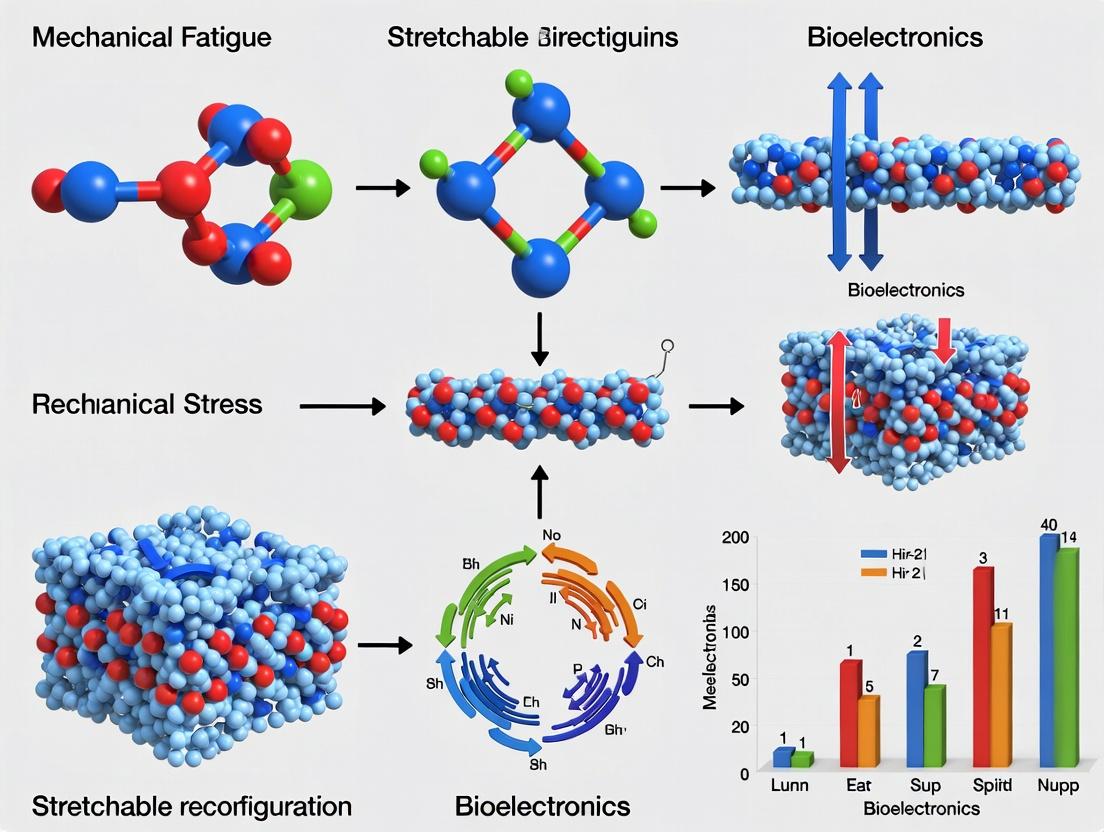
This article provides a comprehensive analysis of mechanical fatigue in stretchable bioelectronics, a critical challenge limiting long-term device reliability.
Strategies and Solutions: Overcoming Mechanical Fatigue in Next-Generation Stretchable Bioelectronics
Abstract
This article provides a comprehensive analysis of mechanical fatigue in stretchable bioelectronics, a critical challenge limiting long-term device reliability. We first explore the fundamental mechanisms of fatigue failure, including micro-crack propagation and interfacial delamination, then detail innovative material and structural design methodologies to enhance durability. We address common troubleshooting scenarios and optimization protocols for real-world application. Finally, we present standardized validation frameworks and comparative performance metrics for different material systems. This guide is essential for researchers and professionals developing robust bioelectronics for chronic monitoring and therapeutic interventions.
The Silent Failure: Understanding the Core Mechanisms of Fatigue in Stretchable Electronics
Technical Support Center: Troubleshooting & FAQs
This support center is designed to assist researchers investigating mechanical fatigue in stretchable bioelectronic devices, providing guidance for common experimental challenges within the broader thesis context of mitigating fatigue failure.
Frequently Asked Questions (FAQ)
Q1: During cyclic tensile testing of my stretchable gold conductor, I observe a sudden, step-like increase in electrical resistance after a certain number of cycles, not a gradual one. What does this indicate? A: A step-change in resistance typically indicates a critical crack propagation event, not uniform material degradation. This is a hallmark of fatigue failure. The crack initiates at a micro-defect or stress concentrator (e.g., a film edge) and propagates with each cycle until it severs a critical percolation path for current flow. Check your fabrication process for particulate contamination and use profilometry to inspect film edge quality. Consider implementing a strain-engineering layer to redistribute stress away from the conductor's edges.
Q2: My elastomeric encapsulation layer is delaminating from the metallic trace after repeated stretching. How can I improve adhesion? A: Delamination is a primary failure mode due to interfacial fatigue. Surface energy mismatch is often the cause.
- Solution 1: Implement an oxygen plasma treatment of the elastomer surface (e.g., PDMS) prior to metal deposition to increase its surface energy and create silanol groups for better bonding.
- Solution 2: Apply a molecular adhesion promoter, such as (3-Aminopropyl)triethoxysilane (APTES), to create a covalent bridge between layers.
- Protocol: For APTES application: Clean substrate, activate with O2 plasma for 1 min at 100W. Immerse in 2% v/v APTES in ethanol for 20 min. Rinse thoroughly with ethanol and cure at 110°C for 10 min.
Q3: How do I differentiate between material fatigue and purely electrical failure (e.g., electromigration) in my cyclically strained interconnect? A: You must perform a controlled decoupling experiment. Run two identical sets of devices under the same thermal conditions.
- Set A: Apply cyclic mechanical strain with electrical bias.
- Set B: Apply the same cyclic mechanical strain but only apply electrical bias intermittently for measurement (minimizing electromigration driving force).
- Interpretation: If both sets fail at a similar cycle count, the failure is mechanically driven (fatigue). If Set A fails significantly earlier than Set B, electromigration is a contributing factor.
Experimental Protocols
Protocol 1: Standardized Cyclic Fatigue Test for Stretchable Conductors Objective: Quantify the electrical fatigue lifetime (N_f) of a stretchable thin-film conductor under uniaxial cyclic strain.
- Sample Mounting: Mount the fabricated device on a uniaxial tensile stage equipped with electrical contacts. Ensure the gauge region is isolated and free of pre-buckling.
- Baseline Measurement: Measure initial resistance (R0) using a 4-point probe method to exclude contact resistance.
- Strain Regime: Program the tensile stage to apply a sinusoidal strain waveform. Common parameters for bioelectronics testing are:
- ε_max: 10-30% (physiological relevant range)
- Frequency: 0.1-1 Hz (to minimize hysteretic heating)
- Waveform: Sine or triangle wave.
- In-situ Monitoring: Continuously monitor resistance (R) throughout cycling. A failure criterion is typically defined as R/R0 > 2 (100% increase) or open circuit.
- Post-mortem Analysis: Use scanning electron microscopy (SEM) on the fatigued sample to identify crack initiation sites and propagation patterns.
Protocol 2: Characterization of the Fatigue Crack Propagation Rate Objective: Determine the crack growth rate per cycle (da/dN) to model device lifetime.
- Pre-cracking: Introduce a controlled micro-notch at the edge of the conductor using a focused ion beam (FIB) or laser ablation.
- Cyclic Loading: Subject the notched sample to cyclic strain (e.g., Δε = 5%) at a low frequency (0.1 Hz).
- Crack Imaging: Pause the test at regular intervals (e.g., every 100 cycles) to image the crack tip using an optical microscope or in-situ SEM (if available).
- Data Analysis: Measure crack length (a) after each interval. Plot a vs. number of cycles (N). The slope of this curve in the stable propagation region is da/dN.
- Model Fitting: Fit the data to the Paris' Law for fatiguing solids: da/dN = C(ΔK)^m, where ΔK is the strain intensity factor range.
Data Presentation
Table 1: Fatigue Lifetime (N_f) of Common Stretchable Conductor Architectures at 20% Cyclic Strain
| Material/Architecture | Typical Deposition Method | Average N_f (cycles to R=2R0) | Primary Failure Mode | Key Advantage |
|---|---|---|---|---|
| Sputtered Gold (Planar) | Magnetron Sputtering | 5,000 - 15,000 | Through-thickness cracking in grain boundaries | High conductivity, cleanroom compatible |
| Gold Nanowire Network | Solution Casting | >50,000 | NW reorientation & junction separation | High intrinsic stretchability |
| Eutectic Gallium-Indium (eGaIn) | Microfluidic Injection | >100,000 | Oxide rupture & reformation | Liquid conductivity, self-healing capability |
| Buckled Gold Film | Pre-strain + Sputtering | 20,000 - 100,000 | Crack propagation in buckle valleys | Wavy geometry dissipates strain |
Table 2: Effect of Encapsulation on Fatigue Lifetime
| Encapsulation Strategy | Material (Thickness) | Interfacial Treatment | Avg. N_f Improvement vs. Bare Conductor | Failure Mode with Encapsulation |
|---|---|---|---|---|
| None (Bare) | N/A | N/A | Baseline (1x) | Crack propagation in air |
| Uniform Layer | PDMS (100 µm) | None | 1.5x | Delamination then conductor crack |
| Uniform Layer | PDMS (100 µm) | O2 Plasma + APTES | 3.0x | Subsurface cracking in conductor |
| Gradient Modulus | Silicone Bilayer (Soft/Hard) | Chemical Grafting | 5.0x | Crack confinement in stiff layer |
Visualizations
Title: Stages of Mechanical Fatigue Failure
Title: Experimental Fatigue Analysis Protocol
The Scientist's Toolkit: Research Reagent Solutions
| Item | Function & Relevance to Fatigue Studies |
|---|---|
| Polydimethylsiloxane (PDMS; Sylgard 184) | The standard elastomeric substrate/encapsulant. Varying base:curing agent ratio (e.g., 10:1 vs. 30:1) controls modulus, affecting stress transfer to the device layer. |
| (3-Aminopropyl)triethoxysilane (APTES) | Adhesion promoter. Forms covalent -Si-O- bonds with oxide surfaces and provides -NH2 groups for bonding with metals, critically reducing interfacial delamination fatigue. |
| Ecoflex Gel (Series 00-30) | Ultra-soft silicone (modulus ~30 kPa). Used as a stress-buffering interlayer or substrate to reduce the effective strain on rigid functional films. |
| Hydrogen Tetrachloroaurate (HAuCl4) | Precursor for electrodeposition or self-assembly of gold nanostructures, enabling the creation of compliant, fatigue-resistant porous conductors. |
| Poly(3,4-ethylenedioxythiophene):Poly(styrene sulfonate) (PEDOT:PSS) | Conductive polymer. Often used as a compliant interfacial coating to improve charge injection and reduce mechanical mismatch at electrode surfaces. |
| Fluorescent Microspheres (1µm) | Dispersed in elastomers to act as strain markers for digital image correlation (DIC) measurements, visualizing local strain concentrations that precede fatigue failure. |
Troubleshooting Guides & FAQs
Q1: During cyclic stretching of my gold film on PDMS substrate, small cracks appear earlier than predicted by my fatigue life model. What are the primary causes and how can I mitigate this? A: Premature crack initiation often stems from surface defects or processing-induced stress concentrators. Key mitigation strategies include:
- Pre-cleaning: Use oxygen plasma treatment (e.g., 100W for 60s) followed by (3-aminopropyl)triethoxysilane (APTES) priming to enhance adhesion and create a more uniform surface.
- Deposition Parameters: For evaporated metal films, reduce deposition rate (e.g., from 5 Å/s to 1-2 Å/s) to lower intrinsic tensile stress.
- Neutral Mechanical Plane (NMP) Design: Engineer your device stack (encapsulation, substrate, film) to position the strain-sensitive layer near the NMP. Use the following formula to calculate the NMP position (ȳ) from the bottom of a multilayer stack: ȳ = (Σ(E_i * t_i * y_i)) / (Σ(E_i * t_i)) where E_i, t_i, and y_i are the Young's modulus, thickness, and centroidal position of the i-th layer.
Q2: I observe crack propagation that deviates from a perpendicular path, sometimes causing extensive delamination. What does this indicate and how can it be prevented? A: Non-perpendicular or branched crack propagation typically indicates significant interfacial shear stresses or heterogeneous adhesion. This often precedes delamination.
- Root Cause: A mismatch in the Poisson's ratio between the film and substrate, or localized adhesion failure, creates mixed-mode (I/II) loading at the crack tip.
- Prevention Protocol:
- Quantify Adhesion: Perform a standardized peel test (e.g., 90° peel at 10 mm/min) to establish a baseline adhesion energy (Γ, in J/m²).
- Interface Modification: Introduce a compliant interfacial layer. A thin layer of silicone epoxy (e.g., ~5 µm) can reduce shear stress transfer.
- Pattern Geometry: Use serpentine or horseshoe mesh geometries for conductors instead of straight lines. This localizes strain and deflects crack paths.
Q3: My encapsulated stretchable device fails at the electrode-encapsulant interface after repeated use. How can I improve interfacial durability? A: Interfacial delamination is a dominant failure mode in hydrated or dynamic environments. Improvement requires both chemical and mechanical solutions.
- Silane-Based Coupling: Apply a bifunctional silane coupling agent (e.g., (3-glycidyloxypropyl)trimethoxysilane, GOPTS) to form covalent bonds between inorganic (metal/oxide) and organic (encapsulant) phases.
- Surface Topography: Incorporate micro-scale or nano-scale roughness on the electrode surface via lithography or selective etching to promote mechanical interlocking.
- Accelerated Test Protocol: To rapidly screen interfaces, subject devices to:
- Autoclave Test: 121°C, 15 psi, 30 min. (Tests adhesion under hydrothermal stress).
- Stretch-Soak Cycling: Cycle between 15% strain and 0% in PBS at 37°C for 1000 cycles. Monitor electrical resistance.
Experimental Protocols
Protocol 1: Quantifying Crack Initiation Strain via In-Situ Microscopy
- Sample Mounting: Secure the stretchable film/substrate composite onto a motorized tensile stage mounted on an optical microscope.
- Baseline Imaging: Capture a high-resolution (100x) image of the pristine film surface at 0% strain.
- Stepwise Strain: Increase applied strain in increments of 0.5% (for metals) or 2% (for polymers).
- Image Capture & Analysis: At each step, hold strain for 30s, capture an image, and use digital image correlation (DIC) or thresholding software to identify the first appearance of micro-cracks (>5 µm in length).
- Data Point: Record the strain value at which the first detectable crack appears. Repeat for n≥5 samples.
Protocol 2: Measuring Interfacial Fracture Energy for Delamination (Blister Test)
- Sample Fabrication: Fabricate your device stack on a rigid carrier substrate. Create a small, intentional delamination "starter" at the edge.
- Setup: Invert the sample. Use a syringe pump to slowly inject a fluid (air or liquid) at the interface through the starter crack, creating a blister.
- Monitoring: Measure the blister radius (r) and applied pressure (P) in real-time using a camera and a pressure sensor.
- Calculation: For a thin film on a thick substrate, calculate the interfacial fracture energy (Γ) using: Γ = (P² * r⁴ * (1 - ν²)) / (16 * E * t³), where E, ν, and t are the film's Young's modulus, Poisson's ratio, and thickness, respectively.
Table 1: Crack Initiation Strain of Common Thin Films on PDMS (ε = 0.5%/sec)
| Film Material | Deposition Method | Thickness (nm) | Avg. Crack Initiation Strain (%) | Key Influencing Factor |
|---|---|---|---|---|
| Gold (Au) | Thermal Evaporation | 50 | 8.2 ± 1.5 | Adhesion promoter (APTES vs. none) |
| Gold (Au) | Sputtering | 50 | 12.5 ± 2.1 | Intrinsic compressive stress |
| PEDOT:PSS | Spin-Coating | 200 | 22.0 ± 3.8 | Additive (5% D-sorbitol) |
| Graphene | CVD Transfer | 1-3 layers | 6.0 ± 1.0 | Transfer wrinkles & defects |
Table 2: Adhesion Energy of Selected Film-Substrate Interfaces
| Interface (Film on Substrate) | Test Method | Adhesion Energy, Γ (J/m²) | Notes |
|---|---|---|---|
| Au on native PDMS | 90° Peel | 0.5 ± 0.2 | Cohesive failure in PDMS |
| Au on APTES-PDMS | 90° Peel | 4.8 ± 0.7 | Mixed adhesive/cohesive |
| SiO₂ (100nm) on PDMS | Blister Test | 10.2 ± 1.5 | Covalent Si-O-Si bonds |
| PI Encapsulant on Au | Lap Shear | 15.3 ± 2.0 | With GOPTS coupling agent |
Visualizations
The Scientist's Toolkit: Research Reagent Solutions
Table 3: Essential Materials for Mitigating Primary Failure Modes
| Item | Function/Description | Typical Use Case |
|---|---|---|
| (3-Aminopropyl)triethoxysilane (APTES) | Silane coupling agent; forms amine-terminated surface on oxides for improved metal adhesion. | Priming PDMS before Au deposition to increase Γ. |
| (3-Glycidyloxypropyl)trimethoxysilane (GOPTS) | Epoxy-functional silane; creates covalent bonds across organic-inorganic interfaces. | Enhancing adhesion between PI encapsulant and Au electrode. |
| Poly(3,4-ethylenedioxythiophene):poly(styrene sulfonate) (PEDOT:PSS) | Conductive polymer; inherently more stretchable than thin metals, higher crack initiation strain. | Forming stretchable electrodes or interconnects. |
| D-Sorbitol or Ethylene Glycol | Secondary dopant/plasticizer for PEDOT:PSS; increases conductivity and ductility. | Added 3-7% wt. to PEDOT:PSS solution before film casting. |
| Sylgard 184 & 527 (PDMS) | Two-part silicone elastomers; can be blended to achieve a range of moduli (e.g., 0.1 MPa to 3 MPa). | Tuning substrate/encapsulant stiffness for NMP engineering. |
| Polydimethylsiloxane (PDMS) Grafting Solution | PDMS-diamine or PDMS-monoamine; used as a mobile surface modifier. | Reducing interfacial shear stress as a compliant layer. |
Troubleshooting & FAQ Center
Q1: During cyclic tensile testing of our PDMS substrate, we observe a gradual decrease in the electrical conductivity of the embedded gold thin-film trace long before macroscopic cracking. What is the likely mechanism and how can we mitigate it?
A: This is a classic case of fatigue-induced microcracking in brittle conductive films on polymer substrates. The mechanism involves the nucleation and coalescence of microcracks within the metal film due to the repeated, larger strain of the underlying polymer. The electrical resistance increases with each cycle as the conductive pathway is disrupted.
Mitigation Protocol:
- Apply a Thin Adhesion Layer: Use a 5-10 nm chromium or titanium layer between the PDMS and gold.
- Adopt a Serpentine or Horseshoe Trace Geometry: This design accommodates strain through out-of-plane buckling rather than direct tensile loading of the metal.
- Use a Metal-Polymer Composite: Consider a percolation network of silver flakes in an elastomeric matrix (e.g., silver nanowires in Ecoflex) for higher strain tolerance.
Q2: Our PEDOT:PSS conductive hydrogel electrode suffers from a ~40% loss in charge storage capacity after 5,000 stretch cycles at 30% strain. Is this a material degradation or an interfacial issue?
A: This is likely a combination of intrinsic material fatigue and interfacial delamination. Repeated stretching can cause:
- Micro-fracturing of the hydrogel network, reducing ionic conductivity and electroactive surface area.
- Progressive dehydration and loss of PSS, altering the material's electrochemical properties.
- Delamination at the interface with current collectors if the bonding is not optimized.
Diagnostic Experiment:
- Perform Electrochemical Impedance Spectroscopy (EIS) before and after cycling. A significant increase in bulk resistance points to material degradation. A change primarily at high frequency suggests interfacial issues.
- Use in-situ optical microscopy during cycling to observe crack formation and delamination.
Q3: For a composite of silicone elastomer with embedded liquid metal (EGaIn) droplets, we see leakage and failure upon cycling. What are the key failure modes and material limits?
A: The primary vulnerabilities are:
- Rupture of the Elastomer Matrix: The silicone itself can fatigue and crack under cyclic strain, releasing the liquid metal.
- Occlusion/Coalescence of Droplets: Repeated deformation can cause the oxide shells on EGaIn droplets to rupture, leading to coalescence into larger channels that are more prone to leakage.
- Oxide Layer Degradation: The gallium oxide skin is crucial for stability. Its repeated fracture and reformation can deplete the gallium content, altering rheological properties.
Table 1: Quantitative Limits of Common Stretchable Materials
| Material Class | Example Materials | Typical Fracture Strain (%) | Electrical Conductivity Range | Key Fatigue Failure Mode | Cycles to Failure (Typical, 20% strain) |
|---|---|---|---|---|---|
| Elastomeric Polymers | PDMS, Ecoflex, SEBS | 100 - 1000+ | Insulator | Chain scission, crack propagation | 10,000 - 100,000+ |
| Metallic Thin Films | Au, Pt, Cr (on elastomer) | 1 - 5 | 10⁶ - 10⁷ S/m | Microcrack nucleation & coalescence | 100 - 10,000 |
| Conductive Polymers | PEDOT:PSS, PANI films | 10 - 50 | 10⁰ - 10⁴ S/m | Loss of dopant, chain degradation | 1,000 - 10,000 |
| Liquid Metal Composites | EGaIn in Silicone | 200 - 500 (composite) | 10⁴ - 10⁶ S/m (percolation) | Matrix rupture, droplet occlusion | 5,000 - 50,000 |
| Nanomaterial Networks | Silver Nanowires, CNTs | 50 - 150 | 10³ - 10⁵ S/m | Nanowire buckling/fracture, junction failure | 1,000 - 50,000 |
Table 2: Research Reagent Solutions for Fatigue-Resistant Stretchable Bioelectronics
| Item | Function | Example Product/Brand |
|---|---|---|
| High-Performance Elastomer | Low-hysteresis, fatigue-resistant substrate/encapsulant | Dow Sylgard 186, Smooth-On Ecoflex 00-30 |
| Conductive Hydrogel Precursors | Form soft, ionically conductive, often self-healing interfaces | GelMA, PVA-PAAc double networks, PEDOT:PSS:PEtOx blends |
| Liquid Metal Alloy | Highly conductive, fluid conductive filler for composites & traces | Gallinstan, Eutectic Gallium-Indium (EGaIn) |
| Stretchable Adhesive/Primer | Promotes interfacial bonding, prevents delamination | (3-Aminopropyl)triethoxysilane (APTES), Polyurethane-based medical adhesives |
| Fatigue-Testing System | Applies precise cyclic mechanical/electrical stimuli | Instron ElectroPuls, BioDynamic Test Instrument |
| In-situ Characterization Suite | Monitors electrical & structural changes during cycling | 4-point probe station on tensile stage, In-situ optical/confocal microscope |
Detailed Experimental Protocols
Protocol 1: Accelerated Fatigue Testing of Stretchable Conductive Traces
- Objective: Quantify electrical and mechanical degradation under cyclic strain.
- Materials: Sample on tensile stage, source-meter, data logger.
- Method:
- Mount sample on cyclic tensile tester.
- Connect leads for 4-point resistance measurement.
- Program strain waveform (e.g., sinusoidal, 0.5 Hz, 20% strain amplitude).
- Simultaneously record resistance (R) and cycle number (N).
- Continue until failure (e.g., R > 10x initial) or target cycles (e.g., 10,000).
- Plot R/R0 vs. N. Use microscopy post-test to correlate R changes with crack density.
Protocol 2: Characterizing Interfacial Adhesion Strength via Peel Test
- Objective: Measure bond strength between thin-film layers to predict delamination risk.
- Materials: Sample prepared with a deliberate delamination initiator, tensile tester with peel fixture, force sensor.
- Method:
- Fabricate a sample with one layer extending to form a "tab."
- Secure the substrate in the lower grip and the tab in the upper, 90° or 180° peel angle.
- Perform a constant-rate peel test (e.g., 10 mm/min).
- Record force vs. displacement. The average steady-state force divided by the bond width is the peel strength (N/m).
- Compare peel strengths for different surface treatments (O₂ plasma, silanes) to optimize adhesion.
Visualization: Signaling Pathways & Workflows
Diagram Title: Fatigue Failure Cascade in Stretchable Bioelectronics
Diagram Title: Workflow for Characterizing Material Fatigue Vulnerabilities
Technical Support Center
Troubleshooting Guides & FAQs
Q1: Our stretchable electrode exhibits a rapid increase in electrical resistance (>50%) after only 100 cycles of simulated pulsatile motion in a hydrated PBS bath. The failure appears localized at the encapsulation interface. What is the likely root cause and how can we diagnose it?
A: This is a classic bio-interface fatigue failure. The simultaneous application of mechanical strain and hydration compromises the adhesion and barrier properties of the encapsulation layer. We recommend the following diagnostic protocol:
- Post-Test Inspection: Use optical microscopy (or SEM if the substrate allows) to examine the electrode-encapsulation edge for delamination, cracks, or water intrusion channels.
- Localized Impedance Mapping: Perform electrochemical impedance spectroscopy (EIS) mapping across the electrode surface to pinpoint the exact location of failure. A localized drop in the impedance modulus at low frequency indicates a breach.
- Adhesion Test: Perform a tape test (ASTM D3359) or, preferably, a quantitative peel adhesion test on samples subjected to dry cycling vs. wet cycling. A significant reduction in adhesion strength for wet-cycled samples confirms hydration-assisted interfacial degradation.
Q2: When testing our device on a beating heart model, we observe mechanical fatigue cracks in the conductive traces well before the predicted cycle count from in-air testing. How should we adjust our fatigue life prediction models?
A: In-air models severely overpredict lifespan because they ignore synergistic environmental effects. You must incorporate an environmental acceleration factor. Establish a baseline fatigue life (Nf, dry) in a controlled dry environment. Then, run identical mechanical tests in a 37°C phosphate-buffered saline (PBS) bath or cell culture medium. The ratio Nf, dry / Nf, wet gives you an acceleration factor for your specific material system. This factor must be multiplied into any model used for in vivo lifetime prediction. See Table 1 for typical acceleration factors.
Q3: What is the best practice for experimentally isolating the contribution of interfacial shear stress from bulk material fatigue in a subdermal simulation?
A: Implement a multi-modal strain mapping protocol:
- Sample Fabrication: Create a test substrate with a grid of fiducial markers on the surface.
- Setup: Mount the sample on a bioreactor that applies cyclic biaxial strain. Use a transparent, permeable membrane to separate the hydration chamber from the imaging chamber.
- Data Acquisition:
- Cycle the strain to simulate tissue motion.
- Use digital image correlation (DIC) to measure bulk strain fields in the device material.
- Simultaneously, use micro-particle image velocimetry (μPIV) or track embedded nanobeads at the interface between the device and a simulated tissue gel (e.g., PDMS with matched modulus).
- Analysis: Calculate the strain gradient between the bulk (DIC data) and the interface (μPIV data). This gradient is a direct measure of the interfacial shear stress. Correlate the evolution of this gradient with the onset of electrical or mechanical failure.
Q4: Our hydrogel-based sensor shows excellent fatigue resistance in mechanical tests but fails rapidly when exposed to dynamic biological fluids (e.g., synovial fluid, pericardial fluid). Why?
A: Biological fluids contain active species that accelerate fatigue. The failure mechanism is likely chemically-assisted crack propagation. Proteins and ions can adsorb onto the hydrogel polymer chains, plasticizing the network and reducing the fracture energy at crack tips. To confirm:
- Perform fatigue tests in PBS (control), PBS with added protein (e.g., BSA or fibrinogen), and in collected biological fluid.
- Measure both crack propagation rate and changes in storage/loss modulus (via DMA) in each fluid.
- Use fluorescence microscopy if your hydrogel is compatible with a dye to visualize protein infiltration along crack paths.
Experimental Protocols
Protocol 1: Accelerated Fatigue Testing in Simulated Bio-Environments
Objective: To quantify the fatigue life acceleration of a stretchable electronic material due to combined tissue motion (strain) and hydration.
Materials: (See "Research Reagent Solutions" table below) Equipment: Cyclic tensile tester with an environmental bath chamber, electrochemical workstation, data logger.
Methodology:
- Sample Preparation: Fabricate test strips (e.g., 50mm x 10mm) of the device stack (substrate/conductor/encapsulation). Attach electrodes for in-situ resistance monitoring.
- Baseline Testing (Dry): Mount sample in the tensile tester in air at 25°C. Apply a cyclic strain (e.g., 10-15% ε, 1 Hz) matching the target tissue motion. Continuously log resistance. Define failure as a 20% increase in resistance (R/R₀ = 1.2). Record the number of cycles to failure (Nf, dry). Test n≥5 samples.
- Bio-Interface Testing (Wet): Mount a new set of samples in the chamber filled with 1X PBS at 37°C. Ensure full immersion. Apply identical mechanical cycling parameters. Monitor resistance until failure (R/R₀ = 1.2). Record cycles to failure (Nf, wet).
- Data Analysis: Calculate the mean and standard deviation for Nf for both groups. Compute the Environmental Acceleration Factor (EAF) = Mean(Nf, dry) / Mean(Nf, wet). Statistically compare groups using a Student's t-test (p < 0.05).
Protocol 2: In-Situ Electrochemical Impedance Monitoring of Encapsulation Integrity
Objective: To detect and localize the failure of a bio-electronic encapsulation layer under cyclic strain.
Materials: Potentiostat with EIS capability, 3-electrode setup (working, counter, reference), bioreactor with strain capability.
Methodology:
- Cell Setup: Integrate your device as the working electrode in a 3-electrode electrochemical cell within a bioreactor. Use a Pt counter electrode and an Ag/AgCl reference electrode. Fill cell with PBS.
- Initial Scan: At 0% strain, perform an EIS scan from 100 kHz to 0.1 Hz at a low AC amplitude (10 mV). This is your baseline "intact" spectrum.
- Cyclic Testing: Initiate mechanical cycling (e.g., 5% strain, 0.5 Hz).
- Periodic Monitoring: Pause strain at predefined intervals (e.g., every 100 cycles). At the strained state, perform the same EIS scan.
- Failure Analysis: Plot the impedance modulus at 0.1 Hz (|Z|₀.₁Hz) vs. cycle number. A sharp, orders-of-magnitude drop in |Z|₀.₁Hz indicates a catastrophic loss of encapsulation integrity. The Nyquist plot will show a collapse of the low-frequency capacitive tail.
Data Presentation
Table 1: Fatigue Life Acceleration of Common Materials in Hydrated vs. Dry Conditions
| Material System | Testing Conditions (Strain, Frequency) | Mean Cycles to Failure (Dry, Nf, dry) | Mean Cycles to Failure (Wet, Nf, wet) | Environmental Acceleration Factor (EAF) | Primary Failure Mode |
|---|---|---|---|---|---|
| Parylene-C / Au / PDMS | 15% uniaxial, 1 Hz | 125,400 ± 12,500 | 23,800 ± 3,100 | 5.3 | Interfacial delamination & crack propagation |
| PI / Graphene Composite / Ecoflex | 10% biaxial, 2 Hz | >1,000,000 | 145,000 ± 18,500 | >6.9 | Conductive filler detachment & hydrogel swelling |
| Silicone / Liquid Metal / Silicone | 30% uniaxial, 0.5 Hz | 850,000 ± 75,000 | 95,000 ± 9,000 | 8.9 | Oxide accumulation & channel rupture |
Table 2: Research Reagent Solutions for Bio-Interface Fatigue Studies
| Item | Function | Key Consideration |
|---|---|---|
| Phosphate-Buffered Saline (PBS), 1X, pH 7.4 | Standard ionic hydration environment for in vitro testing. | Provides consistent ion concentration for corrosion and swelling studies. |
| Dulbecco's Modified Eagle Medium (DMEM) | Cell culture medium for more biologically relevant testing. | Contains amino acids and vitamins that can interact with material surfaces. |
| Bovine Serum Albumin (BSA), Fraction V | Model protein for studying biofouling and protein adsorption effects. | Adsorption can plasticize polymers and alter interfacial energy. |
| Polydimethylsiloxane (PDMS), Sylgard 184 | Ubiquitous elastomeric substrate; can be tuned to match tissue modulus. | Ensure proper curing and surface oxidation (if needed) for adhesion. |
| Hydrogel (e.g., Polyacrylamide or Agarose) | Simulates the hydrated, viscoelastic mechanical properties of soft tissue. | Modulus and swelling ratio should be matched to the target organ. |
| Fatigue Testing Membrane (e.g., PET with porous coating) | Permeable membrane for applying strain in liquid environments. | Must be chemically inert and have minimal compliance. |
Diagrams
Title: Bio-Interface Fatigue Failure Pathways
Title: Fatigue Acceleration Factor Protocol
Troubleshooting Guides and FAQs for Mechanical Fatigue Testing
Q1: During cyclic tensile testing of my stretchable electrode, the electrical resistance data becomes extremely noisy after a few hundred cycles. What could be the cause and how can I fix it?
A: This is a common issue indicating the onset of micro-crack formation or loss of interfacial contact.
- Cause: The most likely cause is the delamination of the conductive layer (e.g., metal thin film, conductive polymer) from the elastomeric substrate. As cycles progress, this creates intermittent electrical contact.
- Solution:
- Ensure Proper Surface Preparation: Implement a rigorous substrate cleaning protocol (oxygen plasma treatment for 1-2 minutes at 100W) followed by a primer layer (e.g., <1% silane in ethanol) to improve adhesion.
- Verify Clamping: Ensure your sample is uniformly clamped without pre-stress or slippage. Use sandpaper interfaces in the grips to prevent slippage.
- Incorporate In-situ Microscopy: If possible, use a setup that allows for simultaneous optical or scanning electron microscopy to visually correlate resistance spikes with crack initiation.
Q2: How do I definitively determine the "failure threshold" for my device? Is it a complete break or a performance degradation?
A: Failure is application-defined and must be specified in your experimental protocol.
- Structural Failure: Catastrophic fracture of the substrate or conductor. This is a clear endpoint.
- Functional Failure: A predefined level of performance degradation. For bioelectronics, this is often more relevant.
- Protocol: Before testing, define a threshold (e.g., "a 50% increase in sheet resistance" or "a 20% drop in signal-to-noise ratio for electrophysiology"). Monitor your key performance metric (KPM) in real-time alongside mechanical cycling. The cycle number at which the KPM crosses your threshold is the functional fatigue life (Nf).
Q3: My calculated fatigue life (Nf) shows high variability between samples from the same batch. How can I improve reproducibility?
A: High scatter is inherent in fatigue data but can be minimized.
- Cause: Inconsistencies in sample fabrication (film thickness, curing), subtle defects (dust, bubbles), or testing parameters (alignment, humidity).
- Solution:
- Standardize Fabrication: Implement spin-coating or blade-coating in a controlled environment (clean bench, stable temperature/humidity). Measure and record layer thickness for every sample.
- Increase Sample Size: Fatigue data requires statistical analysis. A minimum of 5-7 samples per test condition is recommended for reliable Weibull analysis.
- Control Environmental Factors: Conduct tests in an environmental chamber or sealed fixture with controlled temperature and humidity, as polymer mechanics are viscoelastic and sensitive to these parameters.
Q4: What is the difference between fatigue life (Nf) and the crack initiation threshold, and how do I measure the latter?
A: They are related but distinct metrics.
- Fatigue Life (Nf): The total cycles to functional failure (as defined above).
- Crack Initiation Threshold (εₐ, th): The critical strain amplitude below which cracks do not initiate within a practically infinite number of cycles (often defined as >10⁷ cycles). This is a more conservative design metric.
- Measurement Protocol: Conduct tests at multiple, decreasing strain amplitudes (εₐ). Plot εₐ vs. cycles to failure (Nf) on a log-log scale to create an S-N curve. The strain amplitude where the curve asymptotically flattens indicates εₐ, th. This requires high-cycle fatigue testing, potentially using a faster test frequency for the lower strain amplitudes.
Table 1: Representative Fatigue Life of Common Stretchable Conductor Technologies
| Material System | Substrate | Key Metric Monitored | Typical Fatigue Life (Cycles to Failure) @ Strain | Failure Threshold Definition | Primary Failure Mode |
|---|---|---|---|---|---|
| Sputtered Gold (50 nm) | Polydimethylsiloxane (PDMS) | Sheet Resistance (Rs) | 1,000 - 5,000 @ 20% | ΔRs / Rs₀ > 200% | Channeling cracks in Au layer |
| PEDOT:PSS / Ionic Liquid | Styrene-Ethylene-Butylene-Styrene (SEBS) | Impedance @ 1 kHz | >50,000 @ 30% | Impedance increase > 50% | Coalescence of micro-pores |
| Liquid Metal Embedment | Ecoflex | Resistance | >100,000 @ 100% | Resistance increase > 10% | Oxidation at crack surfaces |
| Buckled Gold Nanomembrane | Pre-strained PDMS | Resistance | ~15,000 @ 15% | Open circuit | Rupture at buckle crests |
Table 2: Standardized Experimental Protocol for Uniaxial Mechanical Fatigue Testing
| Step | Parameter | Specification & Rationale |
|---|---|---|
| 1. Sample Prep | Geometry | Dog-bone shape (e.g., ASTM D412-C) to ensure failure within gauge length. |
| 2. Pre-Conditioning | Cycles | 5-10 cycles at test strain to stabilize stress-strain response. Record data after. |
| 3. Loading | Waveform | Sinusoidal, constant strain amplitude. Control via laser extensometer. |
| 4. Frequency | Rate | 0.1 - 2 Hz. Lower rates reduce hysteretic heating in polymers. |
| 5. Environment | Control | 23 ± 2°C, 50 ± 10% RH. Document. |
| 6. Monitoring | In-situ | Simultaneous measurement of resistance/impedance every 10-100 cycles. |
| 7. Failure Criteria | Definition | Pre-set based on application (e.g., Electrical: R > 2R₀; Structural: 50% load drop). |
| 8. Post-Mortem | Analysis | Optical/SEM imaging of fracture surfaces to identify initiation sites. |
Visualizations
Fatigue Life Determination Workflow
Hierarchy of Key Fatigue Metrics
The Scientist's Toolkit: Research Reagent Solutions
| Item | Function in Fatigue Characterization |
|---|---|
| Polydimethylsiloxane (PDMS) | The ubiquitous elastomeric substrate. Sylgard 184 (10:1 base:curing agent ratio) provides a standard modulus (~2 MPa). Varying the ratio tunes stiffness. |
| Ecoflex Gel (Series 00-30) | A very soft, high-failure-strain silicone (∼60-70 kPa modulus). Used for devices requiring extreme stretchability (>300%). |
| Oxygen Plasma System | Critical for surface activation of PDMS prior to conductive layer deposition or bonding, dramatically improving adhesion and delaying delamination. |
| (3-Aminopropyl)triethoxysilane (APTES) | A common adhesion promoter (primer). Forms a self-assembled monolayer on activated surfaces to provide bonding sites for metals or polymers. |
| Poly(3,4-ethylenedioxythiophene):Poly(styrene sulfonate) (PEDOT:PSS) | A conductive polymer dispersion. When formulated with surfactants (e.g., Capstone FS-30) or ionic liquids, it creates stretchable, crack-resistant conductive films. |
| Eutectic Gallium-Indium (EGaIn) | A room-temperature liquid metal. Used to create ultra-stretchable and self-healing conductors via microchannel embedding or particle-based composites. |
| Cyanoacrylate-Based Conductive Adhesive | Used for robust, low-resistance connections between thin-film devices and external measurement cables, crucial for reliable in-situ monitoring. |
| Digital Image Correlation (DIC) Software | Non-contact optical technique to map full-field strain distribution, identifying local strain concentrations that are sites for crack initiation. |
Designing for Durability: Material Innovations and Structural Engineering Solutions
Technical Support Center: Troubleshooting & FAQs
Thesis Context: This support center is designed to assist researchers in overcoming practical experimental challenges related to intrinsically stretchable conductors, with the ultimate goal of mitigating mechanical fatigue in long-term, implantable bioelectronic devices.
Frequently Asked Questions (FAQs)
Q1: My EGaln liquid metal circuit fractures and does not self-heal as reported. What are the likely causes? A: Fracture without self-healing is typically due to a thick surface oxide (Ga2O3) shell that prevents contact and coalescence of the internal liquid.
- Solution: Ensure the fracture occurs in an oxygen-free environment (e.g., nitrogen glovebox) or immediately apply mild mechanical agitation at the fracture point to break the oxide skin. Pre-stretching the elastomeric channel can also create compressive forces that aid coalescence.
Q2: The conductivity of my PEDOT:PSS film drops drastically after the first 100 stretch cycles. How can I improve cycling stability? A: This indicates poor elastic recovery of the polymer matrix or irreversible crack propagation.
- Solution: Incorporate hydrogen-bonding cross-linkers (e.g., (3-glycidyloxypropyl)trimethoxysilane) or soft urethane/ionic liquid additives into your formulation. These enhance the viscoelasticity of the film, allowing the conductive polymer network to rewire during strain. Ensure a slow, room-temperature drying process for better phase separation and ordering.
Q3: When embedding liquid metal droplets in a silicone matrix to make a conductive composite, I get inconsistent conductivity. A: Inconsistent percolation is often due to uneven droplet size distribution or inadequate mixing.
- Solution: Use high-shear mixing (e.g., Thinky centrifugal mixer) followed by sequential calendering (rolling). Pre-sonication of the liquid metal in an ethanol solvent can create a fine droplet emulsion before elastomer incorporation. A minimum filler fraction of 25-30% by volume is typically required for reliable percolation.
Q4: My stretchable gold nanowire network cracks at low strain (<20%), far below the elastomer's failure point. A: This suggests weak adhesion at the nanowire/elastomer interface, leading to interfacial delamination rather than coordinated deformation.
- Solution: Functionalize the nanowire surface with alkanethiols (e.g., 1-dodecanethiol) to create a hydrophobic surface that bonds better with PDMS. Alternatively, use a thin adhesive layer (e.g., polyurethane acrylate) between the network and the elastomer substrate. Employ a pre-stretching and transfer method to create buckled, wavy structures that accommodate strain.
Q5: How do I reliably measure the resistance of a highly stretchable conductor under dynamic cycling? A: Standard two-point probes are susceptible to contact resistance artifacts.
- Solution: Implement a four-point probe (Kelvin) measurement with stretchable, aligned electrodes. Use a synchronized data acquisition system to log resistance at specific points in the strain cycle (e.g., at maximum strain and upon return to 0% strain). For in-situ measurements, ensure probe contacts are made with conductive silver epoxy or eutectic gallium-indium (EGaln) to maintain connection.
Detailed Experimental Protocols
Protocol 1: Formulating Highly Stretchable, Conductive PEDOT:PSS Inks
Objective: To synthesize a PEDOT:PSS-based ink capable of maintaining conductivity under >50% cyclic strain.
Materials:
- PEDOT:PSS aqueous dispersion (Clevios PH1000)
- Dimethyl sulfoxide (DMSO)
- (3-Glycidyloxypropyl)trimethoxysilane (GOPS)
- Fluorosurfactant (Capstone FS-30)
- Deionized water
Methodology:
- Mix 10 mL of PEDOT:PSS dispersion with 1 mL of DMSO (5% v/v) and stir for 15 minutes. DMSO improves crystallinity and charge transport.
- Add 50 µL of GOPS (0.5% v/v) as a cross-linker. Stir vigorously for 10 minutes.
- Add 20 µL of fluorosurfactant to improve wetting on hydrophobic elastomers.
- Filter the final ink through a 0.45 µm PVDF syringe filter.
- Deposition: Treat PDMS substrate with oxygen plasma (30 W, 60 sec). Spin-coat or spray-coat the ink onto the substrate.
- Curing: Dry at 60°C for 1 hour, then at 100°C for 15 minutes to complete siloxane cross-linking.
- Characterize sheet resistance via four-point probe before and after 1000 stretch cycles to 50% strain.
Protocol 2: Fabricating a Self-Healing Liquid Metal (EGaln) Elastomeric Composite
Objective: To create a silicone composite with percolating EGaln networks that recover conductivity after mechanical damage.
Materials:
- Eutectic Gallium-Indium (EGaln: 75% Ga, 25% In by weight)
- Sylgard 184 PDMS (base and curing agent)
- Hexane (anhydrous)
Methodology:
- Dispersion: Combine 3g of EGaln with 20 mL of hexane in a 50 mL centrifuge tube. Sonicate in an ice bath using a probe sonicator (35% amplitude, 10 min total, 5 sec on/5 sec off pulses) to create a fine emulsion.
- Mixing: In a planetary centrifugal mixer, combine 10g of PDMS base and 1g of curing agent. Gradually add the EGaln/hexane emulsion to achieve a 30% volume fraction. Mix at 2000 rpm for 2 minutes, then degas under vacuum until bubbling ceases.
- Curing: Pour the mixture into a mold. Cure at room temperature for 24 hours, followed by 60°C for 2 hours to fully cross-link the PDMS and evaporate residual hexane.
- Testing: Cut a dog-bone sample. Measure initial resistance (R0). Sever the sample completely with a blade. Gently press the cut surfaces together for 30 seconds. Measure recovered resistance (R). Calculate healing efficiency as η = R0 / R (%). Target efficiency >90%.
Table 1: Performance Comparison of Stretchable Conductor Materials
| Material System | Typical Conductivity (S/cm) | Max. Tolerable Strain (%) | Cyclic Stability (∆R/R0 after n cycles) | Key Failure Mode |
|---|---|---|---|---|
| EGaln (Pure, Channel) | ~3.4 x 10⁴ | >500% | <5% after 1000@100% | Oxidation, Leakage |
| EGaln-PDMS Composite | 200 - 2,000 | 150 - 400% | 10-50% after 1000@50% | Percolation disruption |
| PEDOT:PSS (Optimized) | 500 - 1,500 | 50 - 100% | 20-80% after 1000@30% | Crack formation, De-doping |
| Au Nanowire Network | 5,000 - 10,000 | 60 - 120% | >200% after 1000@20% | Nanowire fracture, Delamination |
| Ag Flake/Ionic Liquid | 1,000 - 5,000 | 300 - 800% | <10% after 100@100% | Flake reorientation |
Table 2: Troubleshooting Matrix: Symptoms and Primary Fixes
| Observed Problem | Likely Material Cause | Suggested Corrective Action |
|---|---|---|
| Sudden conductivity loss at low strain | Poor matrix adhesion | Introduce covalent/ionic cross-linkers; Apply surface primers. |
| Gradual, irreversible resistance increase | Material plastic deformation | Reformulate with more elastic polymers (e.g., SEBS, polyurethane). |
| Hysteresis in resistance-strain curve | Viscoelastic matrix relaxation | Lower strain rate; Use polymers with lower hysteresis (e.g., certain silicones). |
| Conductivity degradation in wet/biological env. | Water ingress, Ion leaching | Apply hermetic encapsulation (e.g., Parylene C coating). |
The Scientist's Toolkit: Research Reagent Solutions
| Item | Function & Rationale |
|---|---|
| PEDOT:PSS (Clevios PH1000) | High-conductivity polymer dispersion; base material for printable, tunable stretchable conductors. |
| GOPS Cross-linker | Forms covalent siloxane bonds with PEDOT:PSS and substrate, enhancing mechanical integrity and adhesion. |
| Eutectic Gallium-Indium (EGaln) | Room-temperature liquid metal with low toxicity and fluid self-healing capability for extreme stretchability. |
| SEBS Copolymer (e.g., MD-1644) | Thermoplastic elastomer providing a high-elongation, low-hysteresis matrix for composites. |
| Zonyl FS-300 Fluorosurfactant | Reduces surface tension of aqueous inks, enabling uniform film formation on hydrophobic elastomers. |
| DMSO & Ethylene Glycol | Secondary dopants for PEDOT:PSS that improve molecular ordering and charge carrier mobility. |
| Parylene-C Deposition System | Provides conformal, bio-inert, and moisture-resistant encapsulation for in-vivo stability. |
Experimental Workflow & Pathway Diagrams
Workflow for Developing Stretchable Conductors
Fatigue Mitigation Pathways in Stretchable Conductors
Troubleshooting & FAQs
Q1: My serpentine mesh shows unexpected plastic deformation after fewer stretching cycles than simulated. What could be the cause? A: This is a common fatigue-related failure. Likely causes are: 1) Material Defects: Microscopic cracks or inclusions in the deposited metal (e.g., gold, copper) act as stress concentrators. 2) Over-Etching: Excessive etching of the sacrificial layer can create thinner, weaker serpentine traces. 3) Substrate Adhesion: Poor adhesion between the metal and the elastomer (e.g., PDMS, Ecoflex) leads to localized delamination and stress.
Q2: How do I prevent fractal designs from fracturing at the smallest, highest-order branches during dynamic loading? A: Fracture at terminal branches indicates a stress imbalance. Troubleshoot by: 1) Validating Lithography: Ensure photomask resolution accurately reproduces designed branch thicknesses. Use SEM to verify. 2) Adjusting Hierarchy Ratio: The width ratio between successive branching generations (λ) may be too aggressive. Re-simulate with λ > 0.5 for higher durability. 3) Applying a Conformal Coating: A thin, flexible polymer coating (e.g., Parylene C) can distribute stress.
Q3: My kirigami-inspired sample exhibits out-of-plane buckling in an uncontrolled manner, disrupting electronic function. How can I control the buckling direction? A: Uncontrolled buckling often stems from cut pattern asymmetry or non-uniform substrate pre-strain. 1) Laser Cutting Calibration: Ensure cuts are perfectly vertical and consistent in depth. 2) Pre-strain Protocol: Apply pre-strain using a calibrated, multi-axis stretcher. Manual pre-stretch is not reproducible. 3) Anchor Point Design: Incorporate larger, reinforced pads at strategic nodes to initiate hinge folding in a predictable sequence.
Q4: I am getting inconsistent electrode-skin impedance readings from my stretchable device. What is the primary source of this variation? A: This is typically due to inconsistent interfacial contact caused by mechanical failure. 1) Check for Micro-fractures: Use microscopic inspection during cyclic stretching. A fractured trace creates intermittent contact. 2) Electrode Delamination: Ensure the conductive hydrogel or metal electrode is securely bonded to the stretchable interconnect. Plasma treatment of the substrate may be required. 3) Environmental Control: Perform tests in a humidity-controlled environment, as sweat can create variable contact.
Experimental Protocol: Cyclic Fatigue Testing for Stretchable Meshes
Objective: To quantify the mechanical fatigue life and electrical stability of a geometrically engineered stretchable conductor.
Materials:
- Fabricated device on elastomeric substrate.
- Programmable multi-axis tensile tester (e.g., Instron, or custom-built).
- Real-time resistance measurement system (e.g., 4-point probe, source meter).
- Microscope with high-speed camera.
- Environmental chamber (optional).
Methodology:
- Mounting: Secure the sample ends in the tensile tester grips, ensuring the active mesh is in the gauge region. Attach probe wires to the device's contact pads using conductive epoxy.
- Baseline Measurement: Record initial resistance (R₀) and capture optical micrograph.
- Cyclic Loading: Program the tester to apply a sinusoidal strain profile (e.g., 0% to 20% strain) at a defined frequency (e.g., 0.5 Hz). For kirigami designs, testing may involve off-axis or biaxial strain.
- In-situ Monitoring: Continuously log resistance (R) and force (F) data. Trigger high-speed imaging at periodic intervals (e.g., every 100 cycles).
- Failure Criterion: Run the test until either: a) Resistance increases by a set threshold (e.g., 1000% of R₀), or b) A visible macroscopic fracture occurs.
- Post-mortem Analysis: Use SEM to examine fracture surfaces and crack initiation points.
Data Presentation
Table 1: Comparative Fatigue Performance of Geometric Designs (Typical Data from Literature)
| Design | Typical Material Stack | Max Strain (%) | Cycles to Failure (R > 10R₀) | Key Failure Mode |
|---|---|---|---|---|
| Serpentine (Horseshoe) | Au/PI on PDMS | 50-70% | 10,000 - 50,000 | Crack initiation at inner bend apex. |
| Fractal (Peano) | Cu/Ecoflex | >100% | 5,000 - 15,000 | Fracture at highest-order branches. |
| Kirigami (Cut-network) | Au/PET film | >150% | 20,000 - 100,000 | Tearing at cut termini or hinge creep. |
Table 2: Research Reagent Solutions & Essential Materials
| Item | Function / Rationale |
|---|---|
| PDMS (Sylgard 184) | Silicone elastomer substrate; tunable modulus by base:curing agent ratio. |
| Ecoflex (00-30) | Softer silicone elastomer; for high-strain applications to reduce constraint. |
| Parylene C Conformal Coater | Provides thin, biocompatible, stress-distributing encapsulation layer. |
| AZ 5214E Photoresist | Image reversal photoresist for creating re-entrant profiles for liftoff of metal traces. |
| Ti/Au Evaporation Target | Titanium (10nm) for adhesion, Gold (100nm) for conductive, oxidization-resistant traces. |
| Polyimide (PI) Spin-on | Serves as a flexible, insulating encapsulation or stress buffer layer. |
| Conductive Hydrogel (e.g., PAAm-Alginate-LiCl) | Soft, stretchable interface for stable electrode-skin contact in bioelectronics. |
Diagrams
Title: Fatigue Test & Monitoring Workflow
Title: Mechanical Fatigue Failure Pathway
Technical Support Center
Troubleshooting Guide & FAQs
Q1: During solution processing of PDMS with 1D CNTs, I observe severe agglomeration leading to non-uniform films. How can I improve dispersion? A: Agglomeration is common due to van der Waals forces. Implement this protocol:
- Pre-treatment: Functionalize CNTs via acid oxidation (3:1 v/v H₂SO₄/HNO₃, sonicate at 40°C for 3h). This introduces -COOH groups, enhancing compatibility.
- Solvent Selection: Use a co-solvent system. For PDMS in toluene, first disperse treated CNTs in N-Methyl-2-pyrrolidone (NMP) via tip sonication (500W, 1h, ice bath).
- Gradual Mixing: Slowly add the PDMS-toluene prepolymer to the CNT-NMP suspension under mechanical stirring (500 rpm).
- Stabilizer: Add a non-ionic surfactant (e.g., 0.5 wt% Triton X-100) before final mixing. Cure at 80°C for 2h, followed by vacuum degassing.
Q2: My 2D MXene (Ti₃C₂Tₓ) nanofiller composite shows a drastic drop in conductivity after 1000 fatigue cycles. What is the likely cause and solution? A: This indicates oxidative degradation and crack propagation. Current research (2024) highlights:
- Cause: MXene flakes are susceptible to oxidation, especially at crack interfaces under cyclic strain, breaking conductive pathways.
- Solution A (Encapsulation): Pre-mix MXene with a reducing agent (e.g., 1mM L-ascorbic acid) in the polymer solvent before composite fabrication.
- Solution B (Hybrid Filler): Create a 1D/2D hybrid. Use 0.1 wt% 1D silver nanowires (AgNWs) as "bridges" between MXene flakes. The AgNWs maintain conductive percolation even when flakes separate.
Q3: When testing the fatigue resistance of my nanocomposite, what are the critical parameters to report for stretchable bioelectronics? A: For a thesis on mechanical fatigue, standardize reporting with this table:
| Parameter | Measurement Method | Target for Bioelectronics | Typical Value Range (Example) |
|---|---|---|---|
| Fatigue Life (N₉₀) | Cyclic straining until resistance increases by 90% of initial (R₀). | >10,000 cycles at operational strain. | 15,000 cycles at 20% strain. |
| Conductivity Retention | (Conductivity at N cycles / Initial Conductivity) x 100%. | >80% after N₉₀ cycles. | 85% after 10,000 cycles. |
| Crack Onset Strain | In-situ microscopy during tensile test. | > Operational strain by 50%. | Onset at 30% strain for a 20% op. device. |
| Hysteresis Loss | Area between loading/unloading stress-strain curves. | Minimize; indicates viscoelastic loss. | <15% of total strain energy. |
Q4: What is the optimal sonication protocol to exfoliate and disperse 2D Boron Nitride Nanosheets (BNNS) without damaging the polymer matrix? A: Use a low-power, time-controlled bath sonication method.
- Dissolve polymer (e.g., PU) in DMF to 10% w/v.
- Add pristine h-BN powder (at target wt%, e.g., 0.5%).
- Bath Sonication: 24h at 37 kHz, 100W. Maintain temperature at 25°C using a cooling bath.
- Centrifugation: Spin the dispersion at 3000 rpm for 20 min to remove unexfoliated aggregates. Use the supernatant for film casting. Excessive tip sonication fragments BNNS and can degrade polymer chains.
Q5: How do I characterize the interfacial bonding between a 2D nanofiller and my elastomer, which is critical for fatigue resistance? A: Use a multi-technique approach:
- Spectroscopy: ATR-FTIR to identify new peaks (e.g., Si-O-Ti bond with functionalized MXene in PDMS).
- Thermal Analysis: DMA (Dynamic Mechanical Analysis). Measure the shift in the polymer's tan δ peak. A positive shift of 5-10°C indicates restricted polymer chain mobility due to strong filler interaction.
- Microscopy: TEM with EDS mapping of the filler element at a fractured interface to confirm embedding vs. pull-out.
Experimental Protocol: Standardized Fatigue Test for Stretchable Nanocomposites
Title: Cyclic Loading & Electrical Monitoring of Nanocomposite Films. Objective: To evaluate the electromechanical fatigue resistance of a conductive nanocomposite under simulated bioelectronic operation.
Materials:
- Nanocomposite film (e.g., PDMS/CNT, 30mm x 5mm x 0.1mm).
- Universal tensile tester with cyclic strain capability.
- Digital Source Meter (e.g., Keithley 2450).
- Copper tape electrodes (attached with silver epoxy).
- Data acquisition software synchronized for stress, strain, and resistance.
Methodology:
- Mounting: Clamp film ends in tensile grips. Attach electrodes 10mm apart in the gauge region.
- Baseline: Measure initial resistance (R₀) and conductivity.
- Cyclic Loading: Program the tester for a sinusoidal strain cycle between 0% and your target strain (e.g., 20%) at 0.5 Hz.
- Synchronous Measurement: The source meter applies a constant current (e.g., 1 mA) and logs resistance in situ at 50 Hz throughout cycling.
- Failure Criterion: Run test until R > 10*R₀ or visible fracture. Plot R/R₀ vs. Cycle Number (N).
Visualization: Fatigue Failure Pathways in Nanocomposites
Fatigue Failure Mechanism Map
The Scientist's Toolkit: Key Research Reagent Solutions
| Item | Function in Nanocomposite Fatigue Research |
|---|---|
| Carboxylated CNTs | 1D filler; improves stress transfer via covalent bonding with matrix, delaying crack onset. |
| Ti₃C₂Tₓ MXene Solution | 2D conductive filler; forms percolating networks at low load, but requires anti-oxidation steps. |
| Aminopropyl-terminated PDMS | Elastomer prepolymer; provides amine groups for covalent bonding with functionalized nanofillers. |
| (3-Aminopropyl)triethoxysilane (APTES) | Coupling agent; forms siloxane bonds with oxides and amine links to polymer, enhancing interface. |
| L-Ascorbic Acid | Antioxidant; protects susceptible nanofillers (e.g., MXene) from oxidative degradation during cycling. |
| Silver Nanowire Dispersion | 1D conductive additive; bridges 2D flakes to maintain electrical percolation under strain. |
| Boron Nitride Nanosheets | 2D filler; non-conductive but excellent for enhancing fracture toughness and barrier properties. |
| Hydrazine Vapor | Reducing agent; used in post-fabrication treatment of composites to restore filler conductivity. |
Dynamic Bonding and Self-Healing Materials for In-Situ Repair
Technical Support Center: Troubleshooting & FAQs
Context: This support center is designed for researchers addressing mechanical fatigue in stretchable bioelectronics using dynamic bonding and self-healing polymers. The following guides address common experimental challenges.
Frequently Asked Questions (FAQs)
Q1: My self-healing polymer film shows poor autonomic healing efficiency (<80%) at room temperature. What could be the cause? A: This is often due to suboptimal dynamic bond density or mobility. Ensure your polymer network has sufficient reversible groups (e.g., Diels-Alder adducts, disulfides, hydrogen bonds). Quantify the molar ratio of dynamic bonds to polymer backbone. Check for excessive cross-linking from side reactions, which can restrict chain mobility. Pre-stretching the film slightly before damage can sometimes improve re-contact.
Q2: The electrical conductivity of my self-healing composite does not recover after healing. How can I troubleshoot this? A: This indicates a failure to re-establish percolation networks of conductive fillers (e.g., silver flakes, carbon nanotubes). First, verify the polymer matrix itself is healing by checking mechanical recovery. If it is, the issue is filler-related. Ensure filler particles are functionalized with groups compatible with the dynamic bonds in your matrix. Applying mild heat and pressure during healing can aid filler re-connection. Consider using a hybrid filler system.
Q3: During in-situ repair of a simulated bioelectronic device, the self-healing material adheres poorly to the substrate (e.g., PDMS, Ecoflex). What should I do? A: Poor interfacial adhesion is common. You must engineer the interface. Propose a protocol: 1) Treat the substrate with oxygen plasma for 60 seconds to create reactive hydroxyl groups. 2) Immediately apply a thin primer layer of your polymer resin mixed with a silane coupling agent (e.g., (3-Aminopropyl)triethoxysilane, 1% wt). 3) Cure the primer, then apply your main self-healing layer. This creates covalent linkages across the interface.
Q4: The kinetics of my hydrogen-bond based self-healing system are too slow for practical in-situ repair. How can I accelerate them? A: Hydrogen bond kinetics are highly sensitive to temperature and the presence of catalysts. Propose an experiment: Introduce a small molar percentage (e.g., 2-5%) of a tertiary amine catalyst (e.g., Triethylenediamine) into your polymer network. This can facilitate bond exchange. Alternatively, incorporate a low-Tg (glass transition temperature) soft segment like poly(tetrahydrofuran) to increase segmental mobility at your target operating temperature (e.g., 37°C for biomedical applications).
Q5: My healed material exhibits significantly reduced stretchability compared to the virgin material. What's the solution? A: This is a classic sign of irreversible bond formation at the damage site, leading to a localized "hard spot." Ensure your healing conditions (e.g., temperature, pH, light exposure) are precisely controlled to favor reversibility. For photo-reversible systems, verify wavelength and intensity. For dynamic covalent systems, consider adding a small excess of the reversible monomer to the damage zone to promote re-bonding over permanent cross-linking.
Experimental Protocols
Protocol 1: Quantifying Self-Healing Efficiency via Tensile Testing Objective: To measure the mechanical recovery of a self-healing polymer film.
- Prepare dog-bone specimens (e.g., ASTM D638 Type V) from your cured polymer film.
- Test 5 virgin samples to fracture using a tensile tester. Record average fracture stress (σv) and strain at break (εv).
- For healing test, carefully cut through the center of new specimens with a scalpel to create a complete rupture.
- Bring the cut surfaces into gentle contact and subject to healing conditions (e.g., 60°C for 24h, or ambient conditions for specified time).
- Test the healed samples to fracture. Record average healed fracture stress (σh) and strain (εh).
- Calculate healing efficiencies: ηstress = (σh / σv) * 100%; ηstrain = (εh / εv) * 100%.
Protocol 2: In-Situ Electrical Resistance Recovery Measurement Objective: To monitor the restoration of conductivity in a self-healing composite during healing.
- Fabricate a rectangular strip of your conductive self-healing composite with two embedded parallel electrodes.
- Measure initial resistance (R_initial) using a digital multimeter or source meter.
- Sever the strip completely between the electrodes using a razor blade.
- Immediately rejoin the cut surfaces and apply standard healing conditions (e.g., heat, light, pressure).
- Monitor resistance (R(t)) across the cut at regular intervals (e.g., every 5 minutes) without disturbing the sample.
- Plot R(t) vs. time. Calculate final conductivity recovery: ηconductivity = (Rinitial / R_final) * 100% (assuming geometric factors remain constant).
Data Presentation
Table 1: Comparison of Dynamic Bond Types for Self-Healing Stretchable Composites
| Dynamic Bond Type | Typical Healing Stimulus | Healing Time (Approx.) | Healing Efficiency (Mechanical) | Conductivity Recovery | Key Advantage for Bioelectronics |
|---|---|---|---|---|---|
| Diels-Alder | Thermal (60-120°C) | 1-12 hours | 85-95% | 80-90% (with fillers) | Excellent reversibility, strong healed strength |
| Disulfide Exchange | Thermal/UV/Catalytic (37-80°C) | 2-8 hours | 75-90% | 70-85% | Catalyst allows healing at body temperature |
| Hydrogen Bonding | Ambient/Thermal (25-60°C) | 1-24 hours | 60-85% | 50-70% | Autonomous, often requires no external stimulus |
| Ion-Dipole Interactions | Ambient | Instant - 1 hour | 95-100% (strain) | 90-98% | Extremely high stretchability & rapid healing |
| Boronic Ester Exchange | Moisture/PH | 10 min - 2 hours | 80-95% | N/A | Responsive to biological stimuli (sweat, pH) |
Table 2: Troubleshooting Guide: Symptoms and Proposed Solutions
| Observed Problem | Potential Root Cause | Recommended Diagnostic Experiment | Proposed Solution |
|---|---|---|---|
| Slow Healing Kinetics | Low chain mobility, low bond exchange rate | Measure storage/loss modulus (DMA) vs. temperature to find Tg. | Plasticize with non-volatile solvent; add catalyst; increase healing temperature within safe range. |
| Healed Region is Brittle | Formation of irreversible bonds at interface | Perform FTIR on healed interface to look for new, irreversible peaks (e.g., C=C). | Fine-tune stimulus (e.g., precise wavelength for photo-healing); use protective atmosphere (N2) to prevent oxidation. |
| Conductive Filler Aggregation | Poor compatibility between filler and polymer matrix | Analyze SEM images of composite cross-section. | Functionalize fillers with polymers/compatibilizers; use in-situ polymerization to embed fillers. |
| Poor Adhesion to Electronic Components | Mismatch in surface energy/chemistry | Measure contact angle of polymer resin on component surface. | Use surface-initiated polymerization; apply conductive adhesive interlayer (e.g., PEDOT:PSS with cross-linker). |
The Scientist's Toolkit: Research Reagent Solutions
| Item | Function in Self-Healing Bioelectronics | Example(s) |
|---|---|---|
| Furan-Maleimide Monomers | Forms reversible Diels-Alder networks for thermal healing. | 2,5-Furandimethanol dimethacrylate, Bismaleimide. |
| Disulfide Cross-linkers | Enables dynamic reshuffling of networks via disulfide exchange. | Bis(2-hydroxyethyl) disulfide, 2,2'-Dithiodibenzoic acid. |
| UPy (Ureidopyrimidinone) Monomer | Provides strong quadruple hydrogen bonding for autonomous healing. | 2-Ureido-4[1H]-pyrimidinone functionalized polymers. |
| Ionic Liquid / Metal Salt | Creates ion-dipole interactions for highly stretchable, instant healing. | 1-Ethyl-3-methylimidazolium ethyl sulfate, Zinc triflate. |
| Catalyst for Exchange | Accelerates dynamic bond reshuffling at lower temperatures. | Triethylamine (for disulfides), Dibutyltin dilaurate (for transesterification). |
| Stretchable Conductive Fillers | Restores electrical pathways post-healing. | Silver flakes (AgFlakes), Silver-coated copper microspheres, Liquid metal (Galinstan). |
| Biocompatible Polymer Base | Provides the main stretchable, possibly biodegradable, matrix. | Polycaprolactone (PCL), Poly(glycerol sebacate) (PGS), Polyurethane (medical grade). |
Visualization: Experimental & Conceptual Diagrams
Title: Workflow for Developing & Validating Self-Healing Materials
Title: Key Dynamic Bonding Mechanisms for Self-Healing
Troubleshooting Guides & FAQs
Q1: During cyclic stretching tests, our thin-film metal traces on PDMS delaminate at low strain (<10%). What adhesion strategies can prevent this?
A: This is a classic interfacial fatigue failure. Implement a two-pronged approach:
- Surface Priming: Use an oxygen plasma treatment (50-100 W, 30-60 seconds) on the PDMS substrate immediately before deposition. This creates a silanol (Si-OH) rich surface, improving chemical bonding.
- Adhesion Interlayer: Deposit a 5-10 nm chromium (Cr) or titanium (Ti) layer before your primary conductive metal (e.g., gold). These metals form stronger oxide bonds with the treated PDMS surface.
Experimental Protocol: Adhesion Interlayer Test
- Materials: Plasma-treated PDMS substrate, E-beam evaporator.
- Method:
- Mount treated PDMS in evaporator.
- Deposit a 10 nm Cr layer at a rate of 0.5 Å/s.
- Without breaking vacuum, deposit a 100 nm Au layer.
- Pattern the metal stack using standard lithography.
- Subject to 1,000 stretch cycles at 15% strain. Measure electrical resistance and visually inspect for delamination after every 250 cycles.
Q2: Our encapsulation layer (silicone) develops microcracks, allowing moisture ingress and device failure. How can encapsulation toughness be enhanced?
A: Microcracking indicates poor fracture toughness and mismatch in the modulus. Modify your silicone encapsulation:
- Matrix Modification: Mix Sylgard 184 PDMS base with 10-20 wt% of a silicone-based organic modifier (e.g., poly(dimethylsiloxane-b-ethylene oxide)) to increase its elongation at break.
- Layered Encapsulation: Apply a thin, stiff first layer (e.g., Parylene C, 2 µm) followed by your toughened silicone layer. The Parylene conformally coats and provides a primary moisture barrier, while the silicone absorbs strain.
Experimental Protocol: Encapsulation Efficacy Test (Water Vapor Transmission Rate - WVTR)
- Materials: Calcium (Ca) squares, test substrates, toughened silicone, Parylene coater.
- Method:
- Deposit and encapsulate a thin Ca square (optical moisture sensor) on your device substrate.
- Apply your encapsulation strategy (e.g., single-layer toughened silicone vs. Parylene C + silicone bilayer).
- Place samples in a controlled humidity chamber (85% RH, 37°C).
- Monitor Ca oxidation (transparent to opaque) via optical microscopy. Time to full opacity correlates with WVTR.
Key Quantitative Data
Table 1: Adhesion Energy of Different Metal Layers on Plasma-Treated PDMS
| Metal Layer (10 nm) | Adhesion Energy (J/m²) | Critical Strain for Delamination* |
|---|---|---|
| Gold (Au) | 0.5 - 1.0 | < 10% |
| Chromium (Cr) | 4.0 - 6.0 | 25 - 35% |
| Titanium (Ti) | 5.0 - 7.0 | 30 - 40% |
Data from blister tests and cyclic stretching of 100 nm films. Values are representative ranges from recent literature.
Table 2: Performance of Encapsulation Strategies
| Strategy | WVTR (g/m²/day) @ 37°C | Crack-Onset Strain | Fatigue Life (Cycles to Failure @ 20% strain) |
|---|---|---|---|
| Single-layer PDMS (Sylgard 184) | 10 - 15 | ~45% | ~5,000 |
| Toughened Silicone (15% modifier) | 8 - 12 | ~85% | > 20,000 |
| Parylene C (2 µm) | 0.2 - 0.5 | ~3% (brittle) | N/A |
| Bilayer (Parylene C + Toughened Silicone) | 0.5 - 1.0 | >80% | > 50,000 |
Diagrams
Title: Workflow for Testing Metal Adhesion on PDMS
Title: Logic for Bilayer Encapsulation Design
The Scientist's Toolkit: Research Reagent Solutions
Table 3: Essential Materials for Interface Toughness Experiments
| Item | Function/Description | Example Product/Chemical |
|---|---|---|
| Oxygen Plasma System | Creates hydrophilic -OH groups on PDMS for enhanced chemical adhesion. | Harrick Plasma Cleaner, Femto (Diener) |
| Chromium/Titanium Pellets (4N-5N purity) | Source for E-beam evaporation of high-strength adhesion interlayers. | Kurt J. Lesker, Testbourne |
| Sylgard 184 Elastomer Kit | Base silicone material for substrates and encapsulation. | Dow Silicones |
| Silicone-Polyether Copolymer | Toughness modifier for silicone, increases elongation at break. | Gelest PSF-Ph, DMS-C15 |
| Parylene C Dimers | Precursor for conformal, biocompatible, ultra-low WVTR barrier coating. | Specialty Coating Systems, Kisco |
| Calcium (Ca) Granules (4N purity) | For visual WVTR testing; oxidizes transparent → opaque with H2O. | Sigma-Aldrich |
| Polyimide Tape (Kapton) | Used as a mechanical mask for defining encapsulation areas. | DuPont Kapton HN |
| Fluorescent Microspheres (1µm) | Mixed into encapsulation to visualize stress concentrations and crack paths. | ThermoFisher FluoSpheres |
Diagnosis and Remedy: Troubleshooting Fatigue Failures in Prototype Devices
Technical Support Center
Troubleshooting Guides & FAQs
Q1: Why does my deposited thin metal film (e.g., Gold, Platinum) on PDMS show micro-cracking or delamination immediately after fabrication? A: This is a classic symptom of high residual tensile stress induced during the deposition process. Common causes are:
- Excessive deposition rate or power: High kinetic energy of arriving atoms creates a compressive "peening" effect, which relaxes into tensile stress.
- High substrate temperature mismatch: Differences in the coefficient of thermal expansion (CTE) between the metal and elastomer cause stress upon cooling.
- Poor adhesion layer: Lack of or improper use of an adhesion layer (e.g., Chromium, Titanium) prevents chemical bonding.
Protocol: Adhesion & Stress Test for Sputtered Films on PDMS
- Substrate Prep: Prepare oxygen plasma-treated PDMS (100W, 45s).
- Adhesion Layer: Deposit a 5-10 nm layer of Chromium via magnetron sputtering. Parameters: Base pressure ≤ 5x10⁻⁶ Torr, Ar flow 20 sccm, power 50W, rate ~0.2 Å/s.
- Functional Layer: Deposit 50 nm of Gold without breaking vacuum. Use identical pressure/flow, but power at 75W, rate ~0.5 Å/s.
- In-situ Monitoring: If available, use a wafer curvature system to measure stress in real-time. Target a stress value between -200 MPa (compressive) and +100 MPa (tensile).
- Ex-situ Validation: Perform a standard tape test (ASTM D3359) and observe under an optical microscope (200x) for any lifting.
Q2: How do I determine if observed wrinkles in my device are beneficial (for stretchability) or detrimental (pre-cursors to failure)? A: Wrinkles form due to compressive stress upon release from a carrier substrate or due to thermal contraction. Their role depends on geometry and orientation.
Protocol: Wrinkle Characterization for Bilayer Structures
- Fabricate Test Structure: Create a defined bilayer of PI (1.2 µm) / Au (100 nm) on a pre-stretched (15%) PDMS substrate. Release pre-stretch to generate ordered wrinkles.
- Imaging: Use atomic force microscopy (AFM) or confocal microscopy to map wrinkle topography.
- Measure Parameters:
- Amplitude (A): Peak-to-trough height. (Target: 0.5 - 2 µm)
- Wavelength (λ): Distance between peaks. (Target: 5 - 20 µm)
- Cyclic Test: Subject the wrinkled structure to 1000 cycles at 10% strain. Image again. A >30% increase in amplitude or local cracking indicates the wrinkles are unstable and detrimental.
Q3: My lithographically defined electrodes fail at the metal/polymer interface after repeated stretching. What process steps most commonly cause this? A: This is often due to chemical contamination or plasma-induced damage at the interface, creating weak points where fatigue cracks initiate.
Protocol: Interface Cleaning Pre-Bonding
- After developing the photoresist pattern on your metal layer, do not use oxygen plasma descum.
- Instead, use a gentle wet clean: Immerse the sample in fresh PG Remover at 40°C for 5 minutes, followed by an IPA rinse and N₂ dry.
- Before spin-coating the encapsulating polymer (e.g., PDMS, PU), treat the surface with a 5-second, low-power (50W) argon plasma to activate the metal surface without oxidizing the underlying polymer.
- Spin-coat and cure the elastomer immediately.
Table 1: Impact of Deposition Parameters on Residual Stress in Sputtered Gold Films
| Substrate | Adhesion Layer | Deposition Power (W) | Pressure (mTorr) | Measured Stress (MPa) | Observed Defect (after 10% strain) |
|---|---|---|---|---|---|
| PDMS | None | 100 | 5 | +320 ± 40 | Complete delamination |
| PDMS | Cr (10 nm) | 100 | 5 | +180 ± 30 | Micro-cracks at 50 cycles |
| PDMS | Cr (10 nm) | 75 | 10 | +75 ± 20 | No cracks until 1000 cycles |
| PI on Si | Ti (10 nm) | 100 | 5 | -150 ± 25 (Compressive) | Buckling/wrinkles upon release |
Table 2: Common Process-Induced Defects and Mitigation Strategies
| Defect Type | Likely Fabrication Source | Consequence for Fatigue Life | Recommended Mitigation |
|---|---|---|---|
| Micro-cracks in trace | High tensile stress, thick metal layer | Crack propagation under cyclic load | Use thinner metal (<150 nm), anneal post-deposit. |
| Pinholes in encapsulation | Un-optimized spin-coat, particle contamination | Localized fatigue failure, fluid ingress | Filter polymer solution, use multiple thin coats. |
| Interfacial delamination | Surface contamination, poor adhesion | Sudden catastrophic failure | Implement in-situ Ar plasma clean before coating. |
| Non-uniform wrinkling | Inconsistent pre-strain during bonding | Inhomogeneous stress distribution | Use a calibrated mechanical stretcher stage. |
Experimental Workflow for Fatigue-Resistant Fabrication
Title: Fabrication Workflow for Fatigue-Resistant Devices
The Scientist's Toolkit: Research Reagent Solutions
Table 3: Essential Materials for Mitigating Process Stress & Defects
| Item | Function & Rationale |
|---|---|
| Chromium (Cr) or Titanium (Ti) Pellets | High-purity (99.99%) source for e-beam or sputter deposition of critical adhesion layers between noble metals and polymers. |
| Filtered, Two-Part Sylgard 184 PDMS | Pre-filtered (0.22 µm) kits reduce particle-induced pinholes. Mixing ratio (base:curing agent) can be tuned (e.g., 15:1) to modify modulus. |
| Polyimide (PI) Spin-on Solutions (e.g., HD-4100) | Provides a uniform, stress-balanced dielectric layer. Cure temperature profile must be ramped slowly to minimize thermal stress. |
| Anisotropic Conductive Film (ACF) | Enables bonding of rigid ICs to stretchable circuits without localized solder-induced stress points. |
| In-situ Stress Measurement System | Integrated tool (e.g., k-Space Associates) for monitoring thin-film stress in real-time during deposition to adjust parameters immediately. |
| Low-Temperature (≤100°C) Cure Epoxy | For component attachment, avoids thermal degradation or stress build-up in sensitive polymer substrates. |
Technical Support Center
Troubleshooting Guides & FAQs
Q1: During in-situ cyclic stretching of a bioelectronic patch, my electrical impedance measurements show erratic, non-reproducible spikes. What could be the cause? A: Erratic impedance spikes are typically indicative of intermittent contact failure. Follow this protocol:
- Pause the experiment and perform ex-situ optical microscopy (50-100x magnification) on the stretchable conductor traces.
- Look for micro-cracks that open under strain and close upon release. Use a table to quantify your findings:
| Observation | Potential Cause | Recommended Action |
|---|---|---|
| Localized, aligned cracks | Fatigue fracture of thin film metal (e.g., Au, Ag) | Reduce strain amplitude; switch to a nanocomposite (e.g., AgNW/elastomer) conductor. |
| Delamination at electrode/elastomer interface | Poor adhesion | Implement O2 plasma treatment (50W, 1 min) on PDMS prior to metal deposition. |
| Entire trace becoming discontinuous | Substrate fracture | Verify substrate curing protocol; ensure cyclic strain is below polymer's yield point. |
Q2: My in-situ optical microscopy images during fatigue testing are blurry when the sample moves. How can I improve image clarity? A: This is a motion artifact issue. Implement the following:
- Synchronization: Use a trigger from your mechanical tester to activate image capture at the same point in the strain cycle (typically at maximum or minimum strain).
- Lighting: Use pulsed LED illumination synchronized with the camera shutter to "freeze" motion.
- Protocol: High-Speed Imaging for Crack Initiation.
- Mount sample on tensile stage.
- Connect synchronization cable between tensile tester's TTL output and camera's external trigger input.
- Set tensile tester to pause for 500 ms at peak strain of each cycle.
- Configure camera software to capture an image upon receiving the trigger during this pause.
- Use a pulse generator to fire a high-intensity LED for 10 µs concurrent with the camera exposure.
Q3: When correlating ex-situ SEM images with in-situ electrical data, I cannot pinpoint the exact location of electrical failure. How can I map this? A: You need to create fiducial markers for post-mortem correlation.
- Methodology: Photolithographic Fiducial Marking.
- Before fabricating your stretchable device, use photolithography to pattern a grid of tiny (5 µm) crosshairs from a non-stretchable material (e.g., SiO2) on your substrate.
- Fabricate your device electrodes over this grid.
- During in-situ testing, note the cycle number when electrical failure occurs (e.g., >20% resistance jump).
- Perform ex-situ SEM imaging. Use the immutable grid coordinates to locate the precise area under electrical measurement and identify the fatigue damage morphology.
Q4: My stretchable electrode's resistance increases gradually over cycles instead of failing suddenly. How do I determine if this is due to material fatigue or other factors? A: A gradual increase suggests cumulative damage. You must decouple material fatigue from geometric effects.
- Troubleshooting Protocol:
- Measure the Baseline: Record the resistance at zero strain (R0) at the start of every 10th cycle. If R0 increases, it indicates intrinsic material damage (fatigue).
- Measure at Fixed Strain: Record resistance at a fixed, peak strain (e.g., 20%) every cycle. An increase here could be due to material damage or permanent plastic deformation of the substrate.
- Correlate with Imaging: Use the synchronized imaging protocol from Q2 to check for the formation of sub-critical microcracks that do not fully open/close.
- Quantify with Table:
| Data Trend | R0 (Relaxed) | R@20% Strain | Likely Cause |
|---|---|---|---|
| Trend 1 | Increases steadily | Increases steadily | Material Fatigue (Crack accumulation) |
| Trend 2 | Remains stable | Increases steadily | Substrate Plastic Deformation (Geometry change) |
| Trend 3 | Fluctuates | Fluctuates wildly | Intermittent Contact (See Q1) |
The Scientist's Toolkit: Research Reagent Solutions
| Item | Function & Rationale |
|---|---|
| Polyimide Tape (Kapton) | Creates rigid "islands" for reliable electrical connections to moving stretchable circuits, reducing stress concentrations. |
| Ecoflex Gel (00-30) | Used as an encapsulation layer to protect fragile conductive traces from environmental factors and moderate surface abrasion during cycling. |
| PEDOT:PSS (PH1000) with DMSO & Zonyl | A conductive polymer formulation for transparent, stretchable electrodes. DMSO enhances conductivity; Zonyl fluorosurfactant improves wettability and film formation on elastomers. |
| AgNW Dispersion (Isopropyl Alcohol) | Provides a percolation network for highly stretchable, conductive coatings. IPA allows for spray-coating onto heat-sensitive substrates. |
| Oxygen Plasma Cleaner | Critically modifies PDMS surface energy from hydrophobic to hydrophilic, enabling uniform coating of aqueous inks and dramatically improving metal film adhesion. |
| Polydopamine Coating Solution | A universal, bio-inspired adhesive primer. A thin layer on elastomers significantly improves the adhesion of subsequent metal or conductive polymer layers. |
Experimental Protocols
Protocol 1: In-Situ Combined Electro-Mechanical Fatigue Test Objective: To simultaneously monitor electrical performance and visualize damage evolution under cyclic loading.
- Setup: Mount the stretchable bioelectronic device on a cyclic tensile stage equipped with electrical feedthroughs.
- Connection: Use a 4-point probe setup connected to a multiplexed source-meter unit to monitor resistance of multiple traces independently.
- Synchronization: Connect the trigger output of the tensile tester to the external trigger input of a digital microscope and a data acquisition (DAQ) unit.
- Programming: Program the tester to perform 10,000 cycles at 0.5 Hz with a 20% strain amplitude. Set the DAQ to record resistance from all channels at 100 Hz.
- Imaging: Configure the microscope to capture a high-resolution image from a region of interest at the peak strain of every 100th cycle.
- Analysis: Correlate the resistance vs. cycle number plot with the time-lapsed image series to identify the cycle at which crack initiation occurs and track its propagation.
Protocol 2: Ex-Situ Multi-Modal Failure Analysis Objective: To characterize the morphology and composition of fatigue-failed areas identified during in-situ testing.
- Sample Preparation: After in-situ test, carefully cut out the region containing the electrical failure point.
- Optical Inspection: Use a 3D laser scanning confocal microscope to create a topographic map of the crack and measure its depth/profile.
- SEM/EDS: Sputter-coat the sample with a thin (5 nm) Ir layer. Image the crack at high magnification (10,000x) in SEM mode. Use Energy Dispersive X-ray Spectroscopy (EDS) to map element distribution (e.g., Au, C, O) to check for oxidation or interdiffusion at crack edges.
- FIB-SEM Cross-Section: If needed, use a Focused Ion Beam (FIB) to mill a trench perpendicular to the crack. Image the cross-section to examine subsurface delamination or microstructural changes in the conductive layer.
Visualizations
Diagram Title: Integrated Fatigue Diagnostic Workflow
Diagram Title: Root Causes of Electrical Fatigue in Stretchable Conductors
Frequently Asked Questions (FAQs) & Troubleshooting
Q1: Our cyclic testing data shows high variability in the failure point of our stretchable gold microelectrode. What could be causing this inconsistency? A: Inconsistent failure points often stem from non-uniform strain application or sample clamping artifacts. Ensure your tensile tester's grips apply uniform pressure without causing pre-stress or slippage. Use optical markers or digital image correlation (DIC) during a preliminary test to visualize the strain field across the sample. Variability can also originate from fabrication defects; implement rigorous optical inspection (e.g., with a digital microscope) of all samples prior to testing.
Q2: How do I design a physiologically relevant strain profile for testing a cardiac patch sensor? A: Design a profile based on published in vivo data for the target organ. For cardiac muscle, a profile typically includes:
- A static pre-strain (e.g., 10-15%) to mimic the heart's resting diastolic state.
- A dynamic cyclic strain superimposed on the pre-strain. The amplitude is often 5-10% with a frequency of 1-1.5 Hz (60-90 beats per minute).
- Consider adding periodic higher-amplitude "atrial kick" peaks or variable rates to simulate stress or arrhythmia. The key is to derive parameters from literature specific to your application.
Q3: Our bioelectronic device's electrical performance degrades rapidly during cyclic testing, but no visible mechanical fracture is observed. What should I investigate? A: This points to micro-crack formation or delamination at the conductive layer-elastomer interface. Prioritize these checks:
- Interface Adhesion: Perform a tape test (ASTM D3359) on control samples to quantify adhesion strength.
- Material Compatibility: Ensure the coefficient of thermal expansion (CTE) between layers is matched as closely as possible to minimize interfacial stress.
- Electrical Monitoring Protocol: Implement in-situ monitoring of resistance and impedance spectroscopy during cycling to detect early-stage degradation before complete failure.
Q4: What is the recommended control experiment when establishing a new cyclic protocol? A: Always run a static control alongside your cyclic tests. Subject identical devices to the same average strain or pre-strain level as your cyclic profile, but hold it constant for the equivalent duration. This isolates the effect of the dynamic cycling from pure creep or static stress relaxation.
Q5: How many cycles are sufficient to claim device durability for a chronic implant? A: There is no universal number; it must be justified by the intended use. A common benchmark is to test for the equivalent of at least 10x the expected implant lifetime. For example, for a 1-year cardiac implant requiring ~40 million cycles, accelerated testing at 2-3 Hz is standard, but you must verify that increased frequency does not introduce anomalous heating or fatigue mechanisms.
Experimental Protocols
Protocol 1: Validating Grip Uniformity and Sample Alignment Objective: To ensure the testing apparatus applies pure, uniform uniaxial strain without introducing shear or stress concentrations. Method:
- Fabricate a uniform PDMS substrate (e.g., 50mm x 10mm x 1mm).
- Print or deposit a regular grid of dots (using a waterproof ink) on the sample's gauge region.
- Mount the sample in the tensile tester grips, ensuring it is perfectly aligned.
- Apply a slow strain ramp (e.g., 1% strain) while recording the sample with a high-resolution camera.
- Use Digital Image Correlation (DIC) software or manual tracking to calculate the displacement of each grid point.
- Analysis: Strain uniformity is confirmed if the calculated strain across the central 80% of the sample length varies by less than ±5%.
Protocol 2: In-Situ Electro-Mechanical Characterization During Cycling Objective: To simultaneously monitor mechanical strain and electrical integrity of a stretchable conductor. Method:
- Connect the device-under-test (DUT) to a multiplexed source measure unit (SMU) or LCR meter using flexible, low-resistance wires to minimize noise.
- Program the mechanical tester with the desired physiological strain profile (see Table 1).
- Synchronize the data acquisition clocks of the mechanical tester and electrical measurement equipment.
- Define a triggering protocol to measure resistance (or impedance at a key frequency, e.g., 1 kHz) at the peak strain, valley strain, and optionally at intermediate points of each cycle or at a set cycle interval (e.g., every 1000 cycles).
- Plot normalized resistance (R/R0) versus cycle number (N) to generate the characteristic "electrical fatigue" curve.
Data Presentation
Table 1: Exemplary Physiological Strain Profile Parameters for Different Tissues
| Tissue / Application | Static Pre-Strain (%) | Dynamic Amplitude (Δε, %) | Frequency (Hz) | Approx. Cycles per Year | Key Profile Notes |
|---|---|---|---|---|---|
| Cardiac Muscle | 10 - 15 | 3 - 8 | 1.0 - 1.67 | 31.5 - 52.6 Million | Sinusoidal, often with resting period variability. |
| Lung Pleura | 5 - 20 (Tidal) | 10 - 30 (Deep Breath) | 0.2 - 0.33 | 6.3 - 10.5 Million | Multi-axial, complex. Simplified to uniaxial with two superimposed amplitudes. |
| Skin (Joint) | 10 - 20 | 20 - 40 | 0.5 - 1.0 | 15.8 - 31.5 Million | Sawtooth or trapezoidal waveform to mimic flexion/extension. |
| Bladder | 0 (Empty) | 50 - 100+ (Filled) | 0.05 - 0.1 (4-6/day) | ~2000 | Low-cycle, high-amplitude fatigue regime. Slow fill/empty waveform. |
Table 2: Common Failure Modes and Diagnostic Signatures
| Failure Mode | Mechanical Signature | Electrical Signature | Recommended Diagnostic Tool |
|---|---|---|---|
| Bulk Metal Fracture | Sudden load drop, visible crack. | Abrupt, permanent open circuit. | High-mag optical microscopy, SEM. |
| Micro-Crack Propagation | Gradual decrease in load at peak strain. | Gradual, monotonic increase in resistance. | In-situ resistance monitoring, SEM post-test. |
| Interface Delamination | Noisier load signal, possible buckling. | Intermittent or noisy resistance spikes. | Cross-sectional SEM, tape adhesion test pre-cycle. |
| Substrate Creep | Increasing permanent deformation (set). | Stable resistance but device geometry changes. | DIC to measure plastic strain recovery. |
Visualizations
Workflow for Developing a Cyclic Testing Protocol
Fatigue Failure Pathway in Stretchable Conductors
The Scientist's Toolkit: Key Research Reagent Solutions
| Item | Function / Rationale |
|---|---|
| Polydimethylsiloxane (PDMS) | The ubiquitous elastomeric substrate (e.g., Sylgard 184). Tunable modulus by varying base:curing agent ratio. Provides biocompatibility and flexibility. |
| Ecoflex Gel | A family of very soft, high-stretch silicone rubbers. Ideal for simulating highly compliant tissues (e.g., brain, lung) or as an encapsulation layer. |
| PEDOT:PSS Conductive Polymer | A flexible, conductive hydrogel. Often used as a compliant electrode or interfacial layer to improve adhesion and strain tolerance of metallic traces. |
| Polyurethane (PU) Substrates | Offer higher toughness and tear resistance compared to PDMS. Used for devices requiring extreme durability under cyclic load. |
| Liquid Metal (eGaIn) | Gallium-based alloys that are conductive and liquid at room temp. Used to create ultra-stretchable, self-healing interconnects that resist fatigue via flow. |
| Zirconia Nanoparticle Fillers | Added to polymer matrices to improve fracture toughness and hinder crack propagation, thereby extending fatigue life. |
| Silane Coupling Agents | Molecules (e.g., (3-Aminopropyl)triethoxysilane) used to functionalize substrate surfaces, creating strong covalent bonds with subsequently deposited layers to prevent delamination. |
| Digital Image Correlation (DIC) Software | Critical for non-contact, full-field strain mapping. Validates applied strain profiles and identifies local strain concentrations leading to premature failure. |
Mitigating Stress Concentrations at Electrode Junctions and Interconnects
Technical Support Center
Frequently Asked Questions (FAQs)
Q1: During cyclic stretching tests, my thin-film gold interconnects on PDMS are cracking at the electrode junction. What is the primary cause and how can I prevent it? A: This is a classic stress concentration failure. The primary cause is a significant modulus mismatch between the stiff metallic conductor and the soft elastomer, combined with an abrupt geometric change at the junction. Prevention strategies include:
- Geometric Engineering: Implement "horseshoe" or "serpentine" mesh layouts for the interconnect to accommodate strain via out-of-plane buckling rather than material fracture.
- Interfacial Modification: Use an oxygen plasma treatment on the PDMS to create a stronger, more gradient-like adhesion with the metal layer, preventing delamination.
- Strain-Isolation Design: Incorporate a "strain-relief" segment using a softer, conductive composite (e.g., silver flakes in silicone) between the rigid electrode and the main stretchable interconnect.
Q2: My printed silver nanowire (AgNW) interconnects are showing a rapid increase in resistance after repeated stretching. Is this a material or interface problem? A: It is likely both. The increase can stem from:
- Material Fatigue: Nanowire fragmentation and loss of percolation pathways.
- Interface Delamination: Poor adhesion between the AgNW network and the encapsulation/ substrate layer allows voids to form.
- Troubleshooting Protocol:
- Use in-situ resistance monitoring during a static hold at strain (e.g., 20%) to see if change is immediate (suggesting rapid fracture/delamination) or gradual (suggesting creep).
- Inspect under SEM post-cycling. Look for nanowire pull-out, aggregation, or cracks in the encapsulation.
- Solution: Introduce a thin, conformal coating of a conductive polymer (e.g., PEDOT:PSS) or a silicone-based adhesive layer to improve mechanical coupling and electrical stability.
Q3: How do I accurately measure the local strain at a specific electrode junction in my device? A: Optical methods are most effective for localized strain mapping.
- Protocol: Digital Image Correlation (DIC):
- Apply a fine, high-contrast speckle pattern (e.g., aerosol spray) to the device surface.
- Mount the device on a calibrated tensile stage under a high-resolution camera or microscope.
- Capture images at incremental strain steps (e.g., 1% intervals).
- Use DIC software (e.g., GOM Correlate, Ncorr) to track the displacement of speckle subsets between images.
- The software calculates the Lagrangian strain tensor, allowing you to plot the strain field and identify concentrations at specific junctions.
Q4: What are the key quantitative metrics to compare the mechanical reliability of different interconnect designs? A: The following table summarizes the core metrics:
Table 1: Key Metrics for Interconnect Reliability Assessment
| Metric | Measurement Method | Target for Stretchable Bioelectronics | Significance |
|---|---|---|---|
| Stretchability (ε_max) | Uniaxial tensile test with in-situ resistance monitor. | Typically >20-30% for epidermal devices. | Maximum strain before electrical failure (e.g., R > 10*R0). |
| Cyclic Durability (N) | Cyclic stretching to a set strain (e.g., 15%) until failure. | >10,000 cycles for long-term monitoring. | Number of cycles to electrical/mechanical failure. Indicates fatigue resistance. |
| Resistance Stability (ΔR/R₀) | Measure resistance at pre-strain, peak strain, and after relaxation. | <10% change after 1000 cycles. | Hysteresis and permanent deformation indicator. |
| Critical Radius (R_c) | Finite Element Analysis (FEA) simulation or analytical model. | Minimize; < 100 µm for sharp turns. | For serpentine designs, the inner radius below which stress concentrates excessively. |
Experimental Protocol: Fatigue Life Testing for Stretchable Interconnects
This protocol assesses the mechanical-electrical fatigue life of a novel composite interconnect.
1. Objective: Determine the number of stretching cycles to failure for a AgNW-Polyurethane composite interconnect patterned in a serpentine shape.
2. Materials & Reagents:
- Research Reagent Solutions Table:
Item Function AgNW Ink (20 mg/mL, 30 µm length) Forms the conductive percolation network within the elastomer. Thermoplastic Polyurethane (TPU) pellets (Estane 58887) Elastic matrix providing stretchability and AgNW dispersion. Dimethylformamide (DMF) Solvent for dissolving TPU and creating printable ink. Oxygen Plasma System Modifies substrate (PDMS) surface energy for improved ink adhesion. Programmable Tensile Tester Applies precise, cyclic uniaxial strain. SourceMeter (e.g., Keithley 2450) For 4-wire in-situ resistance measurement.
3. Procedure: 1. Ink Preparation: Dissolve TPU pellets in DMF (15% w/w). Mix with AgNW dispersion (1:4 AgNW:TPU by solid weight) under sonication. 2. Fabrication: Treat PDMS substrate with O₂ plasma (100 W, 1 min). Direct-write the serpentine interconnect pattern using a pneumatic dispensing system. Cure at 80°C for 1 hour. 3. Instrument Setup: Mount the sample on the tensile stage. Connect the SourceMeter to the two ends of the interconnect using silver epoxy and thin copper wires. 4. Testing: Program the tensile tester for 0-15% strain with a 0.5 Hz sinusoidal waveform. Simultaneously, program the SourceMeter to record resistance every 0.1 seconds. 5. Failure Criterion: Run the test until the measured resistance exceeds 1000% of its initial value (R₀) for 10 consecutive cycles.
4. Data Analysis: Plot R/R₀ vs. Cycle Number (N). Determine N at failure. Perform Weibull statistical analysis on 5+ samples to estimate characteristic fatigue life.
Troubleshooting Interconnect Fatigue Failures
Fatigue Test Workflow for Stretchable Interconnects
Technical Support Center
Troubleshooting Guides & FAQs
FAQ 1: Device Fabrication & Material Selection
Q1: Our fabricated serpentine gold traces on polydimethylsiloxane (PDMS) crack after fewer than 100 stretch cycles at 20% strain. How can we improve the fatigue life without switching materials? A: This is a classic manifestation of the trilemma. The likely failure mode is strain localization at the trace's inner bends. To improve fatigue life:
- Design Optimization: Increase the arc angle of the serpentine bends. A wider arc (e.g., 180° vs. 90°) reduces the peak strain experienced by the metal. Implement a "self-similar" serpentine design where the width of the trace is tapered at the bend to distribute stress more uniformly.
- Interface Engineering: Ensure optimal adhesion between gold and PDMS. Use a molecular adhesion layer like (3-Mercaptopropyl)trimethoxysilane (MPTMS). Inadequate adhesion leads to delamination and early cracking.
- Substrate Tuning: Use a slightly softer PDMS formulation (e.g., a 15:1 base-to-curing agent ratio instead of 10:1) to reduce the modulus mismatch between the stiff metal and the soft substrate.
Q2: When we incorporate conductive polymers like PEDOT:PSS for better flexibility, the sheet resistance increases dramatically after 1,000 cycles of dynamic stretching. What is the failure mechanism and solution? A: The increase is due to microcrack formation and irreversible deformation (plastic flow) of the polymer matrix under cyclic load.
- Failure Mechanism: Cyclic strain causes the rupture of conductive pathways within the brittle PSS-rich domains, leading to increased resistance.
- Solution Paths:
- Additive Blending: Incorporate ionic liquids (e.g., 1-ethyl-3-methylimidazolium tetracyanoborate) or zwitterions into PEDOT:PSS. These additives improve molecular ordering, enhance ductility, and facilitate "self-healing" of conductive pathways.
- Hybrid Approach: Create a nano-composite by embedding a very low percentage (0.1-0.5 wt%) of silver nanowires or flakes into the PEDOT:PSS matrix. The metallic network provides redundancy and maintains percolation even as the polymer cracks.
FAQ 2: Experimental Characterization & Testing
Q3: Our in-house fatigue testing setup yields highly variable cycle-to-failure data for identical devices. How can we standardize the protocol? A: Variability often stems from inconsistent sample mounting and strain calibration.
- Standardized Protocol:
- Mounting: Use a non-porous, double-sided adhesive tape (e.g., 3M VHB) to affix the ends of the substrate to the motorized stages. Mark fiduciary lines on the substrate to visually confirm uniform, uniaxial stretching.
- Pre-Cycling: Subject all devices to 10 "pre-conditioning" cycles at the target strain rate before formal data collection. This minimizes the Mullins effect in elastomers.
- In-Situ Monitoring: Employ a microscope camera (even a USB microscope) focused on a critical feature (e.g., a serpentine bend) to visually record the initiation of the first microcrack, which defines fatigue life more precisely than a bulk resistance cutoff.
Q4: How do we accurately measure the actual strain experienced by the conductive layer, which is different from the applied substrate strain? A: This requires mapping the local strain field.
- Methodology: Digital Image Correlation (DIC)
- Sample Preparation: Apply a stochastic speckle pattern (e.g., using aerosol spray paint) onto the device surface.
- Data Acquisition: Record high-resolution video of the sample during stretching cycles using a monochrome CCD camera with a telecentric lens to minimize parallax error.
- Analysis: Use open-source DIC software (e.g., Ncorr or DaVis) to track the displacement of speckle subsets between frames and compute the full 2D Lagrangian strain tensor (εxx, εyy, εxy). This reveals local strain concentrations.
Key Experimental Protocols Cited
Protocol 1: Accelerated Fatigue Testing of Stretchable Interconnects
- Objective: Determine the number of cycles to electrical failure (N_f) under cyclic strain.
- Equipment: Linear motorized stage, source meter, data logger, microscope.
- Steps:
- Mount device and connect to a 4-wire resistance measurement circuit.
- Program stage for sinusoidal displacement (e.g., 0-30% strain at 0.5 Hz).
- Log resistance (R) in real-time. Define failure criterion (e.g., R > 2*R_initial).
- Simultaneously record video at 30 fps for post-hoc DIC and crack initiation analysis.
- Test a minimum of n=5 devices per design variant.
Protocol 2: Fabrication of PEDOT:PSS/Ionic Liquid Hybrid Films
- Objective: Produce conductive films with enhanced mechanical endurance.
- Materials: PEDOT:PSS (Clevios PH1000), Ionic Liquid (IL, e.g., EMIM:TFSI), Dimethyl sulfoxide (DMSO), surfactant (Capstone FS-30).
- Steps:
- Prepare solution: Mix 5 mL PH1000, 3% v/v DMSO, 0.1% v/v FS-30, and 5 wt% (relative to PEDOT:PSS solids) IL.
- Stir for 2 hours at room temperature.
- Filter through a 0.45 µm PVDF syringe filter.
- Spin-coat or blade-coat onto oxygen-plasma-treated PDMS.
- Anneal at 120°C for 15 minutes in air.
Data Presentation
Table 1: Performance Comparison of Stretchable Conductor Strategies
| Material/Design | Conductivity (S/cm) | Max Stretchability (%) | Fatigue Life (Cycles @ 20% strain) | Key Failure Mode |
|---|---|---|---|---|
| Bulk Metal Film (Au) | ~4.1x10⁵ | <5% | <100 | Brittle fracture, cracking |
| Serpentine Au on PDMS | ~4.0x10⁵ | 30-60% | 10,000 - 50,000* | Fatigue crack at bend |
| PEDOT:PSS (Neat) | ~500 | 10-20% | ~1,000 | Microcrack formation |
| PEDOT:PSS + Ionic Liquid | ~850 | >50% | >20,000 | Gradual resistance creep |
| Eutectic Gallium-Indium (EGaIn) | ~3.4x10⁴ | >400% | >100,000 | Oxide rupture, leakage |
*Highly dependent on geometric parameters (arc angle, thickness, width).
Table 2: Impact of Serpentine Geometry on Fatigue Life
| Design Parameter | Tested Value Range | Optimal Value for Fatigue Life | Effect on Conductivity | Effect on Flexibility |
|---|---|---|---|---|
| Arc Angle (θ) | 90° to 270° | 180° - 220° | Negligible | Higher θ increases areal coverage, reducing net stretchability. |
| Trace Width (W) | 10 µm to 100 µm | 20 µm - 40 µm | Wider = lower resistance. | Wider traces are stiffer, increasing local strain. |
| Pitch (P) | 200 µm to 1000 µm | 400 µm - 600 µm | Negligible. | Smaller pitch increases areal density, limiting overall deformation. |
| Thickness (t) | 50 nm to 200 nm | < 100 nm | Thinner = higher resistance. | Thinner films are more compliant, delaying crack initiation. |
The Scientist's Toolkit: Research Reagent Solutions
| Item | Function in Stretchable Bioelectronics |
|---|---|
| PDMS (Sylgard 184) | The ubiquitous silicone elastomer substrate. Ratio of base:curing agent (10:1 to 30:1) tunes modulus. |
| (3-Mercaptopropyl)trimethoxysilane (MPTMS) | Silane-based adhesion promoter. Forms strong Au-S bonds with metal and Si-O bonds with oxide-treated PDMS. |
| PEDOT:PSS (Clevios PH1000) | Aqueous conductive polymer dispersion. The workhorse for transparent, flexible electrodes. |
| Ionic Liquids (e.g., EMIM:TFSI) | Plasticizing dopant for PEDOT:PSS. Improves film morphology, conductivity, and mechanical resilience. |
| Zonyl FS-300 | Fluorosurfactant. Reduces surface tension of aqueous inks, enabling uniform coating on hydrophobic PDMS. |
| Ecoflex Gel (00-30) | Ultra-soft silicone (modulus ~3 kPa). Used as an encapsulation layer or substrate for ultra-conformable devices. |
| Hydrogen Tetrachloroaurate (III) (HAuCl₄) | Precursor for electrodeposition or in-situ synthesis of gold nanostructures within elastomers. |
Mandatory Visualizations
Title: The Design Trilemma and Resolution Strategies
Title: Fabrication Workflow with Key Branching
Title: Mechanical Fatigue Failure Pathways
Benchmarking Performance: Validation Frameworks and Comparative Material Analysis
Troubleshooting Guide & FAQs
Q1: Our cyclic fatigue testing results show high variability between samples. What are the primary sources of this scatter and how can we minimize it? A: High variability often stems from inconsistent sample mounting, non-uniform substrate thickness, or environmental fluctuations. To minimize scatter:
- Mounting: Use a custom夹具 (fixture) that ensures precise, repeatable alignment and avoids pre-strain. Implement a pre-cycling regimen (e.g., 50 cycles at low amplitude) to settle the sample.
- Environment: Conduct tests in an environmental chamber controlling temperature (23±1°C) and humidity (50±5% RH). Table 1 summarizes impact factors.
- Protocol: Adhere to a standardized pre-test checklist for substrate preparation (cleaning, baking) and electrode application (spin-coat speed, cure time).
Q2: How do we define and measure "failure" of a stretchable conductor during fatigue testing? Is it a 10% resistance increase, complete open circuit, or visual cracking? A: Failure criteria must be defined by both electrical and structural metrics, reported concurrently.
- Electrical Failure: A 100% increase in initial resistance (R/R₀ = 2) is a common benchmark for functional failure in interconnects.
- Catastrophic Failure: Complete loss of conductivity (open circuit).
- Optical/Structural Failure: Onset of visible cracks or delamination observed via in-situ microscopy. Use a high-resolution camera or microscope synchronized with the tester. The failure mode should guide your criterion (see Table 2).
Q3: Our thin-film metal traces on elastomer fail much sooner than reported in literature. Are we using incorrect strain parameters? A: Likely, yes. The strain waveform is critical. Many studies apply engineering strain to the substrate, but the local strain on the trace can be significantly different due to buckling, serpentine geometry, or interfacial adhesion.
- Solution: Characterize the local strain field using digital image correlation (DIC) or track the displacement of nanoparticles on the surface. Ensure your test strain (ε_test) matches the actual operational strain of the device, not the substrate's limit.
- Protocol: For a 2D in-plane stretch test: 1) Apply speckle pattern to substrate surface. 2) Use a monochrome CCD camera with a fixed focal length lens perpendicular to the sample. 3) Correlate images from consecutive cycles using DIC software (e.g., GOM Correlate) to compute true local strain maps.
Q4: What is the recommended control experiment setup for isolating the fatigue of the conductive material from the substrate? A: Implement a substrate-matched control and a freestanding film test.
- Methodology:
- Substrate Control: Test the bare elastomeric substrate (e.g., PDMS, Ecoflex) under identical cycling conditions to characterize its mechanical hysteresis and potential permanent set.
- Freestanding Film: Fabricate the conductive film (e.g., PEDOT:PPS, Au nanowire mesh) on a sacrificial layer, release it, and mount it on a fixture that tests the material alone (e.g., a tensile tester for thin films). This isolates the material's intrinsic durability.
- Full Device: Test the complete stacked structure (substrate/encapsulation/conductive trace).
Table 1: Impact of Environmental Factors on Fatigue Life Variability
| Factor | Controlled Range | Typical Variability (Coefficient of Variation) | Mitigation Action |
|---|---|---|---|
| Temperature | 23 ± 1°C | < 5% | Use environmental chamber |
| Humidity | 50 ± 5% RH | < 8% | Use environmental chamber |
| Sample Alignment | < 1° offset | < 15% | Use alignment jig & laser level |
| Pre-strain | < 2% | < 20% | Use load cell feedback during mounting |
| Substrate Thickness | ± 5% of target | < 12% | Use spin-coater & profilometer validation |
Table 2: Common Fatigue Failure Criteria for Different Conductor Types
| Conductor Type | Typical Geometry | Recommended Electrical Failure (R/R₀) | Recommended Structural Analysis |
|---|---|---|---|
| Sputtered Metal (Au, Pt) | Thin Film (50-200 nm) | 2.0 | In-situ optical microscopy for channeling cracks |
| Printable Nanoparticle Ink (Ag, Au) | Microtrace (20-50 µm wide) | 1.5 | SEM post-mortem for sintered network fracture |
| Conductive Polymer (PEDOT:PSS) | Coated Film | 1.1 (small changes significant) | 4-point probe mapping & optical transparency shift |
| Liquid Metal (EGaIn) | Microchannel-embedded | Catastrophic Open Circuit | High-speed video for fracture & oxide rupture |
Experimental Protocols
Protocol 1: Uniaxial Tensile Fatigue Test for Stretchable Interconnects Objective: Determine the cycles-to-failure of a serpentine Au trace on a PDMS substrate under cyclic stretching. Materials: See "The Scientist's Toolkit" below. Procedure:
- Sample Mounting: Secure the sample ends in the pneumatic grips of a cyclic tensile tester. Use a torque wrench to apply uniform grip pressure (e.g., 5 N-cm).
- Pre-Cycling: Apply 50 cycles at 5% strain, 0.5 Hz, to allow sample settling.
- Baseline Measurement: Measure initial resistance (R₀) via 4-wire probe at 0% strain.
- Fatigue Test: Program the tester with a sine waveform. Parameters: 10% applied engineering strain, frequency: 0.1 Hz, R measurement taken at peak strain every 10 cycles.
- Failure Detection: Test continues until R/R₀ ≥ 2.0 or 10,000 cycles is reached.
- Post-Test: Perform optical microscopy (50x) and SEM on the sample to correlate electrical failure with crack morphology.
Protocol 2: In-Situ Resistance Monitoring During Biaxial Fatigue Objective: Characterize the performance of a stretchable electrode grid under biaxial stretching. Procedure:
- Setup: Mount a square sample (e.g., 4x4 cm) on a custom biaxial stage with corner clamps. Connect each electrode pad to a multiplexed digital multimeter.
- Mapping: Define a grid of measurement points (e.g., 16 intersections).
- Cycling: Program synchronized biaxial stage motion (equibiaxial or independent axis control). Cycle at 1% strain, 0.2 Hz.
- Data Collection: The multiplexer sequentially scans the resistance at all grid points once every full cycle.
- Analysis: Generate 2D contour maps of resistance change (R/R₀) over time to identify localized failure initiation points.
Diagrams
Diagram Title: Universal Fatigue Test Experimental Workflow
Diagram Title: Failure Mode Decision Tree Based on In-Situ Data
The Scientist's Toolkit: Research Reagent Solutions
Table 3: Essential Materials for Standardized Fatigue Testing
| Item | Function & Specification | Example Product/Chemical |
|---|---|---|
| Elastomeric Substrate | Provides stretchable base. Consistency in modulus and thickness is critical. | PDMS (Sylgard 184), Ecoflex 00-30 (Smooth-On) |
| Conductive Material | Forms the stretchable conductor/electrode. Choice dictates failure mechanism. | Sputtered Au (50nm), AgFlake Epoxy (MG Chemicals), EGaIn Liquid Metal |
| Encapsulation Layer | Protects conductor from environment and defines neutral mechanical plane. | Spin-on PDMS, Parylene-C, Polyurethane (PU) film |
| Cyclic Tensile Tester | Applies precise, repeatable strain cycles with load monitoring. | Instron ElectroPuls, Bose ElectroForce, or custom linear actuator system |
| 4-Wire Probe Multimeter | Measures low resistances accurately, eliminating lead resistance errors. | Keithley DMM6500 or 2450 SourceMeter |
| Environmental Chamber | Controls temperature and humidity to reduce experimental scatter. | Tenney or Thermal Products Solutions bench-top chamber |
| Digital Image Correlation (DIC) System | Measures local strain fields on sample surface non-invasively. | Correlated Solutions VIC-2D system or open-source 2D DIC software with CCD camera |
| In-Situ Microscope | Visually monitors crack initiation and propagation during cycling. | Keyence VHX series with long working distance lens, mounted on stage. |
Troubleshooting Guides & FAQs
Q1: My AgNW electrode conductivity degrades significantly after 1000 stretch cycles. What could be the cause? A: This is a classic sign of fatigue-induced nanowire fragmentation and junction failure. Ensure your substrate pre-strain during transfer is optimized (typically 20-50%). Verify curing temperature; under-curing leaves polymer binder viscous, allowing excessive NW slippage. Over-curing makes the matrix brittle. A stepwise curing protocol (e.g., 80°C for 10 min, then 120°C for 20 min) is often recommended.
Q2: PEDOT:PSS films crack and lose conductivity under cyclic stretching. How can I improve adhesion and cohesion? A: Incorporate cross-linkers like (3-glycidyloxypropyl)trimethoxysilane (GOPS) at 1-3 vol%. Post-treatment with ethylene glycol vapor or immersion in sulfuric acid can enhance chain connectivity and film robustness. Ensure slow, uniform drying to prevent stress concentration. Using a softer elastomer substrate (e.g., Ecoflex) can also reduce stress mismatch.
Q3: EGaIn liquid metal traces develop an insulating oxide "skin" that hinders electrical recovery after fatigue cycles. How to manage this? A: The oxide skin is critical for pattern stability but can overgrow. Confine EGaIn in microchannels to stabilize morphology. For surface traces, a thin silicone oil coating can suppress excessive oxide formation. If conductivity drops, a gentle mechanical agitation (e.g., via substrate flexing) can often rupture and redistribute the oxide, restoring conductivity.
Q4: Graphene-based electrodes show an irreversible increase in sheet resistance after fatigue. Is this due to crack propagation? A: Yes. Monolayer graphene typically fails via crack initiation and propagation. Consider using graphene wrinkles, flakes, or a porous 3D foam architecture. Embedding graphene in a viscoelastic polymer matrix can blunt crack propagation. Check transfer quality; residual PMMA or wrinkles from transfer act as stress concentrators.
Q5: How do I accurately measure fatigue performance across these different materials? A: Standardize your test. Use a motorized cyclic stretcher with in-situ or ex-situ four-point probe resistance measurement. Key parameters: Strain amplitude (typically 10-30%), frequency (<1 Hz to minimize heating), and number of cycles (≥10,000 for meaningful data). Normalize resistance as R/R0. Environmental control (temperature, humidity) is crucial.
Q6: My fatigue test data is highly variable. What are common experimental pitfalls? A: 1) Substrate inconsistency: Ensure uniform thickness and cure of PDMS/Ecoflex. 2) Clamping artifacts: Use non-slip clamps and ensure the gauge length is consistent. Avoid over-clamping which pre-strains the sample. 3) Sample alignment: Misalignment causes non-uniform strain. 4) Environmental drift: Perform tests in a controlled environment. 5) Measurement contact pressure: Maintain consistent pressure for probe-based measurements.
Table 1: Fatigue Performance Metrics of Stretchable Conductor Materials
| Material | Typical Formulation | Fatigue Strain Amplitude | Cycles to Failure (R/R0=2) | Initial Sheet Resistance (Ω/sq) | Key Fatigue Failure Mechanism |
|---|---|---|---|---|---|
| AgNWs | Nanowire network in elastomer | 20-50% | 10,000 - 100,000+ | 10 - 50 | NW fragmentation, junction slippage & breakage |
| PEDOT:PSS | Polymer film with additives | 10-30% | 5,000 - 20,000 | 50 - 200 | Crack formation, delamination from substrate |
| EGaIn | Liquid metal alloy | 100-200%+ | >100,000 (if confined) | 0.1 - 0.3 (unoxidized) | Oxide accumulation, channel wetting failure |
| Graphene | Monolayer, wrinkled, or composite | 5-15% (monolayer), up to 50% (composite) | 1,000 - 10,000+ | 200 - 1000+ | Crack propagation, interfacial debonding |
Table 2: Recommended Mitigation Strategies for Fatigue
| Material | Primary Strategy | Secondary Strategy | Resulting Δ in Cycles to Failure |
|---|---|---|---|
| AgNWs | Substrate pre-strain (25%) | Hybrid with graphene flakes | +300% |
| PEDOT:PSS | 2% GOPS cross-linking | Zonyl FS-300 surfactant doping | +150% |
| EGaIn | Microchannel encapsulation | Silicone oil thin film coating | Prevents catastrophic failure |
| Graphene | Pre-wrinkling architecture | Integration into polyurethane acrylate IPN | +400% |
Experimental Protocols
Protocol 1: Standardized Uniaxial Tensile Fatigue Test with In-Situ Resistance Monitoring Objective: To evaluate the electromechanical fatigue performance of stretchable conductor materials. Materials: Motorized linear actuator, force sensor, 4-point probe station, data acquisition (DAQ) system, environmental chamber. Procedure:
- Fabricate sample on elastomer substrate (e.g., 1mm thick PDMS) with defined gauge length (e.g., 30mm x 10mm).
- Mount sample on tensile stage, ensuring no pre-strain. Attach probes for resistance measurement.
- Program actuator for sinusoidal cyclic strain (e.g., ε_max = 20%, frequency = 0.5 Hz).
- Initiate test. DAQ records simultaneous resistance (R) and strain (ε) at 10-50 Hz.
- Continue cycling until sample fails (e.g., R/R0 > 10) or reaches target cycle count (e.g., 10,000).
- Plot R/R0 vs. cycle number (N). Calculate cycles to specific failure criterion (e.g., N@R/R0=2).
Protocol 2: Fabrication of Fatigue-Resistant AgNW/Polymer Composite Electrode Objective: To create a robust AgNW network with enhanced fatigue life. Materials: AgNW dispersion (20 mg/mL in IPA), polydimethylsiloxane (PDMS) Sylgard 184, toluene, spin coater, pre-stretched PDMS substrate. Procedure:
- Pre-strain a cured PDMS sheet by 25% and fix it on a glass slide.
- Mix AgNW dispersion with toluene (1:1 vol) and sonicate for 10 min.
- Spray-coat or drop-cast the AgNW mixture onto the pre-strained substrate.
- Allow the solvent to evaporate, then carefully release the pre-strain, creating buckled AgNW network.
- Prepare a dilute PDMS precursor (base:curing agent 10:1, diluted 1:3 in hexane) and spin-coat over the AgNWs.
- Cure at 80°C for 1 hour to embed the network.
Experimental & Analysis Workflow Diagrams
Title: Fatigue Analysis Workflow for Stretchable Conductors
Title: Comparative Fatigue Failure Pathways
The Scientist's Toolkit: Research Reagent Solutions
Table 3: Essential Materials for Fatigue-Resistant Stretchable Conductor Research
| Item | Function | Example Product/Chemical |
|---|---|---|
| Elastomeric Substrate | Provides stretchable base; properties dictate strain transfer. | PDMS Sylgard 184, Ecoflex 00-30, SEBS gels |
| Conductive Nanomaterial | Primary conductive component. | AgNWs (Blue Nano, ACS Material), PEDOT:PSS (Clevios PH1000), Graphene flakes (Graphenea), EGaIn (Sigma-Aldrich) |
| Cross-Linking Agent | Enhances polymer matrix cohesion & adhesion. | GOPS, Divinyl sulfone, Polyethylene glycol diglycidyl ether |
| Surfactant/Dopant | Modifies material morphology and electronic properties. | Zonyl FS-300, DMSO, Ethylene Glycol |
| Encapsulation Matrix | Protects conductor, distributes stress. | Polydimethylsiloxane (PDMS), Polyurethane acrylate, Silicone rubber |
| Solvent for Processing | Disperses materials, controls film formation. | Toluene, Isopropanol (IPA), Deionized Water, N,N-Dimethylformamide (DMF) |
| In-Situ Resistance Probe | Measures electrical continuity during fatigue cycling. | 4-point probe head (Signatone) with gold-plated tips |
| Cyclic Stretching Stage | Applies precise, repeatable mechanical strain. | Motorized linear actuator (LinMot) with force sensor |
Technical Support Center
Troubleshooting Guides & FAQs
Q1: During cyclic stretching of our PEDOT:PSS conductor in vitro, we observe a sharp increase in electrical resistance after ~10,000 cycles, contrary to the predicted stability from static testing. What is the likely cause and solution?
A: This is a classic mechanical fatigue failure. The discrepancy between static and dynamic testing is common. The likely cause is the propagation of microcracks at strain-concentrating features (e.g., edge defects, inhomogeneities in film thickness) under repeated loading.
- Troubleshooting Steps:
- Inspect Film Morphology: Use SEM or AFM to compare film surfaces pre- and post-cycling. Look for microcrack initiation sites.
- Analyze Strain Distribution: Use digital image correlation (DIC) or apply a fluorescent bead layer to visualize localized strain concentrations during cycling.
- Modify Formulation/Architecture:
- Incorporate polyurethane dispersions or ionic liquids into PEDOT:PSS to enhance ductility.
- Switch to a serpentine or horseshoe mesh geometry to reduce applied strain on the conductive material itself.
- Revise Test Protocol: Ensure your in-vitro cycling frequency and strain rate match expected in-vivo conditions (typically 0.5-1 Hz for cardiac or pulmonary applications).
Q2: Our hydrogel-based sensor performs excellently in buffer solution but loses adhesion and signal fidelity when tested on explanted tissue. How can we improve the tissue-device interface?
A: This gap highlights the complexity of the biological environment. Failure is often due to poor interfacial toughness and biofouling.
- Troubleshooting Steps:
- Quantify Interfacial Toughness: Perform a 90-degree or 180-degree peel test on explanted tissue (e.g., porcine skin/muscle) to measure adhesion energy.
- Surface Functionalization: Apply a thin, mussel-inspired polydopamine coating to the device-tissue contact surface to promote covalent and non-covalent bonding.
- Manage Biofluids: Incorporate a superabsorbent polymer layer or a hydrophobic barrier to isolate the sensing element from interstitial fluid infiltration.
- Test in Physiologic Media: Replace simple buffer with a protein-rich medium (e.g., 10% FBS in PBS) during in-vitro testing to precondition the interface to fouling.
Q3: Our wireless stretchable device shows stable operation in a 37°C incubator but fails after 24 hours in a subcutaneous rat model. What are the key factors to investigate?
A: In-vivo failure often results from a combination of factors not present in controlled in-vitro environments.
- Troubleshooting Checklist:
- Encapsulation Failure: Perform a post-explant leak test and microscopic inspection of the encapsulation layers (e.g., PDMS, parylene) for delamination or hydrolytic degradation.
- Foreign Body Response (FBR): Histologically analyze the implantation site. A thick collagenous capsule can mechanically strain the device and isolate it from the target tissue.
- Dynamic Mechanical Loading: Subcutaneous strain in a living animal is multi-axial and irregular, unlike uniaxial in-vitro cycling. Redesign substrate geometry to accommodate omnidirectional strain.
- Power Transfer Efficiency: Measure the shift in resonant frequency of your antenna due to the dielectric constant of surrounding tissue; retune accordingly.
Experimental Protocols
Protocol 1: Accelerated In-Vitro Fatigue Testing of Stretchable Conductors Objective: To predict the in-vivo mechanical longevity of a stretchable conductive trace. Materials: Custom-built or commercial cyclic tensile tester, phosphate-buffered saline (PBS), incubator (37°C), source meter, eutectic gallium-indium (EGaIn) compliant electrodes. Methodology:
- Fabricate test samples (e.g., 50mm x 5mm strips) with the conductor on a stretchable substrate.
- Mount sample in tester, submerge in PBS at 37°C, and connect to a 4-wire resistance measurement setup via EGaIn electrodes.
- Apply a sinusoidal strain profile matching the target anatomy (e.g., 10-15% strain for epicardial devices).
- Cycle at an accelerated rate (e.g., 2 Hz) while continuously monitoring resistance (R).
- Define failure criterion (e.g., R > 2 * initial R). Record number of cycles to failure (N_f).
- Perform Weibull analysis on N_f for multiple samples (n≥8) to estimate reliability.
Protocol 2: Ex-Vivo Validation of Tissue-Device Adhesion Objective: To quantitatively assess the interface toughness before in-vivo implantation. Materials: Fresh explanted tissue (e.g., porcine skin), 90-degree peel fixture, tensile tester, device sample, surgical cyanoacrylate (for clamp attachment). Methodology:
- Cut tissue and device sample into 25mm wide strips.
- Bond the device firmly to the tissue surface using light pressure for 60 seconds, simulating surgical placement.
- Attach the free ends of the tissue and device to the peel fixture's arms using cyanoacrylate and clamps.
- Perform a 90-degree peel test at a constant rate of 10 mm/min.
- Record the peel force (F) over distance. Calculate the average interfacial toughness (Γ, in J/m²) as Γ = (2F) / w, where w is the sample width.
- Compare Γ values for different device surface treatments.
Data Presentation
Table 1: Comparison of Key Validation Metrics: In-Vitro vs. In-Vivo
| Metric | In-Vitro Standard Test Condition | Typical In-Vivo Challenge | Data Discrepancy Range (Reported) |
|---|---|---|---|
| Conductor Fatigue Life | Uniaxial, constant amplitude cycling in air/fluid. | Multi-axial, irregular loading in a dynamic biological milieu. | In-vivo failure can occur at 10-50% of in-vitro predicted cycle count. |
| Adhesion Strength | Peel test on synthetic substrate or glass. | Presence of biofluids, tissue viscoelasticity, and active healing response. | In-vivo adhesion energy can be 70-90% lower than in-vitro measurements. |
| Electrical Stability | Continuous monitoring in controlled EM environment. | Variable dielectric environment, ionic interference, encapsulation drift. | Impedance drift can be 3-5x higher in vivo over 72 hours. |
| Sensor Drift (Chemical) | Calibration in static buffer solution. | Protein fouling, inflammatory response, metabolite activity. | Sensitivity loss of 40-70% within 24 hours post-implantation is common. |
Table 2: Research Reagent Solutions for Fatigue-Resistant Bioelectronics
| Item | Function | Example Product/Composition |
|---|---|---|
| Elastic Conductor | Provides stable conductivity under strain. | PEDOT:PSS blended with (3-glycidyloxypropyl)trimethoxysilane (GOPS) and D-sorbitol. |
| Tough Hydrogel Adhesive | Forms robust, biocompatible interface with wet tissues. | Polyacrylamide-alginate double-network hydrogel crosslinked with chitosan. |
| Fatigue-Resistant Encapsulant | Protects electronics from biofluid penetration and mechanical damage. | Alternating thin films of parylene-C and silicone elastomer (e.g., PDMS). |
| Strain-Isolating Substrate | Dissipates applied strain to protect rigid active components. | Laser-patterned serpentine mesh of polyimide or polyethylene terephthalate (PET). |
| Anti-Fouling Coating | Reduces protein adsorption and fibrotic encapsulation. | Grafting of poly(ethylene glycol) (PEG) or zwitterionic polymers like poly(sulfobetaine methacrylate). |
Diagrams
Title: Iterative Validation Workflow for Fatigue Resistance
Title: Foreign Body Response Impact on Device Performance
Technical Support Center
Frequently Asked Questions (FAQs)
Q1: During chronic animal trials, our stretchable electrode impedance shows a sudden, permanent increase after ~3 months. What could be the cause? A: This is a classic sign of mechanical fatigue-induced fracture in the conductive trace. Cyclic stretching from natural animal movement causes micro-cracks, leading to increased resistance. Solution: Review your trace geometry (adopt a serpentine or fractal design) and ensure the encapsulation layer has a matched low modulus to neutralize the strain on the metal layer. Implement periodic Electrochemical Impedance Spectroscopy (EIS) to monitor the trend before failure.
Q2: We observe inconsistent signal fidelity in early human trials during subject movement. How do we isolate the issue? A: Inconsistency often stems from the device-skin interface or from fatigue in interconnects. First, verify skin preparation and hydrogel adhesion stability. If the interface is stable, the issue is likely within the device. Use a simultaneous measurement protocol: compare signals from a rigid reference electrode placed near the stretchable device. A synchronized loss of signal points to interconnect fatigue.
Q3: Our encapsulant polymer shows delamination from the substrate after repeated sterilization cycles. How can we improve adhesion? A: Delamination is a failure of the long-term reliability of the bond. Surface energy modification is critical. Implement an oxygen plasma treatment on the substrate prior to polymer deposition to increase surface energy. Furthermore, consider using a silane-based adhesion promoter (e.g., (3-Aminopropyl)triethoxysilane) as a molecular glue layer to form covalent bonds between surfaces.
Q4: Data from our control vs. experimental implant groups shows high variance in fatigue life. How should we structure our study? A: High variance is typical in biological environments. Mandatory steps: 1) Increase cohort size to power your statistics for fatigue failure, a stochastic process. 2) Implement a sham-surgery control group to account for biological encapsulation effects. 3) Use accelerated fatigue testing in vitro to establish a baseline Weibull distribution for failure before animal studies, allowing for better experimental design.
Q5: How do we differentiate between biological fouling and material degradation as the cause of signal drift? A: A post-explant analysis protocol is required. After explanation, perform: 1) Microscopy (SEM) to check for biofilm or fibroblast overgrowth on the surface. 2) X-ray Photoelectron Spectroscopy (XPS) to analyze the surface chemistry of the device for oxidation or degradation. 3) Functional testing in a saline bath to see if original electrical performance is restored after gentle cleaning. Recovery suggests fouling; persistent drift indicates material degradation.
Experimental Protocols for Key Cited Studies
Protocol 1: Accelerated Mechanical Fatigue Testing for Stretchable Interconnects Objective: To predict in vivo mechanical failure of stretchable gold traces on elastomeric substrates. Methodology:
- Fabricate test devices with the interconnect design of interest on a polydimethylsiloxane (PDMS) substrate.
- Mount the device on a uniaxial or biaxial cyclic strain tester.
- Apply a defined strain amplitude (e.g., 15%, 20%, 25%) at a frequency of 1 Hz. In vivo frequencies are lower, so this is an accelerated test.
- Continuously monitor electrical resistance in situ using a digital multimeter.
- Define failure as a 100% increase in baseline resistance.
- Record the number of cycles to failure (Nf) for n≥10 samples per condition.
- Plot data on a strain-cycle (S-N) curve or analyze using Weibull statistics to characterize reliability.
Protocol 2: Chronic In Vivo Biocompatibility & Function Reliability Study (Rodent Model) Objective: To assess long-term in vivo performance and biological integration of a stretchable bioelectronic device. Methodology:
- Sterilize the device (ethylene oxide gas or cold sterilization).
- Surgically implant the device in the target location (e.g., subcutaneous, epicardial) in an anesthetized rodent (n≥8 per group for power).
- Close the surgical site and administer post-operative analgesics.
- Monitor daily for clinical signs of infection or distress.
- At weekly intervals, under light sedation, perform in vivo functional tests: Electrochemical Impedance Spectroscopy (EIS) and recording of stimulation/recording fidelity.
- At predetermined endpoints (e.g., 1, 3, 6, 12 months), euthanize the animal and explant the device with surrounding tissue.
- Perform histopathological analysis (H&E staining, immunohistochemistry for macrophages/CD68, fibroblasts) on the tissue interface.
- Analyze the explanted device via microscopy (SEM, AFM) and surface analysis (XPS) for material degradation.
Protocol 3: Signal Stability Verification in Early Human Feasibility Trials Objective: To isolate device fatigue from motion artifact in human pilot studies. Methodology:
- Deploy the stretchable bioelectronic device (e.g., epidermal patch) on the volunteer subject alongside a validated, rigid commercial electrode (control) in close proximity.
- Subject performs a standardized movement protocol (e.g., repeated joint flexion, walking, daily activities).
- Simultaneously record biopotential signals (e.g., ECG, EMG, EEG) from both the experimental device and the control electrode using synchronized data acquisition systems.
- Data Analysis:
- Calculate the Signal-to-Noise Ratio (SNR) for both devices during static and dynamic periods.
- Perform cross-correlation analysis between the two signals during motion. A sustained high correlation suggests good fidelity; a drop in correlation specific to the stretchable device suggests internal failure.
- Inspect signal morphology for consistent features.
Table 1: Chronic Animal Study Data Summary (12-Month Implant)
| Metric | 1-Month Endpoint (Mean ± SD) | 6-Month Endpoint (Mean ± SD) | 12-Month Endpoint (Mean ± SD) | Measurement Technique |
|---|---|---|---|---|
| Electrode Impedance (1 kHz) | 5.2 ± 0.8 kΩ | 8.1 ± 2.1 kΩ | 15.3 ± 5.6 kΩ* | Electrochemical Impedance Spectroscopy (EIS) |
| Signal Amplitude (% Baseline) | 98 ± 3% | 92 ± 7% | 78 ± 12%* | Electrophysiology Recording |
| Capsule Thickness (µm) | 85 ± 22 µm | 120 ± 35 µm | 150 ± 45 µm* | Histology (H&E Stain) |
| Device Integrity (%) | 100% | 95% | 82%* | Post-Explant Microscopy |
*Indicates statistically significant change from baseline (p < 0.05, ANOVA).
Table 2: Accelerated In Vitro Fatigue Test Results for Interconnect Designs
| Interconnect Geometry | Substrate Modulus (MPa) | Strain Amplitude (%) | Mean Cycles to Failure (Nf) | Weibull Shape Parameter (β) | Predicted In Vivo Lifetime (Months) |
|---|---|---|---|---|---|
| Straight Line | 0.5 | 20 | 12,450 | 1.8 (Early Failures Likely) | < 1 |
| Horseshoe Serpentine | 0.5 | 20 | 152,000 | 3.5 (More Predictable) | ~8 |
| Fractal Mesh | 0.5 | 20 | >1,000,000 (No failure) | N/A | >24 (Expected) |
| Horseshoe Serpentine | 2.0 (Mismatch) | 20 | 45,200 | 2.1 | ~3 |
Extrapolation based on an estimated 10,000 movement cycles per month.
Visualizations
Reliability Study Workflow & Iterative Design Feedback
Troubleshooting Signal Failure: Root Cause & Strategy Map
The Scientist's Toolkit: Research Reagent Solutions
| Item & Example Product | Function in Long-Term Reliability Research |
|---|---|
| Polydimethylsiloxane (PDMS)Sylgard 184 | The foundational silicone elastomer. Used as substrate and encapsulant. Its modulus (~0.5-2 MPa) is tuned to match tissue. Key for mechanical fatigue testing and flexible encapsulation. |
| Parylene-C Deposition System | Provides a conformal, biocompatible, and pin-hole-free moisture barrier. Critical for protecting thin-film metals from hydrolysis and corrosion during chronic in vivo studies. |
| (3-Aminopropyl)triethoxysilane (APTES) | A silane coupling agent. Used as an adhesion promoter between inorganic (metal/oxide) and organic (polymer) layers. Essential for preventing delamination under cyclic strain. |
| Polyethylene glycol (PEG) or Zwitterion SolutionsSigma-Aldrich | Used to create antifouling surface coatings. Reduces protein adsorption and cellular adhesion, mitigating fibrotic encapsulation and biofouling-related signal drift. |
| Simulated Body Fluid (SBF)BioXtra, R&D Systems | An inorganic solution with ion concentrations similar to human blood plasma. Used for in vitro aging tests to study material degradation (corrosion, ion diffusion) over time. |
| Platinum/Iridium Oxide Sputtering Targets | Source materials for depositing conductive layers. Preferred over silver or copper for chronic implants due to superior electrochemical stability and corrosion resistance in biological media. |
| Flexible Substrate CyclersInstron with BioBath | Specialized mechanical test equipment. Applies programmable cyclic strain to devices in a temperature-controlled fluid bath (saline or SBF) to simulate in vivo mechanical and chemical stress. |
Cost-Benefit and Scalability Analysis of High-Fatigue-Resistance Materials
Technical Support Center: Troubleshooting & FAQs
This technical support center is designed to assist researchers in the implementation and analysis of high-fatigue-resistance materials for stretchable bioelectronics, within the context of a thesis focused on overcoming mechanical fatigue failure. Below are common issues and their resolutions.
FAQ 1: During cyclic strain testing, my conductive composite (e.g., AgNWs/PDMS) shows a rapid, exponential increase in electrical resistance after a low number of cycles (<10,000). What is the primary cause and how can I mitigate this?
- Answer: This typically indicates poor interfacial adhesion between the conductive nanomaterial and the elastomeric matrix. Under cyclic strain, micro-cracks initiate at these weak interfaces, leading to rapid fracture of the percolation network.
- Troubleshooting Guide:
- Verify Surface Functionalization: Ensure your nanowires or flakes are properly functionalized with coupling agents (e.g., (3-Mercaptopropyl)trimethoxysilane for Au, Polydopamine coating for general adhesion).
- Protocol - Silane Coupling Agent Treatment:
- Prepare a 2% v/v solution of the silane in ethanol/water (95/5).
- Immerse cleaned conductive nanomaterials for 1 hour.
- Rinse thoroughly and dry at 80°C for 30 minutes before composite integration.
- Check Curing Parameters: For thermosets like PDMS, ensure a slow, staged cure (e.g., 70°C for 1h, then 100°C for 2h) to reduce internal stress gradients.
FAQ 2: My fatigue-resistant device exhibits stable performance in ambient lab conditions but fails rapidly in simulated physiological environments (e.g., PBS at 37°C). What factors should I investigate?
- Answer: This points to environmentally assisted fatigue, combining mechanical stress with chemical degradation (hydrolysis, ion permeation) and corrosion.
- Troubleshooting Guide:
- Test Barrier Layer Integrity: Apply a thin, conformal barrier coating (e.g., Parylene-C, SiO₂ deposited by ALD).
- Protocol - Accelerated Aging Test:
- Subject devices to simultaneous cycling (e.g., 10% strain, 1 Hz) and immersion in PBS at 50°C (accelerated conditions).
- Monitor resistance every 1000 cycles. A faster failure rate than in dry cycling confirms an environmental factor.
- Material Compatibility: Verify that all polymers are hydrolytically stable. Consider silicone elastomers (like PDMS) over polyurethane for long-term wet stability.
FAQ 3: When scaling up the fabrication of a serpentine mesh electrode from a 1cm² to a 10cm² area, my yield drops due to inconsistent film thickness and crack formation. How can I improve process scalability?
- Answer: This is a classic scalability challenge where manual deposition methods (spin coating) become insufficient. Transition to large-area, controlled deposition techniques.
- Troubleshooting Guide:
- Shift Deposition Method: Replace spin coating with slot-die coating or spray coating with automated rastering.
- Protocol - Optimized Spray Coating for AgNWs:
- Use an ultrasonic spray coater with stage heating set to 60°C.
- Disperse AgNWs in isopropanol (0.2% wt) with 0.1% ethyl cellulose as binder.
- Key parameters: Nozzle speed = 100 mm/s, flow rate = 0.1 mL/min, pass number = 10 (with 30s interval for solvent evaporation).
- Post-anneal at 130°C for 15 minutes to improve percolation.
- Implement In-line Monitoring: Integrate optical microscopy or laser profilometry post-deposition to flag areas with thickness deviations before proceeding.
FAQ 4: How do I quantitatively decide if a higher-cost, fatigue-resistant material (e.g., a gold-sputtered serpentine) is justified over a lower-cost alternative (e.g., carbon-black composite) for my specific bioelectronic application?
- Answer: Perform a Cost-Benefit Analysis (CBA) based on critical performance requirements.
- Troubleshooting/Analysis Guide:
- Define Failure Criteria: What is the maximum allowable resistance change (∆R/R₀) for your application? (e.g., 10% for precision sensing vs. 50% for simple on/off switching).
- Gather Comparative Data: Run standardized fatigue tests on both material systems.
- Construct a Cost-Benefit Matrix: Use the data table below to inform your decision.
Data Presentation
Table 1: Comparative Fatigue Performance & Cost Analysis of Candidate Materials
| Material System | Avg. Cycles to Failure (ε=20%, 1Hz) | Initial Sheet Resistance (Ω/sq) | Relative Material Cost per cm² | Best-Suited Application Context |
|---|---|---|---|---|
| Carbon Black/PDMS Composite | 5,000 - 20,000 | 10⁴ - 10⁶ | 1.0 (Baseline) | Short-term wearables, single-use sensors |
| Silver Nanowire (AgNW)/Ecoflex | 50,000 - 200,000 | 10 - 50 | 4.5 - 6.0 | Medium-term bio-monitoring (days-weeks) |
| Laser-Scribed Graphene on PI | 100,000 - 500,000 | 30 - 100 | 3.0 - 4.0 | Flexible (non-stretchable) circuits |
| Sputtered Gold Serpentine on PDMS | >1,000,000 | 0.2 - 0.5 | 25.0 - 40.0 | Chronic implants, high-fidelity long-term studies |
| Liquid Metal (EGaIn) Microchannel | >2,000,000 | 0.1 - 0.3 | 15.0 - 20.0 | Extreme stretchability (>200%) devices |
Table 2: Key Cost Drivers in Scalable Fabrication
| Process Step | High-Cost/Low-Scale Approach | Lower-Cost/Scalable Alternative | Impact on Fatigue Performance |
|---|---|---|---|
| Conductor Patterning | Photolithography + Etching | Direct Laser Writing or Screen Printing | Critical. Alternatives require optimization to maintain edge definition and avoid micro-notches. |
| Encapsulation | Atomic Layer Deposition (ALD) | Chemical Vapor Deposition (CVD) or Solution-Processed Barriers | High. ALD offers superior conformality. CVD/barriers may have pinholes, reducing environmental fatigue resistance. |
| Substrate Curing | Thermal Oven (Batch Process) | Roll-to-Roll IR or UV Curing | Moderate. Consistent, rapid curing is essential for uniform cross-linking and mechanical properties. |
Experimental Protocols
Protocol: Standardized Fatigue Resistance Test for Stretchable Conductors
Objective: To quantitatively determine the electrical fatigue life of a stretchable conductor under cyclic mechanical strain.
Materials: Custom or commercial cyclic tensile tester, source measure unit (SMU), sample mounted on custom fixture.
Methodology:
- Sample Preparation: Fabricate conductor into a standardized dog-bone or rectangular strip (e.g., 30mm x 5mm active area). Attach copper tape with conductive epoxy at ends for electrical connections.
- Fixture Mounting: Clamp sample in tensile tester without pre-strain. Connect SMU probes in 2-wire configuration.
- Baseline Measurement: Measure initial resistance (R₀).
- Cyclic Testing: Program the tensile tester to apply a sinusoidal strain profile (e.g., 10-20% amplitude, 0.5-1 Hz frequency).
- In-situ Monitoring: Use the SMU to record resistance (R) at the peak strain of every cycle or at a defined interval (e.g., every 100 cycles).
- Failure Criterion: Run the test until ∆R/R₀ = (R - R₀)/R₀ exceeds a predefined threshold (e.g., 100%) or physical fracture occurs.
- Data Analysis: Plot ∆R/R₀ vs. Cycle Number (N). Report the cycle number at failure (N_f).
Mandatory Visualization
Title: Fatigue-Resistant Material Development & Troubleshooting Workflow
Title: Fatigue Failure Signaling Pathways in Composites
The Scientist's Toolkit: Research Reagent Solutions
| Item | Function in Fatigue-Resistant Material Research |
|---|---|
| Ecoflex (00-30 Series) | A silicone elastomer with lower modulus and higher tear strength than PDMS, used as a matrix to reduce mechanical mismatch and improve fatigue life under high strain. |
| Parylene-C Conformal Coater | A chemical vapor deposition (CVD) system for applying pinhole-free, biostable barrier layers to protect against environmental (hydrolytic) fatigue. |
| (3-Aminopropyl)triethoxysilane (APTES) | A common silane coupling agent used to functionalize inorganic filler (e.g., metal oxides, nanowires) surfaces to improve adhesion to polymer matrices. |
| AgNW Dispersion (Isopropanol) | A ready-to-use dispersion of high-aspect-ratio silver nanowires for creating transparent, conductive, and stretchable networks via spray or slot-die coating. |
| Polydopamine Coating Kit | Provides reagents for a simple, aqueous surface coating that improves adhesion for virtually any material, crucial for enhancing interfacial fatigue resistance. |
| Biaxial Stretching Stage | A motorized stage capable of applying controlled, cyclic strain in two axes simultaneously, essential for testing devices under complex, physiologically relevant deformation. |
| Cyclic Voltammetry Setup | Used not only for electrochemical sensing but also to monitor the stability of conductive surfaces under electrical bias during mechanical cycling. |
Conclusion
Mechanical fatigue is no longer an insurmountable barrier but a design parameter for stretchable bioelectronics. By integrating a deep understanding of failure mechanisms (Intent 1) with novel material and structural solutions (Intent 2), robust devices can be engineered. Systematic troubleshooting (Intent 3) and rigorous, comparative validation (Intent 4) are essential to translate laboratory innovations into clinically viable technology. Future progress hinges on developing accelerated aging models that accurately predict multi-year performance in dynamic biological environments. Success in this domain will unlock the full potential of bioelectronics for permanent or long-term implantation, enabling transformative applications in closed-loop neuromodulation, chronic disease management, and personalized medicine.