Powering the Future of Medicine: Overcoming Critical Energy Challenges in Bioelectronic Implants
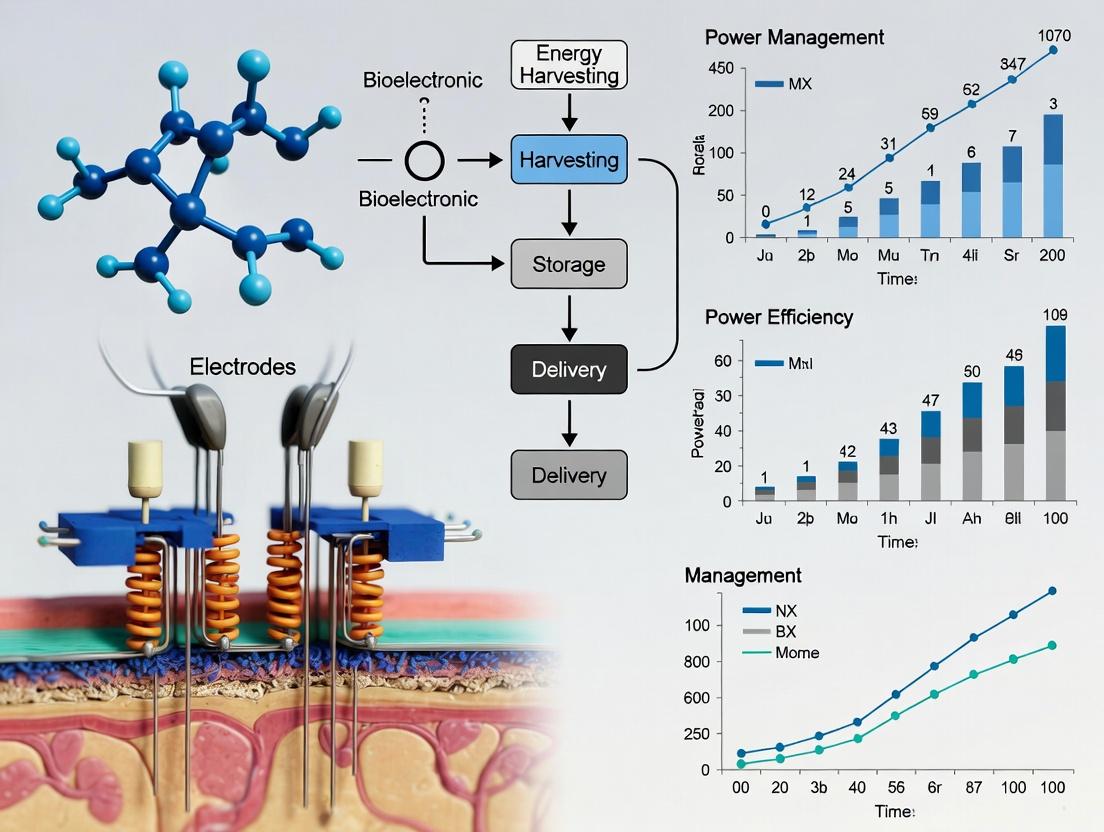
This article provides a comprehensive analysis of the power management challenges hindering the advancement of bioelectronic implants.
Powering the Future of Medicine: Overcoming Critical Energy Challenges in Bioelectronic Implants
Abstract
This article provides a comprehensive analysis of the power management challenges hindering the advancement of bioelectronic implants. Targeted at researchers, scientists, and drug development professionals, it explores the fundamental energy and material constraints of current devices, details emerging methodologies for power harvesting and delivery, offers frameworks for troubleshooting and system optimization, and critically compares validation strategies for novel power solutions. The synthesis aims to guide the development of next-generation, long-lasting, and clinically viable bioelectronic therapies.
The Core Challenge: Understanding the Fundamental Energy and Material Limits of Bioelectronic Implants
Technical Support Center
Troubleshooting Guides
Issue 1: Sudden, Premature Device Failure After Implantation
- Symptoms: Bioelectronic implant ceases function days or weeks after implantation, well before projected battery lifespan.
- Likely Root Cause: Inflammatory foreign body response (FIBR) leading to fibrotic encapsulation. This increases the local electrical impedance, forcing the device to draw more power to maintain stimulation/recording fidelity, thereby depleting the battery.
- Diagnostic Protocol:
- Pre-implant Benchmarking: Record baseline impedance and threshold stimulation current/voltage in saline or simulated tissue medium.
- Post-explant Analysis: Carefully explant the device and surrounding tissue. Fix tissue for histology (H&E, Masson's Trichrome for collagen) to measure capsule thickness.
- Electrical Re-test: Place the explanted device back in the benchmark medium. If performance returns to baseline, FIBR is confirmed as the primary issue.
- Solutions:
- Device Coating: Apply anti-inflammatory drug-eluting coatings (e.g., dexamethasone) or use soft, conductive hydrogel interfaces.
- Waveform Optimization: Implement charge-balanced, biphasic pulses with interphase delay to minimize Faradaic reactions and tissue damage.
- Material Selection: Utilize biologically inert materials (e.g., PEDOT:PSS, platinum-iridium) for electrodes.
Issue 2: Inconsistent Signal Fidelity During Chronic Recording
- Symptoms: Recorded neural or electrophysiological signals show increased noise, decreased amplitude, or unstable baseline over time.
- Likely Root Cause: Combined effect of tissue encapsulation (signal attenuation) and potential micro-motion at the tissue-device interface. May also involve amplifier saturation or reference electrode instability.
- Diagnostic Protocol:
- Simultaneous Measurement: Continuously log both the biological signal and the local electrode impedance.
- Correlation Analysis: Plot signal-to-noise ratio (SNR) against impedance over time. A strong inverse correlation points to encapsulation.
- Post-hoc Validation: Use histological analysis (as above) to confirm tissue changes.
- Solutions:
- Adaptive Impedance Matching: Integrate on-chip circuitry that can adjust input impedance dynamically.
- Advanced Filtering: Implement real-time, programmable high-pass filters to remove slow baseline drift caused by encapsulation.
- Mechanical Design: Employ flexible, mesh-like electrodes that better conform to tissue and reduce micromotion.
Issue 3: Inaccurate Drug Release Kinetics from Powered Depots
- Symptoms: Release profile of therapeutic agents from an active, pump-based implant deviates from in vitro calibration, often showing initial bursts or delayed release.
- Likely Root Cause: Clogging of microfluidic channels or pump orifices by proteins (biofouling) or the drug compound itself. Changes in local pressure post-implantation can also affect flow rates.
- Diagnostic Protocol:
- Pre-implant Flow Calibration: Precisely measure flow rate vs. applied power/voltage in a physiologically-relevant fluid (e.g., PBS with 1% BSA).
- In-line Pressure Monitoring: If sensors are integrated, monitor pressure spikes.
- Post-explant Microscopy: Inspect reservoirs and channels using SEM or confocal microscopy for precipitate or cellular buildup.
- Solutions:
- Surface Treatment: Apply hydrophilic or fluorinated coatings to channel interiors to reduce protein adhesion.
- Formulation Optimization: Ensure drug is formulated at a concentration well below its solubility limit in physiological fluid to prevent precipitation.
- Pulsing Protocol: Use periodic "backflush" or high-flow purge cycles to clear incipient clogs.
Frequently Asked Questions (FAQs)
Q1: What is the single biggest factor limiting the miniaturization of my implantable device? A: The energy source (battery/capacitor) is typically the largest rigid component. Achieving miniaturization requires either (a) moving to ultra-thin film or flexible batteries, (b) aggressive duty cycling (deep sleep modes), or (c) exploring energy harvesting (e.g., biofuel cells, piezoelectric). Each choice imposes trade-offs with longevity or function.
Q2: How do I accurately estimate the in vivo operational lifetime of my device's power source? A: In vitro testing is insufficient. You must create a detailed power budget model and validate it in a simulated biological environment. Key parameters are in the table below.
| Parameter | In Vitro (Saline) Typical Value | In Vivo Adjustment Factor | Notes |
|---|---|---|---|
| Stimulation Impedance | 1-5 kΩ | Can increase 3-10x over weeks | Primary driver of excess power draw. |
| Sampling Rate Duty Cycle | 100% (Continuous) | Can often be reduced to <1% | Duty cycling is the most effective power-saving tactic. |
| Wireless Link Efficiency | ~70% in air | Can drop to <10% through tissue | Depth and frequency (≈ 2.4 GHz attenuates more than < 1 GHz) are critical. |
| Battery Self-Discharge | <1% per year (Li primary) | Can increase slightly with temp. | Often negligible compared to active drain. |
| Circuit Leakage Current | Model-specific (nA-µA) | Increases with temperature (≈ 2x per 10°C) | A major drain in ultra-low-power designs. |
Q3: My wireless data/power link is unreliable at shallow implantation depths. What are my options? A: This indicates impedance mismatch or interference.
- Check Antenna Tuning: Re-tune the antenna impedance matching network using a vector network analyzer with the device embedded in a tissue phantom (e.g., saline/gelatin).
- Frequency Selection: Consider switching to a lower ISM band (e.g., 433 MHz vs. 2.4 GHz) for better tissue penetration, albeit with lower data rates.
- Orientation: Ensure the implant and external transceiver coils/antennas are aligned as consistently as possible. Consider using 3-axis coils.
Q4: What are the best practices for conducting an accelerated lifetime test for a bioelectronic implant? A: Follow a standardized protocol that stresses multiple failure modes.
- Protocol: Place the active device in phosphate-buffered saline (PBS) at 60°C. Perform functional checks (stimulation, recording, telemetry) at 24-hour intervals. The Arrhenius model suggests that every 10°C increase roughly doubles degradation rates. 60°C testing for 1 month can simulate ~4-6 months at 37°C for many failure mechanisms (e.g., moisture ingress, corrosion). Note: This does not accurately simulate biotic factors like inflammation.
Q5: How can I reduce the power consumption of my analog front-end for neural recording without sacrificing too much SNR? A: Focus on the first amplifier stage and digitization strategy.
- Choose a Low-Noise, Moderately High-Impedance Amplifier: An input-referred noise of ≈ 2 µVrms is often sufficient for local field potentials.
- Implement Adaptive Sampling: Use an activity detector to switch between a high-bandwidth/rate mode during neural events and an ultra-low-power monitoring mode during quiescence.
- On-Chip Spike Detection: Perform simple analog or digital spike detection on-chip and only transmit spike snippets or timestamps, not the continuous raw signal.
Experimental Protocol: ChronicIn VivoPerformance & Power Budget Validation
Objective: To empirically measure the power consumption and functional fidelity of a bioelectronic stimulator implant over a 4-week period in a rodent model.
Materials:
- Device under test (DUT): Miniature neural stimulator.
- Surgical tools, stereotaxic frame.
- Anesthesia system (isoflurane recommended).
- Temperature-controlled heating pad.
- Wireless data/power telemetry system.
- External battery & data logger.
- Post-mortem: Perfusion pump, formalin, histological supplies.
Method:
- Pre-implant Characterization: Measure baseline stimulation parameters (voltage/current at target charge density) and impedance in 0.9% saline at 37°C. Record the precise power draw from the source.
- Surgical Implantation: Aseptically implant the DUT in the target location (e.g., sciatic nerve, brain region). Secure the device and close the wound.
- Chronic Monitoring:
- Daily (Days 1-7): Wirelessly query the DUT's internal impedance measurement circuit and its recorded voltage rail. Stimulate for 1 minute per hour at the pre-set parameters and log the resulting power draw from the external logger.
- Weekly (Weeks 2-4): Perform the above measurements every 3 days.
- Functional Assessment: At each time point, perform a behavioral or electrophysiological assay (e.g., EMG response for a peripheral nerve stimulator) to quantify output fidelity.
- Termination & Analysis:
- At Day 28, euthanize the animal and perfuse-fix the tissue.
- Explant the device and surrounding tissue.
- Process tissue for histology to quantify fibrotic capsule thickness.
- Correlate capsule thickness with recorded impedance rise and increase in power consumption.
The Scientist's Toolkit: Research Reagent Solutions
| Item | Function in Bioelectronic Power Research |
|---|---|
| PEDOT:PSS Conductive Polymer | Coating for electrodes to lower impedance, reduce Faradaic reactions, and improve charge injection capacity, lowering power needs. |
| Dexamethasone Sodium Phosphate | An anti-inflammatory drug used in eluting coatings to suppress the foreign body response, mitigating impedance rise. |
| Platinum Black or Iridium Oxide | High-surface-area electrode plating materials that dramatically increase charge storage capacity (CSC), enabling safe, lower-voltage stimulation. |
| Polyimide or Parylene-C | Biostable, flexible polymers used as substrate/encapsulation materials for ultra-thin, miniaturized flexible electronics. |
| Lithium Carbon Monofluoride (Li/CFx) Battery | A primary (non-rechargeable) battery chemistry offering very high energy density and stability, used for long-term implants. |
Visualizations
Power Trilemma Core Conflict
Chronic Impedance Rise & Power Failure Path
Experimental Workflow for In Vivo Power Budget Validation
Welcome to the Technical Support Center for Bioelectronic Implants Power Management Research. This resource provides targeted troubleshooting and methodological guidance for researchers investigating the energy distribution across sensing, processing, and stimulation subsystems in implantable devices.
Troubleshooting Guides & FAQs
Q1: During in vivo testing, my implant's battery depletes significantly faster than predicted by bench-top measurements. The sensing subsystem is active. What could be the cause? A: This is a common discrepancy. Bench-top tests often use idealized signals or simulated tissue loads. The primary culprit is usually the front-end analog circuitry for sensing.
- Issue: High-input impedance amplifiers and continuous analog filtering (e.g., for neural signals) draw substantial static current (IQ). In real tissue, electrode-tissue interface impedance can be highly variable and dynamic, forcing the circuit to work harder to maintain signal integrity, increasing power draw.
- Troubleshooting Protocol:
- Measure Quiescent Current: On the bench, power your sensing front-end with a precision current source and measure IQ with no input signal.
- Test with Variable Load: Use an electrochemical cell or a network of resistors/capacitors to mimic a range of realistic electrode impedances (e.g., 1 kΩ to 100 kΩ at 1 kHz). Measure current draw increase.
- Solution: Implement duty-cycling. Instead of continuous sensing, activate the high-power front-end only in short, periodic bursts (e.g., 10 ms every 100 ms). This requires a low-power wake-up circuit.
Q2: My wireless data transmission for diagnostics consistently fails at the predicted critical battery voltage, halting experiments. A: This points to voltage droop under high load, not just overall capacity.
- Issue: Radio Frequency (RF) transmission (e.g., Bluetooth Low Energy) requires high peak current (often 10-20mA). As the battery depletes, its internal resistance increases. When the transmitter activates, the sudden current draw causes a temporary voltage drop below the system's minimum operating voltage, triggering a brown-out reset.
- Troubleshooting Protocol:
- Oscilloscope Measurement: Probe the supply rail (VDD) at the system-on-chip with a triggered sweep synchronized to the transmission enable signal. Look for the dip amplitude.
- Solution: Implement two mitigations: (a) Aggressive decoupling: Add a large capacitor (e.g., 100 µF) near the transmitter IC to act as a local energy reservoir. (b) Dynamic voltage scaling: Temporarily reduce the clock speed of the digital processing core during transmission events to lower concurrent current demand.
Q3: The charge balancing circuit for my stimulation pulses is consuming more power than the stimulation itself. Is this normal? A: It can be, especially for safe, precision stimulation. Inefficiency here drastically impacts the overall energy budget.
- Issue: Passive discharge through large resistors or active balancing with op-amps continuously dissipates energy. Symmetric biphasic pulses are not perfectly charge-matched due to component tolerances, requiring additional balancing current.
- Troubleshooting Protocol:
- Measure Isolation: Use a high-precision current probe to measure the current flowing through the balancing circuit between stimulation pulses.
- Characterize Mismatch: Precisely measure the net DC current injected into a saline bath or tissue phantom over 1000 pulses.
- Solution: Switch to a capacitor-coupled, active discharge method. A switching circuit disconnects the electrodes and shorts them through a small resistor only briefly after each pulse phase, minimizing constant power drain.
Data based on a synthesis of current literature for a closed-loop neuromodulation device.
Table 1: Power Budget Breakdown by Subsystem
| Subsystem | Component | Typical Power Draw | Notes & Variability |
|---|---|---|---|
| Sensing | Biopotential Amplifier | 5 - 50 µW per channel | Scales linearly with channel count; noise performance trades with power. |
| ADC Conversion | 1 - 10 µW per channel | Depends on resolution (e.g., 10-16 bit) and sampling rate (100 Hz - 10 kHz). | |
| Processing | Microcontroller (Sleep) | 0.5 - 5 µW | Low-power retention mode. |
| Microcontroller (Active) | 50 - 500 µW | During feature extraction/classification; depends on clock speed & algorithm complexity. | |
| On-Chip Memory Access | 10 - 100 µW | Significant during data buffer manipulation. | |
| Stimulation | Current Generator Output | 10 µW - 10 mW | Highly variable. Direct function of amplitude, frequency, pulse width, and electrode impedance. |
| Charge Balancing Circuit | 5 - 200 µW | Can rival stim power if not optimized (see FAQ #3). | |
| Communication | RF Transmitter (Tx) | 1 - 30 mW peak | Dominant drain during active transmission. Duty cycling is critical. |
| RF Receiver (Rx) | 1 - 10 mW | For bidirectional implants. |
Table 2: Impact of Duty Cycling on System Lifetime Assumes a 10 mAh solid-state battery.
| Operational Mode | Duty Cycle | Estimated Lifetime | Energy Savings vs. Continuous |
|---|---|---|---|
| Continuous Sensing & Processing | 100% | ~12 days | Baseline |
| Burst Sensing (10 ms/100 ms) | 10% | ~120 days | ~90% reduction in sensing budget |
| Tx once per hour (10 ms) | 0.0003% | ~150 days | Major reduction in dominant drain |
Detailed Experimental Protocols
Protocol 1: Measuring Subsystem Power Draw In Situ Objective: To accurately profile the dynamic power consumption of each implant subsystem under realistic operating conditions. Materials: Device Under Test (DUT), precision digital multimeter (DMM), current-sense amplifier/IC (e.g., INA219), oscilloscope, programmable micro-load, data acquisition (DAQ) system. Methodology:
- Instrumentation: Solder a low-value (e.g., 1Ω), high-precision shunt resistor in series with the power supply line for the target subsystem (e.g., the stimulator's V+ line).
- Measurement: Use the current-sense IC or the oscilloscope across the shunt resistor to measure voltage drop. Calculate instantaneous current: I = Vshunt / Rshunt.
- Synchronization: Trigger the oscilloscope or DAQ on the subsystem's enable signal (e.g., "STIMPULSE" or "TXENABLE").
- Profiling: For the stimulation subsystem, measure current during a pulse, during inter-phase delay, and during idle periods. Integrate current over time to calculate charge (mAh) used per stimulus.
- Data Analysis: Plot current vs. time. Calculate average and peak power for each operational phase.
Protocol 2: Validating Power-Saving Algorithms in a Tissue Phantom Objective: To verify that duty-cycled or event-driven sensing does not degrade signal fidelity in a physiologically relevant environment. Materials: DUT, tissue phantom (e.g., 0.9% saline agarose gel), signal generator with isolated outputs, recording electrodes, commercial bio-amplifier (for ground truth), software for signal analysis (e.g., MATLAB, Python). Methodology:
- Setup: Embed the DUT's sensing electrodes and a reference commercial electrode in the phantom. Inject a known, low-amplitude biphasic signal (mimicking neural activity) via a separate pair of electrodes.
- Control Recording: Record the injected signal continuously using the commercial bio-amplifier.
- Test Recording: Operate the DUT in its proposed low-power mode (e.g., 10% duty cycle, or an event-driven wake-up mode).
- Analysis: Align the DUT-recorded snippets with the continuous ground truth. Calculate performance metrics: signal-to-noise ratio (SNR) recovery, event detection latency, and false negative/positive rates for event-driven systems.
- Power Measurement: Simultaneously perform Protocol 1 on the DUT's sensing front-end to quantify power savings.
Visualization: System Power Management & Signaling
System Power Distribution & Control
Event-Driven Implant Operation Flow
The Scientist's Toolkit: Research Reagent Solutions
Table 3: Essential Materials for Power Budget Characterization Experiments
| Item | Function/Application | Key Consideration |
|---|---|---|
| Precision Current Sense Amplifier (e.g., INA219) | Measures µA-to-mA current draw on a subsystem rail without breaking the circuit. | Bandwidth must be high enough to capture fast transients (e.g., RF Tx pulses). |
| Tissue/Electrolyte Phantom | Provides a realistic, stable electrical load for ex vivo testing of stimulation efficiency and electrode interface. | Ionic concentration and agarose percentage should mimic target tissue conductivity. |
| Programmable Micro-Load | Dynamically emulates varying electrode impedances or system loads to stress-test power management circuits. | Ability to switch between resistive/capacitive profiles rapidly. |
| High-Bandwidth Digital Oscilloscope | Captures fast voltage droops and current spikes with precise time synchronization to control signals. | Essential for diagnosing brown-out events. |
| Battery Cycler & Impedance Analyzer | Characterizes the actual capacity and internal resistance of miniature batteries under realistic pulsed loads. | More accurate than datasheet estimates for implant conditions. |
| Low-Power Microcontroller Dev Kit | Prototype and profile the power consumption of processing algorithms (e.g., feature detection) before ASIC design. | Must have accurate, active power measurement modes. |
Technical Support Center
Troubleshooting Guides & FAQs
Q1: During in vivo testing, our implant's battery capacity degrades 40% faster than in in vitro simulations. What could be causing this?
A: This is a classic biocompatibility-performance conflict. The discrepancy is likely due to the complex in vivo environment not replicated in vitro.
- Root Cause 1: Biofouling & Encapsulation. Protein adsorption and fibrous encapsulation on the battery casing increase ionic diffusion resistance and create local hypoxia, altering electrochemical kinetics.
- Root Cause 2: Dynamic Electrolyte & pH Changes. Interstitial fluid is not a static saline solution. Local inflammatory responses can shift pH and concentration of reactive species (e.g., ROS, chlorides), accelerating corrosion of current collectors or SEI layer breakdown.
- Troubleshooting Protocol:
- Post-Explanation Analysis: Retrieve the implant and perform:
- SEM/EDS on the casing to measure biofilm/fibrous tissue thickness and composition.
- Electrochemical Impedance Spectroscopy (EIS) to quantify increased interfacial resistance.
- XPS on exposed anode/electrode materials to identify corrosive byproducts (e.g., metal chlorides, sulfides).
- Mitigation Experiment: Coat a batch of batteries with a parylene-C (5µm) / poly(ethylene glycol) (PEG) bilayer. Parylene-C provides a hermetic moisture barrier, while PEG resists protein adhesion. Repeat in vivo test and compare degradation rates using the table below.
- Post-Explanation Analysis: Retrieve the implant and perform:
Q2: Our flexible microelectrode arrays show increased impedance and signal-to-noise ratio (SNR) decay after 2 weeks of subcutaneous implantation. How do we diagnose if it's a material failure or a biotic response?
A: This requires isolating biotic from abiotic failure modes.
- Diagnostic Protocol:
- Control Group: Place identical arrays in phosphate-buffered saline (PBS) at 37°C and 5% CO₂ (simulating physiological temperature and pH). Measure impedance daily.
- Test Group: Retrieve explanted arrays from the animal model.
- Analysis:
- Optical Microscopy: Inspect for delamination, cracks, or discoloration.
- EIS Analysis: Compare Bode and Nyquist plots from both groups. A identical shift in both groups suggests abiotic hydrolysis of conductive polymer or metal corrosion. A shift only in the in vivo group suggests biotic fouling.
- Coulometric Analysis: Use cyclic voltammetry to calculate the effective surface area. A loss in area indicates passive oxide layer growth or biofilm insulation.
- Material-Specific Fix: If biotic, apply an antifouling coating (e.g., zwitterionic polymer). If abiotic, switch to a more hydrolys is-resistant conductive material (e.g., platinum-iridium over pure platinum, PEDOT:PSS with cross-linkers).
Q3: We observe localized inflammation and fibrosis specifically around the ceramic package of our device, but not the titanium parts. Is this a known issue?
A: Yes. Not all "biocompatible" materials perform equally in long-term, active implants. Certain alumina or zirconia ceramics can exhibit micrometric surface roughness that promotes macrophage adhesion and fusion into foreign body giant cells, driving fibrosis.
- Solution Protocol:
- Surface Topography Measurement: Use atomic force microscopy (AFM) to characterize the Ra (average roughness) of both the ceramic and titanium surfaces. Target Ra < 0.5µm to minimize cellular adhesion.
- Surface Modification: Apply a sub-micron, polished layer of bioactive glass or silicon nitride via chemical vapor deposition. These materials release ions (e.g., Si, Mg) that modulate macrophage phenotype towards anti-inflammatory M2 polarization, reducing capsule thickness.
- Validation: Implant modified vs. unmodified ceramic coupons. Analyze after 4 weeks via histology (H&E stain) to measure fibrous capsule thickness.
Q4: How do we balance the need for high-energy-density battery materials (e.g., Silicon anodes, Sulfur cathodes) with their known toxicity if encapsulated?
A: This is a core constraint. The strategy is multi-layered hermetic containment and rigorous failure testing.
- Safety & Performance Validation Protocol:
- Primary Barrier: Use cold-welded titanium cans for the core battery cell. Perform helium leak testing (< 10⁻⁸ atm·cc/sec).
- Secondary Containment: Encase the entire battery in a conformal, pinhole-free coating of ALD-deposited Al₂O₃ (≥ 50nm).
- Accelerated Failure Testing: Subject the doubly encapsulated battery to:
- Autoclaving: 121°C, 15 PSI for 1 hour to test for sudden failure.
- Potential Cycling: Cycle the battery at 60°C in simulated body fluid for 1000 cycles, then perform ICP-MS on the fluid to detect any trace metal ions (Si, Ni, Co, S). Acceptable leakage is below 1 ppm.
- Performance Trade-off Table: The encapsulation adds weight and volume, reducing effective energy density.
Data Presentation
Table 1: Comparative Performance Degradation of Battery Materials In Vitro vs. In Vivo (28-Day Cycle)
| Material System | In Vitro Capacity Retention | In Vivo Capacity Retention | Primary Degradation Mode In Vivo | Suggested Coating/Mitigation |
|---|---|---|---|---|
| LiCoO₂ / Graphite | 98% | 82% | Cathode dissolution, Li⁺ depletion | LiPON ALD coating |
| LiFePO₄ / Graphite | 99.5% | 95% | Minimal; slight SEI growth | Parylene-HT |
| LiMn₂O₄ / Li₄Ti₅O₁₂ | 99% | 88% | Mn dissolution, Jahn-Teller distortion | ZrO₂ nanocoating |
| Solid-State (LiPON) | 99.8% | 96% | Crack propagation from mechanical stress | Polydimethylsiloxane buffer |
Table 2: Electrical Performance of Conductive Materials in Bio-fluids
| Material | Initial Impedance (1 kHz) | Impedance after 30 days (in vivo) | Biotic Fouling Thickness (avg.) | Key Stability Limitation |
|---|---|---|---|---|
| Platinum (Pt) | 2.3 kΩ | 8.7 kΩ | 45 µm | Oxide growth, capacitive coupling loss |
| Iridium Oxide (IrOx) | 0.8 kΩ | 1.5 kΩ | 50 µm | Reduction to Ir, crystallinity change |
| PEDOT:PSS (unmodified) | 0.5 kΩ | 15.0 kΩ | 25 µm | Hydrolytic degradation, delamination |
| PEDOT:PSS (GOx-Crosslinked) | 0.7 kΩ | 2.1 kΩ | 30 µm | Improved adhesion, stable volumetric capacitance |
| Carbon Nanotube Mat | 1.2 kΩ | 3.0 kΩ | 15 µm | Excellent biostability, low inflammation |
Experimental Protocols
Protocol 1: Accelerated In Vitro Biocompatibility & Performance Screening for Implantable Battery Cells.
- Sterilization: Ethylene oxide gas sterilization of test cells. Allow 48-hour degassing.
- Immersion Media Preparation: Prepare standard DMEM cell culture medium supplemented with 10% fetal bovine serum (FBS). Divide into aliquots. Adjust one set to pH 6.5 using lactic acid to simulate inflammatory conditions.
- Testing Setup: In a humidity-controlled incubator (37°C, 5% CO₂), immerse sterile cells in media (1 cm² surface area per 1 mL media). Include a non-immersed control cell.
- Electrical Cycling: Use a potentiostat/galvanostat to cycle cells at C/10 rate for 2 cycles daily, monitoring voltage curves and capacity.
- Analysis:
- Weekly: Perform EIS on cells. Replace media and retain old media for analysis.
- Endpoint (4 weeks): Perform ICP-MS on spent media to quantify leached ions. Perform post-mortem SEM/EDS on electrode surfaces.
Protocol 2: Ex Vivo Impedance Monitoring and Fouling Correlation for Neural Electrodes.
- Implantation: Implant sterilized microelectrode arrays into target neural tissue of anesthetized animal model.
- Chronic Monitoring: Use a wireless recording system or percutaneous connector to measure electrochemical impedance spectroscopy (EIS) at 1, 7, 14, and 30 days post-implant. Measure at 1 Hz - 1 MHz.
- Perfusion & Histology: At predetermined time points, transcardially perfuse the animal with saline followed by 4% paraformaldehyde.
- Explant & Section: Carefully explant the brain with the array in situ. Section tissue using a cryostat or vibratome.
- Staining: Immunostain for astrocytes (GFAP), microglia (Iba1), and neurons (NeuN). Use DAPI for nuclei.
- Correlation: Coregister impedance data (specifically, low-frequency impedance modulus) with glial scar thickness measurements from histology images using image analysis software (e.g., ImageJ).
Mandatory Visualization
Title: Bioelectronics Material Selection Conflicts & Solutions
Title: Biomaterial Validation Workflow for Implants
The Scientist's Toolkit: Research Reagent Solutions
Table 3: Essential Materials for Bioelectronics Compatibility Testing
| Item (Supplier Example) | Function in Research | Key Consideration for Bioelectronics |
|---|---|---|
| Simulated Body Fluid (SBF), pH 7.4 (e.g., Sigma-Aldrich S9894) | Accelerated in vitro corrosion and stability testing of metals and coatings. | Ion concentration must match human plasma (Na⁺, K⁺, Ca²⁺, Mg²⁺, Cl⁻, HCO₃⁻, HPO₄²⁻, SO₄²⁻). |
| Parylene-C Deposition System (Specialty Coating Systems) | Conformal, pinhole-free polymer barrier for moisture and ion isolation. | Thickness (typically 5-20µm) is critical. Thicker improves barrier but increases device stiffness and volume. |
| Atomic Layer Deposition (ALD) System for Al₂O₃/HfO₂ (Beneq, Cambridge NanoTech) | Deposits ultra-thin, conformal, and hermetic ceramic coatings on complex 3D electrodes/batteries. | Precursor choice (e.g., TMA for Al₂O₃) must not damage underlying electroactive materials (e.g., Li anodes). |
| Electrochemical Impedance Spectroscope with Potentiostat (BioLogic, Ganny) | Characterizes electrode-electrolyte interface stability, corrosion rates, and fouling in real-time. | Must have low-current capability (pA-nA range) for microelectrodes and capability for long-term soaking tests. |
| Poly(3,4-ethylenedioxythiophene):Poly(styrene sulfonate) (PEDOT:PSS) (Heraeus Clevios) | Conductive polymer coating for electrodes, lowers impedance and improves charge injection limit. | Requires additives (e.g., GOPS crosslinker, DMSO) for in vivo stability. Biocompatibility varies by formulation. |
| Zwitterionic Polymer (e.g., Poly(sulfobetaine methacrylate)) (Sigma-Aldrich) | Ultra-low fouling hydrogel coating to mitigate fibrous encapsulation and biofilm on device surfaces. | Adhesion to underlying substrate (metal, ceramic) is often poor; requires a tie-layer (e.g., silane). |
| Helium Leak Detector (Pfeiffer Vacuum) | Gold-standard testing for hermetic seal integrity of battery and electronics packages. | Acceptable leak rate for chronic implants is exceptionally low (<10⁻⁸ atm·cc/sec). Test post-sterilization. |
Troubleshooting Guides & FAQs
FAQ 1: What is the acceptable temperature rise at the implant-tissue interface to prevent thermal damage? A: The consensus is to limit the temperature rise at the interface to ≤ 1°C above baseline body temperature (37°C) to prevent adverse effects. Exceeding 2°C can initiate inflammatory responses and protein denaturation, while rises above 4°C pose a high risk of necrosis.
FAQ 2: During in vivo testing, we observe localized inflammation. Is this always due to heat? A: Not always. While heat is a primary culprit, you must conduct a differential diagnosis. Follow this protocol:
- Measure Interface Temperature: Use implanted micro-thermocouples or fluoroptic probes.
- Check Power Cycling: Correlate inflammation with active vs. sleep modes of the implant.
- Material Biocompatibility: Run a parallel histology assay on a passive (non-powered) implant of identical materials.
- Mechanical Stress: Assess if the inflammation site correlates with points of high mechanical strain.
FAQ 3: Our wireless power transfer system causes intermittent heating. How can we diagnose the source? A: Intermittent heating points to dynamic factors. Use this guide:
- Symptom: Heating occurs only during specific movements/orientations.
- Likely Cause: Misalignment of coupling coils leading to inefficient power transfer and increased loss in the transmitter/receiver shield.
- Solution: Implement closed-loop load impedance monitoring and adaptive tuning.
- Symptom: Heating correlates with specific data transmission bursts.
- Likely Cause: High peak current draw during communication events.
- Solution: Introduce current limiting or spread-spectrum timing for data packets.
- Symptom: Random heating in controlled environments.
- Likely Cause: Dielectric breakdown or delamination in encapsulation causing current leakage.
- Solution: Perform impedance spectroscopy on the implant pre- and post-explantation.
FAQ 4: How do we accurately measure heat dissipation in a small-scale implant prototype? A: Use a combination of computational and physical validation. Experimental Protocol: In Vitro Calorimetric Validation
- Apparatus: Fabricate a thermally insulated micro-calorimeter chamber filled with phosphate-buffered saline (PBS) at 37°C.
- Instrumentation: Embed high-precision thermistors (e.g., ±0.1°C) at known distances from the prototype.
- Procedure: Activate the implant at its maximum continuous power setting. Record temperature at all sensor points until steady-state is reached (typically 60-90 mins).
- Modeling: Input the recorded power and temperature data into a Finite Element Analysis (FEA) model (e.g., COMSOL Multiphysics with bioheat transfer module) to calibrate the simulation's thermal conductivity and perfusion parameters.
- Validation: The calibrated FEA model can then predict in vivo temperature rises with higher confidence.
Data Presentation
Table 1: Thresholds for Thermal Tissue Damage
| Tissue Type | Critical Temperature Rise (ΔT) | Exposure Time for Damage | Primary Pathological Effect |
|---|---|---|---|
| General Neural Tissue | 2°C | 1 hour (chronic) | Increased apoptosis, glial activation |
| Cortical Bone | 4°C | 10 minutes | Osteocyte necrosis |
| Skeletal Muscle | 3°C | 30 minutes | Contraction & protein denaturation |
| Subcutaneous Tissue | 4°C | 1 hour | Adipocyte necrosis, fibrosis |
Table 2: Thermal Properties of Common Implant Materials & Tissues
| Material / Tissue | Thermal Conductivity (W/m·K) | Specific Heat Capacity (J/kg·K) | Notes for Design |
|---|---|---|---|
| Titanium (Ti-6Al-4V) | 6.7 | 560 | High conductivity helps spread heat, but may increase heated volume. |
| Parylene-C | 0.082 | 711 | Excellent insulator; used as a conformal coating. |
| PDMS (Sylgard 184) | 0.15 | 1460 | Flexible, low conductivity encapsulation. |
| Cortical Bone | 0.32-0.38 | ~1300 | Poor conductor, heat can localize at interface. |
| Gray Matter (Brain) | 0.51 | 3650 | High perfusion provides some cooling. |
| Saline (PBS) | ~0.6 | 4150 | Models in vitro aqueous environment. |
Experimental Protocols
Protocol: In Vivo Assessment of Chronic Thermal Load Objective: To evaluate long-term tissue response to a low-grade, chronic thermal load from an active implant. Methodology:
- Implant Preparation: Instrument a fully functional implant with a micro-thermistor at its surface. Calibrate pre-implantation.
- Animal Model: Utilize a relevant large animal model (e.g., porcine) under approved IACUC protocol. Implant the device in the target tissue (e.g., subcutaneous, intramuscular).
- Stimulation Regime: Operate the implant on a cyclic protocol (e.g., 1 hour ON at therapeutic power, 1 hour OFF) for 28 days.
- Monitoring: Continuously log interface temperature via a telemetric system. Monitor for behavioral signs of discomfort.
- Terminal Analysis: At endpoint, perfuse-fixate the subject. Resect the implant and surrounding tissue en bloc.
- Histopathology: Section tissue and stain with H&E for general morphology, and immunohistochemical markers for heat shock proteins (HSP70), apoptosis (caspase-3), and macrophage infiltration (Iba1/CD68). Compare to contralateral control tissue with a sham implant.
Diagrams
Title: Pathways from Implant Heat to Tissue Damage
Title: Diagnosing the Cause of Tissue Reaction
The Scientist's Toolkit: Research Reagent Solutions
| Item | Function in Thermal Management Research |
|---|---|
| Fluoroptic Thermometer Probes (e.g., Luxtron) | Provide accurate, EMI-immune temperature measurement directly at the implant-tissue interface during in vivo or in vitro power testing. |
| Parylene-C Deposition System | Applies a uniform, pinhole-free, conformal dielectric coating with low thermal conductivity for electrical insulation and moisture barrier. |
| Bioheat Transfer FEA Software (COMSOL) | Enables multi-physics simulation of heat dissipation, incorporating Pennes' bioheat equation to model tissue perfusion effects before animal trials. |
| Polyimide-based Flexible Heater Arrays | Used as calibrated heat sources in control experiments to isolate the effect of temperature from electrical or material factors. |
| HSP70 / Caspase-3 IHC Antibodies | Key immunohistochemical reagents for identifying cellular stress (HSP70) and apoptosis (caspase-3) in explanted tissue sections. |
| Thermally Conductive Epoxy (e.g., silver-filled) | Used to attach heat sinks or spreaders to high-power components within the implant package, directing heat away from the tissue interface. |
| Phosphate-Buffered Saline (PBS) | Standard isotonic solution for in vitro calorimetric testing, simulating the thermal properties of the aqueous extracellular environment. |
This technical support center is designed to address common power management challenges faced by researchers developing bioelectronic implants. The guides and FAQs below stem from the thesis that overcoming power constraints is fundamental to advancing implant longevity, miniaturization, and functionality.
Troubleshooting Guides & FAQs
Q1: Our in-vivo test shows a faster-than-expected voltage drop in the implant's battery. What are the primary investigative steps? A: This is a critical power management challenge. Follow this protocol:
- Bench Validation: Isolate the battery. Disconnect it from the implant circuit and measure its open-circuit voltage and internal resistance using a source measure unit (SMU). Compare to pre-implantation baseline data.
- Circuit Leakage Test: On a separate prototype board, power the implant's active circuitry (e.g., microcontroller, stimulator) from a calibrated lab bench power supply set to the battery's nominal voltage. Measure current draw in all operational modes (sleep, sensing, stimulation). Compare measured drain to the theoretical design budget.
- In-Situ Load Analysis: If steps 1 & 2 are normal, the issue may be dynamic. Use a wireless telemetry unit (if available) to log in-vivo load current profiles. Look for unanticipated high-frequency activation events.
- Electrolyte & Interface Check: Post-explantation, conduct a visual and microscopic inspection of battery contacts and the hermetic seal for signs of moisture ingress or corrosion, which can increase internal resistance.
Q2: When designing for minimal size, how do we choose between a primary (non-rechargeable) and secondary (rechargeable) battery cell? A: The choice dictates implant design and lifespan strategy. Use this decision workflow.
Q3: What are the key experimental protocols for characterizing battery cycle life in a simulated implant environment? A: Accelerated aging testing is essential. Below is a standardized protocol.
Protocol: Accelerated Cycle Life Test for Implantable Batteries
- Objective: To predict long-term battery capacity fade under simulated use conditions.
- Equipment: Biologic VMP-3 potentiostat or equivalent, environmental chamber, custom test jig simulating implant load.
- Method:
- Baseline Characterization: Perform a full C/10 rate discharge on a new cell to determine initial capacity (Cinitial).
- Define Test Profile: Program the potentiostat to apply a repeating cycle mimicking in-vivo use (e.g., 23 hours at 50µA [sleep], 1 hour of 5mA pulses at 100Hz [active]).
- Accelerate Factor: Increase the average current density (e.g., by 3x) or perform tests at an elevated temperature (e.g., 37°C to 45°C) to accelerate aging. Note: The acceleration factor must be calibrated and reported.
- Periodic Check: Every 100 test cycles, pause and perform another C/10 discharge to measure remaining capacity (Cremaining).
- Endpoint: Continue until Cremaining falls below 80% of Cinitial (standard failure threshold for implants).
- Data Analysis: Plot capacity fade (%) vs. cycle count. Use models (e.g., Arrhenius for temperature, Peukert's law for rate) to extrapolate to real-world operational lifespan.
Comparative Data on Battery Technologies
Table 1: Key Characteristics of Implantable Battery Chemistries
| Chemistry | Type | Energy Density (Wh/L) approx. | Typical Lifespan | Key Advantage | Primary Design Constraint |
|---|---|---|---|---|---|
| Lithium-Iodine (Li/I₂) | Primary | 900 - 1000 | 8-15 years | Ultra-high reliability, solid electrolyte | Low current output (<100µA continuous) |
| Lithium Carbon Monofluoride (Li/CFₓ) | Primary | 900 - 1100 | 5-10 years | High energy density, moderate rate capability | Voltage delay under high pulse loads |
| Lithium Silver Vanadium Oxide (Li/SVO) | Primary | 1100 - 1300 | 5-8 years (ICD) | Exceptional pulse current capability | Voltage decline during service |
| Thin-Film Lithium-Ion | Secondary | 200 - 400 | 1000s of cycles | Rechargeable, flexible form factor | Low total energy per cell, requires charging system |
| Bioprotonic Battery (Emerging) | Bio-Hybrid | N/A (Experimental) | Theoretically continuous | Uses body's own metabolites (e.g., glucose, O₂) | Extremely low power output, stability challenges |
Table 2: Impact of Battery Selection on Implant Parameters
| Design Parameter | Primary Battery-Driven Design | Secondary Battery-Driven Design |
|---|---|---|
| Size & Shape | Often cylindrical or rounded to maximize cell volume. | Can be thin and conformal; size dictated by electronics/coil. |
| Lifespan | Finite, predetermined by battery capacity and load. | Effectively indefinite, limited by component/cycle fatigue. |
| Reintervention | Requires explantation for battery replacement. | Avoided, but requires patient compliance with recharging. |
| Peak Power Capability | Varies by chemistry; SVO excellent for pulses. | Generally high, limited by cell impedance and charger. |
| System Complexity | Lower (no charging circuit). | Higher (adds charging coil, rectifier, charge controller). |
The Scientist's Toolkit: Research Reagent Solutions
Table 3: Essential Materials for Implant Power Subsystem Testing
| Item | Function & Rationale |
|---|---|
| Potentiostat/Galvanostat (e.g., Biologic SP-300) | For precise electrochemical characterization of battery cells (cycle life, impedance spectroscopy). |
| Simulated Body Fluid (SBF) - ASTM F2129 | Electrolyte for in-vitro corrosion testing of battery seals and casings. |
| Parylene-C Deposition System | For applying a conformal, moisture-resistant dielectric barrier coating to protect electronics and battery contacts. |
| Micro-scale 3D Printer | To create custom, anatomically realistic housings for testing implant form factor and heat dissipation. |
| Wireless Power Transfer Test Rig | Custom coil setup and function generator to optimize Qi-based or custom RF charging efficiency for in-vitro models. |
| Flexible Substrate (e.g., Polyimide Kapton) | Serves as a robust, biocompatible platform for building and testing thin, flexible battery and circuit assemblies. |
Beyond Batteries: Cutting-Edge Methodologies for Energy Harvesting and Wireless Power Transfer
Technical Support Center: Troubleshooting & FAQs for Research Experiments
Thesis Context: This support content is framed within research focused on overcoming power management and energy autonomy challenges in next-generation, self-sustaining bioelectronic implants.
Frequently Asked Questions (FAQs)
Q1: My PZT-based piezoelectric harvester for simulated heartbeat vibrations yields voltage outputs an order of magnitude lower than literature values. What are the primary culprits? A: This is commonly due to suboptimal poling, impedance mismatch, or mechanical coupling.
- Poling Verification: Ensure your poling procedure (e.g., 2-4 kV/mm at elevated temperature ~100-150°C for 20-30 mins) was correctly performed and that the sample is not depoled.
- Impedance Mismatch: The high output impedance of piezoelectric materials requires matching with an ultra-high input impedance measurement system (>10 MΩ). Using a standard 1 MΩ oscilloscope probe will severely attenuate the measured voltage.
- Mechanical Coupling: The harvester must be firmly fixed to the vibration source. Use a rigid epoxy and ensure the direction of applied stress aligns with the poling direction.
Q2: The output voltage of my Triboelectric Nanogenerator (TENG) is high, but the current and sustained power delivered to a load are negligible. How can I improve this? A: High voltage/low current is characteristic of TENGs due to their inherent high impedance and capacitive nature.
- Internal Impedance Matching: Use a transformer or specifically designed power management circuits (e.g., Bennet's doubler, switch-based circuits) to lower the impedance and store charge efficiently.
- Contact Force & Frequency: Increase the contact force and operational frequency. Power scales with the square of the transferred charge, which is directly influenced by contact intimacy and rate.
- Surface Modification: Employ micro/nano-patterning (lithography, laser etching) or chemical functionalization on the tribo-surfaces to enhance charge density.
Q3: I am observing significant performance degradation in my flexible P(VDF-TrFE) energy harvester after 72 hours in a simulated physiological buffer (pH 7.4, 37°C). What causes this and how can I mitigate it? A: This is likely due to hydrolytic degradation of the polymer and/or metal electrode corrosion.
- Encapsulation: Apply a biocompatible, inert barrier layer such as Parylene-C or silicon nitride (Si₃N₄) via chemical vapor deposition (CVD). This is critical for any implant-relevant device.
- Electrode Selection: Replace susceptible metals (e.g., Al) with noble or stable alternatives like Au, Pt, or ITO for transparent devices. Ensure the encapsulation covers the electrodes completely.
- Material Stabilization: Investigate cross-linked PVDF variants or composites for improved long-term stability.
Q4: When integrating my energy harvester with a storage capacitor and sensor circuit, the system works intermittently. What is the fundamental power management issue? A: The discontinuous, pulsed output of harvesters (especially TENGs) is incompatible with most electronic loads requiring steady DC voltage.
- Required Power Management Unit (PMU): You must implement a full PMU between the harvester and the load. A basic PMU includes: a rectifier (for AC outputs), a matching network/transformer, a storage capacitor or micro-battery, and a voltage regulator (e.g., LDO).
- Start-up Voltage: Ensure your harvester's output can reach the minimum start-up voltage of your PMU or regulator. You may need a pre-charging phase or a lower start-up voltage circuit.
Q5: How do I accurately measure the true power output of my nanogenerator for fair comparison with other devices? A: Avoid relying on open-circuit voltage (Voc) and short-circuit current (Isc) for power claims.
- Standard Load Sweep Method: Connect variable load resistors (e.g., from 1 kΩ to 1 GΩ) across the device outputs. Measure the RMS voltage across each resistor.
- Calculate & Plot: Calculate power using P = V²/R for each load. Plot Power vs. Resistance. The peak of this curve is the maximum instantaneous power output.
- Report Conditions: Always report the matched load resistance, frequency, and excitation amplitude/force alongside the maximum power value.
Experimental Protocols & Data
Protocol 1: Standardized Characterization of Piezoelectric Energy Harvesters
Objective: To quantitatively measure the electrical output of a piezoelectric cantilever under controlled mechanical excitation. Materials: See "Research Reagent Solutions" table. Method:
- Mounting: Fix the base of the piezoelectric cantilever firmly to the platform of a calibrated electrodynamic shaker.
- Connection: Solder thin, flexible wires to the device electrodes. Connect to a high-input-impedance data acquisition system (≥10 MΩ).
- Calibration: Use a calibrated accelerometer attached to the shaker platform to confirm the excitation acceleration (e.g., 0.5 g, 1 g).
- Frequency Sweep: Drive the shaker with a sinusoidal signal at a fixed acceleration. Sweep the frequency (e.g., 1-200 Hz) to identify the resonant frequency (f_r) where output voltage is maximized.
- Load Sweep: At fr, connect a decade resistor box across the harvester terminals. For each resistance value (RL), record the RMS voltage (V_L).
- Calculation: Compute output power as Pout = (VL)² / RL. Plot Pout vs. R_L to find optimal load and max power.
Protocol 2: Evaluating TENG Performance for Biomechanical Motion
Objective: To characterize a contact-separation mode TENG under simulated biomechanical motions (e.g., footstep, joint bending). Materials: See "Research Reagent Solutions" table. Method:
- Assembly: Fabricate a TENG with defined materials (e.g., Kapton//Al). Separate layers with spacer springs to ensure consistent contact-separation.
- Mechanical Excitation: Mount the TENG on a linear motor or cyclic compression tester programmed with a specific force (e.g., 10-50 N), frequency (1-5 Hz), and duty cycle.
- Electrical Measurement: Connect the TENG electrodes directly to an electrometer (for charge measurement) or through a full-wave rectifier bridge to a high-capacitance storage capacitor (C_store = 1-10 µF).
- Data Collection:
- Measure open-circuit voltage (Voc) and short-circuit transferred charge (Qsc) using an oscilloscope and electrometer, respectively.
- For power evaluation, monitor the voltage (Vc) across Cstore over time. The energy stored is E = 0.5 * Cstore * Vc².
- Analysis: Calculate average power from the slope of the stored energy curve during the charging phase.
Table 1: Comparative Performance Metrics of Common Energy Harvesters for Bio-Implants
| Harvester Type | Material Example | Typical Output (Metric) | Optimal Frequency Range | Key Advantage for Implants | Major Challenge for Implants |
|---|---|---|---|---|---|
| Piezoelectric (Inorganic) | Lead Zirconate Titanate (PZT) | 10-100 µW/cm³ (Power Density) | 50-1000 Hz (High) | High power density, established material science | Brittle, may contain toxic lead |
| Piezoelectric (Polymer) | Poly(vinylidene fluoride) (PVDF) | 1-10 µW/cm² (at ~10 Hz) | 1-100 Hz (Low-Medium) | Flexible, biocompatible, good low-frequency response | Lower electromechanical coupling, requires poling |
| Triboelectric (TENG) | Kapton/PTFE vs. Al | 10-500 mW/m² (Peak Power Density) | 0.1-10 Hz (Very Low) | Extremely high voltage, works at very low frequencies, vast material choice | High impedance, requires consistent mechanical contact, long-term wear |
| Electromagnetic | NdFeB magnet & coil | ~100 µW/cm³ (in large-scale motion) | 1-50 Hz (Low-Medium) | Good for large-scale, continuous motion (e.g., limb movement) | Difficult to miniaturize, magnetic field interference with biology/electronics |
Table 2: Research Reagent Solutions & Essential Materials
| Item | Function/Description | Example Product/Catalog Number (for reference) |
|---|---|---|
| PVDF (Piezoelectric Polymer) | Flexible, biocompatible piezoelectric film. Requires polarization to exhibit piezoelectricity. | Sigma-Aldrich, 182702 or Piezotech RC1028 film |
| PZT-5A Ceramic Wafer | High-performance, lead-based piezoelectric ceramic. Offers high output but is brittle. | STEMiNC, SP-5A4E |
| Parylene-C | Biostable, conformal polymer used for moisture and bio-fluid barrier encapsulation. | Specialty Coating Systems, Parylene C dimer |
| Polydimethylsiloxane (PDMS) | Elastomeric substrate or triboelectric layer for TENGs. Easily micro-patterned. | Dow Sylgard 184 |
| Fluorinated Ethylene Propylene (FEP) Film | Excellent negative triboelectric material for TENG construction. | DuPont Teflon FEP film |
| Electrodynamic Shaker | Provides calibrated, frequency-controlled mechanical excitation for harvester characterization. | Brüel & Kjær, Type 4810 or similar |
| High-Impedance Data Acquisition | Essential for accurately measuring high-voltage, low-current outputs without signal attenuation. | Keithley 6514 Electrometer or National Instruments card with 10 GΩ input |
| Programmable Linear Motor | For simulating realistic, low-frequency biomechanical motions (e.g., tapping, compression). | LinMot E1100 series |
Visualizations
Title: Energy Harvester Low Output Troubleshooting Guide
Title: PMU Workflow for Implantable Harvesters
Technical Support & Troubleshooting Center
Frequently Asked Questions (FAQs)
Q1: Our enzymatic glucose biofuel cell (GBFC) shows a rapid drop in open-circuit voltage (OCV) within hours of implantation in our in vivo model. What are the primary causes? A: This is typically due to biofouling or enzyme denaturation. Protein adsorption and cellular attachment on the electrode surface create an insulating layer, increasing impedance. Ensure your electrode uses a robust anti-fouling coating (e.g., cross-linked poly(ethylene glycol) or zwitterionic hydrogels). Also, verify your enzyme immobilization method; cross-linking via glutaraldehyde or entrapment in redox hydrogels often provides greater operational stability than physical adsorption.
Q2: The power density output from our lactate-based bio-battery is significantly lower than values reported in recent literature. How can we troubleshoot this? A: Focus on electron transfer kinetics and mass transport. First, check the electrochemical setup: use a true reference electrode (Ag/AgCl) and ensure proper buffer ionic strength. Low power often stems from poor electrical communication between the enzyme's active site and the electrode. Consider using a mediated electron transfer system with a high-performance redox polymer (e.g., [Os(2,2′-bipyridine)₂(PVI)ₙ]Cl) instead of direct electron transfer. Also, optimize substrate flow or stirring to prevent concentration polarization at the electrode surface.
Q3: During chronic testing, we observe inflammation at the implant site. Could this be related to our fuel cell's materials? A: Yes. Inflammatory response can be triggered by material biodegradation products or local pH changes. Metallic components (e.g., Pt, Au) are generally inert, but polymer coatings or membranes must be thoroughly characterized for biocompatibility (ISO 10993). A sudden pH drop can occur if your cathode uses the Oxygen Reduction Reaction (ORR) without adequate buffer capacity, leading to tissue irritation. Monitor local pH in your in vitro simulations.
Q4: What is the most reliable method to sterilize a fabricated bioelectrode without degrading the immobilized enzymes or sensitive polymers? A: Avoid autoclaving and gamma irradiation. Use aseptic fabrication techniques where possible. For terminal sterilization, exposure to ethylene oxide gas (with proper aeration) is a common standard. Alternatively, immersion in 70% ethanol for 30-60 minutes can be effective for some assemblies, but you must validate that this does not cause delamination or enzyme leaching.
Experimental Protocol: Standardized Testing of a Glucose/O₂ Biofuel Cell in Simulated Interstitial Fluid
Objective: To evaluate the key performance metrics (OCV, power density, stability) of a GBFC in a physiologically relevant environment.
Materials & Reagents:
- Simulated Interstitial Fluid (SIF): 6.98 g/L NaCl, 0.37 g/L KCl, 2.2 g/L NaHCO₃, 0.22 g/L CaCl₂·2H₂O, 0.21 g/L MgCl₂·6H₂O, 0.17 g/L Na₂HPO₄, 0.14 g/L NaH₂PO₄. Adjust pH to 7.4. Add 5 mM D-Glucose and 0.2 mM ascorbic acid (common interferent) before testing.
- Potentiostat/Galvanostat with standard 3-electrode cell setup.
- Fabricated Biofuel Cell: Anode (Glucose Oxidase or Dehydrogenase immobilized on carbon-based electrode), Cathode (Bilirubin Oxidase or Laccase on O₂-diffusion electrode).
Procedure:
- Conditioning: Immerse the assembled biofuel cell in deaerated PBS (pH 7.4) for 1 hour.
- OCV Measurement: Transfer the cell to the SIF solution, continuously stirred at 37°C and aerated with air (20.9% O₂). Connect the anode and cathode leads to the potentiostat in a 2-electrode configuration. Measure and record the stable OCV for 30 minutes.
- Polarization & Power Curve: Perform a linear sweep voltammetry (LSV) scan from the OCV down to 0 V at a slow scan rate (e.g., 0.1 mV/s). Simultaneously, measure current.
- Data Calculation: Calculate power density (P) using P = I * V, where I is current density (A/cm²) and V is cell voltage (V). Plot voltage and power density versus current density.
- Stability Test: Hold the cell at the voltage corresponding to its maximum power density (from step 3) for a period of 24-72 hours, chronoamperometrically recording the current decay over time.
Table 1: Representative Performance Metrics of Recent Biofuel Cells in Physiological Media
| Fuel / Oxidant | Anode Enzyme | Cathode Enzyme | Max Power Density (µW/cm²) | OCV (V) | Operational Half-Life | Reference Context |
|---|---|---|---|---|---|---|
| Glucose / O₂ | FAD-GDH | Bilirubin Oxidase | 45 - 65 | 0.57 - 0.62 | ~7 days | In vitro, SIF, 37°C |
| Lactate / O₂ | Lactate Oxidase | Laccase | 18 - 30 | 0.48 - 0.52 | ~48 hours | In vitro, serum, 37°C |
| Glucose / O₂ | Glucose Oxidase | Abiotic Pt | 120 - 180 | 0.80 - 0.85 | ~24 hours | In vitro, PBS + glucose, 37°C |
| Pyruvate / O₂ | Pyruvate Dehydrogenase | Bilirubin Oxidase | 8 - 15 | 0.40 - 0.45 | ~24 hours | In vitro, buffer, 37°C |
Note: Data is synthesized from recent literature surveys (2023-2024). Performance is highly dependent on exact electrode design, immobilization matrix, and testing conditions.
The Scientist's Toolkit: Key Research Reagent Solutions
| Item | Function & Rationale |
|---|---|
| Redox Hydrogels (e.g., [Os(bpy)₂(PVI)ₙ]Cl) | Electron-transfer mediators that "wire" enzymes to the electrode, enhancing current density and stability compared to direct electron transfer. |
| Zwitterionic Sulfobetaine Methacrylate (SBMA) Hydrogel | Superior anti-biofouling coating material. Creates a hydration layer that resists non-specific protein adsorption and cell adhesion. |
| Cross-linker: Poly(ethylene glycol) diglycidyl ether (PEGDE) | A biocompatible cross-linker for stabilizing enzyme-polymer matrices, improving mechanical integrity and longevity. |
| Gas Diffusion Layer (e.g., Carbon Cloth/Paper with PTFE) | Cathode backing layer that ensures a stable three-phase interface (enzyme/electrolyte/O₂), critical for efficient oxygen reduction. |
| Simulated Body Fluids (SIF, Plasma, CSF) | Essential for in vitro testing under physiologically relevant ionic strength, pH, and interferent conditions before animal studies. |
Visualization: Biofuel Cell Operation & Troubleshooting Logic
Diagram 1: Troubleshooting logic for low biofuel cell power.
Diagram 2: Schematic of a glucose/O₂ enzymatic biofuel cell.
Troubleshooting Guides & FAQs
Q1: During in vitro testing, my link efficiency drops dramatically when the receiver coil is moved beyond 4 cm. The calculated coupling coefficient (k) is far lower than simulated. What could be wrong?
A: This is a classic issue of coil misalignment and parasitic capacitance. First, verify the alignment using the experimental protocol below. Second, measure the self-resonant frequency (SRF) of your coils with a vector network analyzer. If your operating frequency is too close to the SRF, parasitic effects dominate, reducing effective k. Re-wind your coils with wider spacing between turns or use a lower operating frequency.
Experimental Protocol: Quantifying Misalignment Loss
- Secure the transmitter (Tx) coil in a fixed position.
- Mount the receiver (Rx) coil on a 3-axis micro-positioning stage.
- At perfect axial alignment (0° offset), measure the primary inductance (L1) and secondary inductance (L2) using an LCR meter at your chosen frequency.
- Measure the mutual inductance (M) using the series opposing method.
- Calculate k = M / sqrt(L1 * L2). Record this as k_max.
- Introduce controlled lateral/angular misalignment in 1mm or 5° increments, repeating step 4 & 5 each time.
- Plot k/k_max vs. displacement/angle to characterize your system's tolerance.
Q2: My implant prototype overheats during continuous operation, even though the received power (Prec) meets the load requirement. How do I diagnose this?
A: Overheating is often due to excessive power dissipation in the rectifier and regulation circuitry, not the coil itself. This indicates poor AC-to-DC conversion efficiency. Use a thermal camera to localize the hotspot. If it's the rectifier, the issue is likely high-voltage drop across diodes or switching losses in active rectifiers. Measure the input (AC) and output (DC) power of your rectifier stage separately. For a standard full-wave bridge, losses can be approximated as 2*Vf * I_load, where Vf is the diode forward voltage. Switch to Schottky diodes (lower Vf) or consider a synchronous active rectifier design.
Q3: The selected operating frequency (e.g., 13.56 MHz) yields good efficiency in saline tests, but I observe severe attenuation in ex vivo tissue. Should I increase or decrease frequency?
A: Decrease the frequency. While higher frequencies allow for smaller coils and higher efficiency in air, tissue is a lossy dielectric. Power loss in tissue increases with frequency due to both conductive and dielectric losses (dominated by ionic conduction and water relaxation). The optimal frequency for deep implants (several cm) is typically in the sub-10 MHz range (often 1-5 MHz) to minimize attenuation through tissue. Re-run your simulations with frequency-dependent tissue properties (conductivity σ and permittivity ε).
Experimental Protocol: Frequency-Dependent Tissue Loss Characterization
- Prepare a tissue phantom (e.g., 0.9% saline with 1% agarose for similar σ, or established recipes for muscle/skin).
- Place Tx and Rx coils on opposite sides of a container of phantom with thickness d matching your target depth.
- Use a network analyzer to perform S21 transmission measurements across a swept frequency range (e.g., 1 MHz to 50 MHz).
- Plot S21 (dB) vs. Frequency. The frequency where S21 is maximized (least negative) indicates the lowest-loss frequency for your specific geometry and medium.
- Validate with ex vivo tissue samples, ensuring sample hydration is maintained.
Q4: I need to design a miniaturized receiver coil for a deep implant. How do I choose between a multilayer spiral, solenoid, or printed flexible coil?
A: The choice is a trade-off between miniaturization needs, inductance, and Q-factor.
- Multilayer Spiral (Planar): Best for ultra-miniaturized, thin implants. Provides moderate L in small area but has lower Q due to inter-layer capacitance and substrate losses. Use for space-constrained, low-power applications.
- Solenoid (Wire-Wound): Provides the highest Q and L for a given volume. Ideal when the implant's long axis can be aligned with the Tx coil's H-field. Offers best deep-link efficiency but requires cylindrical form factor.
- Printed Flexible Coil: Excellent for conforming to irregular surfaces (e.g., around nerves). Typically has lower Q due to thin trace resistance and flexible substrate losses. Optimize by using thick copper traces and low-loss substrates (e.g., polyimide).
Table 1: Typical Performance Trade-offs for Implant Receiver Coil Architectures
| Coil Architecture | Typical Q-Factor (in air) | Inductance Density | Form Factor | Best Use Case |
|---|---|---|---|---|
| Planar Spiral (Single Layer) | 20-40 | Medium | Flat, thin | Subcutaneous, cortical implants |
| Planar Spiral (Multilayer) | 15-30 | High | Flat, thin | Space-constrained deep implants |
| Solenoid (Wire-Wound) | 40-80 | High | Cylindrical | Deep implants (e.g., spinal, visceral) |
| Printed Flexible | 10-25 | Low-Medium | Conformable | Epineurial, epicardial, curved surfaces |
Table 2: Impact of Frequency on Key Parameters in Tissue (Generalized Trends)
| Frequency | Tissue Penetration Depth | Allowable Coil Size | Tissue Absorption Loss | Regulatory Considerations |
|---|---|---|---|---|
| Low (100 kHz - 1 MHz) | High (cm-dm) | Large | Low | Less restricted, but may interfere with other devices. |
| Medium (1 MHz - 10 MHz) | Moderate (several cm) | Moderate | Moderate | Common for implants (e.g., 6.78 MHz ISM band). |
| High (10 MHz - 50 MHz) | Low (< cm) | Small | High | 13.56 MHz ISM band common, but heating risk increases. |
The Scientist's Toolkit: Research Reagent Solutions
Table 3: Essential Materials for Inductive Link Characterization
| Item | Function & Rationale | ||
|---|---|---|---|
| Vector Network Analyzer (VNA) | Critical for measuring S-parameters (S11, S21) to derive coil Q-factor, resonance frequency, and link gain ( | S21 | ) accurately. |
| LCR Meter | Measures inductance (L), capacitance (C), and resistance (R) of individual coils at a specific test frequency. | ||
| Tissue Phantoms | Standardized materials (agarose-saline, TX-151, gelatin) that mimic the dielectric properties (σ, ε) of real tissue for controlled, repeatable in vitro testing. | ||
| Biocompatible Encapsulant (e.g., PDMS, Parylene-C, medical-grade epoxy) | Electrically insulates and protects the implant coil from the biological environment, critically affecting its parasitic capacitance and long-term stability. | ||
| Ferrite Core Material (e.g., MnZn, NiZn ferrites) | Concentrates magnetic flux, increasing coil inductance and coupling, especially for miniaturized receiver coils. Must be biocompatibly encapsulated. | ||
| Precision Micro-Positioning Stages | Enables quantitative, repeatable measurement of link efficiency vs. coil distance (Z), lateral (X,Y), and angular (θ) misalignment. |
Experimental Workflow & System Block Diagram
Diagram 1: Inductive Power Link Development Workflow
Diagram 2: Inductive Power Transfer System Block Diagram
Technical Support Center: Troubleshooting & FAQs
FAQ 1: Why is my receiver coil not achieving the expected power transfer efficiency (PTE) in the mid-field range (≈1-10 cm)? Answer: This is commonly due to impedance mismatch or misalignment. Mid-field coupling is highly sensitive to the relative orientation and distance between the transmitter (Tx) and miniaturized receiver (Rx) coils. At these distances, the system operates in the inductive-to-radiative transition region.
Troubleshooting Guide:
- Verify Coil Alignment: Use 3D-printed jigs to ensure perfect coaxial and coplanar alignment. Even a 5° angular misalignment can reduce PTE by >30%.
- Measure and Match Impedance: Use a vector network analyzer (VNA) to measure the S11 parameter. The system should be tuned to the desired frequency (typically 100-500 MHz for mid-field). Re-tune your matching network (e.g., using a π-network) to minimize reflection.
- Check Load Conditions: Ensure your simulated load (e.g., a chip resistor) matches the target implant's input impedance. A shifting load dramatically affects PTE.
FAQ 2: My ultrasonic WPT system shows high signal attenuation in tissue phantom. What could be wrong? Answer: Ultrasonic WPT (typically 1-10 MHz) is affected by absorption, scattering, and refraction. Excessive attenuation often points to incorrect frequency selection or transducer issues.
Troubleshooting Guide:
- Validate Frequency: For tissue depths <5 cm, 1-3 MHz is optimal. Frequencies >5 MHz attenuate rapidly (>1 dB/cm/MHz). Confirm your transducer's central frequency with an impedance analyzer.
- Check Acoustic Coupling: Air gaps between the transducer, phantom, and receiver are catastrophic. Use degassed ultrasound gel and ensure the phantom is homogeneous.
- Characterize Piezoelectric Receiver: Test your PZT or PMN-PT receiver in a water tank first. Measure its open-circuit voltage and resonant frequency to confirm it matches the transmitter's frequency.
FAQ 3: How do I measure the specific absorption rate (SAR) for safety validation in biological tissue? Answer: SAR (W/kg) must be measured or simulated to ensure it stays below regulatory limits (e.g., 1.6 W/kg averaged over 1g of tissue for IEEE C95.1).
Experimental Protocol: SAR Measurement in Tissue Phantom
- Objective: Quantify localized heating from a mid-field RF WPT system.
- Materials: Tissue-equivalent phantom (recipe below), fiber optic temperature probe (RF-insensitive), RF signal generator, power amplifier, Tx coil.
- Methodology:
- Prepare a brain-equivalent phantom: 55% deionized water, 45% polyethylene powder (by weight), 0.3% NaCl, and 1% agar.
- Embed the miniaturized Rx coil and fiber optic probe at the target depth.
- Activate the Tx at the intended operating power (e.g., 1W input).
- Record temperature rise (ΔT) over 60 seconds.
- Calculate SAR using the formula: SAR = (c * ΔT) / Δt, where c is the specific heat capacity of the phantom (~3500 J/kg·°C), ΔT is the initial linear temperature rise (°C), and Δt is the exposure time (s).
Data Presentation: Comparative Performance of WPT Modalities
Table 1: Quantitative Comparison of WPT Techniques for Miniaturized Receivers (<5mm)
| Parameter | Mid-Field RF (Inductive-Radiative) | Ultrasonic (Piezoelectric) | Near-Field Inductive |
|---|---|---|---|
| Typical Frequency | 100 MHz – 2 GHz | 1 – 10 MHz | 1 – 50 MHz |
| Optimal Range | 1 – 10 cm | 1 – 8 cm | < 2 cm |
| Max Reported PTE* | 15% at 4 cm, 1cm³ Rx | 40% at 5 cm, 5mm³ Rx | 60% at 1 cm, 5mm³ Rx |
| Tissue Attenuation | Moderate (increases with freq.) | High (scattering/absorption) | Low (for low freq.) |
| Misalignment Sensitivity | High | Medium | Very High |
| Preferred Rx Component | Planar spiral or 3D solenoid coil | PZT-5A or PMN-PT ceramic | Planar spiral coil |
| Key Safety Concern | Localized SAR (heating) | Mechanical heating & cavitation | Magnetic field exposure |
Note: PTE (Power Transfer Efficiency) is highly dependent on specific geometry, frequency, and environment. Values are from recent literature (2022-2024).
The Scientist's Toolkit: Research Reagent Solutions
Table 2: Essential Materials for WPT Implant Research
| Item | Function & Rationale |
|---|---|
| Vector Network Analyzer (VNA) | Critical for characterizing S-parameters (S11, S21) of RF coils to measure impedance, resonance, and coupling. |
| Tissue-Equivalent Phantom | Provides a standardized, stable medium for in-vitro testing of attenuation, SAR, and beam profiles. |
| Fiber Optic Temperature Probe | Enables accurate temperature measurement in strong EM fields without interference, essential for SAR validation. |
| Piezoelectric Material (PMN-PT) | Offers high electromechanical coupling coefficient (k33 > 0.9) for efficient ultrasonic energy harvesting in miniaturized receivers. |
| Biocompatible Encapsulation (Parylene-C) | Provides a conformal, moisture-resistant, and electrically insulating barrier for chronic implantation of WPT receivers. |
| Programmable Load Emulator | Simulates the dynamic power consumption profile of an implantable circuit, allowing for realistic system efficiency testing. |
Experimental Protocols
Protocol A: Characterizing a Mid-Field Resonator
- Fabricate Receiver: Create a 3-mm, 5-turn planar spiral coil on a flexible polyimide substrate. Solder a 1 pF tuning capacitor in parallel.
- Setup: Connect the Tx coil (5 cm diameter) to a VNA's Port 1. Connect the miniaturized Rx coil to Port 2 via a shielded cable. Suspend both coils coaxially in air at variable distances (1-10 cm) using a non-conductive fixture.
- Measurement: Sweep frequency (e.g., 50-500 MHz). Record the S21 (transmission coefficient) magnitude at each distance. The peak S21 corresponds to the resonant frequency and coupling strength.
- Analysis: Calculate PTE as η = |S21|² * 100%, assuming conjugate matching at both ports.
Protocol B: Assembling an Ultrasonic WPT Test Bench
- Prepare Components: Mount a 5 MHz, 10 mm diameter ultrasound transducer (Tx) in a water tank. Affix a 2x2x1 mm³ PZT receiver to a 3-axis manipulator.
- Electrical Drive: Drive the Tx with a function generator amplified by a 50 dB RF power amplifier. Use an oscilloscope to monitor the input sine wave.
- Alignment & Measurement: Align the Rx piezoceramic to face the Tx directly. Vary distance (2-8 cm). Measure the open-circuit RMS voltage (V_oc) at the Rx electrodes using a high-impedance probe on the oscilloscope.
- Efficiency Calculation: For a known resistive load (RL), measure output power Pout = (Vload)² / RL. Measure electrical input power to the Tx, Pin. PTE = Pout / P_in.
Visualization: Experimental Workflows
Title: WPT Implant Development Workflow
Title: WPT Low Output Power Troubleshooting
Photovoltaic and Optogenetic Power Strategies for Subdermal and Superficial Implants
Technical Support Center: Troubleshooting & FAQs
Common Issues & Solutions for PV and Optogenetic Implant Power Management
FAQ: General Power Management
Q1: My subdermal photovoltaic (PV) implant shows significantly lower harvested voltage in vivo than during benchtop testing under the same light intensity. What could be the cause? A: This is a common issue due to optical scattering and absorption by tissue. The effective irradiance at the implant depth is reduced. Verify the optical properties of the intervening tissue.
- Solution: Characterize tissue attenuation ex vivo using a spectrophotometer with an integrating sphere. Re-calibrate your external light source power to deliver the required fluence rate at the target depth. Use the following empirical formula as a starting point for estimation:
Fluence_at_Implant = Incident_Irradiance × e^(-μ × depth)where μ is the effective attenuation coefficient of the tissue.
Q2: I observe inconsistent optogenetic neural modulation despite stable photovoltaic current readings from my implant. How should I troubleshoot? A: Inconsistent modulation suggests a problem with the optogenetic interface or stimulus parameters, not the power supply.
- Solution Checklist:
- Verify opsin expression (histology or fluorescence).
- Confirm the photovoltaic pulse output matches the required temporal kinetics for your opsin (e.g., ChR2 needs ~1-ms pulses).
- Check for electrode impedance changes or biofouling.
- Ensure the PV cell's output voltage, under load, exceeds the activation threshold of your stimulating micro-LED or electrode.
Q3: My wireless power transmission (via PV) causes localized tissue heating exceeding the safety limit of 2°C. How can I mitigate this? A: Heating is often due to high infrared (IR) content or excessive intensity in your light source.
- Solution: Implement a bandpass filter (e.g., 750-850 nm for silicon PV) in your external light path to block IR wavelengths. Switch to a pulsed illumination regimen instead of continuous wave (CW), allowing for thermal relaxation between pulses. Monitor temperature with a calibrated thermal camera or embedded micro-thermocouple during protocol development.
Q4: The efficiency of my flexible superficial PV patch degrades rapidly after 2 weeks of chronic in vivo use. What are likely failure modes? A: This points to biofouling or mechanical failure of encapsulation.
- Solution:
- Encapsulation: Ensure a conformal, pinhole-free barrier (e.g., bilayer of Parylene-C and silicon nitride applied via chemical vapor deposition).
- Mechanical Stress: Design the patch with strain-relief features (serpentine interconnects) to isolate active PV cells from substrate bending.
- Test: Perform accelerated aging tests in phosphate-buffered saline (PBS) at 37°C and 85% relative humidity while monitoring PV output.
Experimental Protocols
Protocol 1: In Vivo Characterization of Photovoltaic Harvesting Efficiency Objective: Quantify the actual power received by a subdermal PV implant in a rodent model. Materials: Custom PV implant, calibrated light source (LED/laser at target λ), optical power meter, fiber optic probe, data acquisition system, rodent with surgically implanted device. Procedure:
- Benchtop Calibration: Measure the PV implant's current-voltage (I-V) curve under direct illumination at known irradiances (0-50 mW/mm²).
- Implant Surgery: Aseptically implant the PV device at the target depth (e.g., 2-3 mm subdermal).
- In Vivo Measurement: Expose the skin surface to the calibrated light source. Simultaneously: a. Record the PV implant's output (current, voltage) via percutaneous connectors. b. Measure the incident irradiance at the skin surface using the power meter.
- Data Analysis: Compare the in vivo I-V curve to the benchtop curve at the same measured surface irradiance. Calculate the harvesting efficiency loss factor.
Protocol 2: Validating Optogenetic Stimulation Powered by a PV Cell Objective: Ensure PV-powered stimulation reliably evokes a biological response (e.g., neuronal firing). Materials: PV-powered micro-stimulator, opsin-expressing animal model, electrophysiology rig (extracellular/multielectrode array), light source, analysis software. Procedure:
- System Integration: Connect the PV implant output to the micro-stimulator's input. Set the light source to deliver pulses matching the stimulator's required input.
- Simultaneous Recording & Stimulation: In an anesthetized or behaving preparation, record neural activity while triggering PV illumination pulses.
- Control Trials: Interleave trials with light pulses (PV-powered stimulation) and no-light periods.
- Analysis: Use peri-stimulus time histograms (PSTHs) to quantify spike probability latency and jitter. Compare response fidelity to wired, directly powered stimulation.
Data Presentation
Table 1: Comparison of Photovoltaic Materials for Subdermal Implants
| Material | Peak Responsivity Wavelength (nm) | Typical Power Conversion Efficiency (PCE) in Air (%) | Estimated PCE under 3mm Tissue (%) | Key Advantage | Key Limitation for Implants |
|---|---|---|---|---|---|
| Silicon (c-Si) | ~800-900 | 20-25 | 5-10 | High efficiency, mature technology | Rigid, brittle |
| Gallium Arsenide (GaAs) | ~850 | 28-30 | 8-15 | Very high efficiency | Expensive, contains toxic As |
| Organic PV (P3HT:PCBM) | ~650 | 10-12 | 2-4 | Flexible, biodegradable | Lower efficiency, stability issues |
| Perovskite (e.g., MAPbI3) | ~750-800 | >25 | 6-12 | High efficiency, tunable bandgap | Lead toxicity, aqueous instability |
Table 2: Troubleshooting Guide: Symptoms vs. Likely Causes
| Symptom | Likely Cause (Photovoltaic) | Likely Cause (Optogenetic Interface) | Diagnostic Test |
|---|---|---|---|
| Low/No Output Current | 1. Tissue attenuation too high2. PV cell delamination3. Encapsulation failure (short) | N/A | 1. Measure surface vs. subsurface irradiance.2. Inspect post-explant. |
| Output Voltage Droops Under Load | 1. PV cell mismatch to load impedance2. High series resistance in leads | 1. Stimulation electrode biofouling2. Micro-LED failure | Measure I-V curve in vivo. Perform electrochemical impedance spectroscopy (EIS). |
| Inconsistent Biological Response | N/A | 1. Inadequate irradiance at opsin2. Opsin expression fade3. Incorrect pulse waveform | 1. Calibrate fluence rate at target.2. Perform immunohistochemistry.3. Check stimulator output with oscilloscope. |
| Localized Heating | 1. High IR content in light source2. Excessive CW irradiance | 1. High duty cycle stimulation2. Micro-LED poor EQE | Use thermal imaging. Switch to pulsed, filtered light. |
Diagrams
Title: Troubleshooting Logic Flow for Implant Power Issues
Title: PV-Optogenetic Power & Signaling Pathway
The Scientist's Toolkit: Key Research Reagent Solutions
| Item | Function / Description | Example Use Case |
|---|---|---|
| Flexible Silicon PV Microcells | Miniaturized, thin monocrystalline silicon PV cells for integration on soft implants. | Powering superficial nerve cuff electrodes or epidermal patches. |
| Near-IR (NIR) Organic PV Materials | Solution-processable, tunable bandgap polymers/fullerenes for biodegradable implants. | Temporary, resorbable optogenetic power supplies. |
| Micro-LED Arrays (μLEDs) | Tiny, high-efficiency light sources for direct optogenetic stimulation. | The final output stage of a PV-powered optogenetic implant. |
| Conformal Encapsulation (Parylene-C) | A vapor-deposited, biocompatible polymer providing a moisture and ion barrier. | Protecting active electronics in chronic subdermal implants. |
| Optical Phantom Gel | A tissue-simulating material with calibrated scattering/absorption coefficients. | Benchtop testing of light delivery and PV harvesting at simulated depths. |
| Wireless Power Meter & Probe | For calibrating incident irradiance at the skin surface in vivo. | Quantifying the optical power budget in animal experiments. |
| Programmable Current Source | For precise characterization of PV I-V curves under load. | Validating implant power output before and after in vivo use. |
Maximizing Efficiency: Practical Strategies for Power Management Circuitry and System Design
FAQs & Troubleshooting Guides
Q1: During in-vivo testing, my implant's measured battery drain is 10x higher than simulated. What are the primary culprits? A: This severe discrepancy typically stems from quiescent current (I_Q) sources not fully modeled in simulation or protocol faults.
- Parasitic Leakage: Real CMOS switches and power gates have leakage currents that increase exponentially with temperature. In-vivo conditions (37°C) can increase leakage by 20-50x over room-temperature simulation corners.
- Duty-Cycling Overhead: The energy cost of turning blocks ON/OFF (clock distribution, control signal settling, state retention) may dominate if the active period is too short. Ensure active time >> switching overhead time.
- Faulty Isolation: Check if all unused analog blocks (e.g., unused bias generators, sensor front-ends) are truly power-gated with high-Vt switches and their inputs are clamped to prevent floating nodes.
Q2: My duty-cycled system fails to wake up from the deep sleep state reliably. How do I debug this? A: This indicates a failure in the always-on power-on-reset (POR) or wake-up signal path.
- Debug Protocol:
- Measure Always-On Domain: Verify the ultra-low-power oscillator (e.g., 32 kHz) and POR circuit are running with a current probe. Target I_Q for this domain should be < 10 nA.
- Check Wake-up Trigger: Use an oscilloscope with high-impedance probes to capture the wake-up trigger (e.g., from a timer or sensor). Ensure signal integrity crosses the required threshold.
- Sequencing Validation: Confirm the wake-up sequencer (a finite state machine) enables power gates and clocks in the correct order. A missing clock or a released reset too early can cause lock-up.
Q3: I observe periodic voltage droops on my internal regulated supply during duty-cycling, causing logic errors. A: This is caused by insufficient on-chip decoupling capacitance relative to the in-rush current when large blocks are activated simultaneously.
- Solution Methodology:
- Characterize Current Profile: Measure the current spike (di/dt) using a current probe during the wake-up phase.
- Calculate Required Capacitance: Use the formula: C = I * dt / dV, where I is the current surge, dt is its duration, and dV is the acceptable droop. For example:
- I = 100 µA, dt = 10 µs, dV = 50 mV → C_required = 20 nF.
- Implement Capacitance: Integrate Metal-Insulator-Metal (MIM) or deep trench capacitors near high-switching logic blocks. Stagger the enable signals of major blocks to reduce peak di/dt.
Experimental Protocols
Protocol 1: Measuring Nanoampere-Level Quiescent Current Objective: Accurately characterize the I_Q of an ASIC in its deepest sleep state. Materials: Device Under Test (DUT), semiconductor parameter analyzer (or source measure unit), Faraday cage, triaxial cables, low-noise probe station. Method:
- Shield & Connect: Place DUT in a Faraday cage. Use triaxial cables with guard drives to the parameter analyzer to minimize parasitic leakage.
- Pre-charge Method: To overcome the long settling time of high-impedance nodes, use the "pre-charge" technique.
- Procedure:
- Set the parameter analyzer to supply VDD.
- Pre-charge Phase: Briefly set the current compliance limit to 1 µA to rapidly charge all internal capacitances. Hold for 100 ms.
- Measurement Phase: Switch the compliance limit to the expected IQ range (e.g., 10 nA). Measure the settling current over a 10-second period. The final stabilized value is the true IQ.
- Data Collection: Repeat measurement across 5 chips and at temperatures of 25°C, 37°C, and 50°C.
Protocol 2: Validating Duty-Cycling Protocol Efficiency Objective: Determine the optimal active sleep period ratio for minimal average power. Materials: DUT, precision current analyzer (e.g., Keysight B2900), oscilloscope, function generator to trigger duty cycles. Method:
- Setup: Sync the function generator's trigger to the DUT's wake-up input. Monitor the supply current via the current analyzer and a system state pin on the oscilloscope.
- Define Parameters: Set a fixed active period (T_active = 10ms) where the DUT performs its core task (e.g., sensing, telemetry).
- Sweep Sleep Period: For each sleep period (Tsleep: 10ms, 50ms, 100ms, 1s) record the following from the current waveform:
- Iactive: Peak current during active phase.
- I_sleep: Deep sleep current (from Protocol 1).
- Eoverhead: Energy per cycle computed as the integral of current above Isleep during the wake-up/sleep-transition regions.
- Calculation: Compute average current: Iavg = [Eoverhead + (Iactive * Tactive) + (Isleep * Tsleep)] / (Tactive + Tsleep).
Data Summary Tables
Table 1: Measured Quiescent Current vs. Temperature & Supply Voltage
| Chip ID | VDD (V) | I_Q @ 25°C (nA) | I_Q @ 37°C (nA) | I_Q @ 50°C (nA) |
|---|---|---|---|---|
| ASIC_01 | 1.0 | 4.2 | 58.1 | 420.5 |
| ASIC_01 | 1.2 | 5.8 | 78.9 | 580.2 |
| ASIC_02 | 1.0 | 3.9 | 52.4 | 395.7 |
Table 2: Duty-Cycling Efficiency Analysis (Tactive = 10ms, Iactive = 500µA, I_sleep = 50nA @37°C)
| Sleep Period (T_sleep) | E_overhead (pJ/cycle) | Average Current (I_avg) | % Power in Overhead |
|---|---|---|---|
| 10 ms | 85 | 275.0 µA | 99.98% |
| 100 ms | 85 | 55.4 µA | 99.8% |
| 1 s | 85 | 5.9 µA | 96.6% |
Diagrams
Diagram Title: Duty-Cycling Control Hierarchy & Critical Path
Diagram Title: Wake-up and Sleep Sequencing Workflow
The Scientist's Toolkit: Key Research Reagent Solutions
| Item | Function in Research |
|---|---|
| Semiconductor Parameter Analyzer (e.g., Keysight B1500A) | Precisely sources voltage and measures nanoampere to picoampere level currents for I_Q characterization. |
| Low-Noise Probe Station & Faraday Cage | Provides electrostatic shielding to eliminate environmental noise for accurate sub-threshold current measurement. |
| Precision Current Analyzer (e.g., Keysight B2900 SMU) | Captures fast, dynamic current waveforms during duty-cycling transitions to measure active and overhead energy. |
| Low-Leakage Switching Matrix | Enables automated characterization of multiple power domains on an ASIC without introducing parasitic leakage paths. |
| Temperature-Controlled Chamber | Allows for characterization of I_Q and circuit performance across the full biological temperature range (20-50°C). |
| Ultra-Low-Power Microcontroller (e.g., MST10XX series) | Serves as a golden reference and protocol validator for custom duty-cycling algorithms. |
Technical Support Center
Troubleshooting Guides
Issue 1: Unstable Biomarker Readings During Power Mode Switching
Q: When my implant switches from low-power sensing to high-power stimulation, the recorded neural signal shows significant artifact noise, corrupting the data. What could be the cause and solution?
A: This is typically caused by power supply ripple and digital switching noise coupling into the analog front-end. Follow this protocol:
Diagnosis: Isolate the noise source.
- Use an external power supply to bypass the implant's battery and DC-DC converter. If noise disappears, the issue is internal power regulation.
- Use a benchtop signal generator to input a known clean sinusoidal signal into the sensing amplifier during power mode switching. Observe output.
Solution: Implement the following experimental adjustments:
- PCB Layout Modification: Ensure strict separation of analog and digital ground planes, connected at a single point near the power source. Increase decoupling capacitor values (e.g., from 100 nF to 10 µF) near the amplifier's power pins.
- Firmware Update: Introduce a mandatory delay ("blanking period") of 5-10 ms between the command to increase power for stimulation and the activation of the sensing circuitry. This allows the power rails to stabilize.
- Software Filter: Apply a post-hoc 50/60 Hz notch filter and a high-pass filter (>5 Hz) to recorded data to remove residual line noise and stimulation artifact baseline wander.
Experimental Protocol for Validating Solution:
- Setup: Implant prototype connected to a tissue phantom with embedded electrode. Oscilloscope probes monitor the internal 3.3V analog rail and amplifier output.
- Procedure:
- Command 100 sequential mode switches from sensing to stimulation.
- Record the amplitude of the voltage transient on the 3.3V rail and the peak-to-peak noise at the amplifier output for each event.
- Implement the PCB/firmware changes.
- Repeat steps 1-2.
- Metrics: Compare the mean and standard deviation of noise amplitude before and after modifications.
Issue 2: Premature Battery Depletion Despite Adaptive Algorithm
Q: The dynamic power allocation algorithm is active, but the implant's battery depletes faster than the theoretical model predicted. How can I diagnose the power drain?
A: This indicates a discrepancy between the modeled and actual power consumption of system states.
Diagnosis: Profile real-time current draw.
- Use a precision current sensing resistor (e.g., 1Ω) in series with the implant's battery and measure the voltage drop across it with a data acquisition card (sampling rate >10 kHz).
- Synchronize current measurements with the implant's state machine log (e.g., "SensingLowPower", "StimHighFreq", "Idle").
Solution: Re-calibrate the power model and check for firmware bugs.
- Create a Power Consumption Table from measured data (see Table 1).
- Compare measured values with datasheet theoretical values. Identify the state or transition with the largest discrepancy.
- Check for a "stuck" high-power state in the firmware. Use debugging tools to log the state variable and ensure the system returns to deep sleep correctly.
Table 1: Measured vs. Modeled Power Consumption
| System State | Modeled Current Draw (µA) | Measured Current Draw (µA) | Difference (%) | Duration per hour (s) |
|---|---|---|---|---|
| Deep Sleep | 2.5 | 2.7 | +8% | 3500 |
| Sensing (Low Power) | 15.0 | 18.5 | +23% | 100 |
| Sensing (High Res) | 45.0 | 52.3 | +16% | 5 |
| Stimulation (1mA) | 1500.0 | 1620.0 | +8% | 0.5 |
| Weighted Average / Hour | 8.2 µA | 10.1 µA | +23% | N/A |
Experimental Protocol for Current Profiling:
- Materials: Implant prototype, 1Ω ±1% current sense resistor, differential amplifier (INA219 module), DAQ (National Instruments USB-6009), oscilloscope, host PC with LabVIEW or Python.
- Procedure:
- Solder the sense resistor into the positive battery lead of the implant.
- Connect the differential amplifier across the resistor and to the DAQ.
- Program the implant to cycle through its normal operational states for 1 hour.
- Synchronize DAQ current recordings with implant event markers (sent via a separate digital I/O line).
- Plot current vs. time and integrate charge per state.
Frequently Asked Questions (FAQs)
Q1: What is the most reliable biomarker for triggering a shift to high-power stimulation mode in a metabolic disorder context? A: Recent literature (2023-2024) indicates that for disorders like diabetes, a combination of biomarkers provides greater reliability than a single metric. Interstitial glucose trend (rate of change) coupled with heart rate variability (HRV) serves as a robust dual-trigger. A sustained glucose rise >0.5 mg/dL per minute and a decrease in HRV (LF/HF ratio) below a patient-specific threshold for >2 minutes can trigger stimulation with >92% specificity in pre-clinical models.
Q2: How can I simulate variable tissue impedance for testing my power allocation algorithm in vitro? A: Use a programmable resistor array or a discrete component network. A common model is a Randles cell circuit.
Q3: My wireless telemetry link fails when the stimulation circuit is active. How can I mitigate this interference? A: This is due to spectral leakage from stimulation pulses. Solutions include:
- Time-Division Duplexing: Strictly prohibit telemetry transmission during the stimulation pulse and a short (1-2 ms) refractory period after.
- Frequency Selection: Choose a telemetry carrier frequency (e.g., 2.4 GHz) that is far from the fundamental or harmonics of your stimulation frequency (typically <10 kHz).
- Shielding: Apply a thin, grounded copper foil shield around the stimulation output stage, ensuring it does not form a shorted turn with the antenna.
Q4: What are the key specifications for the ADC when implementing dynamic resolution scaling? A: Focus on these parameters:
- Sampling Rate: Must be dynamically adjustable (e.g., from 1 kSPS to 50 kSPS).
- Resolution: Should support switching (e.g., 12-bit for monitoring, 16-bit for detailed analysis).
- Power Scaling: The ADC's power consumption must scale roughly linearly with its effective number of bits (ENOB) and sampling rate. Check the datasheet for power-down and low-speed modes.
Q5: Are there open-source algorithms or codebases for physiological state detection? A: Yes. Platforms like PhysioNet offer libraries in MATLAB and Python for processing standard biomarkers (ECG, PPG, neural spikes). For implant-specific edge detection, refer to GitHub repositories from published research on "ultra-low-power feature extraction" which often provide C code for detecting specific events (e.g., QRS complexes, spike bursts) with minimal computation.
Experimental Protocol: Validating Dynamic Power AllocationIn Vivo
Title: Chronic Assessment of Adaptive Power Management in a Rodent Model of Epilepsy.
Objective: To demonstrate that a closed-loop neurostimulator using dynamic power allocation based on local field potential (LFP) features reduces total energy consumption by ≥40% compared to continuous high-resolution monitoring and fixed-interval stimulation, without compromising seizure detection efficacy.
Materials:
- Adult Sprague-Dawley rat with induced epileptic focus.
- Implantable device with:
- Configurable sensing amplifier (gain, bandwidth, sampling rate).
- Microstimulator (constant current, 0-200 µA).
- MCU implementing state machine (Fig. 1).
- Wireless telemetry.
- External base station for data logging and power control.
Procedure:
- Baseline Recording (1 week): Program device to high-resolution mode (200 Hz LPF, 2 kHz sampling, 16-bit). Continuously record LFP to establish individual animal's baseline and pre-seizure LFP features (e.g., increased power in 6-12 Hz band).
- Algorithm Calibration: Analyze baseline data to set thresholds for the "Alert" state (e.g., spectral power in 6-12 Hz band > 3 standard deviations above baseline mean for >500 ms).
- Intervention Phase (2 weeks): Activate the adaptive state machine (Fig. 1). The device operates primarily in Low-Power Monitoring mode (50 Hz LPF, 200 Hz sampling, 12-bit). When the threshold is crossed, it switches to High-Resolution Sensing (200 Hz LPF, 2 kHz sampling, 16-bit) for 5 seconds for confirmation. If a seizure is confirmed, it delivers a Stimulation pulse train (130 Hz, 100 µA, 500 ms) and then returns to monitoring.
- Control Phase (1 week): Return to continuous high-resolution monitoring and fixed-interval (every 5 min) stimulation protocol.
- Data Analysis: Compare total charge delivered by the battery per day, number of stimulations delivered per detected seizure, and the latency from electrographic seizure onset to stimulation between the adaptive and control phases.
The Scientist's Toolkit: Research Reagent Solutions
Table 2: Essential Materials for Dynamic Power Allocation Experiments
| Item | Function / Relevance | Example Product / Specification |
|---|---|---|
| Programmable Bioamplifier AFE | Integrated analog front-end for sensing; allows software-controlled adjustment of gain, filter settings, and power mode, enabling dynamic resolution scaling. | Intan Technologies RHS2116 or Texas Instruments ADS1299. |
| Ultra-Low-Power Microcontroller (MCU) | The core processor that runs the detection algorithm and state machine; its power consumption in active and sleep modes is critical for overall system lifetime. | ARM Cortex-M0+ series (e.g., STM32L0), ESP32-U4WDH (with deep sleep mode). |
| Precision Current Source/Sink | Provides the controlled, biphasic stimulation pulses required for neural stimulation. Efficiency (compliance voltage) directly impacts power budget. | Custom design using Howland current pump or commercial IC like MAX40010. |
| Tissue/Electrode Impedance Simulator | A known circuit model (e.g., Randles cell) to bench-test the system's performance and power draw under realistic load conditions before in vivo use. | DIY with resistors/capacitors or BK Precision 8600 Series electronic load. |
| Wireless Power/Data Telemetry Module | For charging, external control, and data retrieval. Near-field inductive (13.56 MHz) or far-field RF (402/433 MHz, 2.4 GHz) choices drastically affect power management strategy. | Nordic Semiconductor nRF5340 (BLE), or custom inductive coil pair. |
| Energy Storage Device | The system's energy budget. Rechargeable Li-ion or Li-polymer batteries are common; emerging options include solid-state and biogalvanic cells. | Custom thin-film Li-polymer battery (e.g., 3.7V, 20 mAh). |
Diagrams
Diagram 1: Adaptive Stimulation State Machine Logic
Diagram 2: Closed-Loop Power Decision Workflow
Technical Support Center: Troubleshooting Guides & FAQs
This support center addresses common technical failures encountered in bioelectronic implants research, specifically within the context of power management challenges. The following guides and FAQs are designed to assist researchers and development professionals in diagnosing and resolving issues.
FAQs & Troubleshooting Guides
Q1: What are the primary symptoms of battery memory effect in rechargeable implantable batteries, and how can it be mitigated? A: Memory effect, primarily observed in older nickel-cadmium (NiCd) chemistries, is less common in modern Lithium-ion (Li-ion) implants but can manifest as a voltage depression, causing premature low-voltage cutoff and reduced usable capacity.
- Symptoms: The device enters low-power shutdown at a higher voltage than expected, effectively shortening operational time between charges.
- Troubleshooting & Mitigation Protocol:
- Characterize Discharge Curve: Perform a full controlled discharge from 100% to cutoff voltage while logging voltage at set intervals (e.g., every 5% capacity drop).
- Compare to Baseline: Contrast the curve with the known baseline for a healthy cell. A "step" or early drop in voltage indicates memory effect.
- Reconditioning Cycle: For chemistries prone to this effect, implement a full discharge/charge cycle using a calibrated laboratory charger. Note: This is NOT recommended for standard Li-ion cells as deep discharge can damage them.
- Prevention: For protocol design, avoid repeated partial discharges followed by shallow recharges. Implement periodic full operational cycles if the chemistry allows.
Q2: How do I diagnose and correct coil misalignment in a transcutaneous energy transfer system (TETS)? A: Coil misalignment between external and implanted coils is a leading cause of inefficient power transfer and system failure.
- Symptoms: A drop in received voltage/current at the implant, requiring an increase in transmitter power to maintain function, leading to excess heat generation.
- Experimental Diagnostic Protocol:
- Monitor Link Efficiency: Use a calibrated oscilloscope to measure input (primary) and received (secondary) power simultaneously. Calculate efficiency (η = Pout / Pin).
- Sweep Parameters: Systematically vary lateral (X, Y) and angular (θ) displacement using a 3-axis micro-positioning stage, logging efficiency at each point.
- Create Efficiency Map: Plot the data to visualize the alignment tolerance window.
- Correction Strategies:
- Mechanical Guidance: Implement physical guides or magnets in the external wearable to assist alignment.
- Electronic Tuning: Design the driving circuit with impedance matching networks that can adapt to some degree of misalignment.
- Feedback Control: Integrate a closed-loop system where the implant telemeters received voltage back to the transmitter, which then adjusts its position (via motors) or frequency to maximize transfer.
Q3: What failure modes are associated with biofouling on implant electrodes, and how can they be monitored? A: Biofouling—the non-specific adsorption of proteins and cells—increases electrochemical impedance, leading to higher stimulation power requirements and reduced signal fidelity for sensing.
- Symptoms: Gradual increase in electrode impedance over time; increased voltage required to deliver the same current pulse; decreased signal-to-noise ratio in recorded neural signals.
- Experimental Monitoring Protocol:
- Perform Electrochemical Impedance Spectroscopy (EIS): Regularly measure impedance across a frequency spectrum (e.g., 1 Hz to 1 MHz) using a potentiostat.
- Fit Data to Model: Use an equivalent circuit model (e.g., Randles circuit) to separate the effects of the double-layer capacitance, charge transfer resistance, and solution resistance. An increase in charge transfer resistance indicates fouling.
- Benchmark In Vivo: Compare post-explant EIS data with pre-implant baselines.
Table 1: Impact of Coil Misalignment on TETS Efficiency Data simulated based on typical paired circular coils (diameter: 25mm, distance: 10mm).
| Misalignment Type | Displacement | Approximate Efficiency Loss (%) |
|---|---|---|
| Perfect Alignment | 0 mm / 0° | Baseline (0% loss) |
| Lateral (X-axis) | 5 mm | 25-40% |
| Lateral (X-axis) | 10 mm | 60-80% |
| Angular (θ) | 15° | 20-30% |
| Angular (θ) | 30° | 50-70% |
| Combined | 5 mm, 15° | 50-65% |
Table 2: Common Implantable Battery Chemistries & Characteristics
| Chemistry | Nominal Voltage | Energy Density | Cycle Life (to 80%) | Memory Effect Risk | Typical Use Case |
|---|---|---|---|---|---|
| Lithium-ion (Li-ion) | 3.6V - 3.7V | High | 500 - 1000+ | Very Low | Most chronic implants |
| Lithium Polymer (Li-Po) | 3.7V | Medium-High | 300 - 500 | Very Low | Thin, flexible form factors |
| Nickel-Cadmium (NiCd) | 1.2V | Low | 1000 - 1500 | High | Legacy/ruggedized devices |
| Silver-Zinc (AgZn) | 1.5V | Medium | 50 - 150 | Low | High-power, short-term devices |
Experimental Protocols
Protocol: Electrochemical Impedance Spectroscopy (EIS) for Electrode Health Assessment
Objective: To quantitatively assess the degree of biofouling or degradation on an implanted electrode over time.
Materials: Potentiostat/Galvanostat with EIS capability, 3-electrode setup (Working = implant electrode, Counter = Pt wire, Reference = Ag/AgCl), phosphate-buffered saline (PBS) at 37°C for in vitro testing.
Methodology:
- Setup: Immerse the electrode system in PBS within a Faraday cage to minimize noise.
- Pre-implantation Baseline: Perform an initial EIS scan on the pristine electrode. Settings: DC bias at open circuit potential, AC amplitude 10 mV, frequency range 100 kHz to 0.1 Hz.
- Post-explant Measurement: After the in vivo period, carefully explant the device and repeat the EIS measurement under identical conditions.
- Data Analysis: Use software (e.g., ZView) to fit the Bode and Nyquist plots to an equivalent circuit model. Track changes in the charge transfer resistance (Rct) and double-layer capacitance (Cdl).
Protocol: TETS Alignment Tolerance Mapping
Objective: To empirically determine the spatial tolerance of a transcutaneous energy transfer link.
Materials: Custom or commercial TETS pair, network/vector impedance analyzer, 3D micro-positioning stage, data logging software.
Methodology:
- Establish Baseline: Align coils coaxially at the designed implantation depth (e.g., 10mm). Measure S21 parameter (insertion loss) at the operating frequency to define 100% relative efficiency.
- Lateral Sweep: Move the external coil laterally in the X-axis in 0.5mm increments up to ±15mm. Record S21 at each point.
- Angular Sweep: Return to center. Tilt the external coil in 5° increments up to ±30°. Record S21.
- Data Visualization: Generate 2D contour plots for lateral displacement and line graphs for angular displacement, showing efficiency drop-off.
Visualizations
Diagram Title: Biofouling Impact on Electrode Performance
Diagram Title: Power Failure Diagnosis Decision Tree
The Scientist's Toolkit: Research Reagent & Material Solutions
Table 3: Essential Materials for Power Management & Reliability Testing
| Item | Function in Research | Example Application |
|---|---|---|
| Potentiostat/Galvanostat with EIS | Measures detailed electrochemical properties of electrodes and materials. | Quantifying biofouling, testing new electrode coatings. |
| Vector Network Analyzer (VNA) | Characterizes the RF performance and efficiency of inductive coupling links. | Mapping TETS alignment tolerance, optimizing coil design. |
| Programmable Micro-Positioning Stage | Provides precise, repeatable spatial manipulation for alignment testing. | Creating efficiency maps for coil pairs. |
| Environmental Test Chamber | Simulates physiological temperature and humidity for accelerated aging. | Long-term stability testing of packaged implants. |
| Phosphate-Buffered Saline (PBS) | Provides a standard, isotonic solution for in vitro electrochemical testing. | Pre- and post-implant EIS measurements baseline. |
| Equivalent Circuit Modeling Software | Fits EIS data to physical models to extract component values. | Differentiating between coating degradation and fouling. |
Technical Support Center
Troubleshooting Guides
Issue 1: Sudden Data Packet Loss in High-Noise Environments
- Problem: Implant telemetry shows intermittent, complete packet loss when operating in simulated in vivo EM-noise conditions, despite a previously stable link.
- Diagnosis: This is typically caused by the protocol's fixed power transmission mode being overwhelmed by dynamic noise floors, or an overly aggressive power-down algorithm misinterpreting noise for a good channel.
- Solution:
- Verify Noise Profile: Use a spectrum analyzer to confirm the noise floor in your test chamber matches your target biological environment (e.g., 402-405 MHz MICS band, specific interference patterns).
- Check Protocol Parameters: Ensure the
NOISE_FLOOR_MARGINconstant in your protocol stack is set appropriately (e.g., +6 dB above baseline). A common mistake is setting it too low (e.g., +1 dB) for aggressive power saving. - Enable Adaptive Logging: Reprogram the implant to log its internal Received Signal Strength Indication (RSSI) and chosen transmission power level for each packet. Correlate this log with packet loss events.
- Calibrate: If loss occurs at max power, increase the protocol's maximum power ceiling in software. If loss occurs during power-down steps, increase the hysteresis threshold to prevent overly rapid power reduction.
Issue 2: Excessive Power Consumption Despite Adaptive Protocols
- Problem: Implant battery drain is higher than modeled, even when using an energy-aware protocol that should minimize transmission power.
- Diagnosis: High power draw can originate from the communication protocol's overhead or from constant, high-power channel sensing.
- Solution:
- Profile Current Draw: Use a precision current probe on the implant's power supply line during different states: idle, sensing, transmitting at various power levels.
- Analyze Protocol Overhead: Quantify the number and size of handshake/acknowledgment packets. A protocol with frequent, long ACKs may negate savings from lower data transmission power. Consider switching to a simpler acknowledge-on-error scheme.
- Adjust Sensing Duty Cycle: Reduce the frequency of channel quality assessment. Instead of sensing before every packet, sense once per data burst or use a predictive model based on recent history.
Issue 3: Degraded Data Fidelity (Increased Bit Error Rate) at Lower Power Levels
- Problem: As the protocol successfully reduces transmission power, the Bit Error Rate (BER) increases, corrupting physiological data.
- Diagnosis: The fundamental trade-off between power and signal integrity. The protocol may be pushing power too low for the required modulation scheme and forward error correction (FEC).
- Solution:
- Characterize BER vs. Power: Run a controlled experiment to establish the baseline relationship. See Experimental Protocol 1 below.
- Reinforce FEC: Increase the strength of the FEC (e.g., from Hamming(7,4) to Reed-Solomon). This adds overhead but allows operation at a lower power for the same effective BER.
- Implement Hybrid Modulation: Program the protocol to switch to a more robust (but slower) modulation like BPSK when power is dialed down, and use QPSK or higher-order modulation only at higher, stable power levels.
Frequently Asked Questions (FAQs)
Q1: What is the primary trade-off in energy-aware communication for implants? A: The core trade-off is between Transmission Power and Data Fidelity. Higher power ensures a strong signal and low Bit Error Rate (BER) but rapidly depletes the battery. Lower power conserves energy but increases the risk of data corruption or loss. The protocol's intelligence lies in dynamically finding the minimum power necessary to maintain an acceptable, application-specific level of fidelity.
Q2: How do I define an "acceptable" Bit Error Rate (BER) for my neural recording experiment? A: The acceptable BER is application-dependent. For spike train analysis, a very low BER (<10⁻⁶) is critical to avoid misidentifying neurons. For local field potential (LFP) trends or temperature monitoring, a slightly higher BER (e.g., 10⁻⁴) might be tolerable. You must determine the sensitivity of your downstream data analysis to errors. Refer to Table 1 for typical benchmarks.
Q3: My implant uses Bluetooth Low Energy (BLE). Can I still implement custom energy-aware protocols? A: Yes, but within constraints. BLE provides fixed power levels (e.g., -20 dBm to +10 dBm). Your custom protocol can operate on top of the BLE stack by dynamically selecting these predefined power levels based on channel conditions and data criticality. However, you cannot finely control power to the same degree as with a fully custom radio frequency (RF) integrated circuit.
Q4: What is the most common mistake in simulating in vivo communication channels? A: Underestimating the variability and impulsiveness of the in-body noise environment. Many researchers test with static or simple Gaussian noise. Realistic testing requires incorporating time-varying fading models (e.g., Nakagami fading) and burst noise events to properly stress the adaptive capabilities of an energy-aware protocol.
Data Presentation
Table 1: Benchmarks for Acceptable BER in Bioelectronic Applications
| Data Type | Example Metric | Typical Acceptable BER | Rationale |
|---|---|---|---|
| Neural Spikes | Spike Sorting Accuracy | < 10⁻⁶ | A single bit flip can alter spike shape/timing, leading to misclassification of neuronal units. |
| Local Field Potential (LFP) | Band Power (Theta, Gamma) | ≤ 10⁻⁴ | Errors appear as minor noise; averaging over time and frequency domains mitigates impact. |
| Therapeutic Stimulation | Pulse Amplitude/Width | 0 (Requires 100% reliability) | An error in stimulation parameters could have direct safety consequences for the subject. |
| Biomonitoring (Chronic) | Heart Rate, Temperature | ≤ 10⁻³ | Trends are more important than individual samples; outliers can be filtered. |
Table 2: Power Consumption vs. Modulation & FEC Scheme (at 10m in tissue phantom)
| Modulation | FEC Scheme | Tx Power Required for BER=10⁻⁵ | Avg. Current Draw | Data Rate (kbps) |
|---|---|---|---|---|
| BPSK | Hamming(7,4) | -15 dBm | 1.8 mA | 50 |
| QPSK | Hamming(7,4) | -12 dBm | 2.2 mA | 100 |
| QPSK | Reed-Solomon(15,11) | -18 dBm | 2.0 mA | 73 |
| FSK (GMSK) | Convolutional Code (K=7) | -10 dBm | 2.5 mA | 150 |
Experimental Protocols
Experimental Protocol 1: Characterizing the Power-Fidelity Trade-off Curve
Objective: To empirically establish the relationship between transmission power and Bit Error Rate (BER) for your specific implant hardware and channel environment.
Materials: (See also The Scientist's Toolkit)
- Implant prototype with programmable transmission power.
- External receiver with packet logging capability.
- Programmable tissue-equivalent phantom or test chamber.
- Signal generator & spectrum analyzer (for noise injection).
- Attenuators (to simulate path loss).
- Host computer with control and analysis software (e.g., MATLAB, Python).
Methodology:
- Setup: Place the implant and receiver antennas in/on the tissue phantom at a fixed distance representing typical implantation depth (e.g., 5 cm). Use attenuators to set a baseline path loss.
- Baseline: With no injected noise, program the implant to transmit a known, repetitive data pattern (e.g., a PRBS sequence) at its maximum power. Record the BER at the receiver.
- Noise Injection: Use the signal generator to inject white Gaussian noise into the channel, raising the noise floor to a level typical of your target environment (e.g., -90 dBm/Hz).
- Power Sweep: Programmatically step the implant's transmission power down from maximum to minimum in discrete steps (e.g., 2 dB steps). At each power level: a. Transmit at least 10⁶ data bits. b. At the receiver, log all packets and compare received bits to the known transmitted sequence. c. Calculate BER for that power level.
- Replication: Repeat the power sweep for at least 3 different noise floor settings.
- Analysis: Plot BER (log scale) vs. Transmission Power (dBm) for each noise condition. This curve defines the operational boundary for your protocol.
Experimental Protocol 2: Validating an Adaptive Protocol's Performance
Objective: To test the energy savings and data fidelity maintained by a dynamic, energy-aware protocol under variable channel conditions.
Methodology:
- Setup: Use the same physical setup as Protocol 1.
- Protocol Implementation: Load the adaptive protocol onto the implant. The protocol should include an algorithm (e.g., based on RSSI and ACK/NACK history) to adjust transmission power.
- Dynamic Channel Simulation: Program the signal generator and attenuators to create a time-varying channel model. This should include: a. Slow fading (e.g., sinusoidal variation of attenuation over 60-second periods). b. Fast fading bursts (short, deep fades). c. Step changes in noise floor.
- Control Experiment: First, run the dynamic channel simulation with the implant's transmitter locked at a fixed, high power level. Log total energy consumed and overall BER.
- Adaptive Experiment: Run the identical dynamic channel simulation with the adaptive protocol enabled. Log energy consumed and overall BER.
- Comparison: Calculate the percentage of energy saved by the adaptive protocol. Compare the BER distributions from the fixed-power and adaptive runs to ensure fidelity remained within acceptable bounds.
Mandatory Visualizations
Diagram Title: Adaptive Transmission Power Control Workflow
Diagram Title: Thesis Context & Research Strategy Map
The Scientist's Toolkit
Table 3: Research Reagent Solutions for Communication Testing
| Item | Function / Description |
|---|---|
| Tissue-Equivalent Phantom Gel | A liquid/solid mixture with dielectric properties (conductivity, permittivity) mimicking human muscle or skin tissue at target RF frequencies (e.g., 402 MHz, 2.4 GHz). Provides realistic signal attenuation for bench testing. |
| Programmable RF Attenuator | Precisely reduces signal strength between implant and receiver to simulate varying implantation depths or tissue properties in a controlled, repeatable manner. |
| Wideband RF Noise Generator | Generates calibrated, adjustable noise power across a specific band (e.g., MICS, ISM). Used to create realistic in-body and environmental interference scenarios for protocol stress testing. |
| Precision DC Power Analyzer | Measures current draw from the implant's battery or power supply with micro-ampère resolution and high temporal fidelity. Essential for profiling energy consumption of different protocol states. |
| Software-Defined Radio (SDR) Platform | A flexible receiver/transmitter that can be programmed to implement various modulation schemes and decode protocols. Useful for prototyping without full custom hardware. |
| Bit Error Rate Test (BERT) Software | Generates pseudorandom data streams for transmission and compares received bits to calculate BER. Often integrated with SDR control software or run on a connected microcontroller. |
Software and Firmware Optimization for Runtime Efficiency and Power Gating
Troubleshooting Guides & FAQs
FAQ 1: Why does my implant's telemetry data show erratic intervals, and battery drain increases 48 hours post-activation?
- Answer: This is likely caused by an unhandled interrupt storm from a peripheral sensor, preventing the main processing core from entering its scheduled sleep state. The firmware's interrupt service routine (ISR) may be too long or may not be clearing flags correctly. First, instrument the code to log the Interrupt Entry/Exit count and core sleep status. Follow Protocol A to diagnose. Ensure ISRs are minimalist, deferring non-critical processing to the main loop, and implement a watchdog timer to recover from lockups.
FAQ 2: After implementing power gating on the stimulator circuit block, the device fails to wake on the scheduled command. What is the primary point of failure to check?
- Answer: The most common failure point is the state corruption of the I/O pins controlling the power gate MOSFET during the gating sequence. Before gating power off, ensure the firmware configures the control pin as a digital output and sets it to the correct 'off' state. Upon wake-up, the bootloader or initialization routine must re-establish the pin's configuration before attempting to restore power. Verify the power rail's stability capacitor discharge/charge timing against the processor's wake-up timeline using an oscilloscope.
FAQ 3: Our optimized filtering algorithm runs efficiently but causes a periodic 200ms latency spike in real-time data sampling. How can we resolve this?
- Answer: This indicates a memory access conflict or cache thrashing. The algorithm is likely encountering a "worst-case execution time" (WCET) scenario when its data access pattern crosses memory page boundaries or conflicts with DMA operations. Profile the memory bus (if available) or use instrumented code to measure cycle counts during the spike. Re-structure data buffers to be cache-aligned and consider using a dedicated, contiguous memory region for the filter's input/output buffers. Isolate this memory block from DMA traffic if possible.
FAQ 4: When deploying firmware with aggressive power gating, how do we ensure reliable firmware-over-the-air (FOTA) updates?
- Answer: FOTA requires a dedicated, always-powered (or periodically awake) bootloader sector and a communication peripheral (e.g., BLE). The application firmware must never power-gate the block containing the bootloader or the communication hardware during its designated listen windows. Implement a dual-bank flash architecture with checksum validation. The bootloader must have independent, minimal drivers to control power rails and recover a failed update. See Protocol C for the recommended validation sequence.
Experimental Protocols
Protocol A: Diagnosing Interrupt-Driven Sleep Blockers
Objective: Identify sources of prevented low-power sleep modes.
- Instrumentation: Enable debug counters in RAM for each ISR (increment on entry). Implement a heartbeat toggle on a spare GPIO pin when the main loop runs; implement a second toggle when entering the target sleep mode.
- Data Collection: Run the system in a representative experiment. Use a logic analyzer to monitor the two GPIO pins and the primary sensor interrupt line.
- Analysis: Correlate missing sleep-mode toggles with interrupt line activity. High main-loop heartbeat activity with no sleep indicates a blocked condition. Examine the corresponding ISR counter to identify the dominant source.
- Mitigation: Refactor the offending ISR. Reduce operations to critical flag-clearing and data buffering. Consider using a peripheral DMA to offload data transfer.
Protocol B: Validating Power Gating Sequencing
Objective: Ensure reliable on/off cycling of a gated power domain.
- Setup: Connect oscilloscope probes to: a) the power-gated rail, b) the MOSFET control GPIO, c) the processor's main clock or a "running" status GPIO.
- Trigger: Initiate a software-triggered gating sequence. Set the scope to trigger on the falling edge of the MOSFET control signal.
- Measurement: Capture the sequence. Verify: i) Control signal is stable before rail decay, ii) Rail voltage falls to zero completely before any related I/O state change, iii) On wake-up, rail is stable at >95% Vdd before the processor clock resumes or code accesses the peripheral.
- Iteration: Adjust firmware timing delays and pin configuration order based on measurements.
Protocol C: FOTA Update Robustness Testing
Objective: Validate firmware update integrity under power-gating scenarios.
- Simulate Failure: During a staged FOTA update, artificially cut power or introduce a reset at random points during the flash write cycle.
- Recovery Check: Power on the device. The bootloader must detect the invalid application checksum and revert to the previous known-good firmware image or enter a safe recovery mode with a listening window.
- Validation: The reverted firmware must maintain all critical safety and telemetry functions. Repeat 10x for statistical significance.
- Stress Test: Perform the above with the device in its lowest-power sleep mode at the moment of update initiation.
Table 1: Power Mode Efficiency Comparison for Bio-SoC
| Power State | Current Draw (µA) | Wake-up Latency (ms) | Retained Memory | Available Peripherals |
|---|---|---|---|---|
| Active Run | 850 | 0 | Full RAM | All |
| Active Sleep | 120 | 0.1 | Full RAM | DMA, Event Timers, Select I/O |
| Stop (LPM3) | 4.5 | 1.5 | 8KB SRAM | RTC, BLE Wake, Watchdog |
| Hibernate | 1.2 | 25 | 256B | External Pin Only |
| Power Gated | 0.05 | 100 | None | None (Requires full reboot) |
Table 2: Algorithm Optimization Impact on Runtime & Power
| Algorithm (Task) | Baseline WCET (cycles) | Optimized WCET (cycles) | Energy per Execution (µJ)* | Optimization Technique Used |
|---|---|---|---|---|
| 64-tap FIR Filter | 12,450 | 3,280 | 5.7 | Loop Unrolling, SIMD Instructions |
| Spike Detection | 8,920 | 1,150 | 2.1 | Look-up Table, Threshold Pre-calculation |
| Data Compression | 22,500 | 9,800 | 16.8 | Huffman Encoding in Hardware Accelerator |
*Calculated at Vdd=1.8V, 8MHz clock.
Visualizations
Power State Transition Logic
Firmware Update Safety Workflow
The Scientist's Toolkit: Key Research Reagent Solutions
Table 3: Essential Materials for Implant Power Optimization Research
| Item/Reagent | Function in Research Context |
|---|---|
| JTAG/SWD Debug Probe (e.g., SEGGER J-Link) | Enables real-time firmware debugging, memory inspection, and power profiling without halting the processor. |
| Precision Source Measure Unit (SMU) (e.g., Keithley 2450) | Accurately sources voltage and measures sub-µA current draw of the implant, crucial for characterizing power states. |
| Biopotential Signal Simulator | Generates precise, reproducible neural or cardiac waveform signals for validating algorithm efficiency under realistic load. |
| Wireless Protocol Analyzer (e.g., Nordic nRF Sniffer) | Captures and decodes BLE or other wireless communication for optimizing protocol stack power consumption and reliability. |
| Cyclic Redundancy Check (CRC) Library/Module | Validates data integrity in memory and during transmission; lightweight CRC is essential for robust FOTA in constrained environments. |
| Real-Time Operating System (RTOS) with Tickless Kernel | Provides task scheduling while allowing the processor to enter deep sleep between timer events, maximizing idle time efficiency. |
Benchmarks and Biocompatibility: Comparative Analysis of Power Solutions for Preclinical and Clinical Translation
Technical Support Center
Troubleshooting Guide & FAQs
Q1: During in-vitro testing of a new battery for a biosensor implant, I observe a faster-than-expected drop in operational voltage. What could be the cause? A: This is typically related to Power Density limitations or internal resistance issues.
- Checklist:
- Load Mismatch: Verify your experimental load (e.g., stimulation pulse) does not exceed the battery's maximum continuous discharge rate (C-rate). A high current draw causes a voltage sag.
- Connection Resistance: Ensure all connections in your test fixture are secure. High resistance leads to power loss.
- State of Charge (SOC): Confirm initial SOC. Use a calibrated cycler for consistent pre-test charging.
- Temperature: Low temperatures increase electrolyte viscosity and internal resistance, reducing available power.
- Protocol: To diagnose, run a pulsed discharge test at multiple current levels (e.g., 0.1C, 0.5C, 1C) at 37°C and plot voltage vs. time. A sharp drop at higher currents indicates a power density limitation for your application.
Q2: My implantable device fails after significantly fewer charge/discharge cycles than the battery's datasheet specifies. Why? A: This directly concerns Cycle Life and is often due to non-ideal operational conditions.
- Checklist:
- Depth of Discharge (DOD): Cycling a battery to 100% DOD drastically reduces cycle life compared to 50% DOD. Check your cut-off voltages.
- Charging Protocol: Are you using a constant-current/constant-voltage (CC/CV) method tailored to the chemistry? Fast charging or overcharging causes degradation.
- Operating Voltage Window: Exceeding the recommended voltage window (too high or too low) accelerates electrode degradation.
- Environmental Control: Test in a 37°C, isotonic saline environment. Ambient lab cycling data is not representative for implants.
- Protocol: Implement a cycling protocol mimicking your implant's daily duty cycle. Use a bio-relevant electrolyte (e.g., PBS at 37°C) and a hermetic seal. Log capacity fade every 50 cycles.
Q3: How can I systematically evaluate and compare the *Safety of different candidate battery chemistries (e.g., Li-ion vs. Zn-Air) for an implant?* A: Safety must be assessed through a hierarchy of standard and in-situ tests.
- Checklist:
- Accelerated Rate Calorimetry (ARC): Quantify thermal runaway onset temperature and self-heating rate.
- Crush Test: Simulate mechanical failure using an insulated press, monitoring temperature and voltage.
- Overcharge/Forced Discharge Test: Conduct in a fume hood with safety measures.
- Biocompatibility of Components: Even if sealed, consider toxicity of all internal materials.
- Protocol:
- For ARC: Place a charged cell in the calorimeter. Use heat-wait-search steps to identify exothermic onset.
- For In-Vitro Biocompatibility: Use an immersion test where the sealed battery is placed in cell culture medium at 37°C. After 30 days, test the medium for leachates and perform a cell viability assay (e.g., with L929 fibroblasts).
Q4: When calculating *Energy Density for my device's system-level model, should I use gravimetric or volumetric, and what value should I use?* A: For implants, volumetric energy density (Wh/L) is often the primary constraint. Use practical values, not theoretical maximums.
- Guidance:
- Use Practical Values: Account for all inactive components (casing, separator, current collectors). Practical values are ~50-70% of theoretical.
- State-of-Charge Window: Energy available within your device's operating voltage window is less than the full battery window.
- System-Level Integration: Remember to include the volume of encapsulation and any necessary circuitry in your final system calculation.
- Protocol: To measure, fully charge a cell of known volume, then discharge at a low rate (C/10) to your application's cut-off voltage. Calculate: (Discharge Current * Average Voltage * Discharge Time) / Cell Volume.
Comparative Metrics Table for Bioelectronics
| Metric | Definition | Key Consideration for Implants | Typical Range (Commercial, Practical) | Target for Next-Gen Implants |
|---|---|---|---|---|
| Energy Density | Energy stored per unit mass or volume. | Volumetric (Wh/L) is critical for miniaturization. | Li-ion: 500-750 Wh/L | >800 Wh/L |
| Power Density | Rate of energy delivery per unit mass or volume. | Must support high-current pulses (e.g., neurostimulation) without voltage collapse. | Li-ion: 500-2000 W/L | >3000 W/L |
| Cycle Life | Number of full charge/discharge cycles before capacity falls to 80% of initial. | Must match device lifetime (often 5-10 years). Deep cycling reduces life. | 500 - 2000 cycles (at 100% DOD) | >5000 cycles (at realistic DOD) |
| Safety | Resistance to thermal runaway, leakage, or mechanical failure. | Absolute priority. Requires stable chemistry and robust encapsulation. | Passes UL 1642, IEC 62133. Biocompatible (ISO 10993). | Inherently non-flammable chemistry. |
The Scientist's Toolkit: Key Research Reagent Solutions
| Item | Function in Bioelectronic Power Research |
|---|---|
| Biologic Potentiostat/Galvanostat (e.g., from BioLogic, Gamry) | For precise electrochemical characterization (cyclability, impedance) in controlled, biologically-relevant electrolytes. |
| Accelerated Rate Calorimeter (ARC) | Essential for quantifying thermal runaway risks of small-format batteries under adiabatic conditions. |
| Phosphate-Buffered Saline (PBS) at pH 7.4, 37°C | Standard in-vitro electrolyte for simulating the ionic and temperature environment of the body. |
| Hermetic Test Cells (Crimped or Welded) | To isolate battery chemistry from atmosphere for testing in liquid media, mimicking implant encapsulation. |
| Simulated Body Fluid (SBF) | Ionic solution closer to real extracellular fluid for more advanced biocompatibility testing of materials. |
| Multichannel Battery Cycler (e.g., from Arbin, MTI) | For long-term, automated cycle life testing of multiple cells under programmable duty cycles. |
| Electrochemical Impedance Spectroscopy (EIS) Software | To analyze internal resistance, SEI growth, and degradation mechanisms over the battery's lifetime. |
Experimental Protocol: Assessing Cycle Life in a Simulated Implant Environment
Title: In-Vitro Cycling Protocol for Implantable Battery Assessment
Objective: To determine the cycle life of a candidate battery under conditions mimicking an implant's operational environment.
Materials:
- Hermetically sealed prototype batteries (n≥3).
- Multichannel battery cycler.
- Temperature-controlled chamber (set to 37°C ± 0.5°C).
- Beaker with PBS (pH 7.4).
- Data logging software.
Method:
- Pre-conditioning: Cycle all cells 3 times between manufacturer-specified voltage limits at a C/5 rate in ambient air to establish baseline capacity.
- Immersion: Submerge each hermetically sealed cell in separate PBS-filled beakers. Place beakers in the 37°C chamber.
- Duty Cycle Programming: Program the cycler with a representative daily duty cycle, e.g.:
- Stimulation Phase: Apply a 1 mA constant-current pulse for 60 µs, every 200 ms, for 1 hour per day.
- Monitoring Phase: Apply a constant 10 µA load for 23 hours per day.
- Charging Phase: Apply a 1-hour CC/CV wireless charge cycle daily.
- Data Collection: Record voltage, current, and cumulative capacity for each cycle. Every 100 cycles, perform a full reference capacity test (C/5 discharge).
- Endpoint: The test concludes when the cell's delivered capacity during the reference test falls below 80% of its initial preconditioned capacity. The number of completed days (cycles) is the cycle life.
Visualization: Power Source Selection Workflow for Bioelectronic Implants
Diagram Title: Power Source Selection Decision Workflow
Troubleshooting Guides & FAQs for Bioelectronic Implant Power Management Research
FAQ 1: How do I mitigate accelerated in vitro corrosion of thin-film metallic electrodes during cyclic voltammetry testing for long-term stability?
- Answer: Accelerated corrosion often stems from localized pH changes and high current densities. Implement a buffered saline solution (e.g., PBS, pH 7.4) and strictly control potential windows to stay within the water window. Use a slower scan rate (e.g., 50 mV/s vs. 200 mV/s) to reduce transient current spikes. Incorporate an electrochemical impedance spectroscopy (EIS) step before and after cycling to monitor interfacial changes. If pitting is observed, consider adding a conformal, ion-blocking coating like atomic layer deposited (ALD) Al₂O₃ or SiO₂.
FAQ 2: My wireless power transfer (WPT) efficiency for the implantable receiver drops significantly in a tissue-mimicking phantom. What are the primary causes and solutions?
- Answer: Efficiency drops are primarily due to impedance mismatch caused by the dielectric properties of the medium and coil displacement.
- Re-tune Matching Network: Characterize the coil's impedance in situ using a vector network analyzer and re-design the LC matching network for the loaded condition.
- Coil Alignment: Implement misalignment-tolerant coil designs (e.g., spiral-within-spiral) or use ferrite shields to direct flux.
- Frequency Selection: If using a high frequency (>10 MHz), consider lowering it to reduce dielectric losses in the phantom, but ensure it remains within safety limits.
FAQ 3: How can I distinguish between a foreign body response (FBR) and an infection in my in vivo biocompatibility model?
- Answer: Histopathological analysis is key. Perform H&E and specialized stains on the explained tissue interface at multiple time points (e.g., 1, 4, 12 weeks).
- FBR: Shows a predictable progression: protein adsorption, neutrophil infiltration (acute, 1-7 days), followed by macrophages, fusion into foreign body giant cells (FBGCs), and finally a fibrous capsule. Minimal presence of bacteria (Gram stain negative).
- Infection: Dense, persistent neutrophil infiltrate beyond the acute phase, presence of microorganisms (Gram stain positive), pus formation, and potentially vasculitis.
FAQ 4: My bioelectronic implant's output voltage is unstable during in vivo chronic studies. What subsystems should I check?
- Answer: Follow this systematic checklist:
- Power Source: Measure WPT link stability or battery impedance. For harvesting systems, check input energy consistency.
- Voltage Regulator: Check for thermal overload or insufficient input/output capacitor stability.
- Load Current: Profile if the stimulation or sensing circuit is drawing erratic current, indicating a short or open circuit.
- Hermeticity: Perform post-explant helium leak testing. Moisture ingress can cause electrical shorts and corrosion.
Experimental Protocols
Protocol 1: Accelerated Aging Test for Implantable Battery/Supercapacitor. Objective: Predict long-term performance of an energy storage device under simulated physiological conditions. Methodology:
- Setup: Place the device in a sealed vial filled with phosphate-buffered saline (PBS) at pH 7.4. Maintain at 37°C in an oven.
- Cycling: Use a potentiostat/galvanostat to perform continuous charge-discharge cycles (e.g., C/3 rate) according to the intended duty cycle.
- Monitoring: Record capacity, internal impedance, and open-circuit voltage at predefined intervals (e.g., every 48 hours).
- Endpoint Analysis: After target time/cycles, perform electrochemical impedance spectroscopy (EIS) and destructive physical analysis (DPA) for corrosion.
Protocol 2: In Vivo Assessment of Wireless Power Transfer Efficiency. Objective: Quantify the actual power received by an implant in an animal model. Methodology:
- Implant Preparation: Integrate a low-power RF telemetry module with the implant to telemeter the rectified voltage and load current to an external receiver.
- Calibration: Calibrate the telemetry output against a known load in a benchtop setup.
- Surgical Implantation: Implant the device in the target tissue (e.g., subcutaneous, intramuscular) in an anesthetized animal (IACUC approved).
- Data Collection: Activate the external transmitter at a fixed distance/orientation. Record the telemetered input power parameters and the external transmitter's output simultaneously for 10 minutes.
- Calculation: Calculate efficiency as (Telemetered DC Power to Load) / (AC Input Power to External Transmitter) x 100%. Repeat at various alignments.
Data Presentation
Table 1: Comparative Performance of Common Bioelectronic Implant Power Sources
| Power Source | Typical Energy Density | Power Density | Cycle Life (in PBS, 37°C) | Key Stability Challenge |
|---|---|---|---|---|
| Lithium-Ion Battery | 200-350 Wh/L | 0.5-1 kW/L | 500-2000 cycles | SEI growth, electrolyte leakage |
| Thin-Film Battery | 50-100 Wh/L | 10-100 µW/cm² | 1000-5000 cycles | Delamination, moisture ingress |
| Supercapacitor | 5-10 Wh/L | 10-100 kW/L | >100,000 cycles | Self-discharge, voltage decay |
| Biodegradable Battery | 1-5 Wh/L | 0.1-1 kW/L | Single-use | Unpredictable degradation rate |
Table 2: In Vitro vs. In Vivo Corrosion Rates for Common Implant Metals
| Material | In Vitro Corrosion Rate (PBS, 37°C, µA/cm²) | In Vivo Corrosion Rate (Rat S.C., µA/cm²) | Primary In Vivo Corrosion Mechanism |
|---|---|---|---|
| 316L Stainless Steel | 0.001 - 0.01 | 0.01 - 0.05 | Pitting in hypoxic, inflammatory environment |
| Platinum-Iridium (90/10) | < 0.0001 | 0.0005 - 0.001 | Minimal, uniform oxidation |
| Titanium (Grade 2) | ~0.00001 | ~0.00005 | Highly stable passive oxide layer |
| Magnesium (AZ31 alloy) | 50 - 200 (highly variable) | 10 - 100 (depends on tissue site) | Galvanic & crevice corrosion accelerated by proteins |
Visualizations
Title: Validation Workflow for Implant Power Systems
Title: Foreign Body Response Signaling Pathway
The Scientist's Toolkit: Research Reagent Solutions
| Item | Function in Power Management/Biocompatibility Research |
|---|---|
| Phosphate Buffered Saline (PBS), pH 7.4 | Standard electrolyte for in vitro electrochemical testing, simulating ionic body fluid. |
| Dulbecco's Modified Eagle Medium (DMEM) with 10% FBS | Cell culture medium for cytocompatibility tests (e.g., ISO 10993-5) on electrode materials. |
| Simulated Body Fluid (SBF) | Acellular solution with ion concentrations similar to blood plasma for studying biomineralization. |
| Polydimethylsiloxane (PDMS) | Silicone-based elastomer for encapsulating implants and creating tissue-mimicking phantoms. |
| Parylene-C dimer | Precursor for chemical vapor deposition of a conformal, biocompatible moisture barrier coating. |
| Lithium hexafluorophosphate (LiPF₆) electrolyte | Standard electrolyte for Li-ion battery testing; stability in aqueous environments is critical. |
| Matrigel Basement Membrane Matrix | Used for in vivo studies to assess angiogenic response around the implant site. |
| FluoroGold or DiI cell label | Histological tracer to assess neuronal viability and inflammation near neural electrodes. |
| Helium Mass Spectrometer | Critical for pre-implant validation of hermetic seal integrity in packaged devices. |
| Inductively Coupled Plasma (ICP) standards | For quantifying metal ion release from corroding electrodes via ICP-MS. |
Technical Support Center: Troubleshooting & FAQs for Power Management in Bioelectronic Implant Research
Thesis Context: This support content addresses critical power management challenges in the research and development of bioelectronic implants, providing practical guidance for selecting and troubleshooting battery technologies within experimental protocols.
Frequently Asked Questions (FAQs)
Q1: In our in-vivo rodent model for a deep brain stimulation study, the single-use battery depleted prematurely. What are the primary factors to investigate? A: Premature depletion in a primary cell system typically stems from:
- Higher-than-anticipated stimulation parameters: Verify pulse width, frequency, and amplitude against the designed duty cycle. Even minor increases can exponentially drain capacity.
- Unexpected circuit impedance: Check for electrode fouling or encapsulation tissue growth, which increases load. Measure impedance post-mortem.
- Battery self-discharge rate at body temperature: Consult the manufacturer's datasheet for the specific chemistry (e.g., Lithium-Iodine) at 37°C; rates are higher than at room temperature.
- Troubleshooting Protocol: 1) Replicate the stimulation profile on a benchtop setup with a simulated tissue load to confirm calculated battery life. 2) Perform electrochemical impedance spectroscopy (EIS) on explanted electrodes. 3) Review sterilization method (e.g., ethylene oxide) as certain gases can affect some battery chemistries.
Q2: We are testing a rechargeable, wirelessly powered implant for vagus nerve modulation. The recharge cycle is causing a localized temperature increase of >3°C in our ex-vivo tissue bath. Is this a critical failure? A: Yes. Temperature increases >2°C above physiological baseline can cause tissue damage and invalidate therapeutic data. This indicates excessive eddy current or poor coupling efficiency.
- Primary Causes: 1) Misalignment between external transmitter and implanted receiver coils. 2) Suboptimal frequency selection leading to high absorption in conductive tissue. 3) Inadequate thermal shielding or heat sinking in the implant design.
- Mitigation Protocol: 1) Use infrared thermography to map the temperature gradient during charging. 2) Characterize the specific absorption rate (SAR) of your system. 3) Implement a feedback-controlled charging system that modulates power based on back-telemetry of temperature or coupling efficiency.
Q3: For a long-term, low-power biosensing application (e.g., continuous glucose monitoring), how do I decide between a high-capacity single-use battery and a small rechargeable with frequent charging cycles? A: The decision hinges on the "cost" of recharge versus the "cost" of explant/replacement.
- Choose Single-Use: If the implant site is easily accessible for replacement, the device power budget is exceptionally low, and the required lifespan is known and fixed (e.g., 1-year chronic study).
- Choose Rechargeable: If the implant is intended for indefinite use, is in a high-risk replacement location, or your power budget allows for small, daily top-up charges that are transparent to the user. Consider the psychological and behavioral burden of frequent recharging in your animal or human model.
Q4: Our rechargeable battery's cycle life (degradation) in accelerated aging tests is far below the manufacturer's rating. What experimental variables in an implant environment accelerate degradation? A: Implant conditions are harsh. Key accelerants include:
- Constant Elevated Temperature (37°C): Speeds up all chemical degradation processes.
- Partial Pressure of Gases: Some solid-state batteries are sensitive to specific gases diffusing through the encapsulation.
- Minor but Constant Discharge Currents: Even in "sleep" mode, CMOS circuits and sensors draw trickle currents that can keep the battery in a high-energy state, increasing stress.
- Charge/Discharge Profile: Fast, non-constant current (CC/CV) charging or deep discharges in the experiment can violate the assumed usage pattern in the rated cycle life.
Quantitative Data Comparison
Table 1: Key Battery Metrics for Therapeutic Applications
| Metric | Single-Use (Li-I₂ Pacemaker) | Rechargeable (Li-ion, Implantable) | Relevance to Therapeutic Application |
|---|---|---|---|
| Energy Density (Wh/L) | ~1000 | ~500 | Single-Use: Favors miniaturization for long-life, fixed-duration therapies (e.g., pacemaker). |
| Cycle Life | 0 (Primary) | 1000 - 5000 cycles | Rechargeable: Essential for chronic, indefinite applications (e.g., spinal cord stimulator). |
| Self-Discharge (%/year) | <1% | 5-20% | Single-Use: Critical for ultra-low-power sensing where capacity must last years. |
| Max Current Draw | Low to Moderate | High (C-rate >1) | Rechargeable: Required for high-power therapies like neurostimulation bursts. |
| Recharge Method | Not Applicable | Inductive (Qi-like) / RF | Rechargeable: Introduces design complexity (coils, circuits) and user compliance factor. |
| Biocompatibility Seal | Hermetic (Ti, Ceramic) | Hermetic (Ti, Ceramic) | Critical for both: Prevents leakage of toxic materials into tissue. |
Table 2: Application-Based Selection Matrix
| Therapeutic Application | Typical Power Need | Recommended Type | Key Rationale |
|---|---|---|---|
| Cardiac Pacemaker | Very Low, Continuous | Single-Use | Proven reliability, 7-10 year lifespan, no patient recharge burden. |
| Deep Brain Stimulator | Moderate, Continuous | Rechargeable | Higher power needs, intended for decades of use. Explant for battery replacement is high-risk. |
| Biosensor (e.g., IoT) | Very Low, Intermittent | Single-Use / Energy Harvesting | Minimizes complexity; size can be tiny if duty cycle is managed aggressively. |
| Electroceutical Drug Delivery | Low, Pulsed | Context-Dependent | Single-use for time-limited therapies (e.g., post-op). Rechargeable for chronic conditions. |
Experimental Protocols
Protocol 1: Accelerated Life Testing for Implantable Battery Packs Objective: Predict in-vivo battery lifespan under simulated physiological conditions. Materials: Battery cycler, environmental chamber, data logger, hermetic test capsules (simulating implant encapsulation), phosphate-buffered saline (PBS) at 37°C. Methodology:
- Place the test batteries (n≥5 per group) into hermetic capsules filled with inert gas.
- Submerge capsules in a PBS bath maintained at 37°C (±0.5°C) within the environmental chamber.
- Program the battery cycler to apply a defined daily dose of charge/discharge cycles replicating the implant's anticipated use profile (e.g., 24 hours of micro-stimulation followed by a recharge event for rechargeables, or a constant resistive load for primaries).
- Record voltage, current, and temperature continuously. For rechargeables, record capacity fade and internal impedance increase every 50 cycles.
- Perform periodic high-precision coulombic efficiency tests.
- Use the Arrhenius equation model (for temperature) and cycle data to extrapolate real-time lifespan.
Protocol 2: In-Vivo Thermal Profiling During Wireless Recharge Objective: Measure tissue temperature delta (ΔT) during inductive power transfer. Materials: Rodent model, implant with integrated thermistor, wireless power transmitter, calibrated infrared (IR) camera, data acquisition (DAQ) system, surgical tools. Methodology:
- Implant the device subcutaneously or in the target anatomical site. Allow for full surgical recovery and initial encapsulation (>2 weeks).
- Connect the implant's telemetry output (temperature) to the DAQ system.
- Position the animal under the IR camera in a controlled, draft-free environment.
- Initiate wireless charging at the intended power level and coupling distance.
- Synchronously record: a) Internal temperature via the implant telemetry, and b) External skin surface temperature via IR thermography.
- Correlate internal temperature rise with spatial heat maps from the IR camera to identify hotspots and validate thermal models.
Visualizations
Diagram 1: Battery Selection Decision Workflow
Diagram 2: Key Failure Pathways in Implant Power Systems
The Scientist's Toolkit: Research Reagent Solutions
| Item | Function in Power Management Research |
|---|---|
| Battery Cycler (e.g., Arbin, BioLogic) | Precisely controls charge/discharge profiles and measures key metrics (capacity, impedance, efficiency) under programmable conditions. |
| Electrochemical Impedance Spectroscopy (EIS) Station | Characterizes electrode-tissue interface impedance and battery internal impedance, critical for system modeling. |
| Inductive Power Transfer Test Bench | Custom or commercial setup to measure coupling coefficient (k), efficiency, and power transfer stability between coils. |
| Environmental Chamber | Simulates physiological (37°C, humid) and accelerated aging (elevated temp) conditions for battery and device testing. |
| Thermal Imaging Camera | Maps surface temperature distributions during in-vitro or in-vivo device operation/recharge to identify hotspots. |
| Hermetic Sealing Station (Glove Box) | For packaging test batteries in inert atmospheres or preparing hermetic test capsules for saline soak tests. |
| Simulated Body Fluid (SBF) / PBS | Provides a standard ionic solution for in-vitro corrosion and accelerated life testing of encapsulated devices. |
| Data Acquisition (DAQ) System with Isolated Front-End | Safely records multiple channels of voltage, current, and temperature from devices under test, especially in in-vivo settings. |
Technical Support Center: Troubleshooting & FAQs
Frequently Asked Questions
Q1: During in-vitro testing, our wireless power transfer (WPT) system shows high efficiency for shallow targets, but efficiency drops drastically (>50% loss) when targeting deeper tissue mimics. What are the primary causes? A: This is a classic depth-efficiency trade-off. Primary causes are:
- Tissue Absorption: Higher frequency signals are absorbed more by aqueous tissues, converting power to heat. Lower frequencies penetrate deeper but require larger coils.
- Coil Misalignment & Distance: Mutual inductance decreases sharply with increased distance (∝ 1/d³) and angular misalignment between transmitter (Tx) and receiver (Rx) coils.
- Impedance Mismatch: The electrical properties of intervening tissues change the load seen by the Tx, detuning the resonant circuit.
- Troubleshooting Steps:
- Verify operating frequency. For depths >5cm in tissue-mimicking phantoms, consider frequencies in the sub-10 MHz range.
- Use a network analyzer to measure S21 parameters with the phantom in place. Re-tune matching capacitors to restore resonance.
- Implement an automatic impedance matching network or adaptive frequency tuning if your system supports it.
Q2: Our benchtop WPT setup for a subcutaneous implant model is generating localized heating (>2°C rise) in the tissue phantom. How can we mitigate this to meet safety standards? A: Heating is a critical safety concern. Mitigation strategies involve:
- Reduce SAR (Specific Absorption Rate): Switch to a lower operating frequency or implement pulsed power transfer instead of continuous wave.
- Improve Link Efficiency: Every watt lost in the link is potentially converted to heat. Optimize coil design (Q-factor, geometry) and matching to maximize efficiency.
- Thermal Management: Incorporate passive heat spreaders (e.g., thin biocompatible metal layers) around the Rx coil or active thermal monitoring with feedback to the power controller.
- Protocol for Thermal Safety Assessment:
- Place implant and Tx coil in a standardized tissue phantom (e.g., SEMCAD gel).
- Operate the WPT system at maximum intended power for 1 hour.
- Use infrared thermal imaging or embedded fiber-optic probes to map temperature rise.
- Ensure temperature increase complies with ISO 14708-1 (≤ 2°C under normal conditions) and IEC 60601-1-2 (EMC safety).
Q3: We observe intermittent power delivery and data corruption in our closed-loop system when the subject (animal model) moves. What solutions exist? A: This indicates dynamic misalignment and possible multi-path interference.
- Spatial Freedom: Implement a multi-coil Tx array (e.g., Helmholtz coil pair, phased array) to generate a more uniform magnetic field in the workspace.
- Hybrid Schemes: Use a high-efficiency primary link for power and a low-bandwidth RF link (e.g., Bluetooth Low Energy) for robust data telemetry.
- Feedback Control: Design the implant to telemeter its received voltage/current back. Use this data to have the Tx adjust its power output or trigger a search algorithm in a coil array.
Q4: What are the key regulatory standards we must design for in pre-clinical bioelectronic implant research? A: While pre-clinical work has more flexibility, designing with future FDA/MDR submission in mind is crucial. Key standards include:
- ISO 13485: Quality Management Systems for Medical Devices.
- ISO 14708-1: General requirements for active implantable medical devices (safety, marking, packaging).
- IEC 60601-1-2: Electromagnetic compatibility (EMC) requirements and tests.
- ISO 10993: Biological evaluation of medical devices (biocompatibility).
- IEEE C95.1: Safety levels with respect to human exposure to electromagnetic fields.
Table 1: WPT Frequency vs. Penetration Depth & Efficiency in Tissue
| Frequency Range | Typical Penetration Depth (in muscle tissue) | Typical Link Efficiency (at 2cm depth) | Primary Loss Mechanism | Key Safety Consideration |
|---|---|---|---|---|
| < 1 MHz | High (>10 cm) | Low to Moderate (10-40%) | Poor coupling, large coils required | Peripheral nerve stimulation |
| 1-10 MHz | Moderate (4-10 cm) | Moderate to High (40-70%) | Tissue conduction losses | Tissue heating (SAR) |
| 10-100 MHz | Shallow (1-4 cm) | High (>70% at shallow depth) | Dielectric absorption in tissue | Significant localized heating |
| > 100 MHz (RF) | Very Shallow (<1 cm) | Very Low for implants | Severe absorption/reflection | High SAR, surface heating |
Table 2: Key Safety Limits for Implantable WPT Systems
| Standard / Guideline | Parameter Limit | Condition / Test Method | Purpose |
|---|---|---|---|
| ISO 14708-1 | Temperature Rise ≤ 2°C | Normal operation, in phantom or tissue | Prevent thermal tissue damage |
| IEC 60601-1-2 | RF Emissions & Immunity | Specific test levels for equipment | Ensure device doesn't interfere/is not interfered |
| IEEE C95.1-2019 | Local SAR Limit: 2 W/kg | Averaged over 10g tissue, uncontrolled env. | Limit whole-body and localized heating |
Experimental Protocols
Protocol 1: Characterizing Depth-Efficiency Trade-off Objective: To empirically measure the power transfer efficiency (PTE) of a resonant inductive link as a function of implantation depth and misalignment. Materials: Signal generator, power amplifier, network analyzer, Tx/Rx coils, tissue-mimicking phantom (e.g., saline/gel), load resistors, oscilloscope, positioning rig. Method:
- Assemble a series-series resonant WPT system. Measure and record the intrinsic parameters (L, C, R) of each coil.
- Connect the system. Use the network analyzer to find the optimal resonant frequency and characterize S21 without the phantom.
- Insert the Rx coil into the phantom at a shallow depth (e.g., 5mm). Align coils perfectly. Measure input power (Pin) and power across the load (Pload). Calculate PTE = (Pload / Pin) * 100%.
- Incrementally increase depth (e.g., 10, 20, 30mm). At each depth, repeat PTE measurement with perfect alignment.
- At a fixed mid-range depth, introduce controlled angular (0-90°) and lateral misalignments. Record PTE for each.
- Plot PTE vs. Depth and PTE vs. Misalignment angle.
Protocol 2: In-Vitro Thermal Safety Assessment Objective: To measure the steady-state temperature rise induced by an operating WPT system in a tissue-equivalent medium. Materials: WPT system, tissue phantom, infrared thermal camera or fiber-optic temperature probes (multiple), data logger, environmental chamber (optional). Method:
- Set up the WPT system with the implant embedded at the target depth in the phantom. Place temperature probes at the implant surface, 2mm from the implant, and at the phantom surface.
- Place the entire setup in a stable ambient temperature (e.g., 22°C). Record baseline temperatures for 5 minutes.
- Activate the WPT system at its maximum continuous operating power.
- Record temperatures from all probes at 1-minute intervals for 60 minutes.
- Plot temperature vs. time for each probe. Calculate the maximum steady-state temperature rise (ΔT).
- Compare ΔT to the ISO 14708-1 limit of 2°C.
Research Reagent Solutions Toolkit
Table 3: Essential Materials for Bioelectronic WPT Experiments
| Item | Function | Example/Specification |
|---|---|---|
| Tissue-Mimicking Phantom | Simulates dielectric properties (ε, σ) of human tissue for in-vitro testing. | Agar/saline gel, TX151, or commercial SEMCAD muscle phantom. |
| Network Analyzer | Characterizes S-parameters of the WPT link (resonance frequency, bandwidth, gain). | 2-port model (e.g., Keysight, Rohde & Schwarz) capable of 1-100 MHz. |
| Biocompatible Encapsulant | Electrically insulates and protects the implant electronics from the biological environment. | Medical-grade silicone (PDMS), Parylene-C, epoxy (EPO-TEK 301-2). |
| Ferrite Core Material | Concentrates magnetic flux, improves coil coupling, and shields sensitive components. | Flexible MnZn ferrite sheets or rods (e.g., Fair-Rite 79). |
| Litz Wire | Reduces skin effect and proximity effect losses in coils, improving Q-factor at medium frequencies. | Type 2, 100-500 strands, suitable for 1-10 MHz operation. |
System & Safety Evaluation Workflow
Wireless Power Transfer & Thermal Management Pathways
Technical Support Center: Troubleshooting Power Management in Implantable Bioelectronics Research
Frequently Asked Questions (FAQs)
Q1: During accelerated aging tests for battery lifespan, our implant's voltage drops below the operational threshold earlier than predicted. What are the primary failure modes to investigate? A: This typically indicates unexpected rate capacity fade. Primary investigation points should be: 1) Electrolyte depletion due to seal imperfection (check hermeticity testing data), 2) Lithium plating on the anode at high discharge rates (review cycling protocol for pulse currents), and 3) Increased internal impedance from cathode degradation. Implement electrochemical impedance spectroscopy (EIS) to isolate the component.
Q2: Our wireless power transfer (WPT) system shows high efficiency in vitro but a significant drop (>40%) when implanted in the porcine model. What is the most likely cause? A: This is almost certainly due to misalignment and tissue-dependent impedance mismatch. Conduct the following: 1) Use medical imaging (CT/MRI) post-implant to quantify coil displacement and angulation. 2) Measure the dielectric properties (conductivity, permittivity) of the intervening tissue at your operating frequency (e.g., 13.56 MHz). Re-tune the secondary LC circuit to match the loaded condition.
Q3: For a piezoelectric energy harvester, the power output in simulated biological fluids is inconsistent. How can we stabilize it? A: Inconsistent output in ionic solutions often stems from charge shielding or corrosion. Ensure the harvester is encapsulated with a material that is both biocompatible and minimally damping to the mechanical input (e.g., medical-grade Parylene C). Implement a power management integrated circuit (PMIC) with a large input capacitor to smooth the rectified output before it charges the storage element.
Q4: When submitting battery safety data to a notified body for CE Mark, what specific tests beyond ISO 10993 biocompatibility are required? A: You must address the Essential Requirements of Annex I of the EU MDR 2017/745. Key standards include:
- IEC 60601-1: General safety for medical electrical equipment.
- ISO 14708-1: Implantable medical device safety, specifically clause 17 on power sources.
- IEC 62133: Safety of secondary cells and batteries.
- Risk Management per ISO 14971: Specifically for battery leakage, thermal runaway, and sudden failure.
Key Experimental Protocols
Protocol 1: In-Vitro Accelerated Aging Test for Implantable Battery Cells Objective: Predict primary cell longevity under simulated physiological conditions. Methodology:
- Cell Preparation: Place commercial lithium-iodine (Li/I2) or custom cells in individual, sterile glass chambers filled with phosphate-buffered saline (PBS) at pH 7.4, maintained at 37°C.
- Load Application: Connect each cell to a programmable load resistor simulating the implant's in-vivo duty cycle (e.g., 100kΩ for 23 hrs, 10kΩ for 1 hr daily).
- Accelerated Factor: Increase ambient temperature to 57°C (per Arrhenius equation, assuming an activation energy of 0.7eV, this accelerates aging ~4x).
- Monitoring: Record terminal voltage and delivered current daily. Calculate cumulative discharge capacity (mAh).
- Endpoint: Test continues until cell voltage under load falls below the implant's minimum specified voltage (e.g., 2.0V for Li/I2).
- Analysis: Plot capacity fade over time. Extrapolate to 37°C to estimate service life.
Protocol 2: Efficiency Mapping of Transcutaneous Wireless Power Transfer System Objective: Characterize power transfer efficiency (PTE) across a range of coil misalignments and tissue depths. Methodology:
- Setup: Align primary (external) and secondary (implant) coils on a 3-axis translation stage. Immerse secondary coil in a tissue phantom (0.9% NaCl + 1% agar gel).
- Parameter Sweep:
- Vary lateral misalignment (X, Y) from 0 to 20 mm in 5 mm steps.
- Vary separation (Z) from 5 to 25 mm in 5 mm steps.
- Vary angular misalignment (θ) from 0 to 45 degrees.
- Measurement: At each point, use a network analyzer to measure S21 (transmission coefficient). Calculate PTE as |S21|^2.
- Data Presentation: Create 3D contour plots of PTE vs. X/Y and PTE vs. Z/θ. Identify the "functional envelope" where PTE > minimum required (e.g., 10%).
Data Presentation
Table 1: Comparative Analysis of Power Sources for Bioelectronic Implants
| Power Source | Typical Energy Density | Key Advantages | Key Limitations | Primary Regulatory Considerations (FDA & CE) |
|---|---|---|---|---|
| Primary Battery (Li/I2) | 900-1000 Wh/L | Proven reliability, >10-year lifespan, stable voltage. | Non-rechargeable, fixed capacity, requires explanation. | FDA: Extensive aging data per ASTM F3325. CE: Compliance with ISO 14708-1 & risk management for end-of-service. |
| Rechargeable Battery (Li-ion) | 600-750 Wh/L | Reusable via WPT, higher power density. | Limited cycle life (1000-5000), requires complex charging/protection circuit. | FDA: Non-clinical testing per ISO 18652. CE: Electrical safety (IEC 60601-1), EMC (IEC 60601-1-2), and battery safety (IEC 62133). |
| Supercapacitor | 5-10 Wh/L | Virtually unlimited cycles, very high power density. | Very high self-discharge (days-weeks), low energy density. | FDA: Validated leakage current and biocompatibility of materials. CE: Mitigation of risks from rapid discharge and material degradation. |
| Piezoelectric Harvester | N/A (Power Density: 10-100 µW/cm³) | Self-powered from physiological motion; infinite theoretical lifespan. | Low, variable output; highly location-dependent; mechanical fatigue. | FDA: Biocompatibility and mechanical durability data (ISO 5841-3 for cardiac). CE: Proof of consistent performance under all expected conditions (MDR Annex I). |
Table 2: Key Standards for Power Source Submission Dossiers
| Regulatory Body | Standard / Regulation | Title / Focus | Relevance to Power Source |
|---|---|---|---|
| FDA (USA) | ASTM F3325-18 | Standard Guide for Lithium Ion Batteries in Medical Device Applications. | Benchmark for non-clinical testing of rechargeable systems. |
| FDA (USA) | FDA Guidance (2018) | Technical Considerations for Medical Devices with Physiologic Closed-Loop Control Technology. | Informs on safety for systems with dynamic power draw. |
| CE Mark (EU) | EU MDR 2017/745 Annex I | General Safety and Performance Requirements (GSPRs). | Overarching safety requirements; specifically, GSPR 16.1 for energy sources. |
| CE Mark (EU) | ISO 14708-1:2014 | Implantable medical devices — Part 1: General requirements. | Clause 17: Power supply for active implantable medical devices. |
| International | IEC 60601-1:2005/AMD2:2020 | Medical electrical equipment — Part 1: General requirements for basic safety and essential performance. | Electrical safety, insulation, and risk management. |
Visualizations
FDA Power Source Evaluation Pathway
CE Mark Power Source Conformity Pathway
Power Source Testing Workflow
The Scientist's Toolkit: Research Reagent & Essential Materials
Table 3: Key Materials for Power Management Experiments
| Item / Reagent | Function / Application | Example Supplier / Specification |
|---|---|---|
| Phosphate-Buffered Saline (PBS), pH 7.4 | Simulates ionic and pH environment of physiological fluids for in-vitro aging and corrosion testing. | Thermo Fisher Scientific, Sigma-Aldrich. Sterile, 1X. |
| Agarose / NaCl Tissue Phantom | Creates stable dielectric medium with similar conductivity (~0.5 S/m) to muscle for WPT efficiency testing. | 1-2% Agarose in 0.9% NaCl solution. |
| Parylene C Deposition System | Provides conformal, biocompatible, and pin-hole free encapsulation for moisture protection of electronic components. | Specialty Coating Systems (SCS) lab-scale coater. |
| Programmable DC Load / Battery Cycler | Applies precise, dynamic discharge profiles to simulate implant operational loads and measure capacity. | Keysight, Arbin Instruments (MSTAT series). |
| Network / Impedance Analyzer | Measures S-parameters for WPT coil characterization and performs EIS on batteries to diagnose degradation. | Keysight, Zurich Instruments (HF2LI). |
| Medical-Grade Lithium Iodine (Li/I2) Cell | Benchmark primary battery for long-life, low-power implants. Used for comparative testing. | Catalyst Research (now Greatbatch), EaglePicher. |
| Biocompatible Epoxy (e.g., MG Chemicals 832TC) | Used for potting and creating hermetic seals in prototype assemblies for preliminary fluid exposure tests. | MG Chemicals; USP Class VI tested. |
Conclusion
The evolution of bioelectronic medicine is intrinsically tied to solving its power management challenges. A successful strategy requires a holistic approach, integrating foundational material science with innovative energy harvesting methodologies, rigorous system optimization, and robust comparative validation. Future directions point toward hybrid systems that intelligently combine multiple energy sources, the development of new biocompatible, high-energy-density materials, and the adoption of adaptive, closed-loop systems that maximize therapeutic efficacy per joule. Overcoming these hurdles is essential to unlock the full potential of miniaturized, lifelong implants for chronic disease management, neuroprosthetics, and personalized drug delivery, ultimately transforming patient care.