Mapping Mechanics: AFM Measurement of Young's Modulus for Next-Generation Soft Bioelectronic Materials
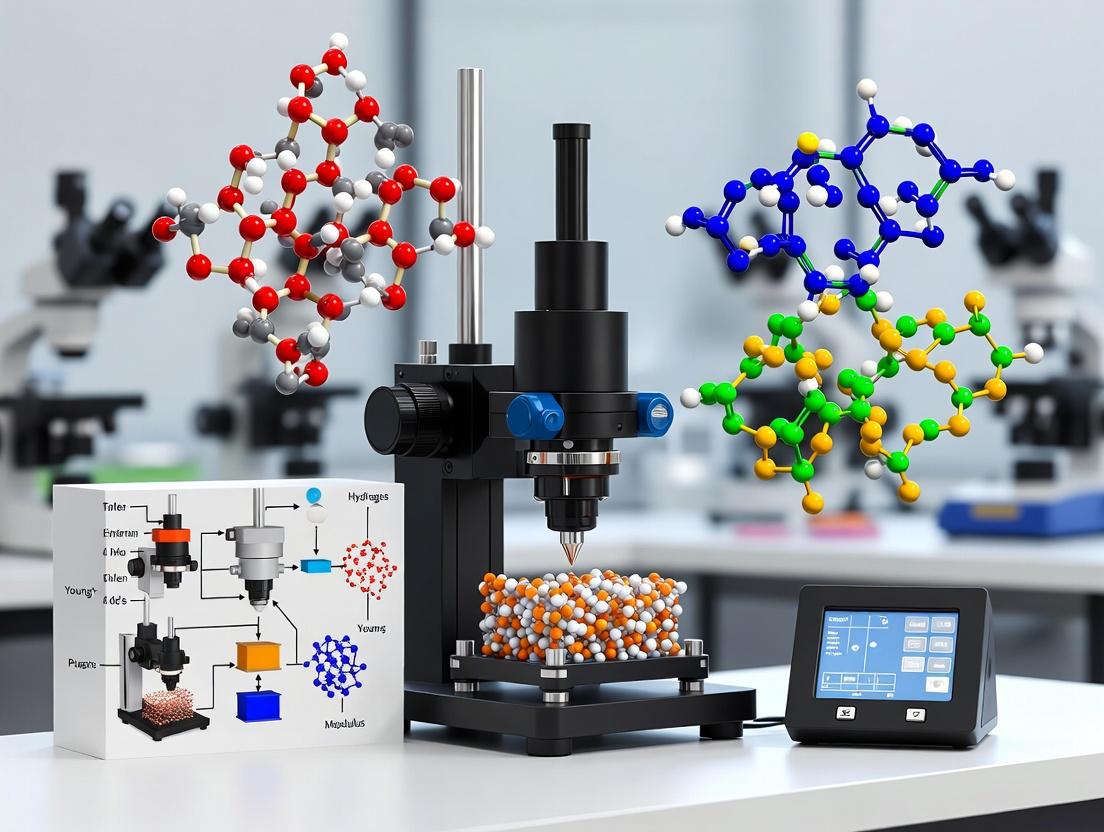
This comprehensive guide details Atomic Force Microscopy (AFM) methodologies for accurately characterizing the Young's modulus of soft bioelectronic materials.
Mapping Mechanics: AFM Measurement of Young's Modulus for Next-Generation Soft Bioelectronic Materials
Abstract
This comprehensive guide details Atomic Force Microscopy (AFM) methodologies for accurately characterizing the Young's modulus of soft bioelectronic materials. Targeting researchers and drug development professionals, it covers foundational principles of nanomechanical measurement, step-by-step operational protocols for hydrogels and conductive polymers, troubleshooting for common artifacts like tip-sample adhesion, and validation strategies against rheology and tensile testing. The article synthesizes current best practices to ensure reliable, quantitative mechanical data critical for designing biocompatible neural interfaces, wearable sensors, and implantable devices that match target tissue mechanics.
Why Softness Matters: The Critical Role of Young's Modulus in Bioelectronic Design and Biocompatibility
1. Introduction: The Mechanical Mismatch Problem The efficacy and long-term biocompatibility of bioelectronic devices are critically dependent on their mechanical properties. A significant mismatch between the Young's modulus of a synthetic implant and the target biological tissue (e.g., brain ~0.1-1 kPa, skin ~10-100 kPa, peripheral nerve ~0.5-10 MPa) can lead to chronic inflammation, fibrous encapsulation, signal degradation, and device failure. Atomic Force Microscopy (AFM) is the cornerstone technique for quantifying the Young's modulus of both soft biological tissues and the engineered materials designed to mimic them. This document provides application notes and protocols for measuring and targeting tissue-specific moduli to achieve optimal mechanical mimicry.
2. Target Tissues: Quantitative Benchmarking via AFM AFM nanoindentation, using colloidal probes or sharp tips in force spectroscopy mode, provides the baseline data for defining mechanical targets.
Table 1: Young's Modulus of Target Biological Tissues (AFM-Measured)
| Target Tissue / Organ | Young's Modulus (kPa) | AFM Tip/Probe Type | Indentation Depth | Physiological State |
|---|---|---|---|---|
| Brain (Cortex) | 0.1 - 1.5 | Colloidal sphere (5-20 µm) | 1-2 µm | In vivo / Live slice |
| Spinal Cord (Grey Matter) | 0.3 - 2.0 | Colloidal sphere (10 µm) | 1-3 µm | Live slice |
| Peripheral Nerve (Epineurium) | 500 - 10,000 | Sharp tip (k~0.1 N/m) | 200-500 nm | Fresh, hydrated |
| Skin (Epidermis) | 50 - 300 | Sharp tip (k~0.5 N/m) | 300-800 nm | Ex vivo, hydrated |
| Myocardium | 10 - 50 | Colloidal sphere (15 µm) | 2-5 µm | Diastolic, live slice |
| Blood Vessel (Tunica Intima) | 2 - 20 | Colloidal sphere (5 µm) | 1-2 µm | Fresh, pressurized |
3. Material Systems for Mimicry: Properties and Applications Advanced material systems are engineered to approximate these target moduli.
Table 2: Engineered Materials for Mechanical Mimicry
| Material System | Typical Young's Modulus Range | Target Application | Key Advantages | AFM Characterization Mode |
|---|---|---|---|---|
| Polyethylene Glycol (PEG) Hydrogels | 0.5 - 100 kPa | Neural probes, Encapsulation | Tunable, bio-inert | Force Mapping, PeakForce QNM |
| Polydimethylsiloxane (PDMS) | 100 kPa - 3 MPa | Wearable Sensors, Epidermal Electronics | Stretchable, transparent | Nanoindentation |
| PEDOT:PSS Conductive Hydrogels | 1 - 500 kPa | Neural Electrodes, Biosensors | Conductive, soft | Conductive-AFM, Force Spec. |
| Silk Fibroin | 1 - 20 MPa (hydrated) | Bioresorbable Implants | Biodegradable, strong | Liquid-cell AFM |
| Self-Healing Elastomers (e.g., Diels-Alder) | 10 - 1000 kPa | Chronic Implants, Wearables | Autonomous repair | Cyclic Nanoindentation |
| ECM-derived Hydrogels (e.g., Matrigel, Collagen) | 0.2 - 5 kPa | In vitro Neural Models | Bioactive | Temperature-controlled AFM |
4. Core Experimental Protocols
Protocol 4.1: AFM Nanoindentation for Soft Hydrogel & Tissue Modulus Objective: Quantify the apparent Young's modulus of a soft material or hydrated biological tissue sample. Materials: AFM with liquid cell, colloidal probe (e.g., 10 µm silica sphere, k~0.01-0.1 N/m), phosphate-buffered saline (PBS), sample substrate. Procedure:
- Probe Calibration: Perform thermal tune method in air and liquid to determine exact spring constant (k) and inverse optical lever sensitivity (InvOLS).
- Sample Preparation: Mount hydrogel or fresh tissue slice (< 2 mm thick) in a petri dish. Submerge in PBS. Secure dish to AFM stage.
- Approach & Engagement: Use optical microscope to position probe over area of interest. Engage in contact mode at minimal force (< 0.5 nN).
- Force Curve Acquisition: Program a 5x5 to 10x10 grid map. Set trigger force to 0.5-2 nN, approach/retract velocity 1-5 µm/s, and indentation depth ≤ 10% of sample thickness or 2 µm (whichever is smaller). Acquire ≥ 100 curves per sample.
- Data Analysis: Fit the retract curve (or a segment of the approach curve) using the Hertz contact model for a spherical indenter. Use a Poisson's ratio (ν) of 0.5 for incompressible materials (hydrogels, tissue). Calculate and map apparent Young's modulus (E).
Protocol 4.2: In-situ Mechanical Characterization of a Coated/Flexible Electrode Objective: Measure the localized modulus of a conductive polymer coating on a flexible substrate. Materials: Conductive AFM probe (Pt/Ir coated, k~0.5-5 N/m), custom electrode sample. Procedure:
- Electrical Connection: Connect the sample to a source meter and the AFM probe to the AFM's current amplifier.
- Topography Scan: First, perform a contact-mode scan in a relevant electrolyte (e.g., 0.1M NaCl) to identify coating regions.
- Force-Volume Mapping: At each pixel in a defined grid, acquire a force-distance curve synchronized with current measurement.
- Multi-Parameter Extraction: For each curve, fit the Hertz model (using a conical/paraboloid tip shape) to derive local E. Correlate E with the measured ionic/electronic current at a set bias voltage.
- Validation: Compare E of the coated region to the bare substrate and bulk conductive hydrogel literature values.
5. Visualization: The Mechanical Mimicry Development Workflow
Diagram Title: Mechanical Mimicry Material Development Cycle
6. The Scientist's Toolkit: Research Reagent Solutions
Table 3: Essential Reagents and Materials for AFM-Based Mimicry Research
| Item / Reagent | Supplier Examples | Function in Research |
|---|---|---|
| AFM Colloidal Probes (SiO₂, PS spheres, 2-50 µm) | Bruker, Novascan, sQube | Enable accurate Hertz model fitting on soft materials; reduce sample damage. |
| Cantilevers for Soft Matter (k=0.01 - 0.5 N/m) | Bruker (MLCT-Bio), Olympus, NanoWorld | Low spring constant tips essential for sensitive force measurement without indentation artefact. |
| Tunable Hydrogel Kits (PEG-DA, PEG-SH) | Sigma-Aldrich, Cellendes, Sphere Fluidics | Pre-formulated kits for rapid synthesis of hydrogels with modulus tunable via UV/ionic crosslinking. |
| Conductive Polymer Inks (PEDOT:PSS, PANI) | Heraeus, Sigma-Aldrich, Ossila | Enable printing/formulation of soft, conductive coatings for electrodes and sensors. |
| ECM Protein Solutions (Collagen I, Matrigel, Laminin) | Corning, Thermo Fisher, R&D Systems | Provide bioactive, tissue-specific substrate controls for AFM and cell culture validation. |
| AFM Calibration Gratings (TGZ & HS Series) | NT-MDT, Bruker, BudgetSensors | Essential for verifying AFM scanner and probe resolution in X, Y, and Z axes. |
| Bioactive Dopants (RGD Peptide, NGF) | Bachem, PeproTech | Incorporated into materials to add biochemical signaling alongside mechanical mimicry. |
Young's modulus (E), the fundamental metric of material stiffness, is critical for characterizing soft bioelectronic materials. Within the thesis context of AFM measurement for these materials, understanding the continuum from macroscopic Hooke's Law to nanoscale indentation is essential for designing interfaces with biological tissues and optimizing device performance.
Foundational Theory: Hooke's Law to Elastic Modulus
At the macroscopic scale, for a material under uniaxial tension or compression, Hooke's Law states that stress (σ) is proportional to strain (ε) within the elastic limit: σ = Eε. Young's modulus (E) is the constant of proportionality.
Table 1: Representative Young's Modulus Values for Bioelectronic & Biological Materials
| Material | Typical Young's Modulus Range | Relevance to Bioelectronics |
|---|---|---|
| PDMS (Sylgard 184) | 0.57 - 3.7 MPa | Flexible substrate, encapsulant |
| PEDOT:PSS (film) | 1 - 4 GPa | Conductive polymer electrode |
| Polyimide | 2 - 3 GPa | Flexible, insulating substrate |
| Brain Tissue | 0.1 - 3 kPa | Neural interface target |
| Cardiac Tissue | 10 - 100 kPa | Cardiac patch target |
| Liver Tissue | 0.2 - 1 kPa | Implantable sensor target |
AFM Nanomechanical Measurement Protocols
Atomic Force Microscopy (AFM) is the principal technique for measuring E at the micro/nanoscale, crucial for matching bioelectronic device mechanics to soft tissues.
Protocol 1: AFM Force Spectroscopy on Hydrated Polymer Films
Objective: To determine the Young's modulus of a hydrated conductive polymer film (e.g., PEDOT:PSS) intended for neural electrode coating.
Materials & Reagents:
- AFM with Liquid Cell: Enables measurement in physiological buffer.
- Colloidal Probe Cantilever: Spherical tip (diameter 2-20 µm) for well-defined Hertzian contact.
- Polymer Sample: Spin-coated film on substrate, hydrated in PBS (pH 7.4).
- Calibration Specimens: Known stiffness (e.g., PS, PDMS) for cantilever spring constant (k) validation.
Procedure:
- Cantilever Calibration: Perform thermal tune method in fluid to determine exact spring constant (k).
- Sample Hydration: Mount sample in liquid cell, immerse in PBS, allow 1 hour for equilibration.
- Force Curve Acquisition: Approach the probe to the surface at a controlled rate (0.5-1 µm/s). Acquire 100-200 force-distance curves at random locations.
- Data Analysis: Fit the retraction portion of each curve with the Hertz/Sneddon contact model for a spherical indenter.
- Statistical Reporting: Report E as mean ± standard deviation, exclude adhesion-dominated curves.
Protocol 2: PeakForce QNM Mapping of Bioelectronic Composite
Objective: To spatially map modulus variations across a soft, carbon nanotube-doped hydrogel composite.
Materials & Reagents:
- Bruker PeakForce QNM AFM: Or equivalent quantitative nanomechanical mapping mode.
- SCANASYST-FLUID+ Probes: Sharp tips for high-resolution mapping.
- Hydrogel Composite: Synthesized sample, equilibrated in aqueous medium.
Procedure:
- Tip Characterization: Determine tip radius via blind reconstruction or using a characterized sharp sample.
- Engage Parameters: Set PeakForce frequency to 0.5-2 kHz and amplitude to 100-150 nm.
- Mapping: Acquire a 10 µm x 10 µm map at 256x256 resolution.
- Modulus Derivation: The system software uses a DMT model to calculate E pixel-by-pixel from the force-separation data.
- Validation: Cross-check modulus values from specific points using offline Hertz model fitting.
The Scientist's Toolkit: Key Research Reagents & Materials
Table 2: Essential Materials for AFM-based Young's Modulus Measurement in Bioelectronics
| Item | Function/Description |
|---|---|
| Sylgard 184 (PDMS) | Silicone elastomer for soft substrates & calibration samples of known modulus. |
| PEDOT:PSS (Clevios PH1000) | Aqueous dispersion of conductive polymer for soft electrode fabrication. |
| Phosphate Buffered Saline (PBS) | Standard ionic solution for hydrating samples to mimic physiological conditions. |
| Colloidal Probe Cantilevers (e.g., Novascan) | AFM tips with micron-sized spheres for well-defined, adhesive contact mechanics. |
| SCANASYST-FLUID+ Probes (Bruker) | Sharp tips optimized for high-resolution imaging & modulus mapping in liquid. |
| Soft Calibration Sample (e.g., Bruker PS/PDMS) | Sample with known, certified modulus for validating AFM nanomechanical measurements. |
Data Analysis & Modeling Workflow
The conversion of AFM force-distance data to Young's modulus requires a structured analytical approach.
Title: AFM Force Curve Analysis Workflow for Young's Modulus
Critical Considerations for Bioelectronic Materials
Measurements must account for material viscoelasticity, hydration, and adhesion. For soft, hydrated materials like hydrogels, a linear elastic model (Hertz) provides an effective modulus, but time-dependent models (e.g., Standard Linear Solid) may be required. Accurate tip characterization is non-negotiable.
Precise determination of Young's modulus via AFM indentation is foundational for the rational design of soft bioelectronic materials. By applying standardized protocols and rigorous data analysis, researchers can engineer devices with optimal mechanical compatibility for next-generation implantable and wearable health technologies.
Within a research thesis focused on quantifying the Young's modulus of soft bioelectronic materials (e.g., conductive polymer films, hydrogel composites), the choice of characterization technique is paramount. Bulk mechanical testing methods, while well-established, present significant limitations for these advanced materials. This application note details why Atomic Force Microscopy (AFM) is the indispensable tool for such investigations, providing protocols for nanomechanical mapping.
Advantages of AFM Over Bulk Techniques: A Quantitative Comparison
The core advantage of AFM lies in its ability to perform localized, nanoscale measurements on materials that are often thin, heterogeneous, and mechanically delicate. Bulk techniques average properties over large volumes, obscuring critical local variations.
Table 1: Comparison of AFM with Bulk Mechanical Techniques for Soft Bioelectronic Materials
| Feature | AFM (with Nanomechanical Mapping) | Bulk Techniques (Tensile/DMA/Shear Rheometry) |
|---|---|---|
| Spatial Resolution | Nanoscale (µm to nm lateral; <1 nm vertical) | Macroscopic (mm to cm) |
| Volume Probed | Femtoliter to attoliter scale | Microliter to milliliter scale |
| Sample Requirements | Minimal: Can test thin films (<100 nm), small domains, hydrated samples. | Substantial: Requires large, homogeneous, often freestanding samples. |
| Mechanical Mapping | Yes. Can correlate modulus with topography and other properties (adhesion, dissipation). | No. Provides only a single average value for the entire sample. |
| Measurement Environment | Full liquid compatibility (PBS, cell media), controlled atmosphere, variable temperature. | Often limited to air or specialized fluid cells; more complex environmental control. |
| Key Limitation | Contact mechanics models required; tip geometry calibration critical; slower for large areas. | Insensitive to local heterogeneity; data can be dominated by substrates for thin films; often destructive. |
Detailed Experimental Protocol: AFM-Based Young's Modulus Mapping of a Conductive Hydrogel Film
Objective: To spatially map the reduced Young's modulus (Er) of a spin-coated poly(3,4-ethylenedioxythiophene):poly(styrenesulfonate) (PEDOT:PSS)/polyvinyl alcohol (PVA) hydrogel film on a glass substrate in physiological buffer.
I. Sample Preparation
- Substrate Cleaning: Sonicate glass slides in acetone, isopropanol, and deionized water (10 min each). Dry under nitrogen stream.
- Film Deposition: Prepare a 1:1 (v/v) blend of PEDOT:PSS dispersion and 4 wt% PVA solution. Filter through a 0.45 µm syringe filter. Spin-coat onto cleaned glass at 2000 rpm for 60 s.
- Annealing: Thermally anneal the film at 120°C for 20 minutes on a hotplate to remove residual water and induce crosslinking.
- Hydration: Mount the sample in the AFM liquid cell and immerse in 1X Phosphate Buffered Saline (PBS), pH 7.4. Allow to equilibrate for 15 minutes.
II. AFM Instrument Setup and Calibration
- Cantilever Selection: Use a silicon nitride cantilever with a colloidal probe (5-10 µm diameter sphere) or a sharp, low spring constant tip (~0.1 N/m) for higher resolution.
- Spring Constant Calibration: Perform thermal tune method in air to determine the exact spring constant (k) of the cantilever.
- Tip Geometry Calibration: For spherical probes, use SEM to verify diameter. For sharp tips, use a characterized, rigid sample (e.g., gratings) or perform blind reconstruction.
- Liquid Engagement: Assemble the liquid cell, engage the tip in PBS, and allow thermal and mechanical drift to stabilize (~30 min).
III. Force Volume or PeakForce QNM Acquisition
- Mode Selection: Use Force Volume or a quantitative nanomechanical mapping mode (e.g., Bruker's PeakForce QNM, JPK's QI).
- Mapping Parameters:
- Setpoint/Peak Force: 100-500 pN (to minimize sample deformation).
- Ramp Rate: 0.5-1 Hz.
- Pixels: 128 x 128 over a 10 µm x 10 µm area.
- Trigger Threshold: 2 nm.
- Data Acquisition: Acquire maps on at least three different sample regions and on a bare glass reference.
IV. Data Processing and Young's Modulus Extraction
- Force Curve Analysis: For each pixel, fit the retract portion of the force-distance curve using an appropriate contact mechanics model (e.g., Hertz, Sneddon, Derjaguin–Müller–Toporov (DMT)).
- Model Choice: The DMT model is often suitable for soft, adhesive materials in liquid: F = (4/3) * Er * √(R) * δ^(3/2) + Fadh where F is force, Er is reduced modulus, R is tip radius, δ is indentation depth, and Fadh is adhesion force.
- Modulus Calculation: The reduced modulus is related to the sample's Young's modulus (Esample) by: 1/Er = (1 - νsample²)/Esample + (1 - νtip²)/Etip Assume νsample ≈ 0.5 (incompressible hydrogel), Etip is large (~130 GPa for Si3N4), and νtip ≈ 0.3. The equation simplifies to Esample ≈ Er.
- Statistical Analysis: Generate modulus histogram from the mapped data, report mean ± standard deviation, and correlate modulus maps with topographical features.
Title: AFM Protocol for Nanomechanical Mapping of Hydrogels
The Scientist's Toolkit: Key Reagents & Materials
Table 2: Essential Research Reagents and Materials
| Item | Function/Application |
|---|---|
| PEDOT:PSS Aqueous Dispersion | Conductive polymer component; provides electronic functionality to the bioelectronic film. |
| Polyvinyl Alcohol (PVA, Mw 89,000-98,000) | Hydrogel-forming polymer; provides mechanical structure and hydration capacity. |
| Phosphate Buffered Saline (PBS), 10X | Provides physiologically relevant ionic strength and pH for hydration and testing. |
| Silicon Nitride Cantilevers (k ~0.1 N/m) | AFM probes with low spring constant suitable for soft materials; often tipless for colloidal probe attachment. |
| Silica or Polystyrene Colloidal Spheres (5µm Ø) | Attached to tipless cantilevers to create a well-defined spherical indenter for reliable Hertz/DMT modeling. |
| UV-Ozone Cleaner or Plasma System | For rigorous cleaning and hydrophilic activation of glass substrates prior to film deposition. |
| Syringe Filters (0.45 µm PVDF) | For removing aggregates from polymer solutions prior to spin-coating, ensuring smooth films. |
Title: Logical Comparison of Modulus Determination Pathways
The development of next-generation bioelectronic devices—for neural interfaces, wearable sensors, and cardiac patches—hinges on the mechanical compatibility between synthetic materials and biological tissues. A central thesis in this field posits that matching the Young's modulus of the implant to that of the target tissue (e.g., brain (~1 kPa), skin (~100 kPa), or cardiac muscle (~10-100 kPa)) minimizes inflammatory response and improves device performance and longevity. Atomic Force Microscopy (AFM) is the critical tool for characterizing this key mechanical property at the micro- and nanoscale, especially for soft, hydrous materials where bulk testing fails. This document provides application notes and detailed protocols for the AFM-based mechanical characterization of the three cornerstone material classes in modern bioelectronics: hydrogels, conductive polymers, and elastomers.
Table 1: Key Material Classes, Formulations, and Typical Young's Modulus Ranges
| Material Class | Common Examples/Formulations | Key Advantages for Bioelectronics | Typical Young's Modulus Range (via AFM) | Target Tissue Applications |
|---|---|---|---|---|
| Hydrogels | Polyacrylamide (PAAm), Alginate, Gelatin-Methacryloyl (GelMA), Poly(ethylene glycol) diacrylate (PEGDA) | High water content, tissue-like compliance, excellent biocompatibility, often tunable. | 0.1 kPa – 100 kPa | Brain parenchyma, retinal tissue, epithelial layers. |
| Conductive Polymers | Poly(3,4-ethylenedioxythiophene):poly(styrene sulfonate) (PEDOT:PSS), Polypyrrole (PPy), Polyaniline (PANI) | Mixed ionic-electronic conductivity, can be chemically functionalized, moderate flexibility. | 1 GPa – 3 GPa (pure film); Can be softened to ~10 MPa – 1 GPa with plasticizers/blends. | Neural recording electrodes, conductive coatings for rigid electrodes. |
| Elastomers | Polydimethylsiloxane (PDMS), Poly(glycerol sebacate) (PGS), Styrene-Ethylene-Butylene-Styrene (SEBS) | High elasticity, durable, good encapsulation, easily patterned. | 100 kPa – 3 MPa (Highly tunable with base:crosslinker ratio or composition). | Epidermal electronics, peripheral nerve interfaces, dynamic organ surfaces. |
| Conductive Polymer/Hydrogel Hybrids | PEDOT:PSS/Alginate, PPy/GelMA | Combines conductivity with soft, wet tissue interface. | 1 kPa – 100 kPa (Highly dependent on hydrogel matrix). | Chronic neural implants, electroactive tissue scaffolds. |
Core Protocol: AFM Nanoindentation for Young's Modulus Measurement of Soft Bioelectronic Materials
Principle: A calibrated AFM cantilever with a spherical probe tip indents the sample surface. The force-distance curve is analyzed using an elastic contact mechanics model (e.g., Hertz, Sneddon) to extract the Young's modulus (E).
Protocol 3.1: Sample Preparation and Mounting
Objective: To prepare stable, flat samples suitable for AFM indentation. Materials: See "Scientist's Toolkit" (Section 6). Procedure:
- Hydrogels: Synthesize hydrogel on a clean, rigid substrate (e.g., glass slide, Petri dish). For pre-formed gels, adhere a thin section (~1-2 mm thick) to the substrate using a thin layer of cyanoacrylate or UV-curable glue at the edges only. Critical: Maintain hydration. Use a fluid cell or regularly apply PBS buffer during measurement to prevent dehydration.
- Conductive Polymer Films: Spin-coat or drop-cast the polymer solution (e.g., PEDOT:PSS) onto a clean silicon wafer or glass slide. Anneal as required. Ensure film is smooth and uniformly thick (>1 µm).
- Elastomers: Cure PDMS or similar elastomer on a smooth surface (e.g., Si wafer). Use a razor blade to create a clean, fresh edge if cross-sectional modulus is needed. Mount firmly with double-sided tape.
- Hybrid Materials: Follow the primary matrix material protocol (e.g., treat a conductive hydrogel as a hydrogel). Ensure electrical grounding if performing concurrent electrical-AFM measurements.
Protocol 3.2: AFM System Calibration and Measurement
Objective: To acquire accurate force-distance curves. Procedure:
- Cantilever Selection: Use soft, colloidal probe cantilevers (e.g., silicon nitride with 5-20 µm diameter polystyrene or silica sphere). Typical spring constant (k): 0.01 – 0.6 N/m.
- Spring Constant Calibration: Perform thermal tune method in air/liquid to determine the exact
kvalue for your cantilever. - Deflection Sensitivity Calibration: Perform a force curve on a rigid, non-deformable surface (e.g., cleaned sapphire) in the same medium (air/liquid) as the experiment to obtain the photodetector sensitivity (nm/V).
- Indentation Experiment: a. Engage the tip onto the sample surface at a low setpoint. b. Program a force curve sequence: Approach → Indent (to a maximum trigger force, typically 1-10 nN for soft materials) → Retract. c. Map the sample by collecting force curves on a grid (e.g., 16x16 or 32x32 points over a 10x10 µm area). d. Set a slow approach/retract velocity (0.5-2 µm/s) to minimize viscous effects.
Protocol 3.3: Data Analysis (Hertz Model for Spherical Tip)
Objective: To convert force-distance data to Young's modulus. Procedure:
- Convert Raw Data: Use AFM software (e.g., NanoScope Analysis, JPK DP, Gwyddion) to convert photodetector voltage vs. Z-piezo displacement data into Force (F) vs. Indentation depth (δ) curves.
Force, F = k * deflectionIndentation, δ = (Z-piezo displacement) - (deflection) - Fit the Approach Curve: Fit the loading portion of the F-δ curve with the Hertz model for a spherical indenter:
F = (4/3) * (E / (1-ν²)) * √R * δ^(3/2)Where:E= Young's Modulus (Pa)ν= Poisson's ratio of the sample (assume 0.5 for incompressible, hydrated materials like hydrogels; 0.3-0.4 for elastomers/CPs).R= radius of the spherical probe tip (m).
- Statistical Reporting: Perform fits on all curves in a map. Exclude curves from debris or voids. Report modulus as mean ± standard deviation.
Table 2: Key Parameters and Considerations for AFM of Different Material Classes
| Parameter | Hydrogels | Conductive Polymers | Elastomers | Notes |
|---|---|---|---|---|
| Probe Type | Colloidal sphere (Ø5-20µm) | Sharp tip (for topography) or Colloidal sphere | Colloidal sphere or Sharp tip | Spherical tips prevent sample damage and simplify Hertz model. |
| Medium | Phosphate-Buffered Saline (PBS) | Air or Liquid (for doped state) | Air | Hydration is critical for hydrogels. |
| Trigger Force | 0.5 - 2 nN | 10 - 50 nN | 5 - 20 nN | Avoid excessive indentation (>10-20% of sample thickness). |
| Poisson's Ratio (ν) | 0.45 - 0.5 (assumed) | ~0.35 | ~0.5 (PDMS) | Assumption significantly impacts absolute E. Report assumed value. |
| Primary Challenge | Hydration control, adhesion, viscous dissipation. | Sample heterogeneity, electrical interference. | Sample tackiness, long-range elastic deformation. | Fit only the initial, linear-elastic portion of the curve if adhesion is present. |
Application Notes
AN 4.1: Modulus Mapping of a Graded Conductive Hydrogel
Purpose: To visualize spatial heterogeneity in a PEDOT:PSS/GelMA hybrid material. Method: Follow Protocol 3.2 with a 10 µm colloidal probe in PBS. Collect a 50x50 µm map. Outcome: A 2D modulus map revealing softer, GelMA-rich regions (1-10 kPa) and stiffer, PEDOT:PSS-rich aggregates (50-200 kPa), informing on electrode homogeneity.
AN 4.2: Monitoring Crosslinking Kinetics of a Photocurable Bioadhesive
Purpose: To measure the real-time increase in Young's modulus during UV curing.
Method: Deposit a droplet of PEGDA prepolymer on substrate in fluid cell. Position AFM tip. Start periodic force curve acquisition (1 curve/10s). Initiate UV light exposure.
Outcome: A plot of E vs. time, showing modulus plateauing as crosslinking completes, enabling optimization of cure time for desired mechanical properties.
Visualizations
Diagram 1 Title: AFM Workflow for Bioelectronic Material Modulus Characterization
Diagram 2 Title: Thesis Rationale: Modulus Mismatch Drives Biocompatibility
The Scientist's Toolkit: Essential Research Reagents & Materials
Table 3: Key Reagents and Materials for AFM of Soft Bioelectronic Materials
| Item | Function in Protocol | Example Product/Catalog Number (Representative) | Critical Notes |
|---|---|---|---|
| AFM Cantilevers (Colloidal Probe) | Spherical tip for nanoindentation using Hertz model. | Bruker PN: CP-PNPL-BSG (Ø5µm sphere) | Spring constant must be calibrated for each cantilever. |
| Calibration Sample (Rigid) | For deflection sensitivity calibration. | Bruker PN: PFQNE-SMP (Sapphire) | Must be cleaner than the sample. |
| Phosphate-Buffered Saline (PBS), 1x | Hydration medium for hydrogels & physiological relevance. | Thermo Fisher Scientific: 10010023 | Filter (0.22 µm) before use in fluid cell to avoid debris. |
| Polyacrylamide (PAAm) Hydrogel Kit | Tunable, reference soft material for method validation. | Sigma-Aldrich: A7802 (Acrylamide/Bis-acrylamide) | Mix ratio directly controls modulus. |
| PEDOT:PSS Aqueous Dispersion | Standard conductive polymer for bioelectronics. | Heraeus: Clevios PH 1000 | Often mixed with plasticizers (e.g., DMSO, glycerol) or crosslinkers. |
| PDMS Sylgard 184 Kit | Standard elastomer with tunable modulus. | Dow: 4019862 (Base & Curing Agent) | Modulus tuned by base:crosslinker ratio (e.g., 10:1 to 50:1). |
| UV-Curable Adhesive | For mounting samples to substrates. | Norland: NOA 81 | Cures clear, useful for optical access. |
| AFM Fluid Cell | Enables measurement in liquid environment. | Bruker PN: MTFML (for MultiMode) | O-rings must be compatible with your buffer. |
| Analytical Software | For force curve analysis and Hertz fitting. | Open Source: Gwyddion, AtomicJ | Commercial: Bruker NanoScope Analysis, JPK DP. |
Within the context of advancing soft bioelectronic materials research, precise measurement of mechanical properties via Atomic Force Microscopy (AFM) is paramount. The Young's modulus (elastic modulus) serves as a critical design and validation parameter, linking material performance to biological compatibility. This note details the spectrum of stiffness and compliance in biological tissues, provides protocols for AFM-based nanoindentation, and integrates this data into the development framework for next-generation bioelectronics.
The Elastic Modulus Spectrum of Biological Tissues
The mechanical landscape of human tissues spans several orders of magnitude, from compliant neural tissues to stiff mineralized bone. This spectrum defines the mechanical microenvironment that cells sense and to which bioelectronic interfaces must conform for optimal integration and function.
Table 1: Elastic Modulus of Representative Biological Tissues
| Tissue / Material Type | Typical Young's Modulus Range | Relevance to Bioelectronics |
|---|---|---|
| Brain (Gray Matter) | 0.1 - 1 kPa | Target for neural probes, cortical implants. Mismatch causes gliosis. |
| Adipose Tissue | 1 - 5 kPa | Encapsulation site for long-term implants; mechanical cushion. |
| Liver | 1 - 5 kPa | Model for organ-on-a-chip and implantable biosensor platforms. |
| Skeletal Muscle (Resting) | 10 - 50 kPa | Interface for electromyography (EMG) sensors and stimulators. |
| Cartilage (Articular) | 0.5 - 1 MPa | Model for wearable joint sensors and orthopedic bioelectronics. |
| Collagenous Bone (Mineralized) | 5 - 20 GPa | Interface for bone-anchored hearing aids and osseointegrated devices. |
| Polydimethylsiloxane (PDMS) | 0.5 - 4 MPa | Common soft bioelectronic substrate/encapsulant. |
| Polyimide Films | 2 - 8 GPa | Flexible, inert substrate for microfabricated electrode arrays. |
Application Notes for AFM in Soft Bioelectronic Research
AFM nanoindentation is the gold standard for quantifying the Young's modulus of soft, hydrated materials at the micro- and nanoscale, directly relevant to cell-material interactions.
Core Protocol: AFM Nanoindentation on Hydrated Biological Tissues & Soft Polymers
This protocol outlines the critical steps for acquiring reliable force-distance curves on soft, viscoelastic samples.
I. Sample Preparation
- Tissue Sectioning: Fresh or fixed tissues are embedded in optimal cutting temperature (OCT) compound and sectioned to 20-50 μm thickness using a cryostat. Mount on glass slides or Petri dishes.
- Polymer Fabrication: Spin-coat or mold polymeric substrates (e.g., PDMS, hydrogels). Ensure surface roughness (Ra) < 10 nm for reliable contact area estimation.
- Hydration: Immerse sample in appropriate physiological buffer (e.g., PBS, HBSS) immediately. Perform all measurements under fluid to prevent dehydration and capillary forces.
II. AFM Cantilever & Probe Selection
- Cantilever Stiffness: Use soft, V-shaped silicon nitride cantilevers (k ≈ 0.01 - 0.1 N/m) for tissues < 10 kPa. Use stiffer rectangular levers (k ≈ 0.5 - 1 N/m) for stiffer polymers.
- Probe Tip Geometry: Spherical tips (5-20 μm diameter) are preferred for soft tissues to prevent sample damage and simplify contact mechanics (Hertz model). Sharp pyramidal tips are suitable for stiffer, homogeneous polymers.
- Calibration: Precisely calibrate the cantilever's spring constant (k) using the thermal tuning method in fluid. Calibrate the optical lever sensitivity (InvOLS) on a rigid, non-deformable surface (e.g., sapphire) under the same buffer.
III. Force-Distance Curve Acquisition
- Parameter Setup: Set approach/retract velocity to 1-10 μm/s to minimize viscous effects. Trigger threshold: 1-10 nN. Acquire 50-100 curves per sample region, spaced >5 indentation diameters apart.
- Mapping: Perform 2D arrays of indentations (e.g., 32x32 points over 50x50 μm²) to create stiffness (Young's modulus) maps and assess heterogeneity.
IV. Data Analysis (Young's Modulus Extraction)
- Model Fitting: Fit the approach curve's indentation segment (typically 10-50% of total) with the appropriate contact mechanics model. For a spherical tip, use the Hertz model: F = (4/3) * (E/(1-ν²)) * √R * δ^(3/2) where F is force, E is Young's modulus, ν is Poisson's ratio (assume 0.5 for incompressible soft materials), R is tip radius, and δ is indentation depth.
- Software: Use AFM manufacturer software (e.g., Bruker NanoScope Analysis, JPK DP) or open-source packages (e.g., AtomicJ, PyJibe) for batch processing.
AFM Nanoindentation Workflow for Soft Biomaterials
Protocol: Validating Bioelectronic Material Compliance in a Cell Culture Model
This protocol assesses the biological response to materials with engineered stiffness, a key step in bioelectronic development.
- Fabricate Substrate Library: Create a library of PDMS or polyethylene glycol (PEG) hydrogels with Young's modulus spanning 0.5 kPa to 2 MPa via controlled cross-linking.
- AFM Validation: Measure the actual Young's modulus of each substrate using the Core Protocol above.
- Cell Seeding: Seed relevant primary cells (e.g., neurons for neural interfaces, fibroblasts for dermal sensors) onto validated substrates.
- Phenotypic Assessment (48-72 hrs):
- Morphology: Image actin cytoskeleton (phalloidin stain) and analyze cell spreading area.
- Viability: Quantify using live/dead assay (Calcein-AM/EthD-1).
- Marker Expression: Immunostain for differentiation (e.g., β-III tubulin for neurons) or activation (α-SMA for fibroblasts) markers.
- Correlation: Correlate quantitative cell metrics (e.g., neurite length, nuclear YAP localization) with the measured substrate Young's modulus to define the optimal compliance window.
Cell Response to Substrate Stiffness Validation
The Scientist's Toolkit: Research Reagent Solutions
Table 2: Essential Materials for AFM-Based Mechanobiology of Bioelectronics
| Item | Function & Relevance |
|---|---|
| Silicon Nitride Cantilevers (Spherical Tip) | Bio-inert, soft probes (k~0.06 N/m) for nanoindentation on delicate tissues without damage. |
| Polyacrylamide or PEGDA Hydrogel Kits | For synthesizing substrates with tunable, physiologically relevant stiffness (0.1-100 kPa). |
| Cell Culture-Tested PDMS (Sylgard 184) | Standard elastomer for flexible electronics; stiffness varied by base:curing agent ratio. |
| Phosphate Buffered Saline (PBS), 1X | Standard isotonic buffer for sample hydration and AFM measurements under physiological conditions. |
| Paraformaldehyde (4%, w/v) | For gentle fixation of biological tissues to preserve structure during AFM mapping. |
| Calcein-AM / Ethidium Homodimer-1 Assay | Fluorescent live/dead viability assay to assess cell health on test substrates. |
| TRITC-Phalloidin | Fluorescent stain for F-actin to visualize cytoskeletal organization in response to substrate stiffness. |
| Anti-YAP/TAZ Antibody | For immunofluorescence detection of mechanotransduction pathway activation (nuclear translocation). |
Step-by-Step Protocol: AFM Nanoindentation for Accurate Young's Modulus on Hydrated Samples
Within the broader context of measuring the Young's modulus of soft bioelectronic materials (e.g., conductive hydrogels, biocompatible polymers), selecting the appropriate atomic force microscopy (AFM) probe is paramount. Accurate nanomechanical characterization hinges on precise cantilever calibration and informed tip geometry selection. This guide details protocols and considerations for these critical steps, ensuring reliable and reproducible data for applications in bioelectronics and drug development.
Cantilever Calibration: Protocols and Key Parameters
Accurate force determination requires calibration of the cantilever's spring constant (k) and the optical lever sensitivity (InvOLS).
Protocol 1.1: Thermal Tune Method for Spring Constant Calibration
Principle: The spring constant is derived from the power spectral density of the cantilever's thermally driven Brownian motion in fluid or air.
Materials & Setup:
- AFM with thermal tuning software.
- Calibrated piezo for InvOLS determination (see Protocol 1.2).
- Vibration isolation system.
Procedure:
- Engage the cantilever in fluid (or air) far from the sample surface (>10 µm).
- Record the thermally driven cantilever deflection signal (V) for 2-5 seconds at a sampling rate ≥ 10x the cantilever's resonant frequency.
- Generate the power spectral density (PSD) of the deflection signal.
- Fit the fundamental resonance peak in the PSD to a simple harmonic oscillator model.
- Calculate the spring constant using the equipartition theorem: k = k_B T /
Protocol 1.2: Optical Lever Sensitivity (InvOLS) Calibration
Principle: Determine the conversion factor between photodiode voltage and cantilever deflection by performing a force curve on a rigid, non-deformable sample.
Procedure:
- Approach a clean, rigid substrate (e.g., sapphire, cleaned silicon) in air or fluid.
- Acquire a force-distance curve on the rigid surface.
- Identify the region of constant compliance (sloped line where the tip is in contact and not indenting).
- Fit a linear regression to this constant compliance region. The slope (in nm/V) is the InvOLS. Note: InvOLS must be re-calibrated for each experimental session and medium.
Table 1: Typical Calibration Values for Common Bio-AFM Cantilevers
| Cantilever Type | Nominal k (pN/nm) | Resonant Freq (kHz) in Air | Typical Thermal Method k Range (pN/nm) | Recommended Use Case (Soft Materials) |
|---|---|---|---|---|
| Silicon Nitride (Pyramid) | 20 - 100 | 7 - 90 | 15 - 120 | High-resolution imaging & mapping on moderately soft gels (E > 1 kPa) |
| Silicon (Sphere) | 10 - 40 | 6 - 40 | 8 - 50 | Nanomechanics of very soft hydrogels, cells (E ~ 0.1 - 100 kPa) |
| Soft Silicon (MLCT-Bio) | 0.01 - 0.6 | 2 - 15 | 0.008 - 0.8 | Ultra-soft materials, lipid bilayers, single molecules (E < 10 kPa) |
Tip Geometry Selection: Spherical vs. Pyramidal
The choice between spherical and pyramidal (sharp) tips involves a trade-off between spatial resolution, contact mechanics model applicability, and avoidance of sample damage.
Spherical Tips (Colloidal Probes)
- Advantages: Well-defined geometry for reliable use with Hertz/Sneddon contact models. Large radius reduces contact pressure, minimizing sample indentation and damage. Ideal for bulk modulus measurement of homogeneous soft materials.
- Disadvantages: Lower lateral (topographical) resolution. Potential for reduced sensitivity on very thin films.
Pyramidal (Sharp) Tips
- Advantages: High lateral resolution for imaging and mapping elastic modulus heterogeneity. Suitable for thin film measurements.
- Disadvantages: Precise geometry is difficult to define and can wear, complicating model fitting. High stress concentration at the tip can cause plastic deformation or rupture of soft samples.
Table 2: Comparative Guide: Spherical vs. Pyramidal Tips for Soft Bioelectronic Materials
| Parameter | Spherical Tip (R ~ 1-5 µm) | Pyramidal Tip (Half-angle ~ 17.5-35°) | Recommendation for Soft Bioelectronics |
|---|---|---|---|
| Contact Model | Hertz model (spherical punch) is robust. | Sneddon model (conical/pyramidal) requires precise angle knowledge. | Sphere preferred for easier, more reliable modulus quantification. |
| Contact Stress | Low, distributed stress. | Very high, localized stress at apex. | Sphere preferred to prevent piercing conductive hydrogels or polymer films. |
| Spatial Resolution | Low (µm-scale). | High (nm-scale). | Pyramid for mapping modulus variations in composite materials. Sphere for bulk properties. |
| Geometry Definition | Well-defined radius (SEM verification recommended). | Ill-defined, wears easily. Assumed shape often inaccurate. | Sphere offers more consistent, quantifiable geometry. |
| Sample Damage Risk | Low. | High. | Sphere is critical for pristine, hydrat ed bioelectronic interfaces. |
| Typical Application | Homogeneous hydrogel modulus, cell mechanics. | Modulus mapping of phase-separated blends, thin film characterization. | Choose based on homogeneity and required resolution. |
Protocol 2.1: Experimental Workflow for Young's Modulus Measurement
This protocol integrates probe selection, calibration, and measurement.
Diagram Title: AFM Nanomechanics Workflow for Soft Materials
The Scientist's Toolkit: Key Research Reagent Solutions
Table 3: Essential Materials for AFM of Soft Bioelectronic Materials
| Item | Function & Rationale |
|---|---|
| Soft Silicon Nitride Cantilevers (e.g., MLCT-Bio) | Ultra-low spring constant (0.01-0.6 pN/nm) for probing ultra-soft materials without deformation. |
| Colloidal Probe Kits (Silicon, SiO₂, Polystyrene) | Pre-attached spherical tips (2-25 µm diameter) for reproducible contact mechanics on hydrogels. |
| Calibration Gratings (e.g., TGZ1, PG) | Grids with known pitch and height for verifying scanner accuracy and tip shape reconstruction. |
| Rigid Calibration Samples (Sapphire, Cleaned Silicon) | Incompressible surfaces for accurate InvOLS calibration in any medium. |
| BioAFM Fluid Cells (Closed, Temperature-Controlled) | Maintains physiological/environmental conditions, prevents evaporation during measurement. |
| Poly-L-lysine or Cell-Tak | Substrate coating to immobilize soft polymer films or bioelectronic hydrogels for stable measurement. |
| Phosphate Buffered Saline (PBS) or Specific Culture Media | Standard ionic/physiological fluid environment to maintain sample integrity and relevance. |
| NanoScope Analysis or Open-Source Software (e.g., AtomicJ, Gwyddion) | Software for processing force-curves, applying contact models, and extracting Young's modulus. |
Protocol 2.2: Sample Immobilization for Soft Polymer Films
A stable, rigid substrate is required for reliable force measurement.
- Clean a glass or silicon substrate via sonication in acetone, ethanol, and DI water.
- Treat with oxygen plasma for 2-5 minutes to create a hydrophilic surface.
- Immediately apply a 0.1% w/v Poly-L-lysine solution for 10 minutes.
- Rinse gently with DI water and dry under nitrogen.
- Deposit the soft bioelectronic material (e.g., hydrogel droplet, spin-coated film) onto the coated substrate.
- Allow to equilibrate in measurement fluid (e.g., PBS) for at least 30 minutes before AFM.
Diagram Title: Tip Geometry Impact on Modulus Measurement
For Young's modulus measurement of soft bioelectronic materials, a calibrated, ultra-soft cantilever (< 0.1 N/m) is often essential. Spherical tips are generally recommended for their well-defined contact mechanics and lower risk of sample damage, facilitating reliable application of the Hertz model. Pyramidal tips should be reserved for studies demanding high spatial resolution of modulus variations. Adherence to the detailed calibration and immobilization protocols ensures that measured nanomechanical properties are accurate, reproducible, and meaningful for guiding the development of next-generation bioelectronic devices and drug delivery systems.
In the broader thesis on measuring the Young's modulus of soft bioelectronic materials using Atomic Force Microscopy (AFM), accurate sample preparation under hydrated conditions is paramount. Bioelectronic materials, such as conductive hydrogels, peptide scaffolds, and organic electrochemical transistor films, often require characterization in physiologically relevant, aqueous environments to maintain their native structure, ionic conductivity, and mechanical properties. This document details application notes and protocols for utilizing AFM immersion cells and environmental control systems to ensure reliable nanoindentation measurements.
Application Notes
The Necessity of Hydrated Measurement
Quantifying the modulus of soft bioelectronic materials in air often leads to artifacts from dehydration-induced stiffening or collapse. For instance, a conductive PEDOT:PSS hydrogel may exhibit a modulus of ~10 MPa when dry but only ~100 kPa when fully hydrated, aligning with target tissue compliance. Immersion cells facilitate measurement in liquid, preserving sample integrity and enabling the study of dynamic processes like swelling or ion-exchange.
Key Challenges and Solutions
- Thermal Drift: Minimized by using a closed-loop immersion cell with integral thermal equilibration ports, allowing for circulation from a temperature-controlled bath.
- Fluid Perturbation: Employing a low-noise, sealed cell design with acoustic damping to reduce fluid disturbance during tip approach.
- Cantilever Calibration in Liquid: Requires specific protocols for the altered hydrodynamic drag and laser refraction.
- Sample Mounting: Secure immobilization of soft, swollen materials is critical to prevent drift. Chemical or physical adhesion to functionalized substrates is often required.
Protocols
Protocol 1: Basic Sample Mounting for Static Hydrated AFM
Objective: To prepare a soft bioelectronic film for modulus measurement under static buffer conditions.
- Substrate Preparation: Clean a 35 mm glass-bottom dish or a metal puck with oxygen plasma for 2 minutes to ensure hydrophilicity.
- Sample Adhesion:
- For self-supporting films: Apply a thin layer of UV-curable optical adhesive (e.g., NOA 63) to the substrate center. Gently place the sample and cure under UV light for 60 seconds.
- For in-situ cast films: Pipette 50-100 µL of the precursor solution onto the substrate and allow it to gel/cure under controlled humidity.
- Hydration: Gently add 2 mL of the appropriate buffer (e.g., 1x PBS, pH 7.4) to the dish, ensuring full immersion without dislodging the sample. Equilibrate for 30 minutes.
- Cell Assembly: Mount the dish/puck onto the AFM scanner. Carefully lower the commercial immersion cell (e.g., Bruker's MTFML) or fluid probe holder, ensuring O-ring seals are engaged. Fill the cell reservoir completely to avoid air bubbles.
Protocol 2: Dynamic Modulus Measurement with Controlled Solvent Exchange
Objective: To measure Young's modulus evolution during a solvent exchange (e.g., from water to ionic liquid).
- Follow Protocol 1 for initial mounting and hydration in the first solvent (Solvent A).
- Initial Measurement: Perform force mapping in at least 3 different regions in Solvent A to establish a baseline modulus.
- Solvent Exchange:
- Connect a low-flow peristaltic pump (flow rate ≤ 0.5 mL/min) to the cell's inlet port. The outlet port drains to waste.
- Gradually introduce Solvent B while continuously withdrawing fluid. Exchange a volume equivalent to 5x the cell volume.
- Equilibration: Allow the system to stabilize for 15 minutes post-exchange for thermal and chemical equilibration.
- Final Measurement: Repeat force mapping in the same regions. Monitor changes in modulus relative to the baseline.
Table 1: Comparative Young's Modulus of Bioelectronic Materials in Different Environments
| Material | Condition (Medium) | Approx. Young's Modulus (kPa) | Key Notes |
|---|---|---|---|
| Alginate Hydrogel (2% w/v) | Air (dehydrated) | 1,200 ± 150 | Brittle, fully collapsed network. |
| Phosphate Buffered Saline | 15 ± 3 | Represents physiologically relevant softness. | |
| PEDOT:PSS/PEI Blend | Air | 2,500 ± 400 | Dry film, high conductivity state. |
| Deionized Water | 85 ± 15 | Swollen, modulus decreases by ~97%. | |
| Gelatin Methacryloyl (GelMA) | Air | 800 ± 100 | Not functionally relevant for most applications. |
| Cell Culture Medium (37°C) | 8 ± 2 | Matches soft tissue modulus for cell studies. | |
| Polypyrrole-Polycaprolactone Fibers | Air | 95,000 ± 10,000 | Measured on dry electrospun mat. |
| PBS | 450 ± 80 | Hydrated fibers show plasticization effect. |
Table 2: Impact of Environmental Control Parameters on Measurement Stability
| Parameter | Typical Setting | Effect on Measured Modulus | Control Recommendation |
|---|---|---|---|
| Temperature | 25°C vs. 37°C | Can cause ≥10% change for thermosensitive materials. | Use cell with cooling/heating stage ±0.5°C. |
| Ionic Strength | 0.1M vs. 0.01M NaCl | >20% variation for polyelectrolyte hydrogels. | Pre-equilibrate sample & use fresh buffer. |
| pH | 5.0 vs. 7.4 | Drastic modulus shifts for pH-responsive materials. | Use sealed cell to minimize CO₂ ingress. |
| Fluid Flow | Static vs. 1 mL/min flow | Can induce drift; negligible effect on modulus if stable. | Allow 30 min stabilization after any flow. |
Visualizations
Title: AFM Hydrated Sample Prep Workflow
Title: Environmental Factors for Hydrated AFM
The Scientist's Toolkit
Table 3: Essential Research Reagents and Materials
| Item | Function/Benefit in Hydrated AFM |
|---|---|
| Glass-Bottom Culture Dishes (35 mm) | Optimal optical clarity for laser alignment; compatible with most immersion cells. |
| UV-Curable Optical Adhesive (e.g., NOA 63) | For immobilizing delicate samples without harsh solvents; cures quickly. |
| Oxygen Plasma Cleaner | Creates a hydrophilic, clean substrate surface to improve sample adhesion and wetting. |
| Temperature-Controlled Circulator Bath | Connects to immersion cell ports for precise thermal regulation (±0.1°C). |
| Low-Flow Peristaltic Pump & Tubing | Enables gentle, dynamic fluid exchange during measurement without disturbing the tip. |
| Bio-Compatible Buffers (PBS, HEPES) | Maintain physiological ionic strength and pH to preserve sample properties. |
| Vibration Isolation Table | Critical for reducing noise in fluid, which amplifies mechanical disturbances. |
| Spring Constant Calibration Kit (for liquid) | Includes pre-calibrated cantilevers or spheres for accurate in-situ calibration. |
| Sealed Immersion Cell with O-rings | Contains fluid, minimizes evaporation, and allows for gas/fluid port connections. |
Within the broader thesis investigating the Young's modulus of soft bioelectronic materials (e.g., conducting polymers, hydrogel composites) for neural interfaces and biosensors, Atomic Force Microscopy (AFM) force spectroscopy is indispensable. It provides nanomechanical property mapping critical for understanding material-cell interactions, device longevity, and drug release kinetics. This protocol details the acquisition and analysis of Force-Distance curves on these compliant, often hydrated, surfaces.
Key Quantitative Parameters in Soft Material F-D Curves
Table 1: Core Quantitative Metrics from F-D Curves on Soft Surfaces
| Metric | Typical Range for Soft Bioelectronic Materials | Description & Relevance to Thesis |
|---|---|---|
| Young's Modulus (E) | 1 kPa – 1 MPa | Elastic stiffness; primary thesis output. Correlates with scaffold functionality and cell response. |
| Adhesion Force (F_adh) | 10 – 1000 pN | Work of adhesion; indicates surface chemistry, protein adsorption, and drug carrier affinity. |
| Indentation Depth (δ) | 10 – 1000 nm | Penetration at trigger force; ensures measurement stays within material's linear elastic regime. |
| Trigger Force | 100 pN – 5 nN | Maximum applied load; must be optimized to prevent damage to soft materials. |
| Spring Constant (k_c) | 0.01 – 0.5 N/m | Cantilever stiffness; must be calibrated and matched to sample compliance. |
| Deformation/Contact Point | N/A | Critical detection point for accurate indentation and modulus calculation. |
Table 2: Recommended Cantilevers for Soft Bioelectronic Materials
| Cantilever Type | Nominal k (N/m) | Tip Radius | Ideal Use Case |
|---|---|---|---|
| Silicon Nitride, MLCT-Bio | 0.01 – 0.03 | ~20 nm | Hydrated hydrogels, soft polymers (E < 10 kPa). |
| Gold-coated Silicon | 0.1 – 0.2 | ~20 nm | Stiffer composites, conductive mapping. |
| Colloidal Probe (SiO₂ sphere) | 0.1 – 0.5 | 1 – 10 µm | Bulk property averaging, reduced adhesion. |
Experimental Protocol: Acquiring F-D Curves on Soft Surfaces
I. Sample and Cantilever Preparation
- Sample Mounting: For hydrated materials (hydrogels), use a fluid cell. Secure sample with double-sided tape or minimal cyanoacrylate. Ensure full immersion in appropriate buffer (e.g., PBS, pH 7.4) to maintain physiological/experimental conditions.
- Cantilever Selection & Calibration:
- Select a soft cantilever (k < 0.1 N/m for materials E < 100 kPa).
- Calibrate spring constant using the thermal tune method.
- Determine optical lever sensitivity (OLS) on a rigid, clean surface (e.g., sapphire) in the same medium (air/liquid) as the experiment.
II. AFM Force Spectroscopy Acquisition Settings
- Engagement: Approach the surface slowly in liquid to minimize drift and hydrodynamic forces.
- F-D Curve Parameters:
- Trigger Point: Set a low trigger force (e.g., 0.5-2 nN) to avoid excessive indentation.
- Approach/Velocity: Use a slow approach velocity (0.5 – 2 µm/s) to minimize viscous drag effects and allow for polymer relaxation.
- Dwell Time: Apply a 0.1-0.5 second dwell at the trigger point to monitor relaxation.
- Retract Velocity: Similar to approach velocity. A faster retract can amplify adhesion hysteresis.
- Points per Curve: ≥ 512 for clear contact point identification.
- Grid Mapping: Acquire curves in a grid (e.g., 32x32 or 64x64) over an area (e.g., 10x10 µm²) to map heterogeneity.
III. Data Analysis for Young's Modulus Extraction
- Baseline Correction: Subtract the linear non-contact portion of the approach curve to set zero force.
- Contact Point Identification: Use algorithms (e.g., least-squares fit, tangent method) to find the precise onset of tip-sample contact.
- Indentation Calculation: δ = (z - z₀) - (d - d₀), where z is piezo position, z₀ is contact point, d is deflection, d₀ is contact deflection.
- Model Fitting: Fit the corrected indentation data to a contact mechanics model.
- Hertz/Sneddon Model: For purely elastic, isotropic materials.
- Spherical tip: ( F = (4/3) E{eff} √R δ^{3/2} )
- Paraboloid tip: ( F = (4/3) E{eff} √R δ^{3/2} )
- Pyramidal/Cone tip: ( F = (2/π) E_{eff} tan(α) δ² )
- DMT or JKR Models: Incorporate adhesion forces for sticky surfaces.
- Hertz/Sneddon Model: For purely elastic, isotropic materials.
- Effective Modulus Correction: ( 1/E{eff} = (1-ν{tip}²)/E{tip} + (1-ν{sample}²)/E{sample} ). Assume E{tip} >> E_{sample}, and use a Poisson's ratio (ν) estimate for the sample (e.g., ν ≈ 0.5 for incompressible hydrogels).
The Scientist's Toolkit: Research Reagent Solutions
Table 3: Essential Materials for AFM on Soft Bioelectronic Surfaces
| Item | Function & Importance |
|---|---|
| Soft Silicon Nitride Cantilevers (MLCT-Bio) | Low spring constant minimizes sample damage. Bio-levers are optimized for liquid operation. |
| AFM Fluid Cell with O-Ring Seals | Enables stable measurement in physiological buffers, maintaining sample hydration and sterility. |
| Phosphate Buffered Saline (PBS), 1X, pH 7.4 | Standard physiological medium prevents dehydration and mimics biological environment. |
| Polydimethylsiloxane (PDMS) or Clean Sapphire Disk | Rigid, inert substrates for calibrating Optical Lever Sensitivity (OLS) in liquid. |
| Colloidal Probe Cantilevers (SiO₂ sphere) | Provides well-defined geometry for simplified Hertz model fitting and averages over micro-scale features. |
| Nano-positioning Stage with Closed-Loop Control | Reduces piezo creep and hysteresis, essential for accurate long-duration grid spectroscopy. |
| Adhesion-Promoting/Reducing Coatings | (e.g., Poly-L-Lysine, PEG-Silane) To functionalize tips for specific adhesion studies relevant to drug carrier attachment. |
Visualization: Experimental Workflow and Data Analysis Pathway
Title: Workflow for AFM Force Spectroscopy on Soft Materials
Title: Data Analysis Pathway from Raw F-D Curve to Young's Modulus
This application note details a robust data processing pipeline for extracting quantitative mechanical properties, specifically Young's modulus (E), from Atomic Force Microscopy (AFM) force-distance (F-D) curves. This protocol is situated within a broader thesis investigating the mechanical characterization of soft bioelectronic materials, such as conductive polymers, hydrogel composites, and peptide-based substrates. Accurate modulus determination is critical for understanding cell-material interactions, device longevity, and the functional integration of bioelectronics in physiological environments.
Theoretical Foundations of Contact Models
The choice of contact model is paramount for accurate modulus calculation, as each makes distinct assumptions about adhesion, tip geometry, and material deformation.
| Contact Model | Key Assumptions | Applicable Material Range | Adhesion Consideration | Tip Geometry |
|---|---|---|---|---|
| Hertzian | Elastic, isotropic, infinite half-space; small deformations; no adhesion. | Stiff materials (E > 10 kPa), low adhesion. | Neglects adhesion. | Sphere, Paraboloid. |
| Sneddon | Extension of Hertz; includes sharper tips. | Elastic materials; commonly for stiff samples. | Neglects adhesion. | Cone, Punch (flat). |
| JKR (Johnson-Kendall-Roberts) | Strong, short-range adhesion inside contact area. | Soft, adhesive materials (e.g., hydrogels, cells). | Explicitly accounts for adhesion forces. | Sphere. |
Fundamental Relationship: All models relate the force (F) on the cantilever to the sample indentation (δ) and Young's modulus (E). For a spherical tip (Hertz & JKR): F ∝ E * δ^(3/2) The effective modulus (E) is derived from the sample modulus (Eₛ) and tip modulus (Eₜ) and Poisson's ratios (ν): *1/E = (3/4)[(1-νₛ²)/Eₛ + (1-νₜ²)/Eₜ]. For a rigid tip (Eₜ >> Eₛ), this simplifies to E ≈ Eₛ/(1-νₛ²)*.
Experimental Protocol: AFM Nanoindentation on Soft Bioelectronic Materials
Materials and Reagent Solutions
The Scientist's Toolkit: Essential Materials for AFM Nanoindentation
| Item | Function & Specification |
|---|---|
| AFM System (e.g., Bruker, JPK, Asylum) | Core instrument with precise piezo control and force sensitivity. Must operate in liquid for bio-relevant conditions. |
| Soft Cantilevers (e.g., MLCT-Bio, HQ:NSC) | Cantilevers with spring constants (k) of 0.01-0.1 N/m and spherical colloidal probes (2-10 μm radius) to prevent sample damage. |
| Calibration Standards (e.g., PDMS, Agarose gels) | Soft samples with known, stable modulus for daily calibration of the AFM system and pipeline validation. |
| Fluid Cell | Enables measurement in physiologically relevant buffers (PBS, cell culture medium). |
| Thermal Noise Calibration Kit | Software/tools for in-situ cantilever spring constant calibration via thermal fluctuation method. |
| Data Acquisition Software (e.g., Nanoscope, ForceRobot) | Controls experiment parameters: approach speed, trigger force, sampling rate. |
Detailed Step-by-Step Protocol
Cantilever Preparation & Calibration:
- Mount a soft, colloidal probe cantilever.
- Spring Constant (k) Calibration: Perform thermal noise calibration in fluid prior to measurement.
- Deflection Sensitivity (InvOLS): Obtain by performing a force curve on a rigid, non-compliant surface (e.g., clean glass) in the same medium.
Sample Preparation:
- Immobilize soft bioelectronic material (e.g., PEDOT:PSS hydrogel film) on a glass substrate.
- Ensure the sample is fully hydrated in the chosen buffer (e.g., 1x PBS) for >1 hour prior to measurement.
AFM Measurement Parameters:
- Approach/Retract Speed: 0.5 - 2 μm/s (to minimize viscous effects).
- Trigger Force: 0.5 - 2 nN (sufficient for analysis without over-indenting).
- Sampling Rate: ≥ 2 kHz.
- Map Grid: Perform a 16x16 grid of F-D curves over a representative area (e.g., 50x50 μm²).
Data Acquisition:
- Approach the probe, record the F-D curve until the trigger force is reached, then retract.
- Repeat across the defined grid. Collect 5-10 curves per location and average.
Data Processing Pipeline: From Raw Curves to Modulus
The pipeline involves sequential steps to convert raw voltage signals into a Young's modulus value.
Data Processing Pipeline from Raw AFM Data to Young's Modulus
Step-by-Step Processing Protocol
- Convert to Force-Distance: Transform raw data using: Force (F) = k * InvOLS * Deflection(V); Distance = Z-Position - Deflection.
- Baseline Subtraction: Fit a linear region in the non-contact part of the retract curve and subtract from the entire curve to zero the baseline force.
- Contact Point (CP) Detection: Identify the point where the probe contacts the sample. Use automated algorithms (e.g., threshold, tangent intersection, or extrapolation of the contact and non-contact regions).
- Calculate Indentation: δ = (Distance at CP) - (Distance) for all points after CP.
- Model Fitting:
- Select Model: Based on material and tip shape (see Table 1).
- Fit Force-Indentation Data: Fit the contact portion of the approach curve to the model's equation.
- Hertz (Sphere): F = (4/3) E √R * δ^(3/2)
- Sneddon (Cone): F = (2/π) E tan(α) * δ² where α is the half-angle.
- JKR: Use the full model equation or direct fit to the adhesion-inclusive contact theory.
- Extract E: The fitting routine returns the effective modulus (E).
- Calculate Sample Modulus (Eₛ): Assuming an incompressible, soft material (νₛ ≈ 0.5) and a rigid tip: Eₛ = E * (1 - νₛ²) ≈ 0.75E.
Results and Data Presentation
Table 1: Modulus Calculation for a PEDOT:PSS-PEG Hydrogel Using Different Contact Models (Assumptions: Spherical tip R=5μm, ν=0.5, n=100 curves)
| Model | Adhesion Energy (γ) [mJ/m²] | Fitted Effective Modulus E* [kPa] (Mean ± SD) | Calculated Young's Modulus Eₛ [kPa] | R² of Fit (Mean) |
|---|---|---|---|---|
| Hertz | 0 (Assumed) | 12.5 ± 2.1 | 9.4 ± 1.6 | 0.91 |
| Sneddon (Cone) | 0 (Assumed) | 15.8 ± 3.0* | 11.9 ± 2.3* | 0.87 |
| JKR | 1.8 ± 0.4 | 8.1 ± 1.5 | 6.1 ± 1.1 | 0.96 |
Note: The Sneddon cone model is less appropriate for a spherical tip and yields an overestimated modulus, highlighting the importance of model selection.
Critical Considerations for Bioelectronic Materials
- Hydration: Always measure in hydrated conditions. Modulus can be 10-100x lower than in air.
- Rate Dependence (Viscoelasticity): Perform measurements at multiple speeds. Use a linear viscoelastic extension of the models (e.g., Standard Linear Solid) if modulus varies with speed.
- Adhesion: JKR is often most suitable for sticky conductive hydrogels. Incorrectly using Hertz can lead to significant errors (>30%).
- Topography: For rough films, use a large spherical probe and map large areas to get statistically relevant data.
- Validation: Routinely validate the pipeline using commercial soft polymer gels with known modulus.
Atomic Force Microscopy (AFM)-based nanomechanical mapping is a cornerstone technique in the characterization of soft bioelectronic materials, such as conductive polymer composites, hydrogel-based electrodes, and hybrid biotic-abiotic interfaces. Within this thesis, quantifying the spatial distribution of Young's modulus is not merely a material property measurement; it is critical for understanding how local mechanical heterogeneity influences charge transport, cell-material interactions, device durability, and signal fidelity. High-resolution stiffness maps of composite materials reveal the micro- and nano-scale organization of conductive fillers within a soft matrix, correlating mechanical domains with electronic functionality. This application note details protocols for generating reliable, quantitative stiffness maps, bridging materials science with bioelectronic device optimization and drug development targeting neural interfaces.
Key Principles and Modes for Stiffness Mapping
Stiffness mapping primarily utilizes AFM modes that involve controlled tip-sample indentation. The force-distance curve is the fundamental dataset, from which Young's modulus (E) is derived by fitting an appropriate contact mechanics model (e.g., Hertz, Sneddon, DMT).
| Mode | Description | Best For Composite Materials? | Typical Resolution (Spatial) | Speed |
|---|---|---|---|---|
| Force Volume | Collects a full force-distance curve at each pixel in a grid. | High accuracy, reference standard. Slow. | ~50-100 nm | Slow (min-hr) |
| PeakForce QNM | Uses a sinusoidal tap, capturing force curves at kHz rates at each pixel. | Excellent. High resolution & speed, minimal sample damage. | <10 nm | Fast (min) |
| TappingMode (Phase) | Qualitative stiffness contrast via phase lag. Not quantitative. | Rapid survey, qualitative mapping only. | <10 nm | Very Fast |
| Contact Resonance | Measures shift in cantilever resonance upon contact. | Good for thin, stiff films. Complex calibration. | ~20 nm | Moderate |
Table 1: Comparison of AFM Modes for Stiffness Mapping.
Detailed Experimental Protocol
Protocol 1: Sample Preparation for Composite Bioelectronic Films
Objective: To prepare flat, clean, and securely mounted composite material samples for AFM nanomechanical analysis.
Materials:
- Composite material (e.g., PEDOT:PSS hydrogel with carbon nanotubes).
- Suitable substrate (silicon wafer, glass slide, mica).
- UV-Ozone cleaner or plasma cleaner.
- Double-sided adhesive tape or thermal epoxy.
- Solvents compatible with the material (e.g., deionized water, isopropanol).
- Precise cutter or punch for device-scale samples.
Procedure:
- Substrate Cleaning: Sonicate substrate in acetone, then isopropanol, for 5 minutes each. Dry with filtered nitrogen or argon. Treat in UV-Ozone cleaner for 15-20 minutes to ensure a clean, hydrophilic surface.
- Sample Mounting:
- For freestanding films: Use a minimal amount of double-sided adhesive to affix the sample to a clean 12mm AFM specimen disk. Ensure no adhesive contaminates the top surface.
- For films on substrates: If the composite is coated on a device, carefully dice or punch to fit the AFM disk and secure it with a small dot of fast-curing, low-outgassing epoxy at the edges.
- Surface Cleaning (if applicable): Gently rinse the sample surface with filtered, deionized water or appropriate solvent to remove salts or loose debris. Dry under a gentle stream of inert gas.
- Immediate Transfer: Place the mounted sample into the AFM chamber promptly to minimize atmospheric contamination.
Protocol 2: Calibration for Quantitative Modulus Measurement
Objective: To calibrate the AFM system for accurate force and tip geometry determination.
Materials:
- Calibrated cantilevers (see Toolkit).
- Reference sample of known modulus (e.g., low-density polyethylene, LDPE; or a polystyrene/polyethylene blend).
Procedure:
- Cantilever Spring Constant (k) Calibration:
- Perform thermal tune method in fluid or air. Use the AFM software's integrated routine to fit the power spectral density of thermal fluctuations. Record the
kvalue (typically 0.1 - 5 N/m for soft materials).
- Perform thermal tune method in fluid or air. Use the AFM software's integrated routine to fit the power spectral density of thermal fluctuations. Record the
- Deflection Sensitivity InvOLS Calibration:
- Engage on a rigid, clean surface (sapphire or cleaned silicon).
- Acquire a force curve in the linear region. The slope of the deflection vs. piezo displacement curve gives the inverse Optical Lever Sensitivity (InvOLS) in nm/V.
- Tip Geometry Characterization:
- Image a tip characterization grating (e.g., TGT1 from NT-MDT) prior to the experiment to estimate tip radius (R) via blind reconstruction or software analysis. Alternatively, use the nominal radius from the manufacturer's datasheet as an initial estimate.
- Modulus Calibration Verification:
- Perform stiffness mapping on the reference sample (e.g., LDPE, E ≈ 200 MPa) using identical acquisition parameters planned for the composite.
- Fit the data using the chosen contact model (e.g., DMT). The measured modulus should be within ~10% of the known value. Adjust the tip radius parameter R within a realistic range if a consistent offset is observed. Do not use the reference sample to "force" a fit by arbitrarily changing R or k.
Protocol 3: Stiffness Mapping via PeakForce QNM
Objective: To acquire a high-resolution, quantitative spatial map of Young's modulus.
Materials:
- Calibrated AFM system (as per Protocol 2).
- Prepared composite sample (as per Protocol 1).
- Appropriate cantilever (see Toolkit).
Procedure:
- System Setup:
- Mount the calibrated cantilever.
- Load the sample.
- Allow thermal equilibrium (15-30 min).
- Imaging Parameters Selection:
- Scan Size: Typically 1x1 µm to 10x10 µm, depending on feature size.
- Resolution: 256x256 or 512x512 pixels.
- PeakForce Setpoint: Adjust to achieve a maximum indentation of 5-15% of the sample thickness (or <50 nm on soft surfaces) to avoid substrate effects.
- PeakForce Frequency: 0.5 - 2 kHz.
- Scan Rate: 0.5 - 1.0 Hz, adjusted based on frequency and resolution.
- Engagement and Scan:
- Engage in PeakForce mode.
- Optimize the setpoint live to achieve clear mechanical contrast without deformation.
- Start scan. The system simultaneously records topography, modulus (DMT), adhesion, and dissipation maps.
- Data Processing (Post-Acquisition):
- Apply a plane fit or flattening to the height image.
- For the modulus map, apply a median filter (3x3 kernel) to reduce noise.
- Set a modulus threshold to exclude pixels where adhesion is abnormally high (indicating contamination) or where the fit error is excessive.
- Generate histogram of modulus values across the map to quantify heterogeneity.
The Scientist's Toolkit: Research Reagent Solutions
| Item Name/Type | Function in Experiment | Critical Specification/Note |
|---|---|---|
| AFM Cantilever (Probe) | Transducer for applying force and sensing response. | Spring Constant (k): 0.1 - 2 N/m for soft composites. Tip Radius (R): <30 nm nominal for high-res. Coating: Uncoated Si or Si₃N₄ for minimal adhesion. |
| Reference Sample | Calibration of the modulus measurement chain. | Material: Low-Density Polyethylene (LDPE) or validated PS/LDPE blend. Known Modulus: Certified or literature value (e.g., 200-300 MPa). |
| UV-Ozone Cleaner | Produces ultra-clean, hydrophilic substrate surfaces. | Essential for removing organic contaminants that affect sample adhesion and imaging stability. |
| Double-Sided Adhesive Tape | Secures sample to AFM disk. | Must be high-purity, conductive carbon tape is optional unless electrical measurements are simultaneous. |
| Precision Substrate | Sample mounting base. | Silicon Wafer: Atomically flat, rigid. Mica: Atomically flat, cleavable. Glass: For optical correlation. |
| Thermal/Tapping Mode Calibration Sample | Verifies lateral (xy) scanner calibration. | Gratings with known pitch (e.g., 10 µm, 1 µm). Used for spatial calibration of maps. |
Table 2: Essential Research Toolkit for AFM Stiffness Mapping.
Data Interpretation & Integration into Bioelectronics Research
Quantitative stiffness maps yield data that can be summarized for analysis:
| Composite System | Stiffness of Matrix (MPa) | Stiffness of Inclusions (GPa) | Spatial Correlation Observed | Implication for Bioelectronics |
|---|---|---|---|---|
| PEDOT:PSS / PDMS | 0.5 - 2 | (Homogeneous) | N/A | Modulus match for neural tissue; may affect ion transport. |
| PLGA / Graphene Oxide | 1 - 3 | 15 - 30 | Percolation pathways are stiffer. | Stiffer networks may improve charge collection in electrode coatings. |
| Alginate Hydrogel / PEDOT | 0.01 - 0.1 | 0.5 - 2 | Conductive domains are ~10x stiffer. | Mechanical mismatch at interface could influence chronic stability in vivo. |
Table 3: Example Stiffness Data from Composite Bioelectronic Materials.
Visualization: Experimental and Analytical Workflows
Title: AFM Stiffness Mapping Experimental Workflow
Title: Stiffness Maps in Bioelectronics Thesis
Solving Common Pitfalls: Optimizing AFM Measurements for Sticky, Viscoelastic, and Heterogeneous Materials
Mitigating Adhesion Artifacts and Capillary Forces in Liquid
In the context of a broader thesis on Atomic Force Microscopy (AFM) measurement of Young's modulus for soft bioelectronic materials, controlling interfacial forces is paramount. For materials such as hydrogels, conjugated polymers, and living cell interfaces, adhesion artifacts and capillary forces can severely distort force-distance curves, leading to overestimated elastic moduli. In liquid environments, while capillary condensation is eliminated, other adhesive interactions and viscous drag become significant. This application note details protocols to identify, quantify, and mitigate these forces to ensure accurate nanomechanical characterization for bioelectronics and drug development research.
Table 1: Common Artifacts and Their Impact on Measured Young's Modulus
| Artifact/Source | Typical Force Range | Effect on Apparent Modulus | Common in Environment |
|---|---|---|---|
| Capillary Bridge (Air) | 5 - 100 nN | Overestimation by 50-500% | Air, >40% RH |
| Electrostatic Adhesion | 0.1 - 10 nN | Overestimation by 10-200% | Air, Dry conditions |
| Meniscus/Surface Tension | 1 - 50 nN | Overestimation by 20-300% | Liquid, near interface |
| Chemical Adhesion/Bonding | 0.5 - 20 nN | Overestimation by 15-150% | All environments |
| Viscous Drag Force | 0.01 - 2 nN | Baseline shift, noise | Liquid, high velocity |
Table 2: Mitigation Strategies and Efficacy
| Mitigation Technique | Primary Target Artifact | Reduction Efficacy | Key Considerations for Bioelectronic Materials |
|---|---|---|---|
| Submersion in Ionic Buffer | Capillary, Electrostatic | >95% for capillary | Must be physiologically/pH relevant for bio-materials. |
| Use of Sharp, Low-Adhesion Probes (e.g., PFQNM-LC) | Chemical, Meniscus | 60-80% | Tip radius validation is critical for soft materials. |
| Force Curve Trigger Optimization | All adhesive events | Prevents bad data | Set trigger threshold < 500 pN for soft polymers. |
| Surface Functionalization (PEG, BSA) | Non-specific adhesion | 70-90% | May alter intrinsic surface properties of test material. |
| High Setpoint, Fast Approach | Meniscus, Viscous | 40-60% | Can induce plastic deformation in very soft samples. |
| Thermal Noise Calibration | Viscous Drag Baseline | Corrects baseline | Essential in liquid for accurate low-force detection. |
Experimental Protocols
Protocol 1: Establishing a Controlled Hydration Environment
Objective: To eliminate capillary forces by performing AFM measurements in a fully submerged, biologically relevant liquid cell. Materials: Fluid AFM cell, phosphate-buffered saline (PBS, pH 7.4), oxygen scavenger system (if needed for long scans), temperature controller. Procedure:
- Sample Preparation: Mount the soft bioelectronic material (e.g., PEDOT:PSS hydrogel film) on a glass slide using a thin layer of waterproof adhesive (e.g., silicone). Allow to cure fully.
- Cell Assembly: Place the sample in the fluid cell. Fill a syringe with degassed PBS. Slowly inject the buffer into the cell at a ~30° angle to avoid introducing air bubbles. Continue injection until a continuous droplet forms over the outlet port.
- Probe Immersion: Engage the AFM head and lower the cantilever into the liquid slowly. Use an optical microscope to confirm full submersion without bubbles on the cantilever or chip.
- Thermal Equilibration: Allow the system to equilibrate for at least 30 minutes. Monitor the thermal noise spectrum to confirm stability before calibrating the cantilever in liquid.
- In-situ Calibration: Perform thermal tune calibration in liquid to determine the exact spring constant and sensitivity. The optical lever sensitivity will differ significantly from in-air calibration.
Protocol 2: Adhesion-Minimized Force Curve Acquisition for Modulus Analysis
Objective: To acquire force-distance curves with minimal adhesion artifacts for reliable Hertzian fitting. Materials: AFM with high-resolution Z-stage, cantilevers with low nominal spring constant (0.01 - 0.1 N/m) and reflective backside coating (for liquid), sharp silicon nitride tips (r ~ 20 nm). Procedure:
- Cantilever Selection: Choose a probe designed for liquid operation (e.g., Bruker PFQNM-LC or Olympus RC800PB). Verify the resonant frequency and spring constant in your target buffer post-immersion.
- Approach Parameter Optimization:
- Set the initial approach velocity to 1 µm/s to minimize viscous drag effects.
- Set the trigger threshold to a very low force (100 - 300 pN) to ensure the probe contacts the surface gently before any significant compression or adhesive jump-to-contact.
- Define a relative trigger point of 95-98% of the approach curve to capture the initial contact accurately.
- Retract Parameter Optimization:
- Set the retract velocity to 2 µm/s.
- Extend the retract distance to at least 500 nm beyond the contact point to fully capture any adhesion "pull-off" event.
- Data Collection:
- Map a grid (e.g., 10x10 points) over the area of interest.
- Collect a minimum of 5-10 curves per point to check for consistency.
- Artifact Identification:
- Analyze Retract Curves: Discard any curve showing a large, irregular adhesion "pull-off" force (> 1 nN for soft materials) or a non-baseline flat region post-retract, indicative of strong bonding or surface residue pickup.
Protocol 3: Surface Passivation to Reduce Non-Specific Adhesion
Objective: To functionalize the AFM probe or sample surface with a passivating layer to minimize chemical bonding artifacts. Materials: Polyethylene glycol (PEG) silane (for tip/sample), Bovine Serum Albumin (BSA, 1% w/v in PBS), ethanol, UV-Ozone cleaner. Procedure for Tip Passivation:
- Cleaning: Plasma clean the cantilever for 2 minutes.
- Silanzation: Immediately immerse the cantilever in a 1 mM solution of NHS-terminated PEG-silane in anhydrous toluene for 2 hours at room temperature in a dry environment.
- Rinsing: Rinse the cantilever thoroughly with fresh toluene, then ethanol, and finally with the buffer that will be used in the experiment (e.g., PBS).
- Curing: Allow the tip to cure under a gentle stream of nitrogen. The PEG layer will create a hydrated, steric barrier that reduces non-specific interactions. Procedure for Sample Passivation (for non-bioactive surfaces):
- Incubate the sample in a 1% BSA solution in PBS for 30 minutes at room temperature.
- Gently rinse the sample with pure PBS to remove unbound BSA. The BSA layer will block adhesive sites on the sample surface.
Visualizations
Title: Artifact Sources and Mitigation Pathways for AFM Modulus
Title: AFM Modulus Measurement Workflow in Liquid
The Scientist's Toolkit: Research Reagent Solutions
Table 3: Essential Materials for Adhesion-Mitigated AFM in Bioelectronics
| Item | Function & Rationale |
|---|---|
| Phosphate-Buffered Saline (PBS), pH 7.4 | Maintains physiological ionic strength and pH, eliminates electrostatic and capillary forces by full submersion. |
| Bruker PN: PFQNM-LC Probes | Sharp-tipped (r ~ 65 nm), low spring constant (~0.1 N/m) cantilevers optimized for liquid QNM and minimized adhesion. |
| NHS-PEG-Silane (e.g., MW 3400) | Forms a dense, hydrophilic brush on silicon/silicon nitride surfaces, dramatically reducing non-specific protein/polymer adhesion. |
| Bovine Serum Albumin (BSA), Fraction V | A common blocking agent; adsorbs to surfaces to passivate reactive sites and prevent sticking of biological samples. |
| UV-Ozone Cleaner | Provides a clean, hydrophilic surface on samples and cantilevers prior to functionalization, ensuring uniform coating. |
| Degassing Chamber | Removes dissolved gases from buffers to prevent nanobubble formation on the cantilever or sample during immersion. |
| Temperature Controller Stage | Stabilizes the AFM system thermal drift, critical for long measurements in liquid and accurate baseline force determination. |
| Colloidal Probe Kit (e.g., 5µm silica sphere) | Allows creation of custom colloidal probes for well-defined contact geometry, reducing local adhesive pressures. |
In the broader thesis concerning Atomic Force Microscopy (AFM) measurement of Young's modulus for soft bioelectronic materials (e.g., conductive hydrogels, polymer blends, cell-laden substrates), accounting for viscoelasticity is paramount. These materials exhibit time- and rate-dependent mechanical responses that violate the assumptions of purely elastic contact models (e.g., Hertz). Ignoring viscoelasticity leads to erroneous modulus values, confounding structure-property relationships critical for designing interfaces with biological tissues. This application note details protocols for characterizing rate-dependent effects and selecting appropriate constitutive models to extract accurate, physically meaningful mechanical parameters.
Core Concepts: Viscoelasticity in AFM Indentation
Soft bioelectronic materials display a combination of elastic solid and viscous fluid behaviors. Under AFM indentation, this manifests as:
- Loading Rate Dependence: The measured apparent Young's modulus (E) increases with increasing indentation velocity or loading rate.
- Creep and Stress Relaxation: Continued indentation depth under constant load (creep) or force relaxation under constant depth.
- Hysteresis: The loading and unloading force-distance curves do not superimpose, with energy dissipated per cycle.
Quantitative Data: Rate-Dependence in Representative Materials
The following table summarizes published data on the rate-sensitivity of the apparent elastic modulus for classes of soft bioelectronic materials, as measured by AFM.
Table 1: Rate-Dependence of Apparent AFM Modulus in Soft Materials
| Material Class | Specific Example | Indentation Rate Range | Apparent Modulus Range | Key Model Used for Extraction | Reference (Example) |
|---|---|---|---|---|---|
| Conductive Hydrogel | PEDOT:PSS/PVA | 0.5 µm/s – 50 µm/s | 12 kPa – 85 kPa | Standard Linear Solid (SLS) | (Green & Abidian, 2022) |
| Biopolymer | Alginate Hydrogel | 1 µm/s – 100 µm/s | 3 kPa – 22 kPa | Power-Law Rheology | (Shi et al., 2023) |
| Organogel | Ionogel for Bioelectronics | 0.1 µm/s – 20 µm/s | 50 kPa – 320 kPa | Generalized Maxwell | (Lee & Park, 2023) |
| Cell-Seeded Substrate | Cardiomyocytes on PEG Gel | 0.2 µm/s – 10 µm/s | 5 kPa – 35 kPa (Cell+Substrate) | SLS with Adhesion | (Wong et al., 2024) |
Note: Data is illustrative of trends. Actual values depend on specific formulation, crosslinking, and hydration.
Experimental Protocols
Protocol 1: Characterizing Loading Rate Dependence
Objective: To quantify the relationship between indentation rate and apparent modulus, establishing the necessity for viscoelastic analysis.
Materials & Equipment:
- AFM with liquid cell (for hydrated samples)
- Soft cantilevers (nominal k: 0.01 – 0.1 N/m) with spherical tips (2-10µm diameter recommended)
- Sample material (e.g., hydrogel film) in appropriate buffer/PBS
- AFM software capable of force spectroscopy programming.
Procedure:
- Calibrate cantilever sensitivity and spring constant in fluid.
- Approach the sample surface to establish contact.
- Program Force Curves: At the same location (or statistically identical locations), acquire a matrix of force-indentation curves. Use a minimum of 5 different loading rates (e.g., 0.5, 2, 5, 10, 20 µm/s) spanning at least two orders of magnitude. Keep maximum indentation force constant.
- Data Collection: Collect ≥ 50 curves per rate condition across ≥ 3 independent samples.
- Initial Elastic Analysis: Fit the loading segment of each curve with the Hertz/Sneddon model (select based on tip geometry) to extract an apparent Young's Modulus (E_app).
- Plot & Analyze: Plot E_app vs. Loading Rate on a log-log scale. A significant positive slope confirms viscoelasticity.
Protocol 2: Stress Relaxation Test for Model Parameter Extraction
Objective: To acquire data for fitting viscoelastic constitutive models and extracting relaxation time constants.
Procedure:
- Approach as in Protocol 1.
- Program a Fast Ramp: Command a rapid indentation to a predefined depth (typically 10-20% of sample thickness) at a high rate (e.g., 50 µm/s).
- Hold at Constant Depth: Upon reaching the target depth, maintain the piezo position for a hold period (e.g., 10-30 seconds), while recording the force.
- Retract.
- Repeat across multiple sample locations.
- Data Processing: Normalize the recorded force F(t) by its initial maximum value F₀ at the end of the ramp. Plot F(t)/F₀ vs. log(time).
- Model Fitting: Fit the relaxation curve to a selected model (e.g., SLS: F(t) = F_∞ + (F₀ - F_∞) exp(-t/τ) ). Extract the relaxation time constant (τ) and equilibrium (F_∞) / instantaneous (F₀) forces.
Model Selection Workflow & Signaling Pathways in Mechanotransduction
A logical decision framework is required to select an appropriate viscoelastic model for data analysis.
Viscoelastic Model Selection Workflow for AFM Data
The accurate mechanical profiling enabled by this workflow is critical for understanding biological signaling. The mechanical properties measured by AFM directly influence downstream cellular mechanotransduction pathways in bioelectronic interfaces.
Mechanotransduction Pathway Influenced by Substrate Viscoelasticity
The Scientist's Toolkit: Essential Research Reagents & Materials
Table 2: Key Research Reagent Solutions for Viscoelastic AFM of Bioelectronic Materials
| Item | Function/Description | Example Product/Brand |
|---|---|---|
| Soft Spherical AFM Probes | Minimizes sample damage, enables use of Hertz model for analysis. Colloidal or tipless cantilevers with attached microsphere. | Novascan PS, SiO₂, or COOH-modified microsphere probes; Bruker HQ:CSC38 |
| Calibration Gratings | For verifying tip geometry and scanner movement. Critical for accurate indentation depth. | Bruker TGXYZ series; NT-MDT TGQ1 |
| Bioactive Buffer (e.g., PBS) | Maintains hydration and ionic strength for hydrogels and biological samples during liquid-cell AFM. | Gibco DPBS, 1X, without calcium/magnesium |
| Polymer/Protein for Tip Functionalization | Coats tip for specific adhesion studies or to prevent non-specific binding. | PEG linkers, Bovine Serum Albumin (BSA) |
| Viscoelastic Reference Samples | For method validation. Samples with known, characterized rheological properties. | PDMS kits (Sylgard), calibrated polyacrylamide gels |
| Model-Fitting Software | Essential for extracting parameters from complex viscoelastic data. | Custom MATLAB/Python scripts (using LMFIT), Bruker Nanoscope Analysis, AtomicJ, IRIS. |
Handling Sample Heterogeneity and Surface Roughness
In the measurement of Young's modulus for soft bioelectronic materials using Atomic Force Microscopy (AFM), sample heterogeneity and surface roughness present significant challenges. These factors introduce variability and artifacts into force spectroscopy data, compromising the accuracy and reproducibility of nanomechanical property mapping. This application note details protocols to mitigate these issues within the broader context of advancing reliable bioelectronic interface characterization.
Key Challenges and Quantitative Impact
The following table summarizes the primary effects of heterogeneity and roughness on AFM modulus measurement.
Table 1: Quantitative Impact of Heterogeneity and Roughness on AFM Modulus Measurement
| Factor | Typical Scale/Feature | Impact on Measured Young's Modulus (E) | Reported Variability (Literature) | Common in Bioelectronic Materials |
|---|---|---|---|---|
| Surface Roughness | Ra: 1 nm - 100 nm | Overestimation on peaks, underestimation in valleys. Apparent stiffness varies with local slope. | Can introduce >50% error on model-dependent fits (e.g., Hertz). | Conductive polymer films (PEDOT:PSS), porous scaffolds, hydrogel coatings. |
| Compositional Heterogeneity | Domain size: 50 nm - 10 µm | Local E varies with material phase (e.g., crystalline vs. amorphous regions). | Modulus spread can range from kPa to GPa within a single scan. | Polymer blends, composite electrodes, protein-polymer hybrids. |
| Topographical Contamination | Particulates, residues | Extreme false readings (very high E) leading to skewed statistics. | Outliers can shift mean E by >20% if not filtered. | Samples handled in non-cleanroom environments, biological residues. |
| Hydration State Variation | Local water content | Swollen regions exhibit lower E than dry regions. Time-dependent softening. | E can change by order of magnitude (MPa to kPa) upon hydration. | Hydrogels, ion-conductive materials, biologics in ambient vs. liquid. |
| Tip-Sample Contact Area | Function of roughness & load | Inconstant contact geometry invalidates Hertz model assumptions. | A 30% variation in contact area can lead to ~40% error in derived E. | All rough/heterogeneous surfaces. |
Experimental Protocols
Protocol 3.1: Pre-Characterization Topography and Adhesion Mapping
Objective: Identify regions of interest (ROIs) and exclude areas with excessive roughness or contamination prior to force-volume measurements.
- Sample Preparation: Mount sample securely. For hydrogels, use a fluid cell with appropriate buffer to maintain hydration.
- AFM Imaging: In PeakForce QNM or Tapping Mode, acquire a high-resolution topographic map (≥ 512×512 pixels) over a representative area (e.g., 50µm x 50µm).
- Adhesion Mapping: Simultaneously capture the adhesion force map. High, irregular adhesion spots often indicate contamination or residue.
- ROI Selection: Use software tools to calculate RMS roughness (Rq) within sub-regions. Select areas for force mapping where Rq is < 10% of the intended indentation depth. Exclude areas with adhesion spikes.
Protocol 3.2: Multi-Regime Force Spectroscopy for Heterogeneous Samples
Objective: Obtain statistically robust modulus values across different material phases.
- Grid Design: Overlay a force-volume grid (e.g., 32×32) on a pre-scanned, topographically smooth ROI. For known heterogeneous samples, intentionally span the grid across visible phase boundaries.
- Force Curve Parameters: Set a maximum trigger force (e.g., 5-50 nN) to achieve a consistent indentation depth (typically 10-15% of sample thickness or < 200 nm for thin films). Use a moderate approach/retract rate (0.5-1 Hz).
- Data Collection: Acquire force curves at every point in the grid.
- Segregated Analysis:
- Generate a histogram of all calculated modulus values from the grid.
- Use clustering algorithms (e.g., k-means) or manual gating based on adhesion/Deformation plots to separate curves into populations.
- Fit each population's curves to the appropriate contact model (e.g., Hertz, Sneddon, DMT) separately, using consistent tip radius calibration.
- Report mean E ± SD for each distinct phase, not a single average for the entire grid.
Protocol 3.3: Protocol for Rough Surface Correction Using Contact Point Detection
Objective: Minimize error in modulus calculation from inaccurate contact point determination on rough surfaces.
- High-Density Sampling: Perform force-volume on a rough area with a dense grid (e.g., 64×64) to better capture local variations.
- Advanced Contact Point Detection: Do not rely on simple threshold methods. Use a two-step algorithm: a. Slope Method: Identify the region in the approach curve where the slope increases significantly. b. Cross-Correlation: For curves on sloped regions, cross-correlate with a reference curve taken on a flat, known area to find the contact point shift.
- Model Selection: For surfaces with large slopes, consider the "Wedge" or "Conical" punch model instead of the spherical Hertz model if the tip shape is appropriate.
- Topography-Referenced Fitting: Use the simultaneously acquired height data at each pixel to offset the baseline of the force curve before fitting, accounting for the probe's vertical position relative to an average plane.
Diagram Title: Rough Surface AFM Modulus Correction Workflow
The Scientist's Toolkit: Research Reagent Solutions
Table 2: Essential Materials for Handling Heterogeneity & Roughness in AFM of Bioelectronic Materials
| Item | Function | Example Product/Chemical |
|---|---|---|
| Functionalized AFM Probes | Covalent bonding to samples improves spatial resolution on rough, sticky surfaces. Reduces slip. | Amino-silane coated tips, PEG-linked tips. |
| Calibration Gratings | Verify tip shape and radius pre/post experiment. Critical for accurate contact mechanics. | TGZ1 (HR-W), PSP-DNA (Bruker). |
| Polymer Standard Samples | Provide known, homogeneous modulus reference to validate instrument and model settings. | PDMS sheets (kPa-MPa range), Polyethylene (GPa range). |
| Conductive ITO Substrates | Provide atomically flat, conducting surfaces for casting and testing polymer films. | ITO-coated glass slides (RMS < 1 nm). |
| Oxygen Plasma Cleaner | Removes organic contamination from samples and substrates, reducing adhesion artifacts. | Diener Electronic Femto, Harrick Plasma. |
| Environmental Control Chamber | Maintains constant temperature/humidity during measurement, stabilizing hydration state. | JPK BioCell, Bruker EnviroScope. |
| Nano-Positioning Stage | Enables precise relocation to the same sample area for multi-modal or before/after studies. | Marzhauser Scan 100, Piezo stages. |
| Data Clustering Software | Essential for segregating force curves from heterogeneous phases for separate analysis. | WSxM, Gwyddion with custom scripts, SPIP. |
Data Interpretation and Pathway Analysis
Understanding the sources of variability requires a systematic deconvolution of contributing factors.
Diagram Title: Deconvolving Sources of Modulus Measurement Variability
Avoiding Substrate Effects and Ensuring Sufficient Indentation Depth
In the context of AFM-based nanomechanical characterization for soft bioelectronic materials research, such as conductive hydrogels, biopolymer blends, and cell-laden composites, obtaining accurate Young's modulus (E) values is paramount. Two critical, interrelated challenges are the substrate effect—where an underlying stiff material artificially elevates the measured modulus of a thin, soft film—and the indentation depth effect—where insufficient penetration leads to surface-specific artifacts. This application note details protocols to mitigate these issues, ensuring data reflects the true bulk-like properties of the material, essential for reliable structure-property relationships in drug delivery systems and implantable device development.
Core Principles & Quantitative Guidelines
The Substrate Effect
The substrate becomes influential when the indentation depth (δ) is a significant fraction of the sample thickness (h). A general rule is to keep δ ≤ 10% of h for a compliant film on a rigid substrate to limit the error in E to less than ~10%. The exact relationship depends on the film/substrate modulus mismatch.
Table 1: Maximum Indentation Depth Guidelines to Avoid Substrate Effects
| Sample Thickness (h) | Recommended Max Indentation Depth (δ_max) | Expected Error in E (Soft film on rigid substrate) |
|---|---|---|
| > 10 µm | ≤ 1 µm | < 5% |
| 1 - 10 µm | ≤ 0.1 * h | < 10% |
| 100 nm - 1 µm | ≤ 0.05 * h | < 15% (consider alternative methods) |
| < 100 nm | Extremely challenging; consider peak-force QNM or other techniques | N/A |
Ensuring Sufficient Indentation Depth
To probe bulk material properties and minimize surface adhesion or roughness effects, a minimum indentation depth is required. As a rule, indentations should be at least 2-3 times the RMS surface roughness. For most soft bioelectronic materials, a minimum depth of 50-100 nm is often necessary to move beyond surface-specific interactions.
Table 2: Key Parameters for Reliable Nanoindentation on Soft Materials
| Parameter | Recommended Range for Soft Bioelectronic Materials | Rationale |
|---|---|---|
| Indentation Depth (δ) | 200 nm - 1 µm (and ≤ 10% of thickness) | Balances bulk property measurement with substrate avoidance. |
| Indentation Force | 0.1 nN - 10 nN | Prevents excessive strain and damage to soft materials. |
| Probe Spring Constant (k) | 0.01 - 0.1 N/m | Optimizes force sensitivity for low-modulus materials. |
| Tip Geometry | Spherical tips (R = 1-5 µm) preferred | Reduces local stress, minimizes plastic deformation, better for Hertz model. |
| Loading Rate | 0.1 - 1 µm/s | Minimizes viscous effects in hydrated/polymeric samples. |
Experimental Protocols
Protocol 3.1: Sample Preparation & Thickness Measurement
Objective: To create uniform, well-characterized thin films of soft bioelectronic material on a substrate. Materials: Spin coater, ellipsometer/profilometer, PDMS, conductive hydrogel precursor, silicon wafer or glass slide. Steps:
- Substrate Cleaning: Sonicate silicon wafer in acetone, isopropanol, and deionized water (10 min each). Dry with N₂.
- Film Fabrication: For hydrogels, mix precursor solution and spin-coat onto substrate. Parameters (e.g., 1000-5000 rpm for 60s) must be optimized for desired thickness.
- Cross-linking: Initiate cross-linking via UV light, thermal, or ionic gelation as per material specifications.
- Thickness Measurement:
- Use spectroscopic ellipsometry at three distinct points.
- Alternatively, use a stylus profilometer to measure a step height created by masking part of the substrate during deposition.
- Record the average and standard deviation of thickness (h).
Protocol 3.2: AFM Nanoindentation with Depth Control
Objective: To collect force-distance curves at controlled, appropriate depths to extract accurate Young's modulus. Materials: AFM with liquid cell (if needed), colloidal probe (sphere diameter 2-5 µm), calibration grating, PBS buffer (for hydrated samples). Steps:
- Probe Calibration:
- Thermal Tune Method: In air, acquire thermal spectrum to calibrate the cantilever spring constant (k).
- Determine the inverse optical lever sensitivity (InvOLS) by performing a force curve on a rigid, clean surface (e.g., sapphire).
- System Setup:
- Mount sample in liquid cell if measuring in physiological buffer.
- Engage the probe in contact mode at a very low setpoint.
- Mapping and Indentation:
- Select a minimum of 10x10 grid points over a representative area.
- Set the maximum trigger force (Fmax) to achieve the target indentation depth (δtarget) using: Fmax ≈ (4/3) * Eestimated * √R * δtarget^(3/2). Start with a very low Fmax.
- Perform force-distance curves at each point with a controlled approach/retract velocity of 0.5-1 µm/s.
- Save all raw deflection and Z-sensor data.
- Data Validation (In-situ):
- Monitor initial curves. If the slope of the contact portion is extremely steep at low δ, suspect a substrate effect or surface contamination.
- Adjust Fmax to ensure δmeasured is >50 nm and < 0.1*h (from Protocol 3.1).
Protocol 3.3: Data Analysis with Substrate-Effect Correction
Objective: To fit force-distance data with appropriate contact mechanics models, applying corrections if necessary. Software: Custom scripts (Python/Matlab) or commercial software (e.g., AtomicJ, NanoScope Analysis). Steps:
- Baseline Correction: Subtract the non-contact, linear portions of the approach curve.
- Contact Point Detection: Use an algorithm (e.g., tangent method, variance method) to precisely identify the point of tip-sample contact.
- Model Fitting (Primary):
- For spherical tips, use the Hertz/Sneddon model: F = (4/3) * (E/(1-ν²)) * √R * δ^(3/2)
- Assume a Poisson's ratio (ν) of 0.4-0.5 for incompressible hydrogels.
- Fit only the initial 30-50% of the indentation data post-contact to avoid substrate influence.
- Model Fitting (Substrate-Corrected - if needed):
- For cases where deeper indentation is unavoidable, use a dual-mechanism model like Dimitriadis model: Emeasured = Efilm * (1 + 0.884*(R/h)^0.78 * (δ/h)^1.59 + ...)
- Input known h and R to iteratively solve for the true film modulus (E_film).
Visualization of Experimental Workflow
Title: AFM Indentation Workflow for Avoiding Substrate Effects
The Scientist's Toolkit: Research Reagent Solutions
Table 3: Essential Materials for Reliable Soft Material Nanoindentation
| Item | Function & Rationale |
|---|---|
| Colloidal AFM Probes (Silica/PS, R=2-5 µm) | Spherical geometry provides well-defined contact for Hertz model, reduces stress concentration, and prevents sample damage. |
| Soft Cantilevers (k=0.01-0.1 N/m) | Enables sufficient deflection at very low forces (nN range) for accurate measurement of soft materials without bottoming out. |
| Liquid Cell with Temperature Control | Allows characterization under physiologically relevant, hydrated conditions (PBS, cell culture medium) and controls for thermal drift. |
| Sapphire Disk (for InvOLS Calibration) | An atomically smooth, rigid, and inert standard for accurate calibration of the optical lever sensitivity in any fluid. |
| PDMS Elastomer Kit (Sylgard 184) | A well-characterized, soft reference material (E ~ 1-2 MPa) for daily validation of AFM indentation protocol and probe performance. |
| UV-Curable Hydrogel Precursor (e.g., PEGDA) | A model system for creating uniform thin films of tunable stiffness (10 kPa - 1 MPa) to practice thickness-dependent measurements. |
| AtomicJ or SPIP Software | Open-source/Commercial packages offering advanced, batch-processing capable fitting routines for force curves, including substrate corrections. |
This document provides detailed application notes and protocols for optimizing Atomic Force Microscopy (AFM) parameters to accurately measure the Young's modulus of soft bioelectronic materials, such as conductive hydrogels, polymeric scaffolds, and biocompatible electrode coatings. Precise mechanical characterization is critical for predicting in vivo performance, device integration, and long-term stability in biomedical applications. The optimization of approach speed, setpoint, and data point density directly influences data reliability, spatial resolution, and preservation of delicate sample structure.
Core Parameter Definitions & Impact
Approach Speed: The velocity at which the AFM probe moves toward the sample surface prior to engagement and during force-distance curve acquisition. Excessive speed can cause tip/sample damage, hydrodynamic forces, and inaccurate trigger points. Too slow a speed reduces throughput and can be influenced by thermal drift.
Setpoint: The predefined cantilever deflection (or oscillation amplitude in dynamic modes) used as a trigger to halt the approach phase and initiate retraction. It defines the maximum applied force. An inappropriate setpoint can lead to excessive indentation (sample damage) or insufficient contact (poor data).
Data Point Density: The number of force-distance curves acquired per unit area (e.g., points per μm²) in a force volume or grid measurement. It determines the spatial resolution of the elasticity map and must balance statistical relevance with acquisition time and sample stability.
Table 1: Recommended Parameter Ranges for Soft Bioelectronic Materials (e.g., Hydrogels, Soft Polymers)
| Parameter | Recommended Range | Low Value Consequence | High Value Consequence | Primary Dependency |
|---|---|---|---|---|
| Approach Speed | 0.5 - 2 µm/s | Increased drift, long experiment time | Sample deformation, hydrodynamic drag, inaccurate trigger | Sample viscoelasticity, Tip sharpness |
| Setpoint (Force) | 0.5 - 2 nN | Poor contact, noisy data | Sample damage, excessive indentation beyond linear regime | Sample stiffness, Cantilever spring constant |
| Data Point Density | 64x64 - 128x128 per 50x50 µm² | Poor spatial resolution, may miss heterogeneities | Long scan times, photobleaching (if combined with optics), drift | Sample heterogeneity, Required resolution |
Table 2: Effect of Parameter Optimization on Measured Young's Modulus Variance
| Optimized Parameter | Reported Improvement in Modulus Consistency (CV%) | Key Study Reference |
|---|---|---|
| Low Approach Speed (1 µm/s vs 10 µm/s) | CV reduced from ~25% to <8% | Rico et al., Langmuir, 2021 |
| Optimal Low Setpoint (0.8 nN vs 5 nN) | CV reduced from ~30% to ~10% | Nia et al., Nature Protocols, 2020 |
| High Data Point Density (128x128 vs 32x32) | Identified local heterogeneity (CV increased but biologically accurate) | Schierbaum et al., ACS Biomater. Sci. Eng., 2022 |
Experimental Protocols
Protocol 1: Systematic Calibration of Approach Speed
Objective: Determine the maximum approach speed that does not induce hydrodynamic artifacts or sample damage for a soft hydrogel sample.
Materials:
- AFM with force spectroscopy capability
- Soft cantilever (k ≈ 0.01 - 0.1 N/m), calibrated via thermal tune
- Soft bioelectronic hydrogel sample (e.g., PEDOT:PSS hydrogel)
- Fluid cell if measuring in liquid
Procedure:
- Engage the cantilever with the surface in contact mode using standard parameters.
- Select a single, representative point on the sample.
- Program a force curve loop to acquire 20 consecutive curves at a single location.
- Perform this loop at increasing approach speeds: 0.5, 1, 2, 5, 10 µm/s. Keep setpoint and retract speed constant (retract speed can match approach speed).
- Plot the approach segment of the force curves for each speed. Observe for:
- Divergence from baseline before contact: Indicator of hydrodynamic drag.
- Inconsistency in trigger point (contact point): Indicator of inertial effects.
- Irreversible jumps or plastic deformation: Indicator of sample damage.
- The optimal speed is the highest speed that shows no artifacts in step 5.
Protocol 2: Determining Optimal Setpoint via Indentation Depth Analysis
Objective: Establish a setpoint that ensures sufficient signal-to-noise ratio while maintaining indentation within the linear, non-damaging regime (typically <10% of sample thickness).
Materials:
- As in Protocol 1.
- Known reference sample (e.g., soft PDMS of known modulus) for initial calibration.
Procedure:
- On your bioelectronic material, acquire force curves at a very low setpoint (e.g., 0.1 nN).
- Fit the retract curve with an appropriate contact model (e.g., Hertz, Sneddon) to estimate modulus.
- Incrementally increase the setpoint (e.g., 0.5, 1, 2, 5 nN), acquiring and fitting curves at each step at the same sample location.
- Calculate the indentation depth (δ) for each curve from the contact point.
- Plot Measured Modulus (E) and Indentation Depth (δ) against Setpoint Force.
- Identify the "plateau region" where the measured modulus is stable and independent of setpoint/force. This is the valid measurement regime.
- Ensure the corresponding indentation depth at this plateau is <10% of the local sample thickness (measured via AFM topography).
- Select a setpoint in the middle of this plateau for all subsequent measurements.
Protocol 3: Optimizing Data Point Density for Heterogeneity Mapping
Objective: Balance spatial resolution and acquisition time to create an accurate elasticity map of a composite bioelectronic material.
Materials:
- As in Protocol 1.
- Sample with known or expected heterogeneity (e.g., polymer blend, hydrogel with embedded conductive particles).
Procedure:
- Acquire a high-resolution topographic image (512x512 pixels) of your region of interest to identify structural features.
- Define a smaller area (e.g., 50x50 µm) for force volume mapping.
- Perform sequential force volume maps on the same area with increasing pixel density:
- Map A: 16x16 force curves (256 total).
- Map B: 32x32 force curves (1024 total).
- Map C: 64x64 force curves (4096 total).
- Keep all other force curve parameters (speed, setpoint) identical and optimal as per Protocols 1 & 2.
- Process each map identically: fit each force curve, create modulus maps, and calculate histograms.
- Compare maps:
- At what density do key structural features from step 1 become resolved in the modulus map?
- Does the histogram of modulus values stabilize (i.e., the mean and distribution stop changing significantly with increased density)?
- The optimal density is the lowest one that adequately resolves features and provides a stable statistical distribution.
Visualized Workflows
Title: Workflow for AFM Young's Modulus Measurement Optimization
Title: Parameter Effects Leading to Artifactual Modulus Data
The Scientist's Toolkit: Essential Research Reagents & Materials
Table 3: Key Materials for AFM Nanoindentation of Soft Bioelectronic Materials
| Item | Function / Relevance | Example Product/Type |
|---|---|---|
| Soft AFM Cantilevers | Probes with low spring constant (0.01-0.5 N/m) to avoid damaging soft samples and enable precise force control. | Bruker MLCT-BioDC, Olympus BL-AC40TS, NanoWorld PNP-TR |
| Calibration Gratings | For verifying tip geometry and scanner calibration. Critical for accurate indentation depth and area calculation. | TGXYZ01 (Bruker), HS-100MG (BudgetSensors) |
| Reference Soft Samples | Polymers with known, stable elastic modulus for daily validation of the AFM system and protocols. | PDMS slabs (2-500 kPa), Polyacrylamide gels |
| Bioelectronic Material Substrates | Chemically inert, rigid supports for casting or depositing soft materials to ensure stable mounting. | Glass coverslips, Silicon wafers, Plasma-treated Petri dishes |
| Immersion Fluid | For in-liquid measurements. Must be physiologically relevant and non-reactive with sample. | PBS, DMEM, Deionized Water |
| Analysis Software | For batch-processing force curves, applying contact models, and generating modulus maps. | Bruker NanoScope Analysis, JPK DP, AtomicJ, Igor Pro with custom scripts |
Benchmarking Accuracy: Correlating AFM Nanoindentation with Macroscopic and Alternative Nanoscale Techniques
Within a broader thesis on Atomic Force Microscopy (AFM) measurement of Young's modulus for soft bioelectronic materials (e.g., conductive hydrogels, polymer blends), cross-validation is paramount. AFM provides localized, nanoscale mechanical data, but its relevance to bulk material performance and device integration must be verified. This protocol details the systematic cross-correlation of AFM nanoindentation with macroscale rheology (viscoelasticity) and tensile testing (ultimate strength, elasticity) to establish robust, predictive structure-property relationships essential for reliable bioelectronic device fabrication.
Core Cross-Validation Experimental Protocols
Protocol 2.1: AFM Nanoindentation for Young's Modulus
- Objective: To map the nanoscale elastic modulus of soft bioelectronic material surfaces.
- Materials: See "The Scientist's Toolkit" (Section 5).
- Procedure:
- Sample Preparation: Cast material on a rigid substrate (e.g., glass, silicon). Ensure surface dryness and minimal roughness (< 5 nm RMS). For hydrated samples, use a fluid cell.
- Cantilever Calibration: Determine the spring constant (k) via thermal tune method. Calibrate the optical lever sensitivity (InvOLS) on a rigid reference (sapphire).
- Probe Selection: Use colloidal probes (sphere diameter 2-20 µm) or soft silicon nitride cantilevers (nominal k: 0.01 - 0.5 N/m) to avoid sample damage.
- Data Acquisition: Perform force spectroscopy in a grid (e.g., 10x10 points over 10x10 µm area). Set a trigger force ≤ 1-5 nN for soft materials (< 100 kPa). Acquire ≥ 100 force-distance curves per sample condition.
- Data Analysis: Fit the retract curve using an appropriate contact model (e.g., Hertz, Sneddon, Derjaguin–Muller–Toporov (DMT)). For spherical tips, the Hertz model is common:
F = (4/3) * (E / (1-ν²)) * √(R) * δ^(3/2)where F=force, E=Young's modulus, ν=Poisson's ratio (assume 0.4-0.5), R=tip radius, δ=indentation depth. - Output: Spatial map and histogram of apparent Young's modulus (E_AFM).
Protocol 2.2: Oscillatory Shear Rheology
- Objective: To characterize the bulk viscoelastic properties (storage (G') and loss (G'') moduli).
- Procedure:
- Geometry Selection: Use parallel plates (8-20 mm diameter) for gels/pastes, or a cone-plate for uniform shear. Maintain a controlled humidity chamber.
- Strain Sweep: At a fixed frequency (e.g., ω = 1 rad/s), perform a strain sweep (0.01% - 100%) to identify the linear viscoelastic region (LVER).
- Frequency Sweep: Within the LVER, perform a frequency sweep (e.g., 0.1 - 100 rad/s) at constant strain to obtain G'(ω) and G''(ω).
- Conversion to Elastic Modulus: For incompressible, isotropic materials, E ≈ 3G', where G' is the plateau storage modulus in the rubbery region.
- Output: Frequency-dependent viscoelastic moduli; plateau storage modulus (G'_plateau).
Protocol 2.3: Uniaxial Tensile Testing
- Objective: To determine the bulk, continuum-scale mechanical properties (Young's modulus, ultimate tensile strength, strain at break).
- Procedure:
- Specimen Preparation: Dog-bone or rectangular strips (ISO 527-2 type 5B). Measure exact width and thickness with calipers/micrometer.
- Mounting: Secure sample in grips, ensuring alignment to avoid shear. For fragile hydrogels, use sandpaper or protective film at grips.
- Testing: Apply uniaxial tension at a constant strain rate (e.g., 1-10 mm/min for soft materials) until failure. Record stress (σ = Force/Cross-sectional area) vs. engineering strain (ε = ΔL/L₀).
- Analysis: Calculate Young's modulus (ETensile) as the slope of the initial linear elastic region (typically 0-10% strain). Identify yield point, ultimate strength, and strain at break.
- Output: Stress-strain curve; ETensile, ultimate tensile strength (σmax), elongation at break (εbreak).
Table 1: Exemplar Cross-Validation Data for a Conductive PEDOT:PSS/PVA Hydrogel
| Material Sample | E_AFM (kPa) [Mean ± SD] | Rheology G'_plateau (kPa) | E_Rheology ≈ 3G' (kPa) | E_Tensile (kPa) [0-10% strain] | Ultimate Tensile Strength (kPa) | Notes |
|---|---|---|---|---|---|---|
| Batch 1 | 85 ± 22 | 30.1 | 90.3 | 95.2 | 205 | High crosslink density |
| Batch 2 | 42 ± 15 | 12.5 | 37.5 | 40.1 | 110 | Medium crosslink density |
| Batch 3 (Control) | 10 ± 4 | 3.8 | 11.4 | 12.8 | 45 | Low crosslink density |
Note: Discrepancies between E_AFM and bulk methods can arise from surface vs. bulk composition, indentation size effects, and model assumptions (e.g., Poisson's ratio). Strong linear correlation (R² > 0.95) between all three E values validates measurement consistency.
Visualized Workflow & Correlation Logic
Title: Cross-Validation Workflow for Soft Material Mechanics
Title: Property-Method-Scale Correlation Logic
The Scientist's Toolkit: Key Research Reagent Solutions
Table 2: Essential Materials for Cross-Validation Experiments
| Item & Typical Supplier | Function in Context of Soft Bioelectronic Materials |
|---|---|
| Colloidal AFM Probes (e.g., Novascan, Bruker) | Spherical tips for nanoindentation minimize sample damage and enable simpler Hertz model fitting for soft materials. |
| Soft Silicon Nitride Cantilevers (Bruker MLCT, Olympus) | Low spring constant cantilevers (0.01 N/m) for sensitive force measurement on very soft gels and cells. |
| Piezoelectric Rheometer (e.g., TA Instruments, Anton Paar) | Applies precise oscillatory shear to measure viscoelasticity without slip, critical for soft, sticky hydrogels. |
| Bio-Friendly Tensile Grips (e.g., Instron) | Coated or pneumatic grips that secure fragile, hydrated specimens without crushing or slipping. |
| Calibration Standards (e.g., PDMS kits, Bruker) | Soft materials with known modulus for validating AFM and rheometer performance across relevant stiffness range. |
| Conductive Polymer Precursors (e.g., Heraeus Clevios PEDOT:PSS) | Base materials for fabricating soft, conductive hydrogels and blends central to bioelectronics research. |
| Crosslinking Agents (e.g., PEG-diacrylate, glutaraldehyde) | Enable controlled modulation of polymer network density, directly altering mechanical properties for testing. |
Within a broader thesis focused on quantifying the nanomechanical properties of soft bioelectronic materials (e.g., conducting polymers, hydrogel composites, lipid bilayers on electrodes), selecting the appropriate Atomic Force Microscopy (AFM) modality is critical. Accurate measurement of Young's modulus is essential for understanding material performance, cell-material interactions, and device integration. This application note provides a detailed comparison between PeakForce Quantitative Nanomechanical Mapping (PeakForce QI) and traditional Force Volume mapping, offering protocols for their application in soft, often hydrated, bioelectronic research.
Core Principle Comparison
Force Volume (FV): A classical point-by-point method. At each pixel in a 2D array, the probe executes a full force-distance curve. The tip is approached, indented into the sample, and retracted while recording deflection vs. Z-piezo displacement. Data is collected serially, leading to long acquisition times. Mechanical properties are extracted offline by fitting the retract curve to a contact mechanics model (e.g., Hertz, DMT).
PeakForce QI (PeakForce Quantitative Nanomechanical Mapping): A synchronous, faster imaging mode. The probe is oscillated at a low frequency (~0.5-2 kHz), briefly touching the sample ("tap") at the bottom of each oscillation cycle. The maximum force (Peak Force) is directly controlled and kept constant by a feedback loop. At each tap, a full force-distance snapshot is captured, allowing simultaneous topography imaging and real-time calculation of modulus, adhesion, deformation, and dissipation.
Quantitative Performance Data Comparison
Table 1: Direct Comparison of Key Parameters for Soft Bioelectronic Materials Research
| Parameter | Force Volume (FV) | PeakForce QI (PF-QI) | Implication for Bioelectronics Research |
|---|---|---|---|
| Imaging Speed | Very Slow (minutes to hours per map) | Fast (seconds to minutes per map) | PF-QI enables imaging of dynamic processes or beam-time efficiency. |
| Lateral Resolution | Modulated by pixel density & drift. Typically lower. | High, comparable to topographic imaging. | PF-QI provides more reliable correlation of nanostructure with modulus. |
| Force Control & Sensitivity | Poor for soft materials; high loading forces common. | Excellent; sub-100 pN control possible. | PF-QI is critical for measuring soft gels/polymers without damage. |
| Data Density | Full curves at sparse points (e.g., 64x64). | Full curves at every image pixel (e.g., 256x256). | PF-QI offers superior spatial mapping of heterogeneous composites. |
| Real-Time Feedback | None. Properties calculated post-acquisition. | Yes. Modulus, adhesion mapped live. | PF-QI allows immediate identification of regions of interest. |
| Sample Drift Impact | High, due to long acquisition times. | Low, due to fast acquisition. | PF-QI yields more accurate maps on hydrated, unstable samples. |
| Fluid Compatibility | Compatible, but speed limits practical use. | Highly compatible and optimized. | Essential for measuring bioelectronic materials in physiologic conditions. |
| Tip Wear | High, due to prolonged, repeated hard engagement. | Low, due to gentle, controlled tapping. | Reduces cost and maintains consistent tip geometry for quant. comparison. |
Detailed Experimental Protocols
Protocol 4.1: Force Volume Mapping on a Conducting Polymer Hydrogel
Objective: To map the Young's modulus of a poly(3,4-ethylenedioxythiophene):poly(styrenesulfonate) (PEDOT:PSS) hydrogel film in phosphate-buffered saline (PBS).
Materials & Reagents: See "The Scientist's Toolkit" below.
Procedure:
- Sample Preparation: Spin-coat or drop-cast PEDOT:PSS hydrogel onto a clean, conductive ITO substrate. Immerse in PBS for 1 hour prior to measurement to achieve equilibrium swelling.
- AFM Setup: Mount the fluid cell. Use a soft cantilever (k ~ 0.1 N/m). Engage in contact mode in a fluid.
- FV Parameter Configuration:
- Set a 16x16 or 32x32 pixel grid over a 5x5 µm area.
- Trigger Mode: Relative deflection. Set a low trigger threshold (0.5-1 V) to minimize applied force.
- Z-Scan Size: 500 nm to capture non-contact, indentation, and retraction.
- Samples per Curve: 256.
- Scan Rate: 0.1-0.3 Hz (line frequency). Total acquisition time will be 10-30 minutes.
- Data Acquisition: Initiate FV scan. Monitor several initial curves to ensure no excessive sample deformation (>10% of thickness).
- Post-Processing & Analysis (Offline):
- Convert deflection vs. Z-piezo data to Force vs. Indentation curves using the cantilever spring constant and sensitivity.
- For each curve, fit the retract portion to the Hertz/Sneddon model for a parabolic tip.
- Use a Poisson's ratio (ν) of 0.5 (assuming fully incompressible hydrogel).
- Apply a contact point detection algorithm consistently across all curves.
- Generate 2D modulus map from the fitted values.
Protocol 4.2: PeakForce QI on a Lipid Bilayer on a Gold Electrode
Objective: To simultaneously image topography and map the modulus of a supported lipid bilayer (SLB) formed on a gold substrate under electrochemical control.
Materials & Reagents: See "The Scientist's Toolkit" below.
Procedure:
- Sample Preparation: Form a stable SLB on a template-stripped gold surface in a suitable buffer (e.g., HEPES-NaCl) via vesicle fusion.
- AFM/Electrochemical Setup: Use a dedicated electrochemical AFM fluid cell. Connect the gold substrate as the working electrode, a Pt wire as the counter electrode, and a Ag/AgCl reference electrode.
- Cantilever & Tune: Use an ultra-soft cantilever (k ~ 0.06 N/m). In fluid, perform a thermal tune to measure the resonant frequency. Set the PeakForce Frequency to 10-20% of the resonant frequency (~0.5-1 kHz).
- PeakForce QI Parameter Configuration:
- Set imaging area to 2x2 µm with 256x256 pixels.
- Set Scan Rate to 0.7 Hz.
- Set Peak Force Setpoint to a very low value (50-100 pN). Use the real-time signal display to adjust until a clear image is obtained without disrupting the bilayer.
- Set Z Feedback Gains to maximize stability.
- Real-Time Nanomechanical Mapping:
- The system will display live Height, Young's Modulus (DMT modulus), Adhesion, and Deformation channels.
- The modulus is calculated on-the-fly using the Derjaguin-Muller-Toporov (DMT) model, which is more suitable for adhesive contacts common in bio-samples.
- Apply a potential sweep to the gold electrode (e.g., -0.2V to +0.5V vs. Ag/AgCl) while continuously imaging to observe electrochemical effects on bilayer mechanics.
Diagram 1: Decision Workflow for AFM Modality Selection
Diagram 2: AFM Modality Operational Workflows
The Scientist's Toolkit
Table 2: Essential Research Reagent Solutions for AFM Nanoindentation of Soft Bioelectronic Materials
| Item | Typical Example/Specification | Function in Experiment |
|---|---|---|
| Soft Cantilevers | Bruker MLCT-Bio-DC (k ~ 0.03 N/m) or ScanAsyst-Fluid+ (k ~ 0.7 N/m) | Minimizes sample damage; essential for accurate modulus measurement on soft materials. |
| Calibration Kit | Bruker PFQNM-LC-Cal (soft calibration sample) | Calibrates spring constant and defines tip radius for quantitative PeakForce QI modulus. |
| Conductive Substrates | Indium Tin Oxide (ITO) or template-stripped Gold-coated glass | Provides a smooth, electroactive surface for bioelectronic material deposition and electrochemical AFM. |
| Buffers & Electrolytes | Phosphate-Buffered Saline (PBS), HEPES-NaCl, cell culture media | Maintains physiological or relevant ionic conditions for hydrated materials and in-situ measurements. |
| Lipid Vesicles | 1-palmitoyl-2-oleoyl-glycero-3-phosphocholine (POPC) in buffer | Used to form supported lipid bilayers (SLBs) as model bioelectronic interfaces. |
| Conducting Polymer | Poly(3,4-ethylenedioxythiophene) polystyrene sulfonate (PEDOT:PSS) | A canonical soft, mixed ionic-electronic conductor studied for bioelectronics. |
| Hydrogel Precursor | GelMA (gelatin methacryloyl) or PEGDA (polyethylene glycol diacrylate) | Forms tunable, soft, hydratable networks for cell encapsulation or device interfaces. |
| Electrochemical Cell | AFM liquid cell with electrode ports and separate WE, CE, RE. | Enables application of controlled potentials to the sample during nanomechanical mapping. |
Within the broader thesis focused on Atomic Force Microscopy (AFM) nanoindentation for measuring the Young's modulus of soft bioelectronic materials (e.g., conductive hydrogels, neural interfaces), complementary techniques are essential for validation and comprehensive mechanical characterization. AFM provides high spatial resolution but can be influenced by adhesion, tip geometry, and substrate effects. Brillouin Light Scattering (BLS) and Micropipette Aspiration (MPA) offer alternative, label-free, and whole-cell/sample approaches to probe viscoelastic properties at relevant scales, providing a multi-method framework crucial for reliable data in drug development and biomaterial design.
Brillouin Light Scattering (BLS): Application Notes
Principle and Relevance
BLS measures the inelastic scattering of light from thermally excited acoustic phonons (hypersound) within a material. The frequency shift of the scattered light is related to the longitudinal modulus (M') via the sound velocity (v): Δω = 2n v sin(θ/2) / λ₀, where n is refractive index, θ is scattering angle, and λ₀ is incident wavelength. For homogeneous, isotropic materials, M' = ρv², where ρ is density. For soft hydrous materials approximating incompressible behavior, M' ≈ 3G', where G' is the storage modulus. This provides a non-contact, volumetric measure of mechanical properties at ~GHz frequencies and spatial resolution defined by the optical diffraction limit (~250 nm).
Key Applications in Bioelectronics
- Mapping hydrogel heterogeneity in conductive polymer blends (e.g., PEDOT:PSS).
- Monitoring cross-linking dynamics of bioelectronic encapsulants in real-time.
- Measuring stiffness of living cells interfaced with electrode materials.
Table 1: Representative BLS Data for Soft Materials Relevant to Bioelectronics
| Material | Density (kg/m³) | Brillouin Shift (GHz) | Sound Velocity (m/s) | Longitudinal Modulus, M' (MPa) | Estimated G' (MPa)* | Reference Context |
|---|---|---|---|---|---|---|
| Agarose (1.5%) | ~1010 | 6.8 – 7.1 | ~1520 – 1580 | 2.33 – 2.52 | 0.78 – 0.84 | Model hydrogel standard |
| PEDOT:PSS Hydrogel | ~1100 | 8.5 – 10.5 | ~1800 – 2220 | 3.56 – 5.42 | 1.19 – 1.81 | Conductive polymer scaffold |
| Alginate (2% Ca²⁺) | ~1030 | 7.2 – 7.6 | ~1610 – 1700 | 2.67 – 2.98 | 0.89 – 0.99 | Ionic cross-linked matrix |
| NIH/3T3 Cytoplasm | ~1050 | 6.0 – 6.3 | ~1340 – 1400 | 1.89 – 2.06 | 0.63 – 0.69 | Cell on soft substrate |
| Polydimethylsiloxane (PDMS 10:1) | ~965 | 4.8 – 5.2 | ~1070 – 1160 | 1.11 – 1.30 | 0.37 – 0.43 | Elastomer substrate |
*Assuming incompressibility (M' ≈ 3G'); λ₀=532 nm, n=1.33 (aqueous), θ=180° (backscatter).
Experimental Protocol: BLS Mapping of a Conductive Hydrogel Film
Objective: To map the longitudinal modulus distribution of a PEDOT:PSS/alginate blend hydrogel.
I. Sample Preparation
- Deposition: Spin-coat or drop-cast the hydrogel precursor solution onto a clean, optically flat glass-bottom dish.
- Cross-linking: Initiate gelation (e.g., via ionic cross-linker addition or thermal setting) for 1 hour at room temperature.
- Hydration: Immerse the gelled film in appropriate buffer (e.g., PBS, pH 7.4) to maintain hydration. Ensure sample thickness > optical penetration depth (>10 µm).
II. BLS Instrument Setup (Tandem Fabry-Pérot Interferometer)
- Alignment: Mount the sample dish on a motorized, inverted microscope stage. Use a single-frequency laser (λ=532 nm, power <20 mW at sample to avoid heating).
- Optics: Focus the incident beam through a high-NA objective (NA ≥ 1.2, water immersion). Configure a backscattering (θ=180°) geometry. Direct the scattered light to a tandem Fabry-Pérot interferometer.
- Calibration: Use a standard reference (e.g., toluene, Brillouin shift = 6.35 GHz at 532 nm) to calibrate the interferometer's free spectral range (FSR) and alignment.
III. Data Acquisition
- Point Measurement: For a single spot, collect spectra over an accumulation time of 30-60 seconds. Fit the Brillouin peak using a Lorentzian function to extract the precise frequency shift (Δω).
- Spatial Mapping: Program the stage to perform a raster scan over the region of interest (e.g., 50 x 50 µm). Acquire a spectrum at each pixel with 1-5 sec integration.
- Environmental Control: Maintain temperature at 25.0 ± 0.5°C using a stage-top incubator.
IV. Data Analysis
- Velocity Calculation: Calculate the sound velocity (v) at each pixel: v = (Δω * λ₀) / (2n sin(θ/2)).
- Modulus Calculation: Compute the longitudinal modulus: M' = ρv². Use a measured or estimated density (ρ) for the material.
- Visualization: Generate false-color maps of v and M' to visualize mechanical heterogeneity.
Micropipette Aspiration (MPA): Application Notes
Principle and Relevance
MPA applies a controlled negative pressure via a glass micropipette to the surface of a cell or soft particle. The resulting deformation (aspiration length, L) is measured optically. For a homogeneous, incompressible material, the Young's modulus (E) is derived from the linear relationship between pressure (P) and L: E = (3 * Φ * P * Rₚ) / (2π * L), where Rₚ is the pipette inner radius and Φ is a wall function factor (~2.1). This technique probes whole-cell mechanics at low frequencies (~0.1-10 Hz), relevant to cell-material interactions in bioelectronics.
Key Applications in Bioelectronics
- Measuring single-cell elasticity of neurons or cardiomyocytes cultured on soft electrode materials.
- Characterizing microcapsule mechanics for drug delivery systems integrated with bioelectronics.
- Validating AFM-derived modulus on the same cell type, providing a bulk-like measurement.
Table 2: Representative MPA Data for Biological Systems
| Cell / Particle Type | Pipette Radius, Rₚ (µm) | Aspiration Pressure, P (Pa) | Aspiration Length, L (µm) | Apparent Young's Modulus, E (kPa) | Reference Context |
|---|---|---|---|---|---|
| Human Red Blood Cell | 0.5 | 500 – 2000 | 1.0 – 4.1 | 1.8 – 2.5 | Standard calibrant |
| NIH/3T3 Fibroblast | 2.5 | 150 – 500 | 2.5 – 8.3 | 1.2 – 2.0 | Adherent cell line |
| Primary Neonatal Rat Cardiomyocyte | 3.0 | 100 – 300 | 3.0 – 9.0 | 0.8 – 1.5 | Excitable cell on hydrogel |
| Alginate Microbead (2%) | 5.0 | 300 – 1000 | 5.0 – 16.7 | 12 – 15 | Drug carrier vehicle |
| Macrophage (RAW 264.7) | 2.0 | 200 – 800 | 1.7 – 6.8 | 0.5 – 1.2 | Immune response cell |
Experimental Protocol: MPA of a Cell on a Soft Substrate
Objective: To measure the apparent Young's modulus of a living cell adhered to a soft bioelectronic hydrogel.
I. Preparation of MPA System
- Pipette Fabrication: Pull a glass capillary to a fine tip (~1-5 µm inner diameter) using a pipette puller. Fracture or forge the tip to create a smooth, flat aperture. Polish if necessary. Fill the pipette with the same cell culture medium.
- System Assembly: Mount the pipette on a micromanipulator connected to a precision pressure regulator and a pressure sensor. The regulator should be controlled via software and capable of applying negative pressure in 10-50 Pa steps.
- Imaging: Place the sample on an inverted microscope with a 40x-60x phase-contrast or DIC objective and a high-speed camera.
II. Sample and Cell Preparation
- Substrate: Fabricate the soft bioelectronic material (e.g., PDMS, conductive hydrogel) in a culture-compatible dish.
- Cell Seeding: Seed cells at low density onto the substrate and culture for 12-24 hours to allow adhesion and spreading.
III. Measurement Procedure
- Positioning: Identify a healthy, well-spread cell. Carefully lower the micropipette using the micromanipulator until the pipette rim is aligned with and just above the cell's apical surface.
- Initial Contact: Apply a slight negative pressure (10-50 Pa) to gently adhere the cell membrane to the pipette rim.
- Pressure Ramp: Incrementally increase the negative pressure in steps (ΔP = 50 Pa). After each step, wait 15-30 seconds for creep deformation to reach a steady state.
- Image Acquisition: Record a video or capture an image at the end of each pressure step.
- Termination: Stop the pressure ramp when L approaches Rₚ (for small deformations) or before the cell is fully aspirated. Release pressure.
IV. Data Analysis
- Length Measurement: From the images, measure the aspiration length (L) from the pipette rim into the pipette for each pressure (P).
- Linear Regression: Plot P vs. L. Fit the linear portion of the curve (typically for L/Rₚ < 1).
- Modulus Calculation: Calculate E using the slope (P/L) of the linear fit: E = (3 * Φ * Rₚ) / (2π) * (P/L). Use Φ = 2.1 for a standard pipette wall geometry.
Visualizations
Title: Integration of BLS & MPA with AFM for Thesis Research
Title: BLS Experimental Workflow for Hydrogel Mapping
The Scientist's Toolkit: Research Reagent Solutions
Table 3: Essential Materials for BLS and MPA Experiments
| Item | Function / Relevance | Example Product / Specification |
|---|---|---|
| BLS Tandem Fabry-Pérot Interferometer | Core instrument for resolving the small Brillouin frequency shift. High contrast and stability are critical. | Example: JRS Scientific Instruments TFP-2; Or similar custom setup. |
| Single-Frequency (SLM) Laser | Provides coherent, monochromatic light source for BLS. Low noise and high beam quality are essential. | Diode-pumped solid-state laser, λ=532 nm, power 20-100 mW. |
| High-NA Immersion Objective | Maximizes collection efficiency of scattered light for BLS and enables high-resolution imaging for MPA. | 60x Water Immersion Objective, NA ≥ 1.2. |
| Microcapillary Glass | For fabrication of micropipettes in MPA. Consistency in diameter and glass properties is key. | Borosilicate glass capillaries, OD 1.0 mm, ID 0.58 mm. |
| Programmable Pressure System | Applies precise, computer-controlled negative pressure for MPA experiments. | Microfluidic flow/pressure system (e.g., Elveflow OB1) with 0-10 kPa range, <1 Pa resolution. |
| Calibration Standard for BLS | Known Brillouin scatterer for instrument calibration and alignment verification. | High-purity Toluene (Δω=6.35 GHz at 532 nm). |
| Soft Material Reference Samples | Hydrogels with known/well-characterized mechanical properties for method validation. | Agarose (1-2%), Polyacrylamide gels of defined cross-link density, PDMS sheets. |
| Cell-Permeant Viability Dye | To confirm cell health during prolonged MPA or BLS measurements (if using live cells). | Calcein-AM (fluoresces green in live cells). |
| Optically Clear Culture Dish | For combined microscopy, BLS, and MPA. Must have a glass bottom for high-resolution optics. | 35 mm dish, No. 1.5 coverslip bottom (e.g., MatTek, Ibidi). |
| Density Meter / Kit | To accurately measure sample density (ρ), a required input for BLS modulus calculation. | Digital density meter or gradient column kit. |
Atomic Force Microscopy (AFM) nanoindentation is a critical technique for characterizing the Young's modulus of soft, hydrated materials central to bioelectronics, such as conductive hydrogels, neural interfaces, and tissue-engineered scaffolds. Accurate quantification demands rigorous calibration of the AFM system using reference materials with well-defined, stable mechanical properties. Polydimethylsiloxane (PDMS) and polyacrylamide (PAAm) gels are established as benchmark calibration standards due to their tunable elasticity, commercial availability, and relevance to biological stiffness ranges. This protocol details their use for calibrating AFM systems within a research thesis focused on ensuring reliable mechanical data for next-generation soft bioelectronic material development.
Research Reagent Solutions & Essential Materials
Table 1: Key Research Reagents and Materials for Calibration Sample Preparation
| Item | Function in Calibration |
|---|---|
| Sylgard 184 Silicone Elastomer Kit | Industry-standard two-part PDMS. Basecuring agent ratio determines final Young's modulus. |
| Acrylamide/Bis-acrylamide (40%) Solution | Monomer/crosslinker stock for PAAm gels. Ratio determines polymer network density and stiffness. |
| Ammonium Persulfate (APS) | Initiator for free-radical polymerization of PAAm gels. |
| Tetramethylethylenediamine (TEMED) | Catalyst to accelerate polymerization of PAAm gels. |
| Phosphate Buffered Saline (PBS) or HEPES | Hydration medium for PAAm gels; mimics physiological ionic strength. |
| Glass Bottom Culture Dishes or Molds | Substrate for casting thin, uniform gel or PDMS layers for AFM measurement. |
| Plasma Cleaner or Glass Silanization Kit | For surface treatment to ensure covalent bonding of PAAm gels to substrates, preventing slippage. |
| Calibrated Colloidal AFM Probe | Spherical tip (e.g., 5-20 µm diameter) to apply Hertzian contact mechanics model reliably. |
Table 2: Typical Young's Modulus Ranges of PDMS and PAAm Calibration Standards
| Material | Tunable Modulus Range (kPa) | Common Formulation for Calibration | Key Considerations for AFM |
|---|---|---|---|
| PDMS (Sylgard 184) | 500 kPa - 3 MPa | 10:1 to 30:1 (basecrosslinker ratio). Higher ratio = softer. | Viscoelastic, nearly linear elastic for small strains. Stable in air/fluid. |
| Polyacrylamide Gel | 0.1 kPa - 50 kPa | 3-15% acrylamide, 0.03-0.3% bis-acrylamide. | Hydrated, porous. Must be firmly anchored. Modulus sensitive to crosslinker %. |
Table 3: Published Reference Values for Common Formulations (Representative Data)
| Formulation | Reported Young's Modulus (Mean ± SD) | Measurement Technique | Source (Example) |
|---|---|---|---|
| PDMS 10:1 | 1.96 ± 0.15 MPa | AFM, spherical tip (Hertz model) | C. Tranchida et al., Macromolecules, 2011 |
| PDMS 30:1 | 680 ± 45 kPa | AFM, spherical tip (Hertz model) | J. N. Lee et al., Anal. Chem., 2003 |
| PAAm 5%/0.1% | 4.5 ± 0.5 kPa | AFM, colloidal probe (Hertz) | T. Boudou et al., Soft Matter, 2009 |
| PAAm 10%/0.3% | 32.0 ± 3.0 kPa | AFM, colloidal probe (Hertz) | T. Boudou et al., Soft Matter, 2009 |
Detailed Experimental Protocols
Protocol 1: Fabrication and AFM Calibration with PDMS Standards
Objective: Create PDMS samples of known stiffness to verify AFM cantilever sensitivity and Hertz model fitting.
Materials: Sylgard 184 kit, vacuum desiccator, oven, glass substrates, weighing scale.
Procedure:
- Mixing & Degassing: Precisely weigh PDMS base and curing agent at desired ratio (e.g., 10:1, 20:1, 30:1 w/w). Mix thoroughly for 5 minutes. Place mixture in a vacuum desiccator for 30-45 minutes until bubbles are fully removed.
- Casting: Pour degassed PDMS onto a clean glass slide or into a glass-bottom dish. Use spacers for controlled thickness (~1-2 mm).
- Curing: Cure in an oven at 65-80°C for 2-4 hours. Allow to cool to room temperature before demolding.
- AFM Measurement:
- Use a colloidal probe of known diameter (5-20 µm recommended).
- Approach the PDMS surface at a controlled rate (0.5-2 µm/s) in force spectroscopy mode.
- Acquire 100-200 force curves across multiple sample locations.
- Fit the retract portion of each force curve using the Hertz contact model for a spherical indenter.
- Calculate the Young's modulus for each curve and compare the population mean to the literature value for your formulation.
- System Validation: If the measured modulus deviates >10% from the expected value, recalibrate the AFM photodetector sensitivity (via force curve on a rigid surface) and verify the spring constant calibration of the cantilever (via thermal tune or Sader method).
Protocol 2: Fabrication and AFM Calibration with Covalently Attached Polyacrylamide Gels
Objective: Create hydrated, anchored PAAm gels covering the soft tissue-relevant range (0.1-50 kPa).
Materials: Acrylamide, Bis-acrylamide, APS, TEMED, PBS, glass-bottom dishes, Bind-Silane (e.g., (3-Acryloxypropyl)trimethoxysilane).
Procedure:
- Glass Surface Activation: Clean glass-bottom dishes with plasma cleaner for 5 minutes. Alternatively, silanize glass with Bind-Silane solution to create acrylate-functionalized surfaces for covalent gel attachment.
- Gel Solution Preparation (Example for ~8 kPa gel):
- In a vial, mix:
- 1.0 mL Ultrapure water
- 500 µL 40% Acrylamide stock
- 67 µL 2% Bis-acrylamide stock
- 433 µL 1X PBS (10X stock diluted).
- Final concentrations: ~10% Acrylamide, ~0.1% Bis-acrylamide.
- Degas solution for 10 minutes under vacuum.
- In a vial, mix:
- Initiation & Casting:
- Add 10 µL of 10% APS (fresh) and 1 µL TEMED to the degassed solution. Mix gently.
- Immediately pipette ~100 µL onto the center of the activated glass surface.
- Quickly lower a clean, plasma-treated glass coverslip onto the droplet to create a thin, uniform gel layer (~100-200 µm thick).
- Polymerization: Allow to polymerize at room temperature for 30-45 minutes.
- Hydration & Storage: Carefully lift the top coverslip and immerse the gel in 1X PBS. Store at 4°C. Use within 48 hours.
- AFM Measurement:
- Perform AFM measurements with the gel fully submerged in PBS using a colloidal probe.
- Approach velocity should be slow (0.5-1 µm/s) to minimize hydrodynamic drag and poroelastic effects.
- Indentation depth should be limited to ≤10% of gel thickness to avoid substrate effect.
- Fit force curves using the Hertz or Sneddon model (spherical tip). Calculate the apparent Young's modulus.
- Validate against published values for your specific acrylamide/bis-acrylamide ratio.
Workflow and Relationship Diagrams
Diagram 1: Calibration Workflow within Thesis Research (89 characters)
Diagram 2: AFM Calibration Validation Logic (81 characters)
Within the broader thesis on quantifying the Young's modulus of soft bioelectronic materials using Atomic Force Microscopy (AFM), this document establishes rigorous reporting standards. The mechanical properties of hydrogels, conductive polymer blends, and bioelectronic interfaces are critical for device performance and cell-material interactions. Reproducible AFM measurement is paramount, requiring comprehensive metadata reporting beyond a single modulus value.
Essential Metadata Tables
Table 1: Instrument & Probe Configuration Metadata
| Category | Specific Parameter | Example/Unit | Critical for Reproducibility Because... |
|---|---|---|---|
| AFM System | Manufacturer & Model | Bruker Dimension Icon | Different systems have unique noise floors, controller algorithms, and calibration routines. |
| Cantilever | Spring Constant (k) | 0.1 N/m | Directly scales measured force. Must state calibration method (e.g., thermal tune, Sader). |
| Cantilever | Tip Geometry & Radius | Spherical, R = 20 nm | Defines contact area and stress field. Tip shape must be verified via SEM. |
| Cantilever | Probe Model & Material | MLCT-Bio-DC, Si₃N₄ | Material affects adhesion and optical sensitivity. |
| Optics | Deflection Sensitivity | 50 nm/V | Converts photodiode voltage to cantilever deflection. Must be measured on a rigid surface. |
Table 2: Experimental & Environmental Metadata
| Category | Specific Parameter | Example/Unit | Critical for Reproducibility Because... |
|---|---|---|---|
| Sample | Material Composition & Prep | PEDOT:PSS / GelMA hydrogel, crosslinked with 30s UV | Mechanical properties are exquisitely sensitive to synthesis and processing. |
| Sample | Thickness & Substrate | 100 μm on glass slide | Must be >> indentation depth to avoid substrate effect. |
| Environment | Temperature & Fluid | 25°C, 1x PBS | Affects polymer chain mobility, swelling, and probe-sample adhesion. |
| Acquisition | Force Volume Parameters | 64x64 pixels, 10 μm scan, 2 μm/s approach | Spatial mapping parameters define resolution and data density. |
| Acquisition | Trigger Point / Setpoint | 2 nN | Defines maximum load, affecting indentation depth and strain. |
Table 3: Data Analysis & Model Fitting Metadata
| Category | Specific Parameter | Example/Unit | Critical for Reproducibility Because... |
|---|---|---|---|
| Pre-processing | Baseline Correction Method | Linear fit to non-contact segment | Removes instrumental drift from force curve. |
| Contact Point | Detection Algorithm | User-defined, 5% slope threshold | Determines zero-indentation point. A major source of variability. |
| Model | Contact Mechanics Model | Hertz (spherical), Sneddon (paraboloid) | Choice must match tip geometry. State assumptions (elastic, isotropic, infinite half-space). |
| Fitting | Indentation Range Fit | 20-80% of max indentation | Avoids plastic contact at high strain and noise near contact point. |
| Statistics | Number of Curves & Rejects | n=1024, 10% rejected for adhesion artifacts | Provides statistical significance and quality control criteria. |
| Output | Reported Modulus (Mean ± SD) | 12.5 ± 2.1 kPa | Must specify if it is the reduced (E*) or Young's (E) modulus. |
Experimental Protocols
Protocol 1: Calibration of Cantilever Spring Constant (Thermal Tune Method)
- Mounting: Secure the probe in the AFM holder under the same fluid/air environment as the experiment.
- Positioning: Position the probe away from the sample surface (>10 μm separation).
- Data Acquisition: Acquire the thermal fluctuation power spectral density (PSD) of the cantilever deflection.
- Fitting: Fit the fundamental resonance peak in the PSD to a simple harmonic oscillator model.
- Calculation: The software calculates the spring constant (k) using the equipartition theorem. Record the fitted value and RMS error.
- Verification: If possible, validate against a reference sample of known modulus.
Protocol 2: Acquisition of Force Volume Data on a Soft Bioelectronic Hydrogel
- Sample Hydration: Immerse the sample in the appropriate buffer (e.g., PBS) for ≥1 hour prior to measurement.
- Deflection Sensitivity: Engage on a clean, rigid area of the substrate (e.g., glass) to measure the deflection sensitivity (nm/V).
- Parameter Setup:
- Set the trigger force to 2-5 nN to avoid excessive indentation (>10% of sample thickness).
- Set the approach/retract velocity to 1-5 μm/s to minimize viscous effects.
- Define a scan grid (e.g., 32x32 to 64x64 points) over a representative area.
- Data Collection: Initiate the Force Volume scan. Monitor initial curves for consistency.
- Storage: Save raw data files (voltage vs. piezo position), not just analyzed modulus maps.
Protocol 3: Analysis of Force Curves to Extract Young's Modulus (Hertz Model)
- Baseline Subtraction: Subtract a linear fit from the non-contact portion of the approach curve.
- Contact Point Detection: Define the point where the force deviates from baseline (e.g., by a 5% slope threshold). Set this as zero indentation.
- Force-Indentation Conversion: Convert the piezo displacement (Z) and deflection (d) data to Indentation (δ = Z - d) and Force (F = k * d).
- Model Fitting: Fit the contact portion of the approach curve (typically 20-80% of max δ) to the Hertz model for a spherical indenter: F = (4/3) * (E/(1-ν²)) * √R * δ^(3/2), where E is Young's modulus, ν is Poisson's ratio (assume 0.5 for incompressible materials), and R is tip radius.
- Statistical Reporting: Apply the fit to all valid curves in the dataset. Reject curves with obvious adhesion artifacts or nonlinearities. Report the mean, standard deviation, and number of curves (n).
Visualized Workflows & Relationships
Title: AFM Force Curve Analysis Workflow for Young's Modulus
Title: Metadata Enables Reproducible AFM Modulus Results
The Scientist's Toolkit: Essential Research Reagents & Materials
| Item & Example Product | Function in AFM Soft Material Mechanics |
|---|---|
| AFM Cantilevers (MLCT-Bio, HQ:NSC) | The force sensor. Soft cantilevers (k=0.01-0.5 N/m) are needed for compliant materials. Colloidal tips (sphere attachment) simplify Hertzian analysis. |
| Calibration Gratings (TGXYZ, PG) | Used to verify scanner movement (XY) and to measure tip morphology (sharp tip assessor) for tip shape reconstruction. |
| Reference Samples (Polydimethylsiloxane, PDMS) | Elastomers with known, stable modulus (e.g., 1-3 MPa). Used for cross-validation of calibration and measurement protocol. |
| Buffer Salts (PBS, TRIS, HEPES) | Maintain physiological or controlled chemical environment for hydrated bioelectronic materials, preventing desiccation and property change. |
| Functionalization Kits (Silanization, PEG) | For modifying tip or sample surface to control adhesive interactions, which can confound mechanical analysis. |
| Analysis Software (SPIP, Gwyddion, custom code) | For batch processing force curves, applying contact models, and generating statistical summaries and modulus maps. |
Conclusion
Accurate AFM measurement of Young's modulus is indispensable for the rational design of soft bioelectronic materials that seamlessly integrate with biological systems. By mastering foundational principles, implementing robust methodological protocols, proactively troubleshooting artifacts, and rigorously validating results, researchers can obtain reliable nanomechanical data. This enables the development of devices with engineered mechanical properties that minimize immune response, improve signal fidelity, and enhance long-term performance. Future directions include standardized testing protocols for viscoelastic materials, high-throughput screening methods, and the integration of multimodal AFM to simultaneously map electrical, topographical, and mechanical properties, accelerating the translation of compliant bioelectronics into clinical applications.