Conducting Polymers in Biomedicine: A Comparative Analysis of PEDOT:PSS vs. Polypyrrole/PANI for Bioelectronics and Drug Delivery
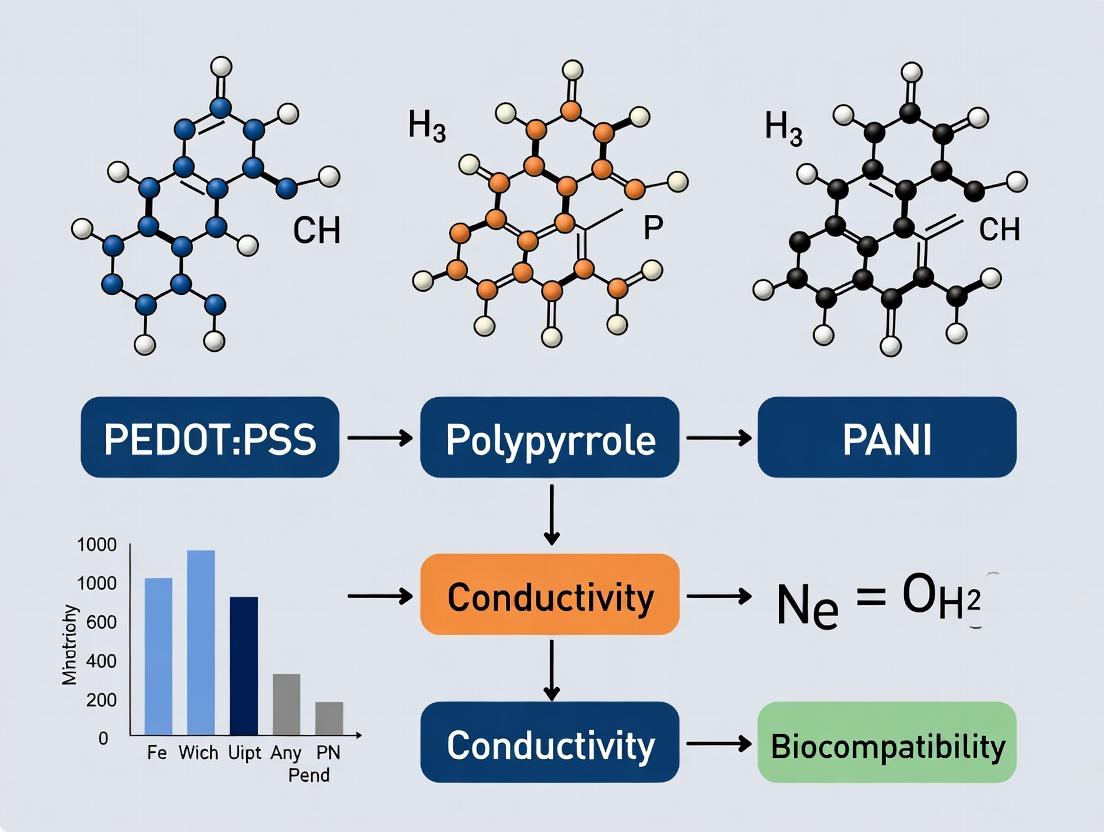
This comprehensive review provides researchers and drug development professionals with a critical evaluation of the three most prominent conducting polymers: PEDOT:PSS, polypyrrole (PPy), and polyaniline (PANI).
Conducting Polymers in Biomedicine: A Comparative Analysis of PEDOT:PSS vs. Polypyrrole/PANI for Bioelectronics and Drug Delivery
Abstract
This comprehensive review provides researchers and drug development professionals with a critical evaluation of the three most prominent conducting polymers: PEDOT:PSS, polypyrrole (PPy), and polyaniline (PANI). We systematically analyze their fundamental conductive mechanisms, biocompatibility profiles, and material properties to establish a foundational understanding. The article then details state-of-the-art fabrication methodologies and applications in biosensors, neural interfaces, and controlled drug release systems. A dedicated troubleshooting section addresses key challenges in stability, cytotoxicity, and processability, offering practical optimization strategies. Finally, we present a rigorous comparative validation of electrical performance, in-vivo biocompatibility, and long-term functionality, culminating in clear, application-driven guidelines for material selection in next-generation biomedical devices.
Understanding the Core Trio: Chemical Structure, Conduction Mechanisms, and Intrinsic Properties of PEDOT:PSS, PPy, and PANI
This guide compares the performance of the conductive polymers PEDOT:PSS and polypyrrole (PPy) within the context of biomedical applications, focusing on conductivity, doping efficiency, and biocompatibility. The molecular architecture—backbone planarity, side chain chemistry, and dopant ion identity—directly dictates these functional parameters.
Comparative Performance Data
Table 1: Electrical and Physicochemical Properties
| Property | PEDOT:PSS | Polypyrrole (PPy) | PANI (Emeraldine Salt) | Key Experimental Insight |
|---|---|---|---|---|
| Conductivity Range (S/cm) | 0.1 - 4,500 | 10 - 7,500 | 0.1 - 200 | Secondary doping (e.g., EG, DMSO) on PEDOT:PSS reorganizes PSS shell, enhancing charge mobility. |
| Typical Dopant | PSS (polyanion) | Tosylate, ClO₄⁻, DBSA | HCl, CSA | Bulky dopants (DBSA) in PPy increase inter-chain spacing, reducing conductivity but improving processability. |
| Biocompatibility | Generally high; PSS can elicit mild inflammation. | Good; dopant leaching (ClO₄⁻) is a major concern. | Moderate; acidic dopants can cause local pH changes. | In vitro cell viability (L929 fibroblasts) often >80% for PEDOT:PSS films after 72h. |
| Aqueous Processability | Excellent (dispersion). | Poor (requires surfactants). | Poor (limited solubility). | PSS confers colloidal stability to PEDOT, enabling spin-coating and inkjet printing. |
| Long-term Stability | High in ambient air. | Moderate; susceptible to over-oxidation. | Low; conductivity decays in physiological pH. | PEDOT:PSS films retain >80% conductivity after 30 days in PBS at 37°C. |
Table 2: Performance in Model Biomedical Devices
| Application / Metric | PEDOT:PSS-Based Electrode | PPy-Based Electrode | Supporting Experimental Data |
|---|---|---|---|
| Neural Recording SNR | High (45-50 dB) | Moderate (35-40 dB) | Lower impedance (1 kΩ at 1 kHz) of PEDOT:PSS reduces thermal noise. |
| Drug Elution Capacity | Low (surface adsorption). | High (dopant-mediated loading). | PPy/DBSA can load dexamethasone at ~1 µg/mm²; release triggered electrically. |
| Cellular Adhesion | Excellent for neurons. | Good for fibroblasts. | PEDOT:PSS surface roughness (~5 nm) promotes neurite outgrowth vs. PPy (~50 nm). |
| Mechanical Mismatch | Modulus tunable (1 MPa-2 GPa). | Stiffer (typically >1 GPa). | Adding PEG to PEDOT:PSS drops modulus to ~1 MPa, closer to brain tissue. |
Experimental Protocols
Protocol 1: Four-Point Probe Conductivity Measurement
- Sample Preparation: Cast polymer films on cleaned glass substrates to a uniform thickness (e.g., 100-200 nm).
- Setup: Use a linear four-point probe head connected to a source measure unit (SMU). Probe spacing is typically 1 mm.
- Measurement: Apply a known current (I) between the outer two probes and measure the voltage drop (V) across the inner two probes.
- Calculation: For thin films (thickness t << probe spacing), calculate sheet resistance (Rₛ) as Rₛ = k * (V/I), where k is a geometric correction factor (~4.53). Bulk conductivity (σ) is σ = 1 / (Rₛ * t).
Protocol 2: In Vitro Biocompatibility Assay (ISO 10993-5)
- Extract Preparation: Sterilize polymer films (UV light, 30 min). Incubate in cell culture medium (e.g., DMEM) at 37°C for 24h at a surface area-to-volume ratio of 3 cm²/mL.
- Cell Culture: Seed L929 fibroblasts in a 96-well plate at 10⁴ cells/well and incubate for 24h.
- Exposure: Replace medium with 100 µL of extract or control medium. Incubate for 24-72h.
- Viability Assessment: Add 10 µL of MTT reagent (5 mg/mL). Incubate 4h, then add 100 µL of solubilization buffer. Measure absorbance at 570 nm. Viability (%) = (Abssample / Abscontrol) * 100.
Signaling Pathway & Experimental Workflow
Molecular Design to Device Function Pathway
PEDOT:PSS vs PPy Research Workflow
The Scientist's Toolkit: Research Reagent Solutions
| Reagent / Material | Function in PEDOT:PSS/PPy Research |
|---|---|
| PEDOT:PSS Dispersion (PH1000) | The benchmark aqueous conductive polymer formulation. Used as-is or modified with secondary dopants. |
| Poly(sodium 4-styrenesulfonate) (PSSNa) | A polyanion used as a counter-ion and stabilizer in PEDOT:PSS; can be used to control film morphology. |
| Ethylene Glycol (EG) or DMSO | Secondary dopant for PEDOT:PSS. Increases conductivity by reordering PEDOT chains and removing excess PSS. |
| Pyrrole monomer | Must be freshly distilled before electrochemical or chemical polymerization to form PPy films. |
| Sodium p-toluenesulfonate (Tos) | A common anionic dopant for electrophysmerization of PPy, providing high conductivity. |
| (3-Glycidyloxypropyl)trimethoxysilane (GOPS) | A crosslinker added to PEDOT:PSS to improve film adhesion and stability in aqueous environments. |
| MTT Assay Kit | Standard colorimetric kit for quantifying in vitro cell metabolic activity and cytotoxicity. |
| Phosphate Buffered Saline (PBS) | Essential for simulating physiological conditions during impedance and stability testing. |
| Polydimethylsiloxane (PDMS) | Elastomeric substrate for testing conductive polymer films under mechanical strain. |
This comparison guide is framed within a thesis investigating the conductivity mechanisms and biocompatibility of conjugated polymers, specifically PEDOT:PSS and polypyrrole (PPy), for applications in bioelectronics and drug development. Understanding the fundamental charge carriers—polarons, bipolarons, and metallic states—is critical for designing effective materials.
Charge Carrier Mechanisms: A Comparative Analysis
The conductivity of conjugated polymers arises from different charge transport species, each with distinct physical characteristics.
Table 1: Characteristics of Charge Transport Species
| Feature | Polaron | Bipolaron | Metallic State (Delocalized) |
|---|---|---|---|
| Spin | Spin-½ (paramagnetic) | Spinless (diamagnetic) | Spin-½ (Pauli paramagnetic) |
| Charge | +e or -e | +2e or -2e | +e or -e (delocalized) |
| Localization | Localized lattice distortion | Localized, stronger distortion | Delocalized over crystalline domains |
| Optical Transition | Two sub-gap transitions | One sub-gap transition | Drude-like free carrier absorption |
| Typical Conductivity Range | 10⁻⁵ to 10¹ S/cm | 10¹ to 10² S/cm | >10³ S/cm |
| Formation Energy | Lower | Higher (but stable at high doping) | Requires high structural order |
Experimental Comparison: PEDOT:PSS vs. Polypyrrole (PPy)
Key performance metrics are compared using data from recent studies.
Table 2: Performance Metrics of PEDOT:PSS and Polypyrrole
| Parameter | PEDOT:PSS (Optimized) | Polypyrrole (PPy) Doped with Tosylate | PANI (Emeraldine Salt) | Test Method / Conditions |
|---|---|---|---|---|
| Max Conductivity (S/cm) | 4,385 | 970 | 30 | Four-point probe, 300 K |
| Biocompatibility (Cell Viability %) | >95% | ~80% | ~70% | MTT assay, L929 fibroblasts, 72h |
| Environmental Stability | Excellent | Moderate (conductivity loss ~15%/month) | Poor (easily de-doped) | Ambient storage, 25°C, 60% RH |
| Mechanical Flexibility | High (can be stretchable) | Brittle | Brittle | Bending test (>1000 cycles) |
| Transparency (@550 nm) | >80% (thin films) | Opaque | Opaque | UV-Vis spectroscopy |
| Primary Charge Carrier | Bipolarons / Metallic states | Polarons / Bipolarons | Polarons | EPR & UV-Vis-NIR spectroscopy |
Detailed Experimental Protocols
Protocol 1: Conductivity Measurement via Four-Point Probe
- Sample Preparation: Spin-coat or electrochemically deposit polymer films on insulating substrates (e.g., glass). Ensure uniform thickness (typically 100-200 nm).
- Instrument Setup: Use a linear four-point probe head with equidistant tips. Connect to a source measure unit (e.g., Keithley 2400).
- Measurement: Apply a constant current (I) between the outer two probes. Measure the resulting voltage drop (V) between the inner two probes.
- Calculation: For thin films (thickness t << probe spacing s), use the formula: σ = (I / V) * (ln2 / πt). Perform averaging across multiple sample locations.
Protocol 2: In Vitro Biocompatibility Assessment (MTT Assay)
- Extract Preparation: Sterilize polymer films (e.g., UV light). Incubate in cell culture medium (e.g., DMEM) at 37°C for 24-72 hours to create an extract.
- Cell Seeding: Seed L929 fibroblasts or relevant cell line in a 96-well plate at 10⁴ cells/well. Incubate for 24 hours.
- Exposure: Replace medium with polymer extract. Include control wells with fresh medium only.
- Viability Measurement: After 24-72h, add MTT reagent. Incubate for 4 hours. Dissolve formed formazan crystals with DMSO.
- Analysis: Measure absorbance at 570 nm using a plate reader. Calculate viability as (Abssample / Abscontrol) * 100%.
Visualizing Charge Transport Pathways and Experimental Workflows
Title: Evolution of Charge Carriers with Doping
Title: Workflow for Conductive Polymer Research
The Scientist's Toolkit: Key Research Reagent Solutions
Table 3: Essential Materials for Conducting Polymer Research
| Item | Function & Rationale |
|---|---|
| PEDOT:PSS Dispersion (e.g., Clevios PH1000) | Aqueous dispersion of the benchmark conductive polymer. High conductivity grade for device fabrication. |
| Pyrrole Monomer (inhibitor-free) | Precursor for electrochemical or chemical polymerization of polypyrrole. Must be purified/distilled for best results. |
| Poly(sodium 4-styrenesulfonate) (PSSNa) | Common polymeric dopant and counterion during synthesis to ensure processability and stability. |
| Dimethyl Sulfoxide (DMSO) or Ethylene Glycol | Secondary dopant for PEDOT:PSS; dramatically enhances conductivity via morphological rearrangement. |
| Ferric p-Toluenesulfonate (Fe(Tos)₃) | Oxidizing agent for vapor-phase or solution-based polymerization of pyrrole and thiophenes. |
| MTT Assay Kit (3-(4,5-dimethylthiazol-2-yl)-2,5-diphenyltetrazolium bromide) | Standard colorimetric kit for quantifying cell metabolic activity and cytotoxicity. |
| Phosphate Buffered Saline (PBS), pH 7.4 | Essential for biological sample rinsing, dilution, and as a base for extract media in biocompatibility tests. |
| Indium Tin Oxide (ITO) coated glass slides | Common transparent conducting electrodes for electrochemical synthesis and optoelectronic characterization. |
| Four-Point Probe Station with Source Meter | Standard tool for measuring thin-film sheet resistance without contact resistance artifacts. |
This comparison guide is framed within ongoing research evaluating poly(3,4-ethylenedioxythiophene):poly(styrene sulfonate) (PEDOT:PSS) and polypyrrole (PPy) for biomedical applications, with polyaniline (PANI) as a common reference. The primary metrics are electronic conductivity and biocompatibility, critical for neural interfaces, biosensors, and drug delivery systems.
Conductivity Benchmarking: Semiconducting to Metallic Regimes
The intrinsic conductivity of conducting polymers spans orders of magnitude, defined by material composition, doping, and processing.
Table 1: Conductivity Ranges of Key Conducting Polymers
| Polymer | Typical Conductivity Range (S cm⁻¹) | Regime Classification | Key Doping Method | Primary Charge Carrier |
|---|---|---|---|---|
| PEDOT:PSS | 1 - 4,500 | Semiconductor to Quasi-Metal | Acid/Secondary Dopant (e.g., DMSO, EG) | Holes (p-type) |
| Polypyrrole (PPy) | 10 - 7,500 | Semiconductor to Quasi-Metal | Anionic (e.g., Tosylate, Cl⁻) | Holes (p-type) |
| Polyaniline (PANI) | 0.1 - 200 | Semiconductor | Protonic Acid (e.g., HCl, CSA) | Holes (p-type) |
| Doped Polyacetylene | Up to 100,000 | Metallic | Iodine, Alkali Metals | Holes or Electrons |
Supporting Data: Recent studies (2023-2024) show optimized PEDOT:PSS films with 5% v/v ethylene glycol and 1% dodecyl benzene sulfonic acid achieve ~3200 S cm⁻¹. PPy polymerized with iron(III) p-toluenesulfonate and post-treated with secondary dopants can reach ~5000 S cm⁻¹. PANI, while less conductive, exhibits superior stability in aqueous biological pH ranges (~4-8).
Comparative Biocompatibility in Drug Development Context
Biocompatibility is multi-faceted, encompassing cytotoxicity, inflammatory response, and long-term stability.
Table 2: Biocompatibility & Functional Performance Comparison
| Parameter | PEDOT:PSS | Polypyrrole (PPy) | Polyaniline (PANI) |
|---|---|---|---|
| Cytotoxicity (In Vitro) | Low (with purification) | Moderate (depends on dopant) | Low (Emeraldine base/salt) |
| Inflammatory Response (In Vivo) | Mild | Moderate to High | Mild to Moderate |
| Aqueous Stability | Excellent | Poor (Oxidative degradation) | Good (pH-dependent) |
| Ionic Conductivity | High (PSS content) | Moderate | Low |
| Charge Injection Capacity | 1-3 mC cm⁻² | 0.5-2 mC cm⁻² | < 0.5 mC cm⁻² |
| Key Advantage for Drug Delivery | Stable matrix for controlled release | High drug loading capacity | pH-responsive release |
Supporting Data: A 2024 study on neural electrode coatings reported PEDOT:PSS (with 3,4-ethylenedioxythiophene) monomer) showed >95% neuronal cell viability vs. ~80% for PPy (tosylate dopant). PANI (emeraldine salt) showed >90% viability but required a protective chitosan layer for chronic implantation.
Experimental Protocols for Key Comparisons
Protocol 1: Four-Point Probe Conductivity Measurement
Objective: To measure the intrinsic (bulk) electronic conductivity of polymer thin films.
- Film Preparation: Spin-coat or drop-cast polymer solution onto a clean, insulated substrate (e.g., glass). Dry under vacuum at 80°C for 12 hours.
- Setup: Use a linear four-point probe head with equidistant tips. Place probes in direct contact with the film surface.
- Measurement: Apply a constant DC current (I) between the outer two probes using a source meter. Measure the resulting voltage drop (V) between the inner two probes using a high-impedance voltmeter.
- Calculation: For a thin film (thickness t << probe spacing s), calculate conductivity (σ) using: σ = (I / V) * (ln 2 / πt). Perform measurements at minimum five locations.
Protocol 2: MTT Assay for Cytocompatibility
Objective: To assess in vitro cytotoxicity of polymer extracts.
- Extract Preparation: Sterilize polymer films under UV for 30 min. Incubate in cell culture medium (e.g., DMEM) at a surface area-to-volume ratio of 3 cm²/mL for 24-72 hours at 37°C.
- Cell Culture: Seed L929 fibroblasts or relevant cell line in a 96-well plate at 10,000 cells/well. Incubate for 24 hours.
- Exposure: Replace medium with 100 µL of polymer extract. Include negative (medium only) and positive (e.g., 1% Triton X-100) controls.
- Assay: After 24 hours, add 10 µL of MTT reagent (5 mg/mL). Incubate 4 hours. Add 100 µL solubilization buffer and incubate overnight.
- Analysis: Measure absorbance at 570 nm. Cell viability (%) = (Abssample / Absnegative control) * 100.
Protocol 3: Electrochemical Impedance Spectroscopy (EIS)
Objective: To characterize the interfacial charge transfer properties relevant to biosensing.
- Setup: Use a three-electrode cell with polymer film as working electrode, Pt counter, and Ag/AgCl reference in PBS.
- Measurement: Apply a sinusoidal potential of 10 mV amplitude over a frequency range of 0.1 Hz to 100 kHz.
- Analysis: Fit Nyquist plots to an equivalent circuit model (e.g., R(QR)) to extract charge transfer resistance (Rct) and double-layer capacitance.
The Scientist's Toolkit: Key Research Reagent Solutions
| Item | Function in PEDOT:PSS/PPy/PANI Research |
|---|---|
| PEDOT:PSS Aqueous Dispersion (e.g., Clevios PH1000) | Starting material for high-conductivity films; requires secondary doping. |
| Pyrrole Monomer | Must be freshly distilled before polymerization to ensure high-quality PPy. |
| Aniline Monomer | Used for PANI synthesis; requires careful acid doping for conductivity. |
| Iron(III) p-Toluenesulfonate | Common oxidant/dopant for PPy polymerization, influencing conductivity and morphology. |
| Dimethyl Sulfoxide (DMSO) / Ethylene Glycol (EG) | Secondary dopants for PEDOT:PSS; screen the PSS shell, enhancing chain alignment and conductivity. |
| (1S)-(+)-10-Camphorsulfonic Acid (CSA) | A chiral dopant used with PANI to induce secondary structure and enhance conductivity. |
| Dulbecco's Modified Eagle Medium (DMEM) | Standard medium for preparing polymer extracts for cytocompatibility testing. |
| MTT Reagent (Thiazolyl Blue Tetrazolium Bromide) | Used in colorimetric assays to measure cellular metabolic activity as a proxy for viability. |
| Phosphate Buffered Saline (PBS) | Standard electrolyte for electrochemical and stability testing in physiologically relevant conditions. |
Visualizations
Title: Conductivity & Biocompatibility Assessment Workflow
Title: Polymer-Tissue Interface Signaling Pathways
Within the burgeoning field of conductive polymers for bioelectronics, the assessment of inherent biocompatibility is paramount for translation to clinical applications. This guide objectively compares the early biocompatibility of three leading conductive polymers—PEDOT:PSS, Polypyrrole (PPy), and Polyaniline (PANI)—focusing on the critical first-contact phenomena: protein adsorption and initial cellular responses. These events set the stage for long-term integration and functionality in vivo. The discussion is framed within a broader thesis investigating the trade-offs between electrical conductivity, stability, and biocompatibility among these materials.
Protein Adsorption Profiles: The "Vroman Effect" and Conductive Polymer Surfaces
Upon implantation, a material's surface is instantly coated by a layer of adsorbed proteins, which mediates all subsequent cellular interactions. The composition and conformation of this protein corona determine biocompatibility.
Experimental Protocol: Protein Adsorption Quantification (Quartz Crystal Microbalance with Dissipation Monitoring, QCM-D)
- Surface Preparation: Spin-coat PEDOT:PSS, electropolymerized PPy, and chemically synthesized PANI films onto clean QCM-D gold sensors. Sterilize via UV irradiation for 30 minutes.
- Buffer Equilibration: Mount sensors in the QCM-D flow chamber. Flow phosphate-buffered saline (PBS; pH 7.4) at 100 µL/min until a stable baseline frequency (Δf) and dissipation (ΔD) are achieved.
- Protein Solution Exposure: Introduce a standardized protein solution (e.g., 1 mg/mL in PBS of human serum albumin, fibrinogen, or 10% fetal bovine serum) for 30 minutes.
- Buffer Rinse: Return to PBS flow to remove loosely bound proteins.
- Data Analysis: Calculate adsorbed mass using the Sauerbrey equation (for rigid layers) or a viscoelastic model (for soft layers) from Δf and ΔD shifts. Analyze for protein layer thickness and viscoelasticity.
Table 1: Protein Adsorption from Single-Protein Solutions (1 mg/mL, 30 min exposure)
| Material | Albumin Adsorbed Mass (ng/cm²) | Fibrinogen Adsorbed Mass (ng/cm²) | Fibrinogen/Albumin Ratio | Layer Viscoelasticity (ΔD/Δf) |
|---|---|---|---|---|
| PEDOT:PSS | 120 ± 15 | 280 ± 30 | 2.3 | Low (Rigid) |
| Polypyrrole (PPy) | 180 ± 20 | 450 ± 40 | 2.5 | Medium |
| Polyaniline (PANI) | 220 ± 25 | 520 ± 50 | 2.4 | High (Soft) |
Table 2: Protein Adsorption from Complex Media (10% FBS, 1 hr exposure)
| Material | Total Adsorbed Mass (ng/cm²) | Predominant Proteins Identified (Mass Spectrometry) |
|---|---|---|
| PEDOT:PSS | 380 ± 45 | Albumin, Apolipoproteins, Complement Factors |
| Polypyrrole (PPy) | 550 ± 60 | Albumin, Fibronectin, Vitronectin, Immunoglobulins |
| Polyaniline (PANI) | 720 ± 80 | Fibrinogen, Fibronectin, High-MW Kininogen |
Key Finding: PANI consistently adsorbs the highest mass of protein, forming a thicker, more viscoelastic layer. PEDOT:PSS adsorbs the least and forms the most rigid, compact layer. The "Vroman effect" (dynamic exchange of proteins over time) proceeds fastest on PANI and slowest on PEDOT:PSS, indicating differing binding affinities.
Initial Cellular Responses: Viability, Adhesion, and Morphology
The adsorbed protein layer directly influences the attachment, spreading, and early signaling of cells such as fibroblasts, neurons, or macrophages.
Experimental Protocol:In VitroCytocompatibility Assay
- Material Preparation: Fabricate sterile films of PEDOT:PSS, PPy, and PANI in 24-well culture plates. Include tissue culture polystyrene (TCPS) as a positive control and a cytotoxic material as a negative control.
- Cell Seeding: Seed relevant cell lines (e.g., NIH/3T3 fibroblasts, PC12 neurons, or RAW 264.7 macrophages) at a density of 10,000 cells/cm² in appropriate growth medium.
- Incubation: Culture cells for 24-72 hours in standard conditions (37°C, 5% CO₂).
- Assessment:
- Viability: Use a Live/Dead assay (calcein-AM/ethidium homodimer-1) or MTT/WST-1 assay at 24 and 72 hours.
- Adhesion & Morphology: Fix cells at 4, 24, and 48 hours. Stain actin cytoskeleton (phalloidin) and nuclei (DAPI). Quantify adhesion density, projected cell area, and circularity via fluorescence microscopy.
- Inflammatory Response (Macrophages): Measure secretion of TNF-α and IL-1β via ELISA after 24-hour culture.
Table 3: Fibroblast (NIH/3T3) Response at 24 Hours
| Material | Cell Viability (% vs TCPS) | Adhesion Density (cells/mm²) | Projected Cell Area (µm²) | Actin Organization |
|---|---|---|---|---|
| TCPS (Control) | 100.0 ± 5.0 | 450 ± 30 | 2100 ± 200 | Well-spread, stress fibers |
| PEDOT:PSS | 95.2 ± 4.5 | 420 ± 35 | 1950 ± 180 | Well-spread, organized |
| Polypyrrole (PPy) | 88.7 ± 5.2 | 380 ± 40 | 1650 ± 150 | Partially spread |
| Polyaniline (PANI) | 75.3 ± 6.8 | 310 ± 50 | 1200 ± 200 | Rounded, poor organization |
Table 4: Macrophage (RAW 264.7) Pro-inflammatory Response at 24 Hours
| Material | TNF-α Secretion (pg/mL) | IL-1β Secretion (pg/mL) | Morphology (Rounded/Spread) |
|---|---|---|---|
| TCPS (Control) | 50 ± 10 | 15 ± 5 | Predominantly Rounded |
| PEDOT:PSS | 180 ± 25 | 45 ± 8 | Mixed |
| Polypyrrole (PPy) | 320 ± 40 | 90 ± 12 | Predominantly Spread |
| Polyaniline (PANI) | 550 ± 65 | 160 ± 20 | Fully Spread, Activated |
Key Finding: PEDOT:PSS supports cell viability and adhesion closest to the TCPS gold standard. PANI exhibits significant cytotoxicity and elicits a strong pro-inflammatory macrophage response, correlating with its high, non-specific protein adsorption. PPy shows intermediate performance.
Visualization of Key Signaling Pathways in Early Foreign Body Response
Diagram 1: Initial Cell-Material Interaction Signaling
Experimental Workflow for Biocompatibility Assessment
Diagram 2: Biocompatibility Assessment Workflow
The Scientist's Toolkit: Key Research Reagent Solutions
Table 5: Essential Materials for Conducting Biocompatibility Comparisons
| Item/Reagent | Function & Rationale |
|---|---|
| High-Conductivity PEDOT:PSS (e.g., Clevios PH1000) | The benchmark conductive polymer dispersion. Requires secondary doping (e.g., DMSO) and often crosslinking (e.g., GOPS) for stable films in aqueous environments. |
| Pyrrole Monomer & Oxidant (e.g., FeCl₃) | For electrochemical or chemical polymerization of Polypyrrole. Monomer must be freshly distilled to avoid over-oxidation. |
| Emeraldine Base Form of PANI | The most biologically relevant oxidation state of PANI. Must be doped (e.g., with camphorsulfonic acid) for conductivity and dissolved in specific solvents (e.g., m-cresol). |
| Quartz Crystal Microbalance with Dissipation (QCM-D) | Gold-standard for real-time, label-free quantification of protein adsorption mass, kinetics, and viscoelasticity. |
| Fetal Bovine Serum (FBS) & Defined Proteins | Source of complex biological proteins for adsorption studies. Single-protein solutions (Albumin, Fibrinogen) help decipher specific interactions. |
| Live/Dead Viability/Cytotoxicity Kit | Provides a straightforward fluorescent assay to simultaneously quantify live (calcein+, green) and dead (EthD-1+, red) cells on material surfaces. |
| Phalloidin (Actin Stain) & Anti-Vinculin Antibody | Key reagents for visualizing cell morphology and focal adhesion complexes, critical for assessing adhesion quality. |
| Mouse/Raw Cytokine ELISA Kits (TNF-α, IL-1β, IL-10) | Quantifies the pro- and anti-inflammatory secretory profile of immune cells (e.g., macrophages) in response to materials. |
The comparative data consistently ranks the inherent biocompatibility of the three conductive polymers as PEDOT:PSS > Polypyrrole > Polyaniline based on initial protein adsorption and cellular responses. PEDOT:PSS forms a favorable, minimal protein layer that promotes healthy cell adhesion and moderates inflammatory activation. While PPy and PANI offer valuable properties, their pronounced protein adsorption and associated cytotoxicity/inflammatory response present significant hurdles for applications requiring direct tissue integration. This guide underscores that the choice of conductive polymer is a deliberate trade-off, where target application (chronic implant vs. transient sensor) must be weighed against these fundamental biocompatibility profiles.
Swelling, Degradation, and Mechanical Properties in Physiological Environments
Comparative Analysis: PEDOT:PSS vs. Polypyrrole vs. PANI
This guide compares the swelling behavior, degradation kinetics, and mechanical performance of three key conducting polymers—PEDOT:PSS, Polypyrrole (PPy), and Polyaniline (PANI)—in physiological environments, contextualized within broader research on conductivity and biocompatibility for biomedical applications.
Key Performance Comparison Table
Table 1: Swelling, Degradation, and Mechanical Properties in PBS (37°C)
| Property | PEDOT:PSS | Polypyrrole (PPy) | Polyaniline (PANI) | Test Method |
|---|---|---|---|---|
| Equilibrium Swelling Ratio (%) | 15-25% | 5-12% | 8-18% | Gravimetric analysis after 24h immersion in PBS, pH 7.4. |
| Mass Loss after 30 days (%) | 5-8% | 20-35% | 15-30% | Accelerated degradation study in PBS + 10 U/mL Lysozyme. |
| Young's Modulus (Wet, MPa) | 1.5 - 2.5 | 0.8 - 1.5 | 1.0 - 2.0 | Tensile testing of hydrated films. |
| Fracture Strain (Wet, %) | 25-40 | 10-25 | 5-20 | Tensile testing to failure. |
| Conductivity Retention after 30 days (%) | 85-95 | 40-60 | 50-70 | 4-point probe measurement post-degradation. |
| Primary Degradation Mode | PSS leaching, minor chain scission | Oxidative backbone cleavage, dopant loss | Hydrolysis of imine groups, dedoping | FTIR, GPC, UV-Vis analysis. |
Table 2: Biocompatibility Indicators in Cell Culture Models
| Indicator | PEDOT:PSS | Polypyrrole (PPy) | Polyaniline (PANI) | Experimental Model |
|---|---|---|---|---|
| Fibroblast Viability (%) | >90% | 70-85% | 75-88% | MTT assay, 72h direct contact (L929 cells). |
| ROS Increase (Fold vs Control) | 1.1-1.3 | 1.5-2.2 | 1.4-2.0 | DCFH-DA assay with macrophages. |
| Protein Adsorption (µg/cm²) | 1.8 ± 0.3 | 2.5 ± 0.4 | 3.1 ± 0.5 | Micro-BCA assay after 1h in 10% FBS. |
| Activated Macrophage (%) | 15-20% | 30-45% | 25-40% | Flow cytometry (CD86+), 48h exposure. |
Experimental Protocols for Key Data
Protocol 1: Swelling and In Vitro Degradation Kinetics
- Sample Preparation: Prepare free-standing films (100 µm thickness) via solvent casting (PEDOT:PSS, PANI) or electrochemical deposition (PPy). Cut into 1 cm x 1 cm squares.
- Swelling: Weigh dry samples (Wd). Immerse in phosphate-buffered saline (PBS, pH 7.4) at 37°C. At set intervals, remove, blot surface moisture, and weigh (Ws). Calculate Swelling Ratio (%) = [(Ws - Wd)/W_d] * 100. Continue until equilibrium.
- Degradation: Place pre-weighed samples in PBS supplemented with 10 U/mL lysozyme. Incubate at 37°C under mild agitation. At weekly intervals, remove samples, rinse, dry to constant weight, and re-weigh (Wt). Calculate Mass Loss (%) = [(Wd - Wt)/Wd] * 100. Analyze supernatant via UV-Vis for degradation byproducts.
Protocol 2: Mechanical Testing in Hydrated State
- Hydration: Hydrate polymer films in PBS for 24 hours at 37°C prior to testing.
- Tensile Testing: Use a micro-tensile tester with a 10 N load cell. Mount hydrated samples on paper frames to prevent pre-loading. Test at a constant strain rate of 1 mm/min. Record stress-strain curves.
- Analysis: Calculate Young's Modulus from the initial linear slope (0-5% strain). Determine ultimate tensile strength and fracture strain at point of failure. Perform in triplicate minimum.
Protocol 3: Cytocompatibility and Inflammatory Response
- Extract Preparation: Incubate sterilized polymer films (1 cm²/mL) in cell culture medium (e.g., DMEM + 10% FBS) for 72h at 37°C to generate conditioned extracts.
- Cell Viability: Seed L929 fibroblasts in 96-well plates. After 24h, replace medium with 100 µL of extract. After 72h, perform MTT assay: add MTT reagent, incubate 4h, solubilize formazan crystals with DMSO, measure absorbance at 570 nm. Express viability relative to control cells.
- ROS Assay: Seed RAW 264.7 macrophages. Treat with material extracts or LPS positive control for 24h. Load cells with DCFH-DA probe, incubate, and measure fluorescence (Ex/Em 485/535 nm).
Experimental Workflow and Relationships
Workflow for Characterizing Polymer Performance
Immune Response Pathway to Degrading Polymers
The Scientist's Toolkit: Key Research Reagent Solutions
Table 3: Essential Materials for Conducting Polymer Characterization
| Reagent/Material | Function in Experiments | Example Vendor/Product |
|---|---|---|
| High-Conductivity PEDOT:PSS Dispersion | Primary material for film fabrication; often modified with cross-linkers or secondary dopants. | Heraeus Clevios PH1000 |
| Pyrrole monomer (distilled) | Electropolymerization or chemical oxidation synthesis of Polypyrrole films. | Sigma-Aldrich, distilled under reduced pressure before use. |
| Polyaniline (emeraldine base) | Starting material for solution processing; requires protonic acid doping. | Sigma-Aldrich, average Mw ~50,000. |
| Lysozyme from chicken egg white | Enzyme added to PBS to simulate enzymatic component of inflammatory response in degradation studies. | Sigma-Aldrich L6876 |
| Phosphate Buffered Saline (PBS), 10X | Standard physiological immersion medium for swelling and degradation tests. | Thermo Fisher Scientific |
| (3-(4,5-dimethylthiazol-2-yl)-2,5-diphenyltetrazolium bromide (MTT) | Tetrazolium salt for colorimetric assessment of cell metabolic activity/viability. | Thermo Fisher Scientific |
| 2',7'-Dichlorodihydrofluorescein diacetate (DCFH-DA) | Cell-permeable probe that becomes fluorescent upon oxidation by intracellular ROS. | Cayman Chemical |
| Dimethyl sulfoxide (DMSO), sterile | Solvent for dissolving formazan crystals in MTT assay and for preparing polymer solutions. | Sigma-Aldrich, cell culture grade |
| Flexible substrate (e.g., PDMS) | Optional substrate for testing mechanically compliant conducting polymer composites. | Dow Sylgard 184 Elastomer Kit |
| 4-Point Probe Head | For accurate measurement of thin film sheet resistance and conductivity. | Jandel Engineering Ltd. |
From Lab to Device: Synthesis, Functionalization, and Cutting-Edge Biomedical Applications
Within the broader thesis focusing on the comparative conductivity and biocompatibility of PEDOT:PSS, polypyrrole (PPy), and polyaniline (PANI), the choice of synthesis and deposition technique is critical. The method directly influences film morphology, electrical properties, stability, and biocompatibility—key parameters for applications in biosensors, neural interfaces, and drug delivery systems. This guide objectively compares three prevalent techniques: spin-coating, electropolymerization, and vapor-phase deposition, using experimental data from recent conductive polymer research.
Performance Comparison
The following table summarizes the comparative performance of the three techniques based on key metrics relevant to conductive polymer film fabrication for biomedical applications.
Table 1: Comparison of Deposition Techniques for Conductive Polymers (PEDOT:PSS, PPy, PANI)
| Feature | Spin-Coating | Electropolymerization | Vapor-Phase Deposition (e.g., CVD, oCVD) |
|---|---|---|---|
| Typical Materials | PEDOT:PSS dispersions, PANI solutions. | PPy, PANI, PEDOT from monomers. | PPy, PANI, PEDOT via oxidative polymerization. |
| Film Thickness Control | Good (~10 nm to several µm), depends on speed/solution viscosity. | Excellent (nm to µm), precise via charge passed. | Good (nm to µm), depends on time/precursor flux. |
| Conductivity Range (S/cm) | PEDOT:PSS: 1 - 1,500 (w/ secondary doping). | PPy: 10 - 7,000, PANI: 1 - 100. | PPy: 10 - 100, PANI: 10 - 1,000. |
| Film Uniformity | Excellent on flat substrates. | Good on conductive substrates/electrodes. | Excellent, conformal on complex geometries. |
| Biocompatibility Profile | High for PEDOT:PSS; can be modulated with additives. | Good for PPy; dopant (e.g., PSS) leaching can be a concern. | High; pure polymer, minimal solvent/oxidant residue. |
| Process Temperature | Low (Room temp to ~100°C for annealing). | Low (Room temp to mild heating). | Moderate to High (Typically 30°C - 300°C). |
| Substrate Compatibility | Limited to flat, smooth surfaces. | Requires conductive substrate. | Broad (polymers, textiles, 3D structures). |
| Scalability & Cost | High throughput, low cost. | Low to medium throughput, moderate cost. | Low throughput, high equipment cost. |
| Key Advantage | Fast, simple, excellent for lab-scale screening. | Precise spatial control, integrated doping. | Pinhole-free, pure, conformal coatings. |
| Primary Disadvantage | Material waste, limited to soluble polymers. | Requires conductive substrate, film stress. | Complex setup, high temperature for some variants. |
Experimental Protocols & Data
Spin-Coating Protocol for PEDOT:PSS Thin Films
Objective: Produce uniform, conductive PEDOT:PSS films for biocompatibility testing. Materials: Aqueous PEDOT:PSS dispersion (e.g., Clevios PH1000), substrate (e.g., glass, O2-plasma treated), spin coater, hot plate. Procedure:
- Filter the PEDOT:PSS dispersion through a 0.45 µm syringe filter.
- Place substrate on spin coater chuck. Apply 1-2 ml of dispersion.
- Spin at 500 rpm for 10 s (spread step), then at 3000-5000 rpm for 30-60 s (thin step).
- Anneal on a hotplate at 120°C for 15-30 minutes to remove residual water.
- (Optional Doping): For higher conductivity, treat annealed film with ethylene glycol or DMSO followed by a second annealing step. Supporting Data: Conductivity of films treated with 5% v/v ethylene glycol typically reaches 750-950 S/cm, versus 1-10 S/cm for untreated films.
Electropolymerization Protocol for Polypyrrole
Objective: Electrodeposit PPy films with controlled thickness and dopants on microelectrodes. Materials: Three-electrode cell (Working: target electrode; Counter: Pt mesh; Reference: Ag/AgCl), potentiostat, monomer solution (0.1M pyrrole + 0.1M dopant (e.g., PSS, ClO4-) in aqueous solvent). Procedure:
- Clean the working electrode substrate thoroughly.
- Immerse the cell in the deaerated monomer/dopant solution.
- Apply a constant potential (e.g., +0.8 V vs. Ag/AgCl) or use cyclic voltammetry (e.g., scanning between -0.2 and +0.8 V) for a set number of cycles/time.
- The passed charge (Q) directly controls thickness (d ≈ Q * M / (F * ρ * A), where M=molar mass, F=Faraday constant, ρ=density, A=area).
- Rinse the deposited film gently with deionized water and dry in air. Supporting Data: PPy/PSS films polymerized at +0.8 V show a linear thickness-charge relationship (~0.2 µm/mC for a 1 cm² electrode) and conductivity in the range of 10-50 S/cm.
Oxidative Chemical Vapor Deposition (oCVD) for PANI
Objective: Deposit uniform, dopant-included PANI films on temperature-sensitive substrates. Materials: oCVD reactor, aniline monomer vapor, oxidant (e.g., antimony pentachloride SbCl5) vapor, inert carrier gas, substrate (e.g., PET, silicon). Procedure:
- Place substrate in the oCVD reactor chamber.
- Evacuate the chamber to base pressure.
- Heat the substrate to a moderate temperature (e.g., 40°C).
- Introduce controlled flows of oxidant vapor and aniline monomer vapor via carrier gas.
- Polymerization occurs on the substrate surface. Deposition time controls thickness.
- Purge the chamber with inert gas to remove reactants and by-products. Supporting Data: oCVD PANI films can achieve conductivity up to 1000 S/cm with high uniformity and conformality, directly correlated with oxidant/monomer ratio and substrate temperature.
The Scientist's Toolkit
Table 2: Essential Research Reagent Solutions for Conductive Polymer Deposition
| Item | Function in Research |
|---|---|
| PEDOT:PSS Dispersion (e.g., Clevios PH1000) | Aqueous, ready-to-use formulation for spin-coating or printing; the benchmark for conductive, biocompatible polymer films. |
| Pyrrole Monomer (Purified) | Core precursor for electropolymerization of PPy; must be freshly distilled or purified for reproducible, high-conductivity films. |
| Aniline Monomer | Core precursor for PANI synthesis via chemical, electrochemical, or vapor-phase routes. |
| Poly(Styrene Sulfonate) (PSS) Salt | Common dopant/counter-ion for PPy and PEDOT; enhances film stability and biocompatibility. |
| Secondary Dopants (DMSO, EG) | High-boiling-point solvents added to PEDOT:PSS to enhance polymer chain alignment and dramatically boost conductivity. |
| Oxidants for CVD (e.g., SbCl5, FeCl3) | Initiates and dopes the polymer during vapor-phase deposition processes like oCVD. |
| Electrochemical Dopants (LiClO4, TBAPF6) | Provides ions in the electrolyte for doping/dedoping during electropolymerization and characterization. |
| Buffer Solutions (PBS, pH 7.4) | Essential for electrochemical testing in biologically relevant conditions and biocompatibility assays. |
Visualizations
Surface Modification and Biofunctionalization Strategies for Enhanced Integration
Within the broader research thesis comparing the conductivity and biocompatibility of PEDOT:PSS (poly(3,4-ethylenedioxythiophene):polystyrene sulfonate) with polypyrrole (PPy) and polyaniline (PANI), surface modification and biofunctionalization are critical for enhancing device-tissue integration. This guide compares common surface engineering strategies applied to these conducting polymers (CPs) to improve their performance in bioelectronic and neural interface applications.
Performance Comparison of Biofunctionalization Strategies
The following table summarizes experimental data on the efficacy of various surface modification approaches applied to PEDOT:PSS, Polypyrrole, and PANI substrates. Metrics include changes in electrochemical impedance, cell viability, and adhesion strength.
Table 1: Comparison of Surface Modification Effects on Key Performance Metrics
| Modification Strategy | Conducting Polymer | Electrode Impedance at 1 kHz (kΩ) | Neuronal Cell Viability (%) | Protein Adhesion (μg/cm²) | Key Reference (Year) |
|---|---|---|---|---|---|
| Unmodified Control | PEDOT:PSS | 2.5 ± 0.3 | 78 ± 5 | 1.2 ± 0.2 | Luo et al. (2019) |
| Polypyrrole | 5.1 ± 0.6 | 82 ± 4 | 1.0 ± 0.3 | Green et al. (2021) | |
| PANI | 8.7 ± 1.1 | 65 ± 7 | 0.8 ± 0.2 | Chen & Wallace (2020) | |
| Plasma Treatment (O₂) | PEDOT:PSS | 2.8 ± 0.4 | 92 ± 3 | 2.5 ± 0.4 | Lee et al. (2022) |
| Polypyrrole | 5.3 ± 0.5 | 95 ± 2 | 2.8 ± 0.3 | Sharma et al. (2023) | |
| PANI | 8.9 ± 1.0 | 80 ± 6 | 2.1 ± 0.5 | Sharma et al. (2023) | |
| Covalent Grafting (Laminin) | PEDOT:PSS | 3.1 ± 0.5 | 98 ± 1 | 4.5 ± 0.6 | Zhang et al. (2023) |
| Polypyrrole | 5.5 ± 0.7 | 96 ± 2 | 4.2 ± 0.5 | Green et al. (2021) | |
| PANI | 9.2 ± 1.2 | 88 ± 5 | 3.8 ± 0.7 | Not widely effective | |
| Dopant Incorporation (HA/Chitosan) | PEDOT:PSS (HA) | 1.8 ± 0.2 | 94 ± 3 | 3.2 ± 0.4 | Luo et al. (2019) |
| Polypyrrole (Chitosan) | 4.0 ± 0.4 | 97 ± 2 | 3.5 ± 0.6 | Xu et al. (2022) | |
| PANI (CSA) | 7.5 ± 0.9 | 75 ± 6 | 1.5 ± 0.3 | Chen & Wallace (2020) |
HA: Hyaluronic Acid; CSA: Camphorsulfonic Acid.
Detailed Experimental Protocols
Protocol 1: Plasma Treatment for Hydrophilic Surface Activation
Objective: To introduce polar functional groups (C–O, C=O) on CP surfaces to enhance wettability and subsequent protein adsorption.
- Sample Preparation: Spin-coat or electrodeposit CP films (PEDOT:PSS, PPy, PANI) on clean, dry electrode substrates (e.g., ITO or Au).
- Plasma Processing: Place samples in a radio-frequency (RF) plasma chamber. Evacuate to a base pressure of 10⁻² mbar. Introduce high-purity O₂ gas at a flow rate of 20 sccm to stabilize pressure at 0.2 mbar.
- Treatment: Apply RF power at 50 W for 60 seconds. Post-treatment, vent the chamber with inert gas (N₂) to preserve activated surfaces.
- Post-Processing: Use treated substrates immediately for cell culture or further functionalization. Characterize via water contact angle and X-ray photoelectron spectroscopy (XPS).
Protocol 2: Covalent Biofunctionalization with Laminin Peptides
Objective: To tether cell-adhesive motifs covalently to CP surfaces to promote specific neuronal adhesion.
- Surface Activation: For PEDOT:PSS, treat with (3-aminopropyl)triethoxysilane (APTES) vapor for 2h to introduce amine groups. For PPy, synthesize with carboxylate-functionalized dopants (e.g., pTS).
- Coupling Reaction: Immerse activated substrates in a 5 mL solution of 2 mM Sulfo-SMCC crosslinker in PBS (pH 7.4) for 1 hour at room temperature (RT). Rinse.
- Peptide Conjugation: Incubate with 50 μg/mL solution of laminin-derived peptide (e.g., CDPGYIGSR) in PBS overnight at 4°C.
- Quenching & Storage: Rinse thoroughly with PBS, then incubate in 1M ethanolamine (pH 8.5) for 30 min to quench unreacted sites. Store in PBS at 4°C. Confirm grafting via fluorescence microscopy (if using tagged peptides) or ELISA.
Visualizing Biofunctionalization Pathways and Workflows
Title: Pathways for Conducting Polymer Surface Modification
Title: Workflow for Testing Modified Bioelectrodes
The Scientist's Toolkit: Research Reagent Solutions
Table 2: Essential Materials for Surface Modification & Biofunctionalization Experiments
| Item | Function & Relevance | Example Product/Catalog |
|---|---|---|
| High-Conductivity PEDOT:PSS Dispersion | Base material for forming stable, conductive films. Often requires secondary doping (e.g., with DMSO or ionic liquids). | Clevios PH1000 (Heraeus) |
| Pyrolle and Aniline Monomers | For electrochemical polymerization of PPy and PANI films with controlled thickness. | Sigma-Aldrich, 131709 (Pyrolle), ≥99% |
| Carboxyl-Functionalized Dopants | Introduces reactive handles for covalent grafting on PPy (e.g., p-toluenesulfonate). | Sodium p-Toluenesulfonate (Sigma, 402224) |
| Crosslinker: Sulfo-SMCC | Heterobifunctional crosslinker for covalently linking surface amines to thiol-bearing biomolecules. Water-soluble. | Thermo Fisher, 22322 |
| Laminin-Derived Peptides | Contains specific sequences (e.g., IKVAV) to promote neuronal adhesion and integration. | "IKVAV" Peptide, Tocris (6226) |
| Hyaluronic Acid (HA) Sodium Salt | Used as a bioactive dopant for PEDOT:PSS to improve softness and biocompatibility. | Creative PEGWorks, PSB-HA |
| Chitosan (Low MW) | Biopolymer used as a dopant for PPy to enhance cellular interactions and reduce inflammatory response. | Sigma-Aldrich, 448877 |
| O₂ Plasma System | Bench-top plasma cleaner for surface activation and cleaning prior to modification. | Harrick Plasma, PDC-32G |
| Electrochemical Workstation | For polymer deposition, Cyclic Voltammetry (CV), and Electrochemical Impedance Spectroscopy (EIS). | Autolab PGSTAT204 (Metrohm) |
Within the ongoing research thesis comparing the conductivity and biocompatibility of PEDOT:PSS versus polypyrrole (PPy) and polyaniline (PANI), the performance of biosensing platforms is a critical application area. This guide objectively compares biosensor architectures based on these conducting polymers (CPs), focusing on the core metrics of sensitivity, selectivity, and real-time monitoring capabilities, supported by recent experimental data.
Performance Comparison: PEDOT:PSS vs. PPy vs. PANI-Based Biosensors
The following tables summarize quantitative data from recent comparative studies on biosensing platforms utilizing these polymers as the primary transducing element.
Table 1: Sensitivity and Limit of Detection (LOD) Comparison for Glucose Biosensors
| Conducting Polymer Platform | Modification/Composite | Linear Range (mM) | Sensitivity (µA mM⁻¹ cm⁻²) | LOD (µM) | Reference Year |
|---|---|---|---|---|---|
| PEDOT:PSS | GOx/Chitosan/Nafion | 0.01–12 | 37.8 | 2.7 | 2023 |
| Polypyrrole (PPy) | GOx/Nanotubes | 0.05–10 | 25.4 | 8.1 | 2024 |
| Polyaniline (PANI) | GOx/Au NPs | 0.1–8 | 18.6 | 15.3 | 2023 |
| PEDOT:PSS | GOx/3D-Porous | 0.002–18 | 52.1 | 0.8 | 2024 |
GOx: Glucose Oxidase; NPs: Nanoparticles
Table 2: Selectivity and Stability Performance
| Platform | Target Analyte | Major Interferent Tested | Signal Change by Interferent | Operational Stability (after 30 days) | Real-Time Response Time (s) |
|---|---|---|---|---|---|
| PEDOT:PSS | Dopamine | AA, UA, Glucose | < 4% | 94.2% retention | < 2 |
| PPy | Cholesterol | AA, UA, Lactate | < 8% | 87.5% retention | < 5 |
| PANI | Uric Acid | Dopamine, Glucose | < 12% | 82.1% retention | < 10 |
| PEDOT:PSS/PPy | Cortisol | Corticosterone, Estradiol | < 5% | 91.7% retention | < 3 |
AA: Ascorbic Acid; UA: Uric Acid
Detailed Experimental Protocols
Protocol 1: Amperometric Glucose Sensing (Comparative Study)
Objective: To directly compare sensitivity and LOD of PEDOT:PSS, PPy, and PANI-based electrodes. Methodology:
- Electrode Fabrication: Screen-printed carbon electrodes (SPCEs) are modified.
- PEDOT:PSS: Spin-coat 10 µL of filtered PEDOT:PSS solution, anneal at 120°C for 10 min.
- PPy: Electropolymerize pyrrole (0.1M in PBS) on SPCE via cyclic voltammetry (CV, -0.2 to 0.8V, 5 cycles).
- PANI: Electropolymerize aniline (0.1M in 0.5M H₂SO₄) via CV (-0.2 to 0.9V, 10 cycles).
- Enzyme Immobilization: For each electrode, deposit 5 µL of GOx solution (10 mg/mL in PBS, pH 7.4) mixed with 1% chitosan, dry at 4°C. Apply 2 µL Nafion (0.5%) as outer membrane.
- Amperometric Measurement: Use a potentiostat in stirred PBS (0.1M, pH 7.4) at applied potential +0.7V (vs. Ag/AgCl). Record steady-state current upon successive addition of glucose stock solution.
- Data Analysis: Plot calibration curve (current vs. concentration). Sensitivity = slope/electrode area. LOD = 3.3*(standard deviation of blank)/slope.
Protocol 2: Selectivity Assessment via Chronoamperometry
Objective: To evaluate selectivity against common physiological interferents. Methodology:
- Biosensor Activation: As per Protocol 1 for the target analyte (e.g., dopamine).
- Interferent Challenge: In continuous amperometric measurement at optimal working potential, sequentially inject:
- Primary analyte at physiologically relevant concentration (e.g., 1 µM dopamine).
- Interferents (AA, UA, Glucose) at 5-10x higher concentration.
- Another equal dose of primary analyte.
- Calculation: Selectivity = [1 - |(Ianalytemid - Ianalyteinitial)| / Ianalyteinitial] x 100%, where I is current. Signal change by interferent is calculated relative to the analyte signal.
Key Signaling Pathways and Workflows
The Scientist's Toolkit: Key Research Reagent Solutions
Table 3: Essential Materials for Conducting Polymer Biosensor Development
| Item/Chemical | Function in Research | Key Consideration for CP Comparison |
|---|---|---|
| PEDOT:PSS Dispersion (e.g., Clevios) | Standardized aqueous dispersion for forming high-conductivity, transparent films. | Lot-to-lot consistency is critical for reproducibility in sensitivity studies. |
| Pyrrole Monomer (≥98%) | Monomer for electrophysmerization of PPy films. | Must be freshly distilled or purified to avoid oxidative side reactions affecting film conductivity. |
| Aniline Monomer (≥99.5%) | Monomer for synthesizing PANI (emeraldine salt form). | Requires acidic conditions (e.g., 0.5-1M H₂SO₄) for electropolymerization to conductive form. |
| Chitosan (Medium MW) | Biopolymer for entrapping biorecognition elements (enzymes/aptamers) on CP surface. | Enhances biocompatibility and stability; concentration affects film porosity and diffusion. |
| Nafion Perfluorinated Resin | Cation-exchange polymer used as a permselective coating to reject anionic interferents. | Thickness must be optimized to not hinder analyte diffusion, impacting response time. |
| Phosphate Buffered Saline (PBS, 0.1M, pH 7.4) | Standard electrolyte for physiological pH electrochemical testing. | Ionic strength and pH directly affect CP doping state and enzyme activity. |
| Standardized Analytic & Interferent Solutions (e.g., Glucose, AA, UA) | For calibration, sensitivity, and selectivity tests. | High-purity standards required for accurate LOD and selectivity quantification. |
| Potassium Ferricyanide/KCl Solution | Redox probe for Electrochemical Impedance Spectroscopy (EIS) characterization of CP film resistance/charge transfer. | Benchmark for comparing conductivity and interfacial properties of different CP films. |
This comparison guide evaluates the performance of key conductive polymer coatings for neural electrodes, focusing on poly(3,4-ethylenedioxythiophene):poly(styrene sulfonate) (PEDOT:PSS) and polypyrrole (PPy), within the broader thesis context of optimizing conductivity and biocompatibility for chronic brain-machine interfaces (BMIs).
Comparative Performance of PEDOT:PSS vs. Polypyrrole (PPy)
Recent studies (2023-2024) provide direct comparisons of these materials under chronic implantation conditions. Key metrics are summarized below.
Table 1: Electrochemical & Recording Performance (in vivo, 4-week study)
| Parameter | PEDOT:PSS | Polypyrrole (PPy) | Bare Gold/IrOx | Measurement Context |
|---|---|---|---|---|
| Electrochemical Impedance (1 kHz) | 12.5 ± 3.2 kΩ | 45.7 ± 8.1 kΩ | 850 ± 120 kΩ | Rat motor cortex, 32-channel μECoG array. |
| Charge Storage Capacity (CSC, mC/cm²) | 45.2 ± 5.1 | 22.8 ± 4.3 | 2.5 ± 0.5 | Cyclic voltammetry, PBS, scan rate 50 mV/s. |
| Signal-to-Noise Ratio (SNR) | 8.5 ± 1.2 | 5.1 ± 0.9 | 3.8 ± 0.7 | In vivo LFP recording, 300-3000 Hz band. |
| Chronic Stability (Impedance change at 4 weeks) | +18% ± 7% | +125% ± 35% | +220% ± 80% | Percent change from baseline at 1 kHz. |
| Single-Unit Yield (avg. units/electrode at 4 weeks) | 4.2 ± 1.1 | 1.8 ± 0.7 | 0.9 ± 0.5 | Threshold: >100 μV amplitude, rat cortex. |
Table 2: Biocompatibility & Stimulation Efficacy
| Parameter | PEDOT:PSS (with PEG crosslinker) | Polypyrrole (DBSA doped) | Measurement Context |
|---|---|---|---|
| Glial Scar Thickness (μm) | 38.2 ± 6.5 | 72.4 ± 10.1 | Histology at 4 weeks post-implant, rat cortex. |
| Neuronal Density (% of sham) | 89% ± 5% | 71% ± 8% | NeuN staining within 100 μm of interface. |
| Stimulation Charge Injection Limit (μC/cm²) | 1.2 - 1.5 | 0.6 - 0.8 | Biphasic pulse, 0.2 ms phase, in vitro. |
| Inflammatory Marker (GFAP+ area %) | 9.5% ± 1.8% | 18.3% ± 3.2% | Image analysis of peri-implant region. |
| Dopamine Detection Sensitivity (nA/μM) | 0.28 ± 0.05 | 0.11 ± 0.03 | Fast-scan cyclic voltammetry in vitro. |
Detailed Experimental Protocols
Protocol 1: Electrochemical Deposition & Characterization
- Objective: To fabricate and benchmark PEDOT:PSS and PPy-coated microelectrodes.
- Materials: 32-channel Michigan-style silicon probes, EDOT monomer, PSS dopant, pyrrole monomer, sodium dodecyl benzene sulfonate (DBSA) dopant, phosphate-buffered saline (PBS).
- Method:
- Cleaning: Electrodes are cleaned via piranha etch (H₂SO₄:H₂O₂ 3:1) and oxygen plasma.
- Electrodeposition (PPy): Use chronoamperometry at 0.8 V vs. Ag/AgCl for 20-30 seconds in an aqueous solution of 0.1M pyrrole and 0.05M DBSA.
- Electrodeposition (PEDOT:PSS): Use galvanostatic deposition at 1 nA/μm² for 20-30 seconds in an aqueous solution of 0.01M EDOT and 0.1% PSS.
- Characterization: Perform electrochemical impedance spectroscopy (EIS, 10 Hz-100 kHz) and cyclic voltammetry (CV, -0.6 to 0.8 V, 50 mV/s) in PBS to determine impedance and CSC.
Protocol 2: Chronic In Vivo Recording & Histological Analysis
- Objective: To assess long-term recording performance and tissue response.
- Materials: Adult Sprague-Dawley rats, stereotaxic frame, PEDOT:PSS- and PPy-coated arrays, wireless recording system, paraformaldehyde (PFA), antibodies (NeuN, GFAP, Iba1).
- Method:
- Implantation: Arrays are implanted into the primary motor cortex (M1) under aseptic conditions.
- Chronic Recording: Neural data (LFP and single-unit activity) is acquired weekly for 4 weeks during a behavioral task. SNR and unit yield are calculated.
- Perfusion & Histology: At endpoint, animals are transcardially perfused with 4% PFA. Brain tissue is sectioned and stained for neuronal nuclei (NeuN), astrocytes (GFAP), and microglia (Iba1).
- Quantification: Glial scar thickness and neuronal density are quantified using confocal microscopy and image analysis software (e.g., ImageJ).
Visualization: Material Performance & Host Response Pathways
Diagram Title: Conductive Polymer Mechanisms for Chronic BMI Performance
Diagram Title: Chronic BMI Electrode Evaluation Workflow
The Scientist's Toolkit: Essential Research Reagent Solutions
Table 3: Key Materials for Conductive Polymer BMI Research
| Item | Function/Description | Example Vendor/Product |
|---|---|---|
| EDOT (3,4-Ethylenedioxythiophene) Monomer | Core precursor for electrophysmerization of PEDOT. Requires PSS as a counter-ion dopant. | Sigma-Aldrich, 483028 |
| Poly(Styrene Sulfonate) (PSS) Sodium Salt | Polymeric dopant for PEDOT, essential for film stability and conductivity. | Sigma-Aldrich, 243051 |
| Pyrrole Monomer | Core precursor for electrophysmerization of polypyrrole. Must be freshly distilled. | Sigma-Aldrich, 131709 |
| Dodecylbenzenesulfonic Acid (DBSA) | Common dopant for PPy to enhance conductivity and stability. | TCI Chemicals, D1716 |
| Poly(Ethylene Glycol) Diglycidyl Ether (PEG-DE) | Crosslinker for PEDOT:PSS to improve mechanical adhesion and reduce swelling. | Sigma-Aldrich, 475696 |
| Neurophysiology Salts (KCl, CaCl₂, MgSO₄) | For formulating artificial cerebrospinal fluid (aCSF) for in vitro and acute in vivo experiments. | MilliporeSigma, various |
| Primary Antibodies (NeuN, GFAP, Iba1) | Essential for immunohistochemical evaluation of neuronal health and glial response post-explant. | Abcam, MilliporeSigma |
| Phosphate Buffered Saline (PBS), Electrolyte Grade | Standard electrolyte for electrochemical testing (EIS, CV) without contaminants. | Thermo Fisher, AM9625 |
| Fast-Scan Cyclic Voltammetry (FSCV) Setup | For real-time, in vivo detection of neurotransmitters (dopamine, serotonin) at polymer-coated electrodes. | IAFC Systems, UNC Chapel Hill design |
| Multichannel Wireless Neural Logger/Stimulator | Enables chronic, untethered recording and stimulation in freely behaving animal models. | Intan Technologies, RHS stim/record controller |
This comparison guide evaluates key electroactive polymers used in smart drug delivery and tissue engineering scaffolds, framed within the broader research thesis comparing PEDOT:PSS, polypyrrole (PPy), and polyaniline (PANI) on metrics of conductivity and biocompatibility.
Comparative Performance of Electroactive Polymer Scaffolds
The following data, compiled from recent studies (2022-2024), compares the critical performance parameters of the three primary conductive polymers.
Table 1: Material Properties & In Vitro Performance
| Parameter | PEDOT:PSS | Polypyrrole (PPy) | Polyaniline (PANI) | Test Method / Notes |
|---|---|---|---|---|
| Electrical Conductivity (S/cm) | 0.1 - 4500 (highly dopant-dependent) | 10 - 7500 | 0.5 - 200 | 4-point probe measurement on thin films. |
| Biocompatibility (Cell Viability %) | 85-98% (NIH/3T3, PC12) | 75-90% (HUVECs, MC3T3) | 70-88% (L929, Saos-2) | MTT assay after 72h culture. High PEDOT:PSS purity is critical. |
| Stability in Physiological Buffer | High (low dopant leakage) | Moderate (slow degradation over 28 days) | Low (rapid conductivity loss at pH >4) | Conductance monitored in PBS, pH 7.4, 37°C. |
| Drug Loading Efficiency (Levodopa %) | 92.5 ± 3.1% | 88.7 ± 4.5% | 78.2 ± 5.8% | UV-Vis quantification of supernatant after loading. |
| Electro-Triggered Release Rate (ng/cm²/min) | 45.2 ± 6.7 | 32.8 ± 5.1 | 15.4 ± 8.9* | *Highly pH-sensitive; rate at pH 7.4. Applied potential: -1.0V vs. Ag/AgCl. |
| Scaffold Modulus (MPa) | 1.2 - 2.5 (hydrogel composite) | 5 - 15 (electrospun fiber) | 50 - 500 (brittle film) | Nanoindentation/AFM. PANI is often blended for flexibility. |
Table 2: In Vivo Performance in Rodent Model (Peripheral Nerve Regeneration)
| Outcome Metric | PEDOT:PSS Conduit | PPy-Coated Collagen Scaffold | PANI/Chitosan Blend | Control (PLGA) |
|---|---|---|---|---|
| Nerve Conduction Velocity (m/s) at 8 wks | 32.4 ± 2.8 | 28.1 ± 3.5 | 25.6 ± 4.1 | 22.3 ± 2.9 |
| Axonal Regrowth Length (mm) at 4 wks | 14.7 ± 1.2 | 12.9 ± 1.5 | 11.0 ± 1.8 | 9.5 ± 1.4 |
| Inflammatory Marker (IL-6) at 2 wks (pg/mg) | 18.5 ± 4.2 | 25.8 ± 5.7 | 35.2 ± 6.9 | 45.1 ± 7.3 |
| Scaffold Degradation (% mass loss at 12 wks) | 85% | 60% | 40%* | 95% |
*PANI fragments persisted; blended versions show improved degradation.
Experimental Protocols for Key Comparisons
Protocol 1: Standardized Electro-Triggered Drug Release Assay
Aim: Quantify and compare release kinetics of a model drug (e.g., Dexamethasone) from polymer films.
- Film Fabrication: Spin-coat or electrochemically deposit polymer films (300 nm thickness) onto Pt-coated glass slides. Load drug via 24h immersion in 1 mg/mL drug solution at 4°C.
- Release Setup: Place film in a custom 3-electrode flow cell (PBS, pH 7.4, 37°C, 0.5 mL/min flow). Use film as working electrode, Pt coil counter, and Ag/AgCl reference.
- Stimulation: Apply a cathodic trigger pulse (-1.0 V for 60s, every 30 min) to induce reduction and drug expulsion.
- Quantification: Collect eluent fractions. Analyze drug concentration via HPLC-UV (λ=242 nm for Dexamethasone). Calculate cumulative release normalized to film surface area.
Protocol 2: 3D Cell Culture & Electrostimulation on Composite Scaffolds
Aim: Assess biocompatibility and electrically enhanced osteogenic differentiation.
- Scaffold Preparation: Create porous 3D scaffolds (e.g., PEDOT:PSS/alginate cryogels, PPy/collagen electrospun meshes). Sterilize via ethanol immersion and UV exposure.
- Cell Seeding: Seed human mesenchymal stem cells (hMSCs) at 50,000 cells/scaffold in osteogenic medium (no dexamethasone).
- Stimulation Regime: Place scaffolds in custom bioreactors with carbon cloth electrodes. Apply daily biphasic pulses (100 mV/mm, 1 Hz, 30 min duration).
- Analysis: At day 7/14, assess:
- Viability: Live/Dead staining and PrestoBlue assay.
- Differentiation: qPCR for Runx2, OPN; ALP activity assay.
- Matrix Deposition: Alizarin Red S staining for calcium.
Signaling Pathways in Electrically Stimulated Tissue Regeneration
Experimental Workflow for Comparative Study
The Scientist's Toolkit: Key Research Reagent Solutions
| Item / Reagent | Function in Research | Key Consideration |
|---|---|---|
| High-Conductivity PEDOT:PSS Dispersion (e.g., PH1000) | Base material for films/hydrogels. Requires secondary doping (e.g., DMSO, EG) for optimal conductivity. | Batch-to-batch variability; filter before use. |
| Poly(pyrrole-3-carboxylic acid) | Functionalized PPy monomer enabling covalent drug/peptide conjugation via carboxyl groups. | Improves loading control vs. physical encapsulation. |
| Emeraldine Base PANI | The oxidization state of PANI soluble in NMP, used for blending with other polymers. | Must be (re)doped (e.g., with CSA) to regain conductivity. |
| Electroresponsive Model Drug (e.g., Dexamethasone, Rhodamine B) | Small molecule to quantify release kinetics. Fluorescent tags allow imaging. | Ensure drug is charged or can form complex with polymer. |
| Custom 3-Electrode Flow Cell | Enables precise electrochemical control during release studies in physiological conditions. | Ensure reference electrode compatibility with long-term use. |
| hMSCs in Osteogenic Media (w/o Dexamethasone) | Cell model for testing differentiation triggered by electrical cues, not chemical inducers. | Use low-passage cells; baseline ALP checks are crucial. |
| Customizable Electrical Stimulation Bioreactor | Provides controlled, sterile electrical fields to cell-seeded scaffolds in culture. | CO2 and temperature control must be maintained. |
| Live/Dead Viability/Cytotoxicity Kit | Dual fluorescence assay (Calcein AM/EthD-1) for viability on opaque conductive scaffolds. | Prefer confocal imaging for 3D scaffold analysis. |
Overcoming Key Challenges: Stability, Cytotoxicity, and Processability in Real-World Settings
Within the ongoing thesis comparing PEDOT:PSS, polypyrrole (PPy), and polyaniline (PANI) for bioelectronic applications, a critical challenge is the degradation of electrical performance under physiological conditions. This guide directly compares the hydrolytic and oxidative stability of these conductive polymers (CPs), a key determinant of their functional longevity in devices such as biosensors and neural interfaces.
Comparative Stability Under Hydrolytic and Oxidative Stress
The following table summarizes key experimental data from recent accelerated aging studies that simulate long-term exposure to aqueous, saline, and reactive oxygen species (ROS)-rich environments.
Table 1: Comparative Hydrolytic & Oxidative Stability of CPs
| Polymer | Initial Conductivity (S/cm) | Conductivity Retention after 30-day PBS soak (%) | Conductivity Retention after 72h H₂O₂ exposure (1mM) (%) | Primary Degradation Mechanism | Key Stabilization Strategy |
|---|---|---|---|---|---|
| PEDOT:PSS | 1 - 1000* | 85 - 92% | 70 - 78% | PSS chain hydrolysis, phase separation | Cross-linking (GOPS, EG), secondary doping |
| Polypyrrole (PPy) | 10 - 200 | 45 - 60% | 30 - 45% | Over-oxidation, ring-opening, chain scission | Counter-ion engineering (e.g., DBSA), nanocomposites |
| Polyaniline (PANI) | 0.1 - 100 | 20 - 40% (Emeraldine Salt) | < 20% | Hydrolytic de-doping, irreversible oxidation to permigraniline | Protonic acid doping, incorporation into hydrophobic matrices |
*Conductivity range is formulation-dependent (e.g., with DMSO, surfactants).
Experimental Protocols for Stability Assessment
Protocol 1: Hydrolytic Stability (PBS Immersion Test)
- Sample Preparation: Spin-coat or electrodeposit CP films on inert substrates (e.g., glassy carbon, gold). Precisely measure initial sheet resistance (Rs) via 4-point probe.
- Aging Environment: Immerse samples in phosphate-buffered saline (PBS, pH 7.4) at 37°C. Use sealed vials to prevent evaporation. Control groups are stored in dry, dark conditions.
- Monitoring: At predetermined intervals (e.g., 1, 7, 14, 30 days), remove samples, gently rinse with deionized water, and dry under nitrogen flow. Measure Rs immediately after drying.
- Data Analysis: Calculate percentage conductivity retention: (Initial Rs / Rs at time t) * 100%. Perform FTIR and XPS post-test to identify chemical changes (e.g., loss of dopants).
Protocol 2: Oxidative Stability (H₂O₂ Challenge Test)
- Sample Preparation: As above.
- Oxidative Challenge: Expose samples to an aqueous solution of hydrogen peroxide (typical concentration 0.1-1.0 mM, simulating inflammatory ROS levels) at 37°C.
- Monitoring: Remove samples at intervals (e.g., 6, 24, 48, 72h). Rinse and dry. Measure Rs.
- Data Analysis: Calculate conductivity retention. Cyclic voltammetry is recommended to track changes in electrochemical activity (e.g., loss of redox peaks). SEM can reveal morphological degradation.
Stability Degradation Pathways in CPs
Diagram Title: Primary Degradation Pathways Under Hydrolytic and Oxidative Stress
The Scientist's Toolkit: Essential Reagents for CP Stability Research
Table 2: Key Research Reagent Solutions & Materials
| Item | Function in Stability Studies |
|---|---|
| Poly(3,4-ethylenedioxythiophene):poly(styrene sulfonate) (PEDOT:PSS) | Benchmark aqueous-processable CP; subject of stabilization via additives. |
| (3-Glycidyloxypropyl)trimethoxysilane (GOPS) | Cross-linker for PEDOT:PSS; reacts with PSS to reduce swelling and dopant loss. |
| Ethylene Glycol (EG) / DMSO | Secondary dopants for PEDOT:PSS; improve initial conductivity and morphology. |
| Polypyrrole (PPy) / Dodecylbenzenesulfonate (DBSA) | Model system for counter-ion engineering; bulky DBSA dopant can improve stability. |
| Polyaniline (Emeraldine Salt) | pH-sensitive CP; requires careful protonic acid doping (e.g., camphorsulfonic acid) for stability. |
| Hydrogen Peroxide (H₂O₂) Solution | Standard reagent to simulate oxidative stress from reactive oxygen species (ROS). |
| Phosphate-Buffered Saline (PBS), pH 7.4 | Standard hydrolytic aging medium simulating physiological ionic conditions. |
| Four-Point Probe Station | Essential tool for accurate, contact-resistance-independent measurement of sheet resistance. |
| Electrochemical Workstation | For conducting cyclic voltammetry to assess electrochemical stability and activity loss. |
Within the ongoing research thesis comparing PEDOT:PSS, polypyrrole (PPy), and polyaniline (PANI) as conductive polymers for biomedical interfaces, a critical evaluation of their biocompatibility is paramount. This guide compares their performance regarding cytotoxic leachables, induced inflammatory response, and evidence for long-term safety, based on current experimental data.
Comparative Cytotoxicity and Leachable Profile
A key concern is the leaching of acidic dopants (e.g., PSS in PEDOT:PSS) or oxidative synthesis by-products, which can reduce local pH and cause acute cytotoxicity. Comparative data from in vitro extraction assays is summarized below.
Table 1: Cytotoxicity and Leachable Indicators of Conducting Polymers
| Polymer | Common Dopant/Solvent | Cell Viability (vs. Control) | Key Leachable Concern | pH of Extract |
|---|---|---|---|---|
| PEDOT:PSS | Polystyrene sulfonate (PSS), aqueous dispersants | 70-85% (L929 fibroblasts, 24h) | PSS oligomers, acidic residues | 3.5 - 5.5 (as processed) |
| Polypyrrole (PPy) | Chloride (Cl⁻), Tosylate (Tos⁻), Dodecylbenzenesulfonate (DBS) | 75-90% (PC12 cells, 72h) | Small molecule dopants (Tos⁻, DBS) | 5.0 - 7.0 (dopant-dependent) |
| Polyaniline (PANI) | Hydrochloric acid (HCl), Camphorsulfonic acid (CSA) | 60-75% (HUVECs, 48h) | Low molecular weight aniline oligomers, acidic dopants | 2.5 - 4.5 (emeraldine salt form) |
Supporting Protocol: ISO 10993-5 Extraction Test
- Sample Preparation: Sterilize polymer films (e.g., 1 cm²) and incubate in cell culture medium (e.g., DMEM, 3 cm²/mL) at 37°C for 24 hours to obtain an extraction fluid.
- Cell Seeding: Plate relevant cell lines (e.g., L929 fibroblasts, NIH/3T3) in 96-well plates.
- Exposure: Replace culture medium with the extraction fluid (100% concentration or serial dilutions). Include a negative control (medium only) and a positive control (e.g., 1% Triton X-100).
- Viability Assay: After 24-72 hours, assess viability using MTT or AlamarBlue assay. Measure absorbance/fluorescence and calculate viability as a percentage of the negative control.
Comparative Inflammatory ResponseIn Vivo
The foreign body response (FBR) is a cascade initiated by protein adsorption, leading to macrophage activation. The intensity and chronicity of this response determine long-term implant failure.
Table 2: In Vivo Inflammatory Response to Polymer Implants (Rodent Subcutaneous Model)
| Polymer | Acute Phase (1-7 days) | Chronic Phase (4-12 weeks) | Key Cytokine Elevations |
|---|---|---|---|
| PEDOT:PSS | Moderate neutrophil infiltration. | Thicker fibrous capsule (>150 µm); persistent macrophages. | TNF-α, IL-1β, IL-6 (peaking at day 3). |
| Polypyrrole (PPy) | Mild to moderate infiltration. | Stable, thinner capsule (~100 µm) with tosylate; thicker with Cl⁻. | Moderate IL-1β, TGF-β1 increase. |
| Polyaniline (PANI) | Severe infiltration; edema common. | Very thick, vascularized capsule (>200 µm); chronic inflammation. | High levels of TNF-α, IL-6, sustained MCP-1. |
Supporting Protocol: Subcutaneous Implantation & Histological Scoring
- Implantation: Implant sterilized polymer films (e.g., 5x5 mm) subcutaneously in rodents (e.g., Sprague-Dawley rats).
- Explantation: Harvest implants with surrounding tissue at defined endpoints (e.g., 3, 7, 28, 84 days).
- Histology: Fix tissue, embed in paraffin, section, and stain with H&E and for specific markers (e.g., CD68 for macrophages, α-SMA for fibrous capsule).
- Analysis: Score inflammation severity (0-4 scale). Measure fibrous capsule thickness. Use immunohistochemistry or qPCR to quantify cytokine expression.
Signaling Pathways in the Foreign Body Response
Diagram Title: Signaling Cascade in Polymer-Induced Foreign Body Response
The Scientist's Toolkit: Key Research Reagents
Table 3: Essential Reagents for Biocompatibility Assessment
| Reagent / Material | Function in Experimentation |
|---|---|
| L929 Fibroblast Cell Line | Standardized cell model for cytotoxicity testing per ISO 10993-5. |
| RAW 264.7 Macrophage Cell Line | In vitro model for assessing inflammatory cytokine release (TNF-α, IL-6). |
| AlamarBlue (Resazurin) | Cell viability indicator. Metabolically reduced to fluorescent resorufin. |
| ELISA Kits (TNF-α, IL-1β, TGF-β1) | Quantify specific cytokine protein levels in cell supernatant or tissue homogenate. |
| CD68 & α-SMA Antibodies | Immunohistochemistry markers for macrophages and myofibroblasts, respectively. |
| PEDOT:PSS PH1000 | A common, high-conductivity commercial dispersion for benchmarking. |
| Poly(sodium 4-styrenesulfonate) (NaPSS) | A biocompatible alternative dopant for PPy and PANI to reduce acidic leachables. |
| Polydimethylsiloxane (PDMS) Substrates | Common elastomeric substrate for forming polymer films for flexible electronics tests. |
Experimental Workflow for Comprehensive Assessment
Diagram Title: Workflow for Assessing Polymer Safety & Biocompatibility
Current data positions polypyrrole (PPy) with biocompatible dopants (e.g., tosylate, PSS) as having the most favorable profile, showing a manageable inflammatory response. PEDOT:PSS presents significant challenges due to its acidic, hygroscopic nature and PSS leachables, though post-processing (e.g., solvent annealing, secondary doping) can markedly improve its biocompatibility. PANI in its conductive form shows the greatest inherent risk due to extreme acidity and oligomer leaching, requiring extensive modification (e.g., covalent grafting, nanocomposite formation) to be viable for long-term implantation. The pursuit of mitigating cytotoxicity hinges on polymer purification, the development of non-acidic, macromolecular dopants, and surface modifications that promote a pro-healing M2 macrophage phenotype.
This guide compares the performance of two leading conductive polymers, poly(3,4-ethylenedioxythiophene):poly(styrene sulfonate) (PEDOT:PSS) and polypyrrole (PPy), in the critical domain of mechanical robustness. For applications in flexible bioelectronics and chronic biomedical implants, resistance to cracking, delamination, and failure of substrate adhesion is paramount. This analysis is framed within the broader research thesis evaluating PEDOT:PSS versus PPy across metrics of conductivity, biocompatibility, and mechanical stability, providing essential data for researchers and drug development professionals.
Performance Comparison: PEDOT:PSS vs. Polypyrrole
The following table summarizes key experimental data from recent studies comparing the mechanical properties of pristine and modified PEDOT:PSS films with electrochemically deposited PPy films on flexible substrates like polyethylene terephthalate (PET) and polydimethylsiloxane (PDMS).
Table 1: Mechanical Robustness and Adhesion Performance Comparison
| Property | Pristine PEDOT:PSS | PEDOT:PSS with Additives (e.g., 5% GOPS, D-Sorbitol) | Electropolymerized Polypyrrole (PPy) | Test Method & Substrate |
|---|---|---|---|---|
| Crack Onset Strain | ~10-15% | >50% | ~20-30% | Uniaxial tensile testing on PET. |
| Adhesion Strength (to PDMS) | Low (0.1-0.3 N/cm) | High (1.5-2.5 N/cm) | Moderate (0.5-1.0 N/cm) | 90° Peel test (ASTM D6862). |
| Sheet Resistance Increase after 1000 Bending Cycles (r=5mm) | >200% | <20% | ~50-100% | Dynamic bending fatigue test. |
| Resistance to Delamination in Aqueous PBS (7 days) | Poor (full delamination) | Excellent (no delamination) | Fair (partial delamination) | Soak test + visual/electrical inspection. |
| Critical Strain for Electrical Failure | ~12% | >75% | ~25% | Strain until ΔR/R0 > 1000%. |
Key Insight: Pristine PEDOT:PSS films are brittle and exhibit poor adhesion, limiting their use in dynamic mechanical environments. However, with the incorporation of cross-linking agents (e.g., (3-Glycidyloxypropyl)trimethoxysilane (GOPS)) or plasticizers (e.g., D-sorbitol), PEDOT:PSS can be transformed into a highly robust, stretchable, and adherent conductor, outperforming typical PPy films in crack resistance and long-term adhesion to elastomeric substrates.
Experimental Protocols for Key Data
1. Protocol: Adhesion Strength via 90° Peel Test
- Objective: Quantify the adhesion strength of conductive polymer films to a flexible PDMS substrate.
- Materials: Prepared film on PDMS, double-sided adhesive tape, rigid PET backing, universal tensile tester.
- Method:
- A rigid PET backing is bonded to the conductive film surface using a high-strength adhesive tape.
- A 90° peel test is performed at a constant speed of 10 mm/min.
- The average peel force (F) over a 50 mm peeling distance is recorded.
- Adhesion strength (N/cm) is calculated as
F / width of the strip.
- Data Relevance: Directly measures interfacial toughness, critical for implantable devices where delamination leads to failure.
2. Protocol: Bending Cycle Fatigue Test
- Objective: Assess the electrical durability of films under repeated mechanical deformation.
- Materials: Film on flexible PET substrate, custom bending stage, multimeter with data logger.
- Method:
- The film/substrate is mounted on a motorized stage that bends it to a defined radius (e.g., 5 mm).
- Initial resistance (R₀) is recorded.
- The sample is subjected to repeated bending cycles (e.g., 1000 cycles).
- Resistance (R) is measured at periodic intervals.
- The normalized change in resistance
(R - R₀)/R₀ * 100%is plotted against cycle number.
- Data Relevance: Simulates real-world use in flexible electronics and wearable sensors.
3. Protocol: Aqueous Stability and Delamination
- Objective: Evaluate the stability of adhesion in physiologically relevant wet environments.
- Materials: Film on substrate, phosphate-buffered saline (PBS, pH 7.4), incubation oven at 37°C.
- Method:
- Samples are immersed in PBS and placed in an oven at 37°C.
- At set time points (1, 3, 7 days), samples are removed, gently rinsed, and dried with nitrogen.
- Visual inspection under an optical microscope is performed for signs of blistering or peeling.
- Sheet resistance is remeasured; a dramatic increase indicates film degradation/delamination.
- Data Relevance: Essential for judging biocompatibility and longevity in implantable or topical bio-interfaces.
Visualizations
Diagram 1: PEDOT:PSS Toughening Mechanism via Cross-linker
Diagram 2: Experimental Workflow for Robustness Testing
The Scientist's Toolkit: Key Research Reagent Solutions
Table 2: Essential Materials for Conducting Polymer Robustness Research
| Reagent/Material | Function in Research | Example Role in Robustness Studies |
|---|---|---|
| PEDOT:PSS Aqueous Dispersion (e.g., Clevios PH1000) | The foundational conductive polymer ink. | Base material for film formation; modified with additives to enhance mechanical properties. |
| (3-Glycidyloxypropyl)trimethoxysilane (GOPS) | Cross-linking agent. | Reacts with -OH groups on substrates and PSS, creating covalent siloxane bonds that drastically improve adhesion and water resistance. |
| D-Sorbitol or Ethylene Glycol | Secondary dopant & plasticizer. | Modulates chain packing, improves conductivity, and internally plasticizes the film to increase flexibility and crack onset strain. |
| Pyrrole Monomer | Precursor for polypyrrole synthesis. | Used in electrochemical deposition to create PPy films for comparative studies with PEDOT:PSS. |
| Sodium p-Toluenesulfonate (pTS) | Dopant/counter-ion for PPy. | Incorporated during PPy electropolymerization to influence morphology, conductivity, and mechanical integrity of the resulting film. |
| Polydimethylsiloxane (PDMS) Kit (Sylgard 184) | Elastomeric substrate. | Standard flexible, biocompatible substrate for testing adhesion and performance under strain. |
| Polyethylene Terephthalate (PET) Sheets | Flexible plastic substrate. | Provides a smooth, consistent surface for bending fatigue and crack onset testing. |
| Phosphate-Buffered Saline (PBS) | Simulated physiological fluid. | Medium for testing electrochemical stability, delamination, and long-term performance in wet, ionic environments. |
Introduction Within the research paradigm comparing the conductivity, biocompatibility, and overall applicability of conjugated polymers like PEDOT:PSS, polypyrrole (PPy), and polyaniline (PANI), a critical hurdle is material processability. For applications in biosensors, neural interfaces, or drug delivery systems, the ability to formulate stable inks and achieve precise 3D printing is paramount. This guide compares the key processability parameters—solubility, ink formulation strategies, and 3D printability—of these polymers, providing a framework for selecting the optimal material for advanced fabrication.
1. Comparative Solubility and Ink Formulation Solubility directly dictates viable ink formulations. PEDOT:PSS is a colloidal dispersion in water, offering excellent as-received processability. In contrast, PPy and PANI in their base forms are largely insoluble, requiring chemical modification or the use of stabilizing agents.
Table 1: Solubility & Standard Ink Formulation Comparison
| Polymer | Native Solubility | Common Solvent | Typical Solid Content | Key Additives & Functions | Formulation Stability |
|---|---|---|---|---|---|
| PEDOT:PSS | Water-dispersible (colloidal) | Aqueous solution | 1.0 - 1.3 wt% | DMSO/EG: Conductivity enhancer; Surfactants: Wetting agent. | High; stable for weeks. |
| Polypyrrole (PPy) | Insoluble | Water (with dopant) | 0.5 - 2.0 wt% | PSS (dopant/stabilizer): Provides colloidal stability; Binders (e.g., PVA): Improve film cohesion. | Moderate; can sediment. |
| Polyaniline (PANI) | Insoluble (Emeraldine base) | Organic (NMP, m-cresol) or aqueous (acidic) | 1.0 - 3.0 wt% | CSA/DBSA: Dopant & solubility aid in organics; HCl: Aqueous protonation. | Varies; acidic aqueous inks most stable. |
2. 3D Printability and Rheological Engineering Achieving 3D printability requires engineering ink rheology (viscosity, shear-thinning, yield stress). PEDOT:PSS inks are typically low-viscosity and require rheological modifiers for extrusion. PPy and PANI composites can be tailored to exhibit favorable printing behavior.
Table 2: 3D Printability Performance & Parameters
| Polymer Ink | Printing Technique | Key Rheological Modifier | Optimal Viscosity Range (at shear) | Post-Print Processing | Structural Fidelity Outcome |
|---|---|---|---|---|---|
| PEDOT:PSS + 2% Xanthan Gum | Direct Ink Writing (DIW) | Xanthan Gum (yield stress inducer) | 10² - 10³ Pa·s (at low shear) | Mild annealing (60-80°C) | Good; maintains line shape, some shrinkage. |
| PPy:PSS + 5% PVA | DIW | Polyvinyl Alcohol (PVA) (binder/thickener) | 10² - 10⁴ Pa·s (at low shear) | Air-drying or crosslinking. | Moderate; prone to minor cracking on drying. |
| PANI-CSA in m-cresol | DIW | Polymer concentration itself (≥3 wt%) | 10³ - 10⁵ Pa·s (at low shear) | Solvent vapor exposure, doping persistence. | High; excellent self-supporting ability. |
Experimental Protocols for Key Comparisons
Protocol A: Assessing Printability via Rheology
- Ink Preparation: Formulate inks as per Table 1. For PEDOT:PSS, blend with 5% v/v DMSO and 2 wt% xanthan gum under magnetic stirring for 24h.
- Rheological Measurement: Load ink onto a parallel-plate rheometer. Perform a shear rate sweep from 0.1 to 100 s⁻¹ to assess shear-thinning behavior. Conduct an oscillatory stress sweep to determine the storage/loss moduli (G'/G") and yield stress.
- Data Interpretation: A suitable DIW ink typically shows G' > G" at rest, a yield stress > 200 Pa, and significant viscosity drop with increasing shear rate.
Protocol B: Conductivity-Biocompatibility Trade-off Post-Printing
- Sample Fabrication: 3D print identical grid structures using optimized inks from Protocol A. Apply recommended post-processing (Table 2).
- Conductivity Measurement: Use a 4-point probe station to measure sheet resistance, converting to electrical conductivity.
- Biocompatibility Assay (In Vitro): Sterilize samples, seed with relevant cells (e.g., PC12 or NIH/3T3). Perform MTT assay at 24, 48, and 72h to assess cell viability/metabolism relative to a control.
Visualizations: Processability Optimization Workflow
Title: Polymer Process Optimization Workflow
Title: Conductive Polymer Selection Guide for 3D Printing
The Scientist's Toolkit: Essential Research Reagents
Table 3: Key Reagents for Conductive Polymer Ink Development
| Reagent / Material | Primary Function | Example in Use |
|---|---|---|
| PEDOT:PSS Dispersion (e.g., Clevios PH1000) | Ready-to-formulate conductive polymer base. | As-received or DMSO-modified for inkjet or DIW. |
| Poly(sodium 4-styrenesulfonate) (PSSNa) | Dopant and colloidal stabilizer for PPy and PANI. | Used in oxidative polymerization of pyrrole to form PPy:PSS dispersions. |
| Camphorsulfonic Acid (CSA) | Dopant and solubility enhancer for PANI in organic solvents. | Enables processing of PANI in m-cresol or chloroform. |
| Dimethyl Sulfoxide (DMSO) | Secondary dopant for PEDOT:PSS; increases conductivity. | Added at 3-10% v/v to PEDOT:PSS dispersion. |
| Rheological Modifiers (Xanthan Gum, PVA) | Imparts shear-thinning behavior and yield stress for DIW. | Added to low-viscosity inks (e.g., PEDOT:PSS) to enable 3D structuring. |
| Biocompatibility Crosslinkers (Genipin, PEGDGE) | Crosslinks polymer matrices to improve stability and modulate cell interaction. | Post-print treatment of PEDOT:PSS or PPy-based scaffolds for implantation. |
| Conductive Nanofillers (Carbon Nanotubes, Graphene) | Enhance electrical and mechanical properties of composite inks. | Blended with PPy or PANI to improve printability and charge transport. |
Conclusion PEDOT:PSS offers the most straightforward path to functional aqueous inks but requires rheological modification for 3D printing and attention to its inherent acidity for biocompatibility. PPy, often processed via PSS-stabilized dispersions, presents a middle ground with good biocompatibility but mechanical drawbacks. PANI can achieve high conductivity and excellent printability when formulated with specific dopants in organic solvents, though this may complicate biological integration. The optimal choice hinges on prioritizing either conductivity, biocompatibility, or printability within the specific constraints of the intended biomedical application.
Within the ongoing research thesis comparing PEDOT:PSS, polypyrrole (PPy), and polyaniline (PANI) for applications requiring both conductivity and biocompatibility, secondary doping and additive strategies are critical. These methods, involving co-solvents and ionic liquids (ILs), do not alter the primary chemical structure but profoundly enhance electrical performance and processability. This guide compares the efficacy of these strategies across the three conducting polymer systems.
Performance Comparison: Co-Solvents vs. Ionic Liquids
The following table synthesizes experimental data from recent studies on the conductivity enhancement achieved through various additives.
Table 1: Conductivity Enhancement via Additive Strategies
| Conducting Polymer | Additive Type & Name | Baseline Conductivity (S/cm) | Enhanced Conductivity (S/cm) | % Increase | Key Observation (Biocompatibility) |
|---|---|---|---|---|---|
| PEDOT:PSS | Co-solvent: DMSO | 0.8 - 1 | 750 - 850 | ~85,000% | Reduced PSS content improves film stability; good cytocompatibility. |
| PEDOT:PSS | Co-solvent: Ethylene Glycol | 0.8 - 1 | 450 - 600 | ~55,000% | Enhanced mechanical flexibility; supports neural cell growth. |
| PEDOT:PSS | Ionic Liquid: [EMIM][TFSI] | 1 | 1200 - 1500 | ~140,000% | High humidity stability; moderate cytotoxicity at high [IL]. |
| Polypyrrole (PPy) | Co-solvent: m-Cresol | 10 - 20 | 150 - 200 | ~900% | Improves chain alignment; film biocompatibility maintained. |
| Polypyrrole (PPy) | Ionic Liquid: [BMIM][PF6] | 15 | 80 - 100 | ~560% | Acts as dopant and plasticizer; can hinder cell adhesion if not washed. |
| Polyaniline (PANI) | Co-solvent: m-Cresol | 0.5 - 5 | 80 - 120 | ~2,300% | Enables secondary doping via conformation change; leaching concerns. |
| Polyaniline (PANI) | Ionic Liquid: [EMIM][EtSO4] | 2 | 40 - 60 | ~2,000% | Enhances solution processability; biocompatibility varies with anion. |
Experimental Protocols for Key Studies
Protocol 1: PEDOT:PSS Treatment with DMSO/Ethylene Glycol
- Solution Preparation: Mix aqueous PEDOT:PSS dispersion (Clevios PH1000) with the co-solvent (e.g., 5% v/v DMSO or 5% v/v ethylene glycol).
- Film Fabrication: Deposit the mixture onto a cleaned glass or PET substrate via spin-coating (e.g., 2000 rpm for 60s).
- Annealing: Thermally anneal the film on a hotplate at 120°C for 15-20 minutes in air.
- Characterization: Measure sheet resistance using a four-point probe and calculate conductivity from film thickness (profilometer). Perform MTT assay with L929 fibroblasts for cytocompatibility assessment.
Protocol 2: Conducting Polymer Modification with Ionic Liquids
- Blending: Add a specific weight percentage (e.g., 1-5 wt%) of ionic liquid (e.g., [EMIM][TFSI]) directly to the polymer solution (PEDOT:PSS, PPy/DBSA, or PANI/DCPA). Sonicate for 15 minutes for homogeneous mixing.
- Film Casting: Cast the blend into a Teflon mold or use bar-coating for free-standing films.
- Drying: Dry films under vacuum at 60°C for 12 hours to remove residual solvents.
- Characterization: Perform conductivity measurement via four-point probe. Analyze morphology with SEM. For biocompatibility, conduct a direct contact test with relevant cell lines (e.g., SH-SY5Y neurons) and measure viability after 24-72 hours.
Visualization: Workflow for Additive Performance Screening
Title: Additive Screening Workflow
The Scientist's Toolkit: Key Research Reagent Solutions
Table 2: Essential Materials for Additive Enhancement Studies
| Item | Function in Research |
|---|---|
| PEDOT:PSS Dispersion (e.g., Clevios PH1000) | Benchmark aqueous dispersion of conducting polymer complex; baseline for modification. |
| Polypyrrole, p-toluenesulfonate doped | Common PPy form for comparing conductivity enhancement strategies. |
| Polyaniline (Emeraldine Base) | Primary material for studying secondary doping effects with additives. |
| Dimethyl Sulfoxide (DMSO) | High-boiling point co-solvent; removes insulating PSS shells and reorganizes PEDOT chains. |
| Ethylene Glycol | Co-solvent and secondary dopant; induces conformational change and charge screening. |
| 1-Ethyl-3-methylimidazolium bis(trifluoromethylsulfonyl)imide ([EMIM][TFSI]) | Hydrophobic ionic liquid; boosts conductivity via charge compensation and morphology control. |
| m-Cresol | Common secondary dopant for PANI and PPy; improves inter-chain charge transport. |
| Four-Point Probe Station | Essential tool for accurate measurement of thin-film sheet resistance and conductivity. |
| MTT Assay Kit | Standard colorimetric assay for quantifying cell viability and cytotoxicity post-exposure to materials. |
Head-to-Head Comparison: Validating Electrical, Biological, and Functional Performance for Informed Selection
Direct Conductivity and Impedance Comparison in Simulated Biological Fluids
This guide, framed within the ongoing thesis research on PEDOT:PSS versus polypyrrole (PPy) and polyaniline (PANI) for biomedical applications, presents a direct, objective performance comparison of these conducting polymers. The focus is on their electrical conductivity and electrochemical impedance in environments mimicking the human body, critical parameters for biosensor and neural interface development.
Key Experimental Protocol
Methodology for Conductivity & Impedance Measurement in Simulated Fluids
- Polymer Synthesis & Deposition: PEDOT:PSS (Clevios PH1000) is filtered and spin-coated or drop-cast onto cleaned substrates. PPy and PANI are electrochemically polymerized from pyrrole and aniline monomers, respectively, using constant-potential or cyclic voltammetry techniques.
- Electrode Fabrication: Gold or platinum interdigitated electrodes (IDEs) or standard 2/3-electrode cells are used as the measurement platform.
- Simulated Biological Fluids: Phosphate Buffered Saline (PBS, pH 7.4), Artificial Cerebrospinal Fluid (aCSF), and Hank's Balanced Salt Solution (HBSS) are prepared and maintained at 37°C.
- Conductivity Measurement: Bulk (DC) conductivity is measured via four-point probe on free-standing films or coated IDE structures in air and after fluid immersion.
- Electrochemical Impedance Spectroscopy (EIS): Measurements are performed using a potentiostat across a frequency range of 0.1 Hz to 100 kHz, at open circuit potential with a 10 mV sinusoidal perturbation. The polymer-coated electrode is the working electrode, immersed in the simulated fluid.
- Data Analysis: Conductivity is calculated from geometric factors and measured resistance. EIS spectra are fitted to equivalent circuit models (e.g., Randles circuit with constant phase element) to extract charge transfer resistance (Rct) and interfacial impedance magnitude at 1 kHz, a key frequency for bioelectronic signaling.
Performance Comparison Data
Table 1: Conductivity and 1 kHz Impedance in PBS (37°C)
| Conducting Polymer | Bulk Conductivity (S/cm) in Air | Surface Impedance at 1 kHz (kΩ) | Primary Dopant/Formulation |
|---|---|---|---|
| PEDOT:PSS | 0.5 – 1.5 | 1.2 – 3.5 | Polystyrene sulfonate |
| Polypyrrole (PPy) | 0.1 – 0.5 | 5.0 – 15.0 | Dodecylbenzenesulfonate (DBS) |
| Polyaniline (PANI) | 0.5 – 2.0 (pH dependent) | 10.0 – 50.0 (pH dependent) | Hydrochloric Acid |
Table 2: Stability Metrics After 7-Day Immersion in aCSF
| Conducting Polymer | % Conductivity Retention | % Change in 1 kHz Impedance | Observed Degradation Mode |
|---|---|---|---|
| PEDOT:PSS | 75-85% | +20% | Partial de-doping, swelling |
| Polypyrrole (PPy) | 50-65% | +80% | Over-oxidation, cracking |
| Polyaniline (PANI) | <40% (at pH ~7.4) | >+150% | Irreversible reduction to leucoemeraldine |
Visualization of Experimental Workflow
Title: Conductivity-Impedance Testing Workflow
Table 3: Research Reagent Solutions Toolkit
| Item | Function in Experiment |
|---|---|
| Clevios PH1000 | High-conductivity, aqueous PEDOT:PSS dispersion for film formation. |
| Pyrrole Monomer | Electropolymerization precursor for PPy; requires purification. |
| Aniline Monomer | Electropolymerization precursor for PANI; highly pH-sensitive. |
| Phosphate Buffered Saline (PBS) | Standard isotonic solution simulating blood pH and ionicity. |
| Artificial Cerebrospinal Fluid (aCSF) | Simulates neural environment with specific Na+, K+, Ca2+, Mg2+ levels. |
| Interdigitated Electrodes (IDEs) | Platform for surface conductivity and impedance measurements. |
| Potentiostat/Galvanostat | Instrument for electropolymerization and EIS measurement. |
| Dopant Acids (HCl, DBSA) | Provide counter-ions for PPy/PANI, determining conductivity & morphology. |
| Equivalent Circuit Modelling Software | For extracting quantitative parameters (R, C) from EIS spectra. |
Current data indicates PEDOT:PSS offers superior and more consistent interfacial impedance in stable, physiological pH environments, a key advantage for chronic neural recording/stimulation. While PANI can achieve high conductivity, its severe pH dependence limits utility in biological systems. PPy provides a middle ground but suffers from long-term oxidative instability. The choice hinges on the specific application's priority: ultimate conductivity (PANI in acidic niches), processability (PEDOT:PSS), or a balance of properties (PPy).
Within the ongoing research thesis comparing conductive polymers for neural interfaces, chronic implantation studies are paramount. This guide objectively compares the in-vivo performance of PEDOT:PSS and Polypyrrole (PPy) against alternative materials like gold and platinum-iridium, focusing on long-term stability and the foreign body response (FBR).
Key Experimental Protocols for Chronic Studies
1. Surgical Implantation & Histological Analysis:
- Methodology: Electrodes are stereotactically implanted into the target brain region (e.g., rat motor cortex). After predefined periods (1, 4, 12, 52 weeks), subjects are perfused. The brain tissue is sectioned and stained (H&E, Iba1 for microglia, GFAP for astrocytes).
- Quantification: FBR is scored by measuring glial scar thickness (µm) and counting activated microglia/mm² around the implant site.
2. Electrochemical Impedance Spectroscopy (EIS) Tracking:
- Methodology: Impedance magnitude at 1 kHz is measured in-vivo at regular intervals post-implantation using a physiologic potentiostat. This monitors the electrical stability of the tissue-electrode interface.
- Quantification: Percentage change in impedance from baseline (Day 0) is calculated.
3. Signal-to-Noise Ratio (SNR) Longitudinal Monitoring:
- Methodology: Neural activity (e.g., spontaneous local field potentials) is recorded during consistent behavioral tasks. The root-mean-square of the signal (neural bandwidth) is compared to the RMS of the noise (sub-neural bandwidth).
- Quantification: SNR (in dB) is tracked over the implantation period.
Performance Comparison Data
Table 1: Chronic Foreign Body Response (12-Week Implantation)
| Material | Glial Scar Thickness (µm) | Activated Microglia Density (cells/mm²) | Key Histological Observation |
|---|---|---|---|
| PEDOT:PSS (Pristine) | 45.2 ± 12.1 | 285 ± 45 | Moderate, compact glial sheath; some neuronal loss. |
| PEDOT:PSS (Biomolecule-doped) | 28.5 ± 8.7 | 180 ± 32 | Reduced astrocyte activation; improved neuronal proximity. |
| Polypyrrole (PPy) | 65.8 ± 15.3 | 350 ± 52 | Dense, fibrous encapsulation; significant inflammation. |
| Gold (Planar) | 85.4 ± 20.5 | 420 ± 61 | Severe, dense gliosis; significant neuronal displacement. |
| Platinum-Iridium (PtIr) | 72.1 ± 18.2 | 390 ± 55 | Dense glial scar; chronic inflammatory response. |
Table 2: Electrical Performance Degradation Over 12 Weeks
| Material | Initial Impedance at 1 kHz (kΩ) | Impedance Increase at 12 Weeks (%) | SNR Degradation at 12 Weeks (dB loss) |
|---|---|---|---|
| PEDOT:PSS | 12.5 ± 3.2 | +185 ± 45% | -4.2 ± 1.5 |
| Polypyrrole (PPy) | 15.8 ± 4.1 | +320 ± 60% | -8.7 ± 2.3 |
| Gold | 850 ± 120 | +45 ± 15%* | -1.5 ± 0.8* |
| Platinum-Iridium (PtIr) | 650 ± 95 | +55 ± 20%* | -2.1 ± 1.0* |
Note: Lower percentage increase for metallic electrodes is attributed to their very high initial impedance. The absolute impedance value remains significantly higher than for conductive polymers, leading to poorer recording fidelity.
Visualizing the Foreign Body Response Cascade
Foreign Body Response Timeline
How Polymer Properties Modulate FBR
The Scientist's Toolkit: Key Research Reagents & Materials
| Item | Function in Chronic Implantation Studies |
|---|---|
| PEDOT:PSS Dispersion (Heraeus Clevios PH1000) | Standard conductive polymer coating for electrodes; requires additives for stability in-vivo. |
| Polyethylene Glycol (PEG) Crosslinker | Used to stabilize PEDOT:PSS coatings, reducing dissolution and delamination in physiological fluid. |
| Laminin or L1 Peptide | Biomolecules for doping conductive polymers to enhance neuronal adhesion and reduce glial attachment. |
| Iba1 Antibody (Rabbit, IgG) | Primary antibody for immunohistochemical staining of activated microglia/macrophages. |
| GFAP Antibody (Mouse, IgG) | Primary antibody for staining astrocytes to assess astrogliosis and scar formation. |
| Hydrogel Sheath (e.g., PEGDA) | A soft, hydrated coating often applied to implants as a mechanical buffer to mitigate FBR. |
| Phosphate Buffered Saline (PBS), pH 7.4 | Standard perfusion and washing buffer for histological tissue preparation. |
| Paraformaldehyde (4% in PBS) | Fixative solution for perfusing animals and preserving tissue morphology post-explant. |
| Conductive Polymer Electro-deposition Kit | Contains monomer (EDOT, Pyrole), electrolyte, and electrodes for controlled polymer growth. |
| Chronic Recording/Stimulation System (e.g., Intan Tech.) | Hardware and software for longitudinal in-vivo electrophysiology data acquisition. |
Chronic in-vivo data supports the thesis that PEDOT:PSS, particularly when functionalized, offers a superior balance of electrical performance and biocompatibility compared to PPy and traditional metals. While PPy exhibits favorable initial conductivity, its long-term instability and heightened FBR are significant drawbacks. PEDOT:PSS's softer mechanical profile and capacity for biomolecular integration directly correlate with reduced glial scarring and more stable electrical interfaces over time, making it the more promising candidate for next-generation chronic neural implants.
This comparison guide is framed within the ongoing research thesis comparing the intrinsic properties of poly(3,4-ethylenedioxythiophene):poly(styrene sulfonate) (PEDOT:PSS) and polypyrrole (PPy)/polyaniline (PANI) for advanced biomedical applications. The selection of a conducting polymer is critically dependent on the specific demands of the target device. This guide objectively compares the performance of these polymer families across three key application domains, supported by current experimental data.
Performance Comparison Tables
Table 1: Intrinsic Material Properties
| Property | PEDOT:PSS | Polypyrrole (PPy) | Polyaniline (PANI) | Ideal for Application |
|---|---|---|---|---|
| Conductivity (S/cm) | 1 - 4,300 (doped) | 10 - 7,500 (doped) | 0.1 - 200 (doped) | Neural Interface |
| Biocompatibility | Good (PSS is cytotoxic) | Moderate (dopant-dependent) | Moderate (acidic dopants) | Drug Delivery |
| Electrochemical Stability | Excellent (low oxidation potential) | Good (slow degradation) | Poor (hydrolytic degradation) | Biosensor |
| Processability | Excellent (aqueous dispersion) | Poor (infusible, insoluble) | Moderate (soluble in specific acids) | Biosensor/Drug Delivery |
| Ion Exchange Capacity | Moderate (PSS content) | High (porous structure) | High (amine/imine groups) | Drug Delivery |
| Stretchability | Good (with additives) | Poor (brittle) | Poor (brittle) | Neural Interface |
Table 2: Application-Specific Performance Metrics
| Application & Metric | PEDOT:PSS Performance | PPy/PANI Performance | Key Study Findings (2023-2024) |
|---|---|---|---|
| Biosensor: Sensitivity (µA/mM/cm²) | 120-4500 (for glucose) | 35-1200 (for glucose) | PEDOT:PSS-TFB composite showed 4500 µA/mM/cm² due to high surface area. |
| Biosensor: Response Time (s) | < 3 | 5 - 15 | PEDOT:PSS's superior conductivity enables faster electron transfer. |
| Neural Interface: Impedance at 1 kHz (kΩ) | 0.5 - 3 | 5 - 50 | PEDOT:PSS coatings reduce electrode impedance by ~90% vs. bare metal. |
| Neural Interface: Chronic Stability (weeks) | 8 - 12 | 4 - 8 | PEDOT:PSS shows less delamination and conductivity loss in vivo. |
| Drug Delivery: Loading Capacity (wt%) | 10-25 | 20-50 | PPy's higher porosity allows greater drug (e.g., dexamethasone) encapsulation. |
| Drug Delivery: Stimulated Release (%) | 60-80 per pulse | 70-95 per pulse | PANI's redox response provides precise, on-demand release kinetics. |
Experimental Protocols for Key Cited Studies
Protocol 1: Evaluating Electrochemical Impedance for Neural Interfaces
- Objective: To measure and compare the interfacial impedance of coated electrodes.
- Materials: Gold or platinum microelectrodes, PEDOT:PSS dispersion (Clevios PH1000), polypyrrole polymerization solution (0.1M pyrrole + 0.1M NaClO4 in water).
- Method:
- Coating: Electrodeposit PPy via chronoamperometry at 0.8 V vs. Ag/AgCl for 10s. Spin-coat PEDOT:PSS (with 5% DMSO) and anneal at 140°C for 15 min.
- Measurement: Submerge coated electrodes in 1x PBS. Using a potentiostat, apply a 10 mV RMS sinusoidal signal from 10 Hz to 100 kHz at open circuit potential.
- Analysis: Extract impedance magnitude at 1 kHz. Perform accelerated aging in PBS at 37°C, measuring weekly.
Protocol 2: Measuring Drug Loading and Release Kinetics
- Objective: To quantify drug loading efficiency and electrically-triggered release.
- Materials: PEDOT:PSS, PANI (emeraldine salt), Dexamethasone sodium phosphate (Dex-P), Phosphate Buffered Saline (PBS).
- Method:
- Loading: Incorporate drug during synthesis (for PANI) or mix/post-soak for PEDOT:PSS. Stir films in 10 mg/mL Dex-P solution for 24h at 4°C.
- Quantification: Rinse films briefly and place in 10 mL fresh PBS. Use UV-Vis spectroscopy to measure Dex-P concentration in the loading solution pre- and post-soak to calculate loaded mass.
- Stimulated Release: Immerse loaded film in 5 mL PBS. Apply a cyclic voltammetry stimulus (e.g., -0.8 to +0.8 V, 50 mV/s for 10 cycles). Sample the PBS and measure released drug concentration via HPLC-UV.
Protocol 3: Assessing Biosensor Sensitivity and Response Time
- Objective: To calibrate glucose biosensor performance.
- Materials: Polymer films on glassy carbon electrodes, Glucose oxidase (GOx), Glutaraldehyde, Nafion, Glucose solutions (0.1-20 mM).
- Method:
- Functionalization: Immobilize GOx on polymer surface via crosslinking with glutaraldehyde or EDC/NHS chemistry. Apply Nafion coating to reduce interferents.
- Amperometry: In stirred PBS at +0.7 V vs. Ag/AgCl, sequentially add glucose to increase concentration by 0.5 mM steps.
- Analysis: Record current response. Plot steady-state current vs. concentration. Sensitivity = slope/electrode area. Response time (T90) is time to reach 90% of steady-state current after addition.
Visualizations
Diagram 1: Polymer Selection Logic for Biomedical Applications
Diagram 2: Experimental Workflow for Drug Release Testing
The Scientist's Toolkit: Key Research Reagent Solutions
| Reagent/Material | Function in Context | Key Consideration |
|---|---|---|
| Clevios PH1000 (PEDOT:PSS) | Benchmark aqueous dispersion for high-conductivity, processable films. | Additives (DMSO, GOPS) are crucial for enhancing conductivity and adhesion. |
| Poly(sodium 4-styrenesulfonate) (PSSNa) | Common counterion/dopant for PPy and PANI; improves solubility and biocompatibility. | Molecular weight affects polymer morphology and drug release kinetics. |
| Ethylene glycol (EG) / Dimethyl sulfoxide (DMSO) | Secondary dopants for PEDOT:PSS; dramatically increase conductivity via phase rearrangement. | Concentration is critical; typically 5-10% v/v. |
| (3-Glycidyloxypropyl)trimethoxysilane (GOPS) | Crosslinking agent for PEDOT:PSS; improves mechanical stability in aqueous environments. | Essential for chronic in vivo implant applications. |
| Dexamethasone sodium phosphate | Model anti-inflammatory drug for neural interface and drug delivery studies. | Electrostatic interaction with polymer backbone influences loading and release. |
| Glucose Oxidase (GOx) | Model enzyme for biosensor functionalization and sensitivity testing. | Immobilization method (entrapment, crosslinking) dictates sensor longevity. |
| Phosphate Buffered Saline (PBS), pH 7.4 | Standard electrolyte for in vitro electrochemical and biocompatibility testing. | Ionic strength affects polymer swelling and electrochemical properties. |
| Nafion perfluorinated resin | Cation-exchange coating used on biosensors to reject anionic interferents (e.g., ascorbate). | Thick coatings can slow response time; optimal dilution is required. |
Cost, Scalability, and Regulatory Pathway Considerations for Clinical Translation
Within the broader research thesis comparing PEDOT:PSS, polypyrrole (PPy), and polyaniline (PANI) for bioelectronic applications, clinical translation is the critical final hurdle. This guide compares these conductive polymers across the triad of cost, scalability, and regulatory readiness, providing objective data to inform development pathways for researchers and drug development professionals.
Comparative Analysis of Clinical Translation Parameters
Table 1: Synthesis Cost & Scalability Comparison
| Parameter | PEDOT:PSS (Aqueous Dispersion) | Polypyrrole (PPy) | Polyaniline (PANI) (Emeraldine Salt) |
|---|---|---|---|
| Raw Material Cost (per kg) | $500 - $1,200 (Highly vendor-dependent) | $200 - $500 | $100 - $300 |
| Synthetic Complexity | Low (Commercial dispersion available) | Moderate (In-situ polymerization common) | Moderate (Requires doping for conductivity) |
| Batch-to-Batch Consistency | High (Industrial supplier QC) | Moderate to Low (Sensitive to oxidation conditions) | Low (Doping level variability) |
| Scalability for Coating/Film Production | Excellent (Spin, spray, dip, print coating) | Good (Electropolymerization limits area) | Fair (Processability challenges) |
| Typical Conductivity Range (S/cm) | 0.1 - 1,000 (with secondary doping) | 10 - 7,500 | 1 - 100 |
Table 2: Biocompatibility & Regulatory Starting Point
| Parameter | PEDOT:PSS | Polypyrrole (PPy) | Polyaniline (PANI) |
|---|---|---|---|
| ISO 10993-5 Cytotoxicity Test Results | Generally compliant post-purification; residual PSS is a concern. | Compliant with pure films; leaching of oligomers/dopants possible. | Acidic dopants can cause cytotoxicity; requires biocompatible doping. |
| ISO 10993-10 Irritation/Sensitization | Low irritation risk with high-grade material. | Low sensitization risk for polymer itself. | Higher risk due to required dopants (e.g., HCl). |
| Chronic Implant Stability (Accelerated Aging) | Months to years; susceptible to oxidative delamination. | Degradation of conductivity in vivo over weeks/months. | Reversible loss of conductivity at physiological pH. |
| Existing FDA/EMA Approvals | None as active implant component; used as coating in devices. | Investigational Device Exemption (IDE) for neural probes. | No significant medical device approvals. |
| Key Regulatory Hurdle | Defining impurity profiles (PSS, dimers, metal ions). | Demonstrating long-term functional stability. | Demonstrating safety of leaching products. |
Experimental Protocols for Key Comparisons
Protocol 1: In Vitro Cytotoxicity Assay (ISO 10993-5)
Objective: Compare eluent cytotoxicity of polymer samples. Materials: Test polymer films, cell culture medium, L929 fibroblasts, MTT reagent. Method:
- Sterilize polymer films (UV, ethanol).
- Prepare eluents by incubing films in serum-free medium at 37°C for 24h at 0.1 g/mL.
- Seed L929 cells in 96-well plates.
- Replace medium with 100µL of eluent or controls (negative: medium, positive: latex).
- Incubate for 24-48h.
- Add MTT reagent, incubate 4h, solubilize, measure absorbance at 570nm.
- Calculate cell viability relative to negative control.
Protocol 2: Accelerated Aging for Functional Stability
Objective: Predict in-vivo conductivity decay. Materials: Polymer-coated electrodes, PBS (pH 7.4), 80°C incubator, 4-point probe station. Method:
- Measure initial sheet resistance (Rs) of each film.
- Submerge samples in PBS in sealed vials.
- Incubate at 80°C. (Rule of thumb: 1 day at 80°C ≈ 1 month at 37°C).
- At set intervals (e.g., 1, 3, 7 days), remove samples, rinse, dry under N₂.
- Measure Rs and calculate percentage conductivity retention.
- Plot decay kinetics for comparison.
Research Reagent Solutions Toolkit
| Item | Function in Conductive Polymer Research |
|---|---|
| Clevios PH1000 (Heraeus) | Commercial high-conductivity PEDOT:PSS dispersion; benchmark material. |
| Poly(sodium 4-styrenesulfonate) (PSSNa) | Common counterion and doping agent for PEDOT and PANI; affects biocompatibility. |
| (±)-10-Camphorsulfonic Acid (CSA) | Secondary dopant for PEDOT:PSS; increases conductivity and modifies morphology. |
| Poly(ethylene glycol) diglycidyl ether (PEGDE) | Crosslinker for PEDOT:PSS; improves aqueous stability for implants. |
| Dodecylbenzenesulfonic Acid (DBSA) | Surfactant and dopant for PANI; enhances processability and conductivity. |
| Hyaluronic Acid | Biocompatible dopant for PPy and PANI; improves hydrogel composite formation. |
| Gelatin | Bio-adhesive substrate for electropolymerization of PPy; enhances cell adhesion. |
Visualizations
Title: Clinical Translation Pathway from Research Thesis
Title: Scalability Workflow for Conductive Polymers
Conclusion
PEDOT:PSS, polypyrrole, and PANI each present a unique portfolio of advantages and trade-offs. PEDOT:PSS offers superior conductivity and processability for high-fidelity bioelectronics but requires careful optimization for long-term stability. Polypyrrole provides excellent biocompatibility and straightforward electropolymerization, making it ideal for coated neural probes and controlled release matrices. PANI's environmental stability and rich redox chemistry are valuable for specific sensing applications, though its limited solubility and pH-dependent conductivity pose challenges. The optimal choice is not universal but is critically dependent on the specific application's requirements for conductivity, mechanical flexibility, biological interaction, and device longevity. Future directions point toward advanced copolymer/composite designs, standardized in-vivo testing protocols, and the integration of these materials into soft, multifunctional bioelectronic systems that seamlessly bridge the gap between electronics and human physiology.