Bioelectronic Frontiers: Engineered Conducting Polymer Hydrogels for Next-Generation Biomedical Devices
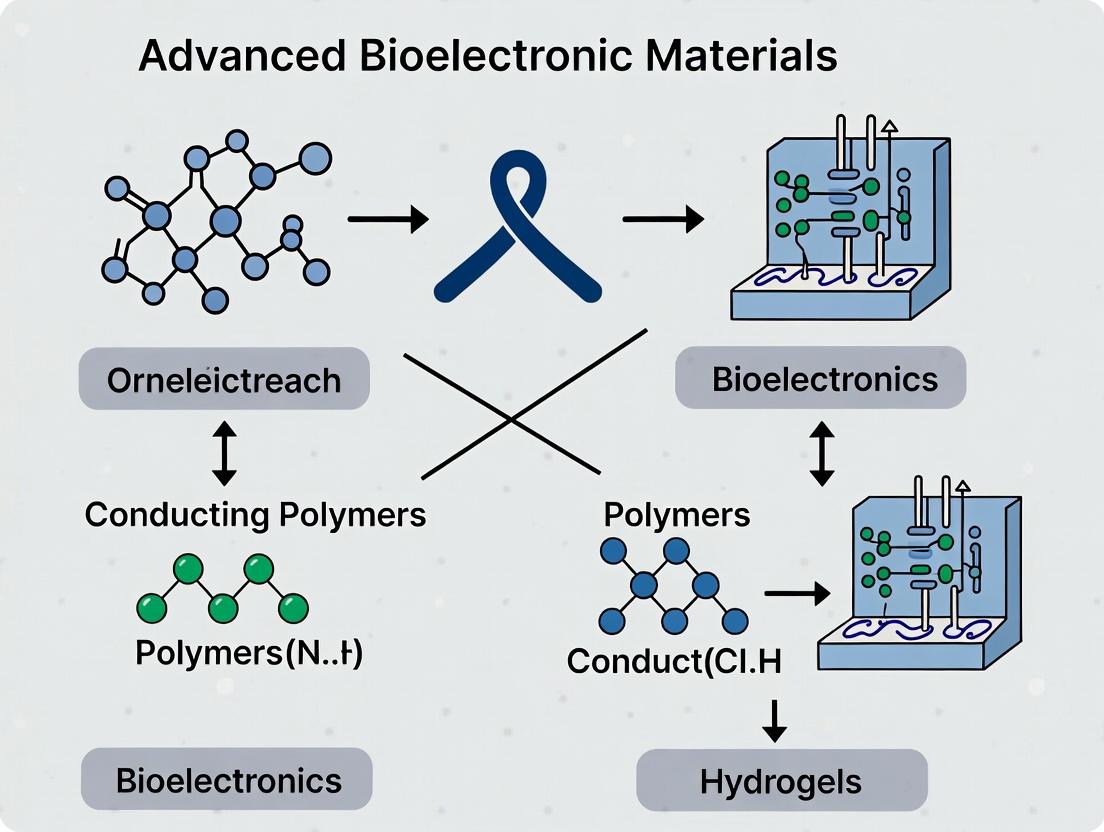
This article provides a comprehensive overview of advanced bioelectronic materials, focusing on the synergistic integration of intrinsically conducting polymers (ICPs) with hydrogels.
Bioelectronic Frontiers: Engineered Conducting Polymer Hydrogels for Next-Generation Biomedical Devices
Abstract
This article provides a comprehensive overview of advanced bioelectronic materials, focusing on the synergistic integration of intrinsically conducting polymers (ICPs) with hydrogels. We explore the fundamental chemical and physical principles that enable mixed ionic-electronic conductivity, biocompatibility, and tissue-mimetic mechanical properties. Detailed methodologies for synthesis, fabrication, and functionalization (e.g., drug loading, biofunctionalization) are examined, alongside targeted applications in neural interfaces, regenerative medicine, and smart drug delivery systems. The guide addresses critical challenges in stability, signal fidelity, and long-term integration, offering optimization strategies and troubleshooting protocols. Finally, we present comparative analyses of material platforms (e.g., PEDOT:PSS, polypyrrole, PANI-based hydrogels) and validate their performance through in vitro and in vivo models. This resource is tailored for researchers, materials scientists, and drug development professionals seeking to design and implement state-of-the-art bioelectronic devices.
The Conductive Mesh: Foundational Principles of Hybrid Conducting Polymer Hydrogels
This whitepaper defines the hybrid material class of conducting polymer hydrogels (CPHs) within the broader thesis that such advanced bioelectronic materials represent a paradigm shift in creating seamless biotic-abiotic interfaces. The convergence of the mixed ionic-electronic conductivity of polymers like PEDOT:PSS with the hydrated, biomimetic nanostructure of hydrogels yields a unique material platform for next-generation biomedical devices, soft robotics, and sustainable electronics.
Core Concepts and Synergistic Properties
Conducting Polymers: Electronic and Ionic Charge Transport
Conducting polymers (CPs) are organic polymers with a conjugated π-electron backbone that, upon doping, support electrical conductivity. Key examples include poly(3,4-ethylenedioxythiophene):poly(styrene sulfonate) (PEDOT:PSS), polypyrrole (PPy), and polyaniline (PANI). They facilitate mixed ionic and electronic conduction (MIEC), crucial for interfacing with biological systems.
Hydrogels: Hydrated and Biocompatible Networks
Hydrogels are three-dimensional, crosslinked polymer networks capable of absorbing large amounts of water or biological fluids. Their high porosity, tunable mechanical properties, and inherent biocompatibility make them ideal scaffolds for biomolecule immobilization and cellular integration.
The Hybrid: Defining Characteristics of CPHs
CPHs are synthesized by integrating conducting polymers into hydrogel matrices, either through in situ polymerization of CP monomers within a hydrogel, blending of pre-formed CPs with hydrogel precursors, or synthesis of inherently conductive hydrogel-forming polymers. The hybrid exhibits:
- Interpenetrating or co-network structures providing continuous pathways for both electrons and ions.
- Electromechanical transduction (converting electrical signals to mechanical changes and vice-versa).
- Tunable electrochemical impedance, optimizing the charge injection capacity at the tissue interface.
- Multifunctional cargo loading for controlled drug release triggered by electrical or environmental stimuli.
Quantitative Data and Material Properties
Table 1: Representative Properties of Common Conducting Polymer Hydrogels
| Material System (Example) | Conductivity Range (S/cm) | Elastic Modulus (kPa) | Swelling Ratio (%) | Key Application Area |
|---|---|---|---|---|
| PEDOT:PSS / PVA Hydrogel | 10⁻³ – 10¹ | 10 – 500 | 150 – 400 | Neural recording electrodes |
| PPy / Alginate Hydrogel | 10⁻⁴ – 10⁻¹ | 2 – 50 | 300 – 800 | Drug-eluting scaffolds |
| PANI / Chitosan Hydrogel | 10⁻⁵ – 10⁻² | 20 – 200 | 200 – 600 | Glucose biosensors |
| PEDOT / HA-PEG Hybrid | 10⁻² – 10⁰ | 1 – 30 | 500 – 1000 | Cardiac tissue engineering |
Table 2: Key Performance Metrics in Bioelectronic Applications
| Performance Metric | Target Value Range | Measurement Technique | Significance for Biointerface |
|---|---|---|---|
| Charge Storage Capacity (CSC) | 1 – 50 mC/cm² | Cyclic Voltammetry | Determines capacity for stimulation. |
| Electrochemical Impedance (1 kHz) | 0.1 – 10 kΩ·cm² | Electrochemical Impedance Spectroscopy | Lower impedance improves signal-to-noise for recording. |
| Water Content | 70 – 95% | Gravimetric Analysis | High hydration correlates with biocompatibility. |
| Drug Loading Efficiency | > 80% | HPLC/UV-Vis Spectroscopy | Critical for therapeutic delivery function. |
Experimental Protocols
Protocol:In SituSynthesis of PEDOT:PSS in a Polyacrylamide Hydrogel
Objective: To create an interpenetrating network hydrogel with homogeneous conductivity. Materials: See "The Scientist's Toolkit" (Section 6). Methodology:
- Hydrogel Precursor Solution: Prepare 10 mL of an aqueous solution containing 40 wt% acrylamide (AAm) and 1 wt% N,N'-methylenebisacrylamide (MBAA) as the crosslinker.
- Oxidant Incorporation: Dissolve 0.1 M ammonium persulfate (APS) and 0.05 M ferric chloride (FeCl₃) as a redox initiator pair into the precursor solution. Vortex thoroughly.
- Monomer Introduction: Add 0.5 M EDOT monomer and 0.75 M PSS (as a dopant and stabilizer) to the solution. Sonicate for 15 minutes to achieve a homogeneous dispersion.
- Polymerization & Gelation: Add 50 µL of tetramethylethylenediamine (TEMED) to catalyze gelation. Quickly pour the solution into a mold and incubate at 60°C for 2 hours. The simultaneous free-radical polymerization of AAm and oxidative polymerization of EDOT forms the interpenetrating network.
- Purification: Soak the synthesized hydrogel in deionized water for 48 hours, changing the water every 12 hours, to remove unreacted monomers, oligomers, and initiator salts.
- Characterization: Perform electrical conductivity measurements via 4-point probe, mechanical testing via rheometry, and analyze morphology via SEM.
Protocol: Electrochemical Deposition of PPy into a Pre-formed Alginate Hydrogel
Objective: To locally deposit a conducting polymer within a patterned hydrogel scaffold. Methodology:
- Hydrogel Fabrication: Prepare a 3% (w/v) sodium alginate solution. Crosslink into a desired shape using a calcium chloride (CaCl₂) bath (2% w/v) for 30 minutes. Rinse.
- Electrochemical Setup: Use the alginate hydrogel as the working electrode in a 3-electrode cell (Pt counter, Ag/AgCl reference). Immerse the cell in an aqueous electrolyte containing 0.1 M pyrrole monomer and 0.1 M sodium p-toluenesulfonate (NaPTS) as the dopant.
- Electrodeposition: Apply a constant potential of +0.8 V vs. Ag/AgCl for 60-300 seconds. Monitor charge passed.
- Result: PPy-PTS deposits within the superficial pores and on the surface of the alginate hydrogel, creating a conductive composite layer.
Signaling Pathways and Experimental Workflows
Title: CPH Stimulus-Response Signaling Pathway
Title: In Situ CPH Synthesis Workflow
The Scientist's Toolkit
Table 3: Essential Research Reagents for CPH Synthesis
| Reagent / Material | Function/Explanation | Example Vendor (Current) |
|---|---|---|
| EDOT (3,4-Ethylenedioxythiophene) | Core monomer for PEDOT synthesis; provides high conductivity and stability. | Sigma-Aldrich, Heraeus |
| Poly(sodium 4-styrenesulfonate) (PSS) | Polymeric dopant and charge balancer for PEDOT; also aids dispersion. | Sigma-Aldrich, Tokyo Chemical Industry |
| Ammonium Persulfate (APS) | Oxidizing agent for the chemical polymerization of pyrrole or aniline. | Fisher Scientific |
| Ferric Chloride (FeCl₃) | Oxidant for EDOT polymerization; often used in combination with PSS. | Alfa Aesar |
| Alginate (Sodium Salt) | Natural polysaccharide for ionically crosslinked hydrogel scaffolds. | NovaMatrix, FMC Biopolymer |
| Poly(vinyl alcohol) (PVA) | Synthetic polymer for forming tough, physically crosslinked hydrogels. | Sigma-Aldrich, Kuraray |
| N,N'-Methylenebisacrylamide (MBAA) | Crosslinking agent for free-radical polymerization of acrylamide. | Sigma-Aldrich |
| Tetramethylethylenediamine (TEMED) | Catalyst for gelation in polyacrylamide systems. | Bio-Rad Laboratories |
| Pyrrole | Volatile monomer for electrochemical PPy deposition; must be freshly distilled. | Sigma-Aldrich |
| Dimethyl sulfoxide (DMSO) | Secondary dopant for PEDOT:PSS; dramatically enhances conductivity. | Honeywell |
| GelMA (Gelatin Methacryloyl) | Photocurable, biofunctional hydrogel base for cell-laden CPHs. | Advanced BioMatrix |
| Lapointe RG 100 | Nanoclay used to enhance mechanical strength and printability of CPH inks. | BYK Additives |
Within the advancing frontier of bioelectronic materials, the integration of intrinsically conducting polymers (ICPs) like poly(3,4-ethylenedioxythiophene) (PEDOT), polypyrrole (PPy), and polyaniline (PANI) into hydrogel matrices represents a paradigm shift. This convergence aims to create soft, ionic-electronic conductors that bridge the biotic-abiotic interface. The core thesis posits that these composite systems uniquely combine the electrochemical activity and electronic conductivity of ICPs with the hydrated, biomimetic, and stimuli-responsive mechanical properties of hydrogels. This synergy is critical for next-generation applications in neural interfaces, controlled drug release, biosensing, and regenerative medicine.
Material Systems: Properties and Synthesis
Conducting Polymer Fundamentals
- PEDOT: Typically used as the oxidatively polymerized complex PEDOT:PSS (poly(styrene sulfonate)). It offers high conductivity, excellent optical transparency in its conducting state, and superior electrochemical stability in aqueous environments.
- Polypyrrole (PPy): Known for its high charge storage capacity, good biocompatibility, and ease of synthesis via oxidative polymerization. Its conductivity and stability are lower than PEDOT but can be enhanced with dopants.
- Polyaniline (PANI): Exists in multiple oxidation states (leucoemeraldine, emeraldine, pernigraniline), with the protonated emeraldine salt being conductive. Its conductivity is highly pH-dependent, which can be leveraged for stimuli-responsive applications.
Hydrogel Matrices
Common hydrogel backbones include natural polymers (alginate, chitosan, gelatin, hyaluronic acid) for enhanced biocompatibility and synthetic polymers (polyacrylamide, poly(ethylene glycol) diacrylate) for tunable mechanical and chemical properties.
Composite Fabrication Strategies
- In-Situ Polymerization: Monomers (EDOT, pyrrole, aniline) are diffused into a pre-formed hydrogel network and polymerized using chemical (e.g., FeCl₃, APS) or electrochemical oxidants.
- Blending/Mixing: Pre-formed ICP nanoparticles or PEDOT:PSS aqueous dispersions are physically mixed with hydrogel precursors before crosslinking.
- Interpenetrating Networks (IPNs): A conducting polymer network is formed within an existing hydrogel network, creating two interwoven but distinct phases.
Quantitative Comparison of Key Properties
Table 1: Comparative Properties of Core Conducting Polymers in Hydrogel Composites
| Property | PEDOT:PSS | Polypyrrole (PPy) | Polyaniline (PANI) | Notes |
|---|---|---|---|---|
| Typical Conductivity (S/cm) | 1 - 1000 | 10 - 100 | 1 - 100 | Highly dependent on doping, hydration, and composite morphology. PEDOT:PSS offers the highest stable conductivity. |
| Electrochemical Stability | Excellent | Moderate | Moderate (pH-sensitive) | PEDOT resists over-oxidation. PPy and PANI degrade under prolonged oxidative potentials. |
| Key Mechanical Effect on Hydrogel | Can increase stiffness, may reduce ductility | Often forms brittle phases; requires careful integration | Can form granular aggregates affecting mechanics | All composites typically sacrifice some hydrogel elasticity for conductivity. |
| Primary Bioelectronic Function | Capacitive charge injection, low-impedance coating | Faradaic charge injection, high charge capacity | pH-switchable conductivity, electrochemical actuator | |
| Common Hydrogel Partners | PEG, Alginate, GelMA, PVA | Chitosan, Alginate, PAAm | Chitosan, PAAm, PNIPAM | Chitosan is popular for its cationic nature aiding anionic dopant retention. |
Experimental Protocols
Protocol: In-Situ Chemical Polymerization of PPy in Alginate Hydrogel
Objective: To synthesize a homogeneous PPy-alginate conductive hydrogel composite. Materials: See "The Scientist's Toolkit" (Section 6). Methodology:
- Hydrogel Formation: Dissolve sodium alginate (2% w/v) in deionized water. Add 1M CaCl₂ solution dropwise under stirring to form a weak pre-gel. Cast into mold and immerse in 1M CaCl₂ for 1h to form ionically crosslinked alginate hydrogel.
- Monomer Infiltration: Rinse hydrogel with DI water. Immerse it in an aqueous 0.2M pyrrole solution for 24h at 4°C to allow full monomer diffusion.
- Oxidative Polymerization: Transfer the pyrrole-loaded hydrogel to an ice-cold 0.4M aqueous solution of ammonium persulfate (APS, oxidant) and 0.1M sodium dodecylbenzene sulfonate (dopant). React for 2-4 hours on ice.
- Post-Processing: Rinse the resulting black composite extensively with DI water to remove oxidant and oligomer by-products. Store hydrated in PBS or DI water.
Protocol: Electrochemical Deposition of PEDOT within a PEGDA Hydrogel
Objective: To electrochemically grow a conformal PEDOT layer within a porous poly(ethylene glycol) diacrylate (PEGDA) hydrogel coated on an electrode. Materials: See "The Scientist's Toolkit" (Section 6). Methodology:
- Electrode Preparation: Clean a gold or ITO working electrode. UV-polymerize a thin layer of porous PEGDA hydrogel (e.g., 10% w/v PEGDA, 0.5% photoinitiator) directly onto the electrode surface.
- Electrochemical Setup: Use a standard 3-electrode cell (Pt counter, Ag/AgCl reference) with the hydrogel-coated electrode as the working electrode.
- Electrolyte Preparation: Prepare an aqueous solution containing 0.01M EDOT monomer and 0.1M sodium poly(styrene sulfonate) (NaPSS) as the dopant/supporting electrolyte.
- Deposition: Perform potentiostatic deposition at +1.0 V vs. Ag/AgCl for 100-500 seconds. Monitor current decay.
- Rinsing: Remove electrode, rinse thoroughly with DI water to remove unreacted monomer. Characterize via cyclic voltammetry and impedance spectroscopy.
Signaling and Experimental Workflow Diagrams
Diagram 1: Conductive Hydrogel Fabrication Routes (83 chars)
Diagram 2: Bioelectronic Signal Transduction Mechanism (99 chars)
The Scientist's Toolkit: Essential Research Reagents
Table 2: Key Research Reagent Solutions and Materials
| Reagent/Material | Function in Research | Typical Use Case Example |
|---|---|---|
| PEDOT:PSS Dispersion (e.g., Clevios PH1000) | Ready-to-use conductive polymer complex for blending. | Mixing with PEGDA for UV-crosslinked conductive hydrogels. |
| EDOT Monomer | Polymerizable precursor for PEDOT synthesis. | In-situ electrochemical polymerization within hydrogels. |
| Pyrrole Monomer | Polymerizable precursor for PPy synthesis. Must be purified/distilled before use. | Chemical oxidative polymerization in alginate hydrogels. |
| Aniline Monomer | Polymerizable precursor for PANI synthesis. Requires acidic conditions for conductive form. | Forming pH-responsive conductive IPN hydrogels. |
| Ammonium Persulfate (APS) | Strong chemical oxidant for polymerizing pyrrole or aniline. | Initiating in-situ polymerization of PPy in chilled solutions. |
| Iron(III) Chloride (FeCl₃) | Alternative chemical oxidant for polymerization. | Oxidative polymerization of EDOT or pyrrole. |
| Sodium Polystyrene Sulfonate (NaPSS) | Polymeric dopant and charge balancer during polymerization. | Providing anions for PEDOT or PPy growth; enhances stability. |
| Poly(ethylene glycol) diacrylate (PEGDA) | Synthetic, photocrosslinkable hydrogel precursor. | Creating tunable, mechanically defined scaffolds for CP integration. |
| Lithium Phenyl-2,4,6-trimethylbenzoylphosphinate (LAP) | Efficient water-soluble photoinitiator for UV crosslinking. | Initiating radical polymerization of PEGDA or other vinyl hydrogels. |
| Calcium Chloride (CaCl₂) | Ionic crosslinker for alginate hydrogels. | Forming stable, divalent cation-linked alginate networks. |
This whitepaper addresses a central challenge in the field of advanced bioelectronic materials: the fundamental dichotomy between ionic and electronic charge transport mechanisms. Within the broader research thesis on conducting polymers and hydrogels for next-generation biointerfaces, achieving seamless synergy between these two regimes is paramount. Such duality is the cornerstone for creating devices that can effectively bridge the biological world (ionically conductive, aqueous) with electronic instrumentation, enabling breakthroughs in neural recording, stimulation, drug delivery systems, and biosensing.
Fundamental Principles of Transport Duality
Charge transport in bioelectronic materials operates through two parallel, often interconnected, pathways:
- Electronic Conductivity: Involves the movement of electrons or holes through delocalized orbitals (bands or hopping regimes). Characterized by high mobility and low mass charge carriers. Dominant in conducting polymers (e.g., PEDOT:PSS) in their doped state.
- Ionic Conductivity: Involves the translocation of ions (e.g., Na⁺, K⁺, Cl⁻) through a medium, typically facilitated by hydration and porous networks. Governed by ion mobility, concentration, and the material's hydration. Intrinsic to hydrogels and aqueous biological tissues.
The "duality" emerges in materials like conducting polymer hydrogels, where a nanostructured electronic network is interpenetrated by an ion-conducting aqueous phase. Here, coupled ion-electron transport and mixed conduction enable novel device physics, such as the operation of organic electrochemical transistors (OECTs).
Quantitative Data on Representative Materials
The following table summarizes key performance metrics for state-of-the-art dual-conducting materials, highlighting the trade-offs and synergies between electronic (σₑ) and ionic (σᵢ) conductivity.
Table 1: Comparative Transport Properties of Advanced Bioelectronic Materials
| Material System | Electronic Conductivity (σₑ) S cm⁻¹ | Ionic Conductivity (σᵢ) S cm⁻¹ | Hydration (%) | Primary Charge Carrier (Electronic) | Key Ions Transported | Typical Application |
|---|---|---|---|---|---|---|
| PEDOT:PSS (Dense Film) | 1 - 10³ | 10⁻⁵ - 10⁻³ | 5-15 | Holes (polarons/bipolarons) | H⁺, Na⁺ | Electrode Coating |
| PEDOT:PSS Hydrogel | 10⁻¹ - 10¹ | 10⁻³ - 10⁻¹ | 70-95 | Holes | Na⁺, K⁺, Cl⁻ | OECT Channel, Soft Electrode |
| Polypyrrole-Alginate Hydrogel | 10⁻³ - 10⁰ | 10⁻² - 10⁻¹ | 80-98 | Holes | Ca²⁺, Na⁺ | Drug-Eluting Electrode |
| Pan-based Carbon Nanofiber Hydrogel | 10¹ - 10² | 10⁻² - 10⁻¹ | 60-85 | Electrons | Various | Neural Tissue Scaffold |
| Pure PEGDA Hydrogel | < 10⁻¹⁰ | 10⁻³ - 10⁻² | ~90 | Insulating | Any physiological ion | Ionic Cable / Matrix |
Experimental Protocols for Characterizing Duality
Protocol 4.1: Four-Point Probe Electronic Conductivity with Hydration Control
- Objective: Measure the electronic conductivity (σₑ) of a hydrated conducting polymer hydrogel film.
- Materials: Four-point probe station, source-measure unit (SMU), environmental chamber, sample on insulating substrate.
- Procedure:
- Mount the hydrated sample on the stage within the environmental chamber.
- Lower four collinear, equally spaced probes onto the sample surface.
- Apply a known current (I) between the outer two probes using the SMU.
- Measure the voltage drop (V) between the inner two probes.
- Calculate sheet resistance (Rₛ) as Rₛ = (π/ln2) * (V/I). For thin films, σₑ = 1 / (Rₛ * t), where t is film thickness.
- Repeat measurement while controlling chamber humidity/temperature to establish σₑ vs. hydration relationship.
Protocol 4.2: Electrochemical Impedance Spectroscopy (EIS) for Ionic Conductivity
- Objective: Deconvolute ionic conductivity (σᵢ) and interfacial properties.
- Materials: Potentiostat with EIS capability, two-electrode cell (e.g., blocking Au electrodes), electrolyte (e.g., PBS).
- Procedure:
- Sandwich the hydrated material between two parallel blocking electrodes in the cell.
- Apply a small AC perturbation (e.g., 10 mV) over a frequency range (e.g., 1 MHz to 0.1 Hz) at open circuit potential.
- Collect complex impedance data (Z', Z'').
- Fit the Nyquist plot to an equivalent circuit model (e.g., a resistor R_bulk in series with a constant phase element, CPE).
- The high-frequency intercept on the real axis gives the bulk resistance (Rb). Calculate σᵢ as σᵢ = d / (Rb * A), where d is thickness and A is electrode contact area.
Protocol 4.3: OECT Characterization of Mixed Transport
- Objective: Quantify the mixed ionic-electronic transport figure of merit, μC*, in an Organic Electrochemical Transistor.
- Materials: OECT device (channel: material of interest), gate electrode (Ag/AgCl), source-measure units, electrolyte (PBS).
- Procedure:
- Immerse OECT channel and gate in a common electrolyte bath.
- Set a constant drain-source voltage (VDS, e.g., -0.2 V).
- Sweep gate voltage (VG) and measure drain current (ID).
- Extract the transconductance, gm = dID / dVG, at the maximum of the gm vs. VG curve.
- Calculate μC* = (gm * L²) / (VDS * W * d), where L, W, and d are channel length, width, and thickness. μ is electronic mobility, and C* is volumetric ionic capacitance.
Visualizing Mechanisms and Workflows
The Scientist's Toolkit: Research Reagent Solutions
Table 2: Essential Materials for Investigating Charge Transport Duality
| Item/Chemical | Function in Research | Key Consideration |
|---|---|---|
| PEDOT:PSS Dispersion (e.g., Clevios PH1000) | Benchmark conducting polymer. Forms the electronic network. Can be blended/gelled. | Additives (DMSO, EG) boost σₑ. Cross-linkers (GOPS) control hydration. |
| Poly(ethylene glycol) diacrylate (PEGDA) | Photocrosslinkable hydrogel precursor. Creates tunable ionic conduction matrix. | Molecular weight dictates mesh size, affecting σᵢ and swelling. |
| Dioxygenase (Sodium p-Toluenesulfonate) | Common dopant/anion for polypyrrole and PANI. Impacts both σₑ and ion exchange capacity. | Size and mobility of the counterion critically influence mixed transport. |
| Polyvinyl alcohol (PVA) / Borax | System for forming stretchable, ion-conducting supramolecular hydrogels. | Reversible borate ester bonds enable self-healing and high toughness. |
| Ionic Liquids (e.g., EMIM:TFSI) | Provide ionic conductivity in non-aqueous systems. Can also act as plasticizers/dopants. | Hydrophobicity can be used to control water uptake and ion selectivity. |
| Gelatin Methacryloyl (GelMA) | Bioactive, photocrosslinkable hydrogel. Provides natural cell adhesion motifs alongside ionic conduction. | Degree of functionalization controls mechanical and swelling properties. |
| Cross-linker: (3-Glycidyloxypropyl)trimethoxysilane (GOPS) | Epoxy-based cross-linker for PEDOT:PSS hydrogels. Enhances mechanical stability in water. | Concentration balances electronic conductivity and hydrogel stability. |
| Electrolyte: Phosphate Buffered Saline (PBS) | Standard physiological ionic medium for testing. Provides relevant ions (Na⁺, K⁺, Cl⁻, PO₄³⁻). | Osmolarity must match target biological environment to prevent anomalous swelling. |
This technical guide examines the four interdependent properties critical for the design of advanced bioelectronic materials based on conducting polymer hydrogels. Framed within broader thesis research on next-generation neural interfaces and bioactive delivery systems, this document provides a standardized framework for the characterization of these materials, essential for researchers and drug development professionals.
The convergence of conducting polymers and hydrogels has created a revolutionary class of bioelectronic materials. Their functionality in applications such as chronic neural implants, biosensors, and regenerative scaffolds hinges on the precise tuning and measurement of four key properties: electronic/ionic conductivity, equilibrium swelling ratio, porosity architecture, and mechanical compliance with biological tissues. This guide details the methodologies for their quantification.
Property Characterization: Methodologies and Data
Conductivity
Conductivity in these materials is biphasic, encompassing both electronic (via conjugated polymer backbones) and ionic (via hydrogel electrolyte) transport.
Experimental Protocol: Electronic Conductivity (4-Point Probe)
- Sample Preparation: Fabricate hydrogel into a rectangular strip (typical dimensions: 10mm x 4mm x 1mm). Ensure full hydration in relevant buffer (e.g., PBS, 0.1M).
- Setup: Mount sample on a flat insulating substrate. Align four collinear, equally spaced (e.g., 1.5mm spacing) probes using a micromanipulator.
- Measurement: Apply a known DC current (I) between the outer two probes using a source measure unit (SMU). Measure the resulting voltage drop (V) between the inner two probes.
- Calculation: Calculate resistivity ρ = (V/I) * (π/ln(2)) * t * k, where t is sample thickness and k is a correction factor for sample geometry. Conductivity σ = 1/ρ.
Experimental Protocol: Ionic Conductivity (Electrochemical Impedance Spectroscopy, EIS)
- Cell Assembly: Sandwich the hydrated hydrogel between two blocking electrodes (e.g., platinum) in a symmetric cell.
- Measurement: Perform EIS from 1 MHz to 0.1 Hz at an amplitude of 10 mV. Obtain the Nyquist plot.
- Analysis: The high-frequency intercept with the real axis represents the bulk resistance (Rb). Calculate ionic conductivity σion = L / (Rb * A), where L is thickness and A is electrode contact area.
Table 1: Representative Conductivity Data for Common Formulations
| Material System | Electronic Conductivity (S/cm) | Ionic Conductivity (S/cm) | Measurement Conditions |
|---|---|---|---|
| PEDOT:PSS / PVA Hydrogel | 1 - 10 | 0.01 - 0.05 | Hydrated, 25°C |
| Polypyrrole-Alginate | 0.1 - 5 | 0.02 - 0.1 | In PBS, 37°C |
| PANi - Chitosan | 0.01 - 1 | 0.005 - 0.03 | In 0.1M HCl, 25°C |
Swelling Ratio
The equilibrium swelling ratio (Q) dictates solute permeability, mechanical properties, and interface stability in vivo.
Experimental Protocol: Gravimetric Analysis
- Dry Mass (Md): Lyophilize the synthesized hydrogel to constant weight and record Md.
- Swelling: Immerse the dry gel in the target swelling medium (e.g., PBS, simulated body fluid) at constant temperature (e.g., 37°C).
- Equilibrium Mass (Ms): At timed intervals, remove gel, blot superficially to remove surface liquid, and weigh. Continue until mass stabilizes (±2% over 24h). Record Ms.
- Calculation: Calculate Q = Ms / Md. The volumetric swelling ratio can be derived if the polymer density is known.
Porosity
Porosity governs nutrient diffusion, cellular infiltration, and drug release kinetics.
Experimental Protocol: Mercury Intrusion Porosimetry (MIP)
- Sample Preparation: Critical point dry the hydrogel to preserve pore structure.
- Measurement: Place sample in a penetrometer. Under vacuum, mercury is intruded into the pores under progressively higher pressure.
- Analysis: The applied pressure corresponds to pore diameter via the Washburn equation. The intruded volume at each step generates a pore size distribution curve, yielding total pore volume, median pore diameter, and porosity percentage.
Table 2: Porosity and Swelling Interrelationship
| Material System | Equilibrium Swelling Ratio (Q) | Median Pore Diameter (µm) | Porosity (%) | Key Influence |
|---|---|---|---|---|
| PEDOT:PSS / PEGDA | 8 - 15 | 0.05 - 0.5 | 70 - 85 | Crosslink density |
| GelMA / PPy Nanoparticles | 12 - 25 | 5 - 50 | 85 - 95 | GelMA concentration |
| PAni - Hyaluronic Acid | 10 - 30 | 0.1 - 2.0 | 75 - 90 | Doping level & pH |
Mechanical Compliance
Matching the elastic modulus of target tissue (e.g., brain ~1 kPa, skin ~100 kPa) minimizes fibrotic encapsulation and improves signal fidelity.
Experimental Protocol: Unconfined Compression Testing
- Sample Preparation: Fabricate cylindrical hydrogel samples (e.g., 8mm diameter x 5mm height). Hydrate fully.
- Setup: Mount sample between parallel plates of a dynamic mechanical analyzer (DMA) or rheometer. Ensure lubrication (e.g., with PBS) to minimize friction.
- Measurement: Apply a small pre-load. Perform a strain-controlled compression ramp (e.g., 0.1% strain per second) up to 15-20% strain. Record stress.
- Analysis: Calculate the compressive elastic modulus (E) from the linear slope of the stress-strain curve in the 5-10% strain region.
Table 3: Mechanical Properties of Tissues and Hydrogels
| Material / Tissue | Compressive Modulus (kPa) | Storage Modulus G' (kPa) | Loss Modulus G'' (kPa) |
|---|---|---|---|
| Brain Tissue | 0.5 - 2 | ~0.3 - 1 | ~0.1 - 0.3 |
| Peripheral Nerve | 10 - 50 | N/A | N/A |
| PEDOT:PSS Hydrogel | 2 - 20 | 1 - 15 | 0.2 - 3 |
| Polypyrrole-Gelatin | 5 - 100 | 3 - 80 | 0.5 - 10 |
The Scientist's Toolkit: Research Reagent Solutions
Table 4: Essential Materials for Conducting Polymer Hydrogel Research
| Item | Function & Rationale |
|---|---|
| PEDOT:PSS Dispersion (e.g., Clevios PH1000) | Industry-standard conductive polymer complex. Serves as the electronic conductor. Can be blended or polymerized in-situ. |
| Polyethylene glycol diacrylate (PEGDA, MW 700) | Photocrosslinkable macromer. Forms the hydrogel matrix; molecular weight controls mesh size and mechanical properties. |
| Lithium phenyl-2,4,6-trimethylbenzoylphosphinate (LAP) | Biocompatible photoinitiator for UV (365-405 nm) crosslinking of hydrogels. Enables cell encapsulation. |
| Gelatin Methacryloyl (GelMA) | Photocrosslinkable, biologically derived hydrogel. Promotes cell adhesion and mimics natural ECM. |
| Pyrole Monomer (≥98%, distilled under N₂) | Monomer for in-situ oxidative polymerization within hydrogels to form conductive polypyrrole networks. |
| Iron(III) p-toluenesulfonate (Fe(Tos)₃) | Oxidant and dopant for vapor-phase or solution-phase polymerization of pyrrole and thiophene derivatives. |
| Phosphate Buffered Saline (PBS), 10X | Standard physiological buffer for swelling, conductivity, and biocompatibility testing. |
| Dulbecco's Modified Eagle Medium (DMEM) | Cell culture medium for in vitro biocompatibility and cell-laden hydrogel experiments. |
Interdependent Property Pathways
The performance of a bioelectronic hydrogel emerges from the complex interplay of its core properties. The diagram below maps the key synthesis parameters to the resulting material properties and their ultimate impact on device functionality.
Title: Property Interdependence in Bioelectronic Hydrogels
Integrated Characterization Workflow
A systematic approach to characterizing a new conducting polymer hydrogel formulation is essential for reproducible research. The following workflow outlines the sequence from synthesis to final multi-property assessment.
Title: Sequential Characterization Workflow
The long-term efficacy of implantable bioelectronic devices, such as those utilizing conducting polymers and hydrogels, is critically limited by the host's foreign body response (FBR). This intricate and dynamic immune reaction leads to fibrotic encapsulation, electrical insulation, and eventual device failure. This whitepaper details the molecular and cellular fundamentals of the FBR and provides a technical guide for researchers aiming to design next-generation materials that minimize this response, thereby enabling chronic, stable biointegration.
The Cellular & Molecular Cascade of the FBR
The FBR is a sequential, non-specific immune reaction to an implanted material.
Key Phases and Mediators
| Phase | Time Post-Implant | Key Cells Involved | Primary Molecular Mediators | Outcome |
|---|---|---|---|---|
| Protein Adsorption | Seconds to minutes | N/A | Albumin, Fibrinogen, Fibronectin, Vitronectin | Formation of a provisional matrix on the material surface. |
| Acute Inflammation | Minutes to Days | Neutrophils, Mast cells, M1 Macrophages | IL-1β, IL-6, TNF-α, ROS, Histamine | Recruitment of innate immune cells; attempt to degrade the material. |
| Chronic Inflammation | Days to Weeks | Monocytes, M1/M2 Macrophages, Lymphocytes | IL-4, IL-13, IFN-γ, TGF-β | Formation of foreign body giant cells (FBGCs) via macrophage fusion. |
| Granulation Tissue | 1-2 Weeks | Fibroblasts, Endothelial cells | TGF-β, PDGF, VEGF | Deposition of immature collagen and matrix; neovascularization. |
| Fibrous Encapsulation | Weeks to Years | Myofibroblasts | TGF-β, CTGF | Maturation of dense, avascular collagenous capsule isolating the implant. |
Central Signaling Pathways
TGF-β/Smad Pathway in Fibrosis
Material Design Strategies to Mitigate the FBR
Surface Physicochemical Modifications
Quantitative impact of surface properties on FBR outcomes (in vivo, 4-week model):
| Material Property | Optimal Value/Range for Minimizing FBR | Effect on Macrophage Attachment | Effect on Capsule Thickness (µm) | Key Mechanism |
|---|---|---|---|---|
| Hydrophilicity (Water Contact Angle) | 40-70° | Moderate Reduction | 50-80 | Optimized protein adsorption profile |
| Surface Topography (RMS Roughness) | < 20 nm | Significant Reduction | 30-60 | Limits focal adhesion points for macrophages |
| Surface Charge (Zeta Potential) | Near Neutral (± 10 mV) | Reduction | 60-100 | Minimizes electrostatic protein denaturation |
| Elastic Modulus | Matches host tissue (0.5 - 100 kPa) | Promotes M2 Phenotype | 40-120 | Mechanotransduction via macrophage integrins |
Bioactive and Biomimetic Coatings
| Coating Strategy | Example Materials | Proposed Anti-Fibrotic Mechanism | Reported Capsule Thickness Reduction* |
|---|---|---|---|
| Non-fouling Zwitterionic Polymers | Poly(sulfobetaine methacrylate) | Forms a hydration barrier, prevents protein adsorption | >70% vs. PDMS |
| Immobilized Anti-Inflammatories | Dexamethasone, IL-1Ra | Local, sustained suppression of pro-inflammatory cytokines | ~60% vs. uncoated metal |
| CD47 Mimetic Peptides | "Self" peptide sequences | Engages SIRPα receptor on macrophages, inhibits phagocytosis ("Don't eat me") | ~50% vs. control peptide |
| Extracellular Matrix (ECM) Mimics | Collagen-IV, Laminin peptide grafts | Promotes constructive remodeling and vascularization | Promotes integration, not discrete capsule |
*Results vary significantly by model and implant site.
Experimental Protocols for Assessing FBR
In Vitro Macrophage Polarization Assay
Objective: To evaluate the immunomodulatory potential of a material by quantifying macrophage phenotype (pro-inflammatory M1 vs. pro-healing M2) in response to material leachates or direct contact.
Protocol:
- Cell Culture: Seed THP-1 monocytes or primary human monocyte-derived macrophages in 24-well plates. Differentiate with PMA (100 ng/mL, 48h).
- Material Conditioning: Place sterile test materials (e.g., 1 cm² discs of conducting polymer/hydrogel) in transwell inserts or directly incubate with material-conditioned media (prepared per ISO 10993-12).
- Stimulation & Co-culture: Refresh medium with material-conditioned medium or place inserts. Include controls: M0 (unstimulated), M1 (LPS 100 ng/mL + IFN-γ 20 ng/mL), M2 (IL-4 20 ng/mL).
- Analysis (24-72h):
- qPCR: Harvest cells, extract RNA, and perform qPCR for M1 markers (TNF-α, IL-1β, iNOS) and M2 markers (ARG1, IL-10, CD206). Normalize to GAPDH.
- Flow Cytometry: Detach cells, stain for surface markers (e.g., CD86 for M1, CD206 for M2), and analyze.
- Cytokine ELISA: Measure secreted TNF-α (M1) and IL-10 (M2) in supernatant.
Workflow for In Vitro FBR Assessment
Subcutaneous Implantation Model for Fibrosis Quantification
Objective: To perform a standard in vivo assessment of the FBR to an implanted material.
Protocol:
- Material Preparation: Sterilize test and control materials (e.g., PDMS, commercial hydrogel) as 1-2 mm diameter cylinders. Ethylene oxide or ethanol immersion is standard.
- Animal Surgery: Anesthetize mice/rats (IACUC protocol required). Make a small dorsal incision, create a subcutaneous pocket using blunt dissection, and implant one material per pocket. Close wound with sutures or clips.
- Explanation & Fixation: Euthanize animals at endpoint (e.g., 2, 4, 8 weeks). Excise the implant with surrounding tissue. Fix in 4% paraformaldehyde for 24-48h.
- Histological Processing: Paraffin-embed tissue, section (5-10 µm) through the center of the implant, and mount on slides.
- Staining & Analysis:
- H&E Staining: Visualize general tissue architecture and immune cell infiltration.
- Masson's Trichrome Staining: Differentiates collagen (blue) for quantifying fibrous capsule thickness. Use image analysis software (e.g., ImageJ) to measure capsule thickness at 4-8 points around the implant perimeter and calculate average.
- Immunohistochemistry: Stain for α-smooth muscle actin (α-SMA) to identify myofibroblasts, or CD68/CD206 to assess macrophage phenotype.
The Scientist's Toolkit: Essential Research Reagents & Materials
| Reagent/Material Solution | Supplier Examples | Primary Function in FBR Research |
|---|---|---|
| THP-1 Human Monocyte Cell Line | ATCC, Sigma-Aldrich | Consistent, renewable source of human macrophages for in vitro polarization assays. |
| Recombinant Human Cytokines (IL-4, IL-13, IFN-γ, TGF-β) | PeproTech, R&D Systems | Used to polarize macrophages (M1/M2) and stimulate fibroblasts in controlled experiments. |
| LPS (Lipopolysaccharide) from E. coli | InvivoGen, Sigma-Aldrich | Standard agonist for inducing pro-inflammatory M1 macrophage polarization. |
| Anti-CD68 / Anti-CD206 / Anti-α-SMA Antibodies | Abcam, Cell Signaling Technology | Key antibodies for identifying macrophages, their phenotype, and activated myofibroblasts in tissue sections. |
| Masson's Trichrome Stain Kit | Sigma-Aldrich, Abcam | Gold standard histological stain for visualizing and quantifying collagen deposition in fibrous capsules. |
| Poly(dimethylsiloxane) (PDMS) Sylgard 184 | Dow Inc. | Ubiquitous, biocompatible elastomer control material for implantation studies. |
| Porous Polyester (PET) Membranes | Falcon (Corning), Millicell | Used in transwell systems for studying macrophage fusion into FBGCs or indirect material contact. |
| ELISA Kits for Mouse/Rat TNF-α, IL-1β, IL-10, TGF-β | BioLegend, R&D Systems | Quantify key inflammatory and fibrotic cytokines from tissue homogenates or serum. |
| Zwitterionic Polymer (e.g., SBMA) | Specific monomers from Sigma or TCI | Used to create non-fouling, hydrogel-like surface coatings to test protein resistance. |
| Picrosirius Red Stain Kit | Polysciences, Inc. | Stain for collagen that, under polarized light, differentiates mature (thick, red/yellow) from immature (thin, green) collagen fibers. |
From Synthesis to System: Fabrication and Application Protocols
Within the thesis on advanced bioelectronic materials, the synthesis of conducting polymer hydrogels (CPHs) is a foundational pillar. These materials uniquely combine the electronic/ionic conductivity of conjugated polymers with the hydrated, tissue-mimetic mechanical properties of hydrogels, making them ideal for neural interfaces, biosensors, and drug-eluting scaffolds. This guide provides a technical roadmap for their synthesis via three core techniques: chemical, electrochemical, and photopolymerization. The choice of method directly impacts critical properties such as conductivity, swelling ratio, pore size, and biocompatibility, thereby dictating the CPH's suitability for specific bioelectronic applications.
Core Synthesis Techniques: Mechanisms and Protocols
Chemical Polymerization (Oxidative)
Mechanism: This solution-based method uses a chemical oxidant (e.g., ammonium persulfate, APS) to initiate the polymerization of monomers like pyrrole, aniline, or 3,4-ethylenedioxythiophene (EDOT) in the presence of a hydrogel precursor (e.g., a polymer like chitosan or polyvinyl alcohol). Polymerization and crosslinking can occur sequentially or simultaneously (one-pot synthesis).
Detailed Protocol: One-Pot Synthesis of Polypyrrole-Alginate Hydrogel
- Solution A Preparation: Dissolve sodium alginate (1.0% w/v) in deionized water under constant stirring. Add pyrrole monomer (0.2 M) to the solution and stir for 30 minutes in an ice bath (0-4°C) under an inert atmosphere (N₂) to prevent premature oxidation.
- Oxidant Solution Preparation: In a separate vial, dissolve ammonium persulfate (APS) (0.5 M) in chilled deionized water. The oxidant-to-monomer molar ratio is typically 2.5:1.
- Polymerization: Slowly add the APS solution to Solution A with vigorous stirring. The solution will gradually turn from clear to black, indicating polypyrrole (PPy) formation.
- Crosslinking: After 2 hours of polymerization, add a calcium chloride solution (2% w/v) dropwise or immerse the mixture in a CaCl₂ bath to ionically crosslink the alginate, forming a stable hydrogel.
- Purification: Wash the resulting composite hydrogel repeatedly with DI water and ethanol to remove unreacted monomers, oligomers, and oxidant by-products until the washings run clear. Store in PBS at 4°C.
Electrochemical Polymerization
Mechanism: This technique involves applying a potential or current to an electrode immersed in an electrolyte solution containing the monomer and supporting salt. The monomer oxidizes at the anode, forming a polymer film that deposits directly onto the electrode surface. For hydrogels, the electrolyte can contain dissolved hydrogel precursors or the polymer can be electrodeposited into a pre-formed hydrogel matrix.
Detailed Protocol: Electrodeposition of PEDOT into a Porous Agarose Hydrogel
- Working Electrode Preparation: Clean a gold or ITO working electrode via sonication in acetone, ethanol, and DI water. Cast a warm agarose solution (1.5% w/v) onto the electrode and allow it to gel at room temperature, forming a porous layer.
- Electrochemical Cell Setup: Use a standard three-electrode system (Pt counter electrode, Ag/AgCl reference electrode). The electrolyte is an aqueous solution containing EDOT (0.01 M) and poly(sodium 4-styrenesulfonate) (PSS, 0.1 M) as the supporting dopant.
- Deposition: Apply a constant potential of +1.0 V vs. Ag/AgCl for 100-300 seconds. The PEDOT:PSS complex polymerizes within and on the surface of the agarose matrix.
- Post-Processing: Carefully rinse the modified electrode with DI water to remove residual electrolyte. Characterize via cyclic voltammetry and electrochemical impedance spectroscopy.
Photopolymerization
Mechanism: This method uses light (UV or visible) in the presence of a photoinitiator to generate free radicals that initiate the chain-growth polymerization of vinyl-based hydrogel monomers (e.g., poly(ethylene glycol) diacrylate - PEGDA) concurrently with the polymerization or incorporation of conducting polymers. This allows for spatial and temporal control over gelation.
Detailed Protocol: UV-Initiated Synthesis of an Interpenetrating PPy-PEGDA Network
- Precursor Formulation: Prepare an aqueous solution containing PEGDA (10% w/v, Mn 700), the photoinitiator Irgacure 2959 (0.5% w/v), and pyrrole (0.15 M).
- Oxidant Incorporation: Dissolve iron(III) chloride (FeCl₃, 0.45 M) in the solution. FeCl₃ acts as both the chemical oxidant for pyrrole and a co-initiator for the radical polymerization.
- Photopolymerization: Pour the solution into a mold or onto a substrate. Expose to UV light (365 nm, 10 mW/cm²) for 60-120 seconds. The UV light cleaves the photoinitiator, generating radicals that crosslink PEGDA. Simultaneously, Fe³⁺ oxidizes pyrrole to form PPy, creating an interpenetrating network (IPN).
- Equilibration: Transfer the polymerized hydrogel into a large volume of PBS or DI water for 24-48 hours to remove unreacted components and allow the gel to swell to equilibrium.
Comparative Analysis
Table 1: Quantitative Comparison of Synthesis Techniques for CPHs
| Parameter | Chemical Polymerization | Electrochemical Polymerization | Photopolymerization |
|---|---|---|---|
| Typical Conductivity Range | 10⁻³ to 10 S/cm | 10 to 500 S/cm | 10⁻⁴ to 10⁻¹ S/cm |
| Spatial Control | Low (bulk) | High (on electrode surface) | Very High (light-patterned) |
| Temporal Control | Low | Medium (potential-controlled) | Very High (on/off with light) |
| Film Thickness Control | Poor (bulk gels) | Excellent (tunable via charge) | Good (tunable via exposure) |
| Swelling Ratio (Typical) | 200% - 1000% | 50% - 200% | 100% - 500% |
| Key Advantage | Simplicity, scalability, good homogeneity | High conductivity, direct electrode integration | Spatial patterning, mild conditions |
| Primary Limitation | Residual oxidant/by-products | Requires conductive substrate | Monomer/initiator biocompatibility |
Table 2: Common Research Reagent Solutions for CPH Synthesis
| Reagent | Function & Rationale | Typical Concentration |
|---|---|---|
| Ammonium Persulfate (APS) | Chemical oxidant for pyrrole/aniline. Provides strong driving force for polymerization. | 0.1 - 0.5 M (in water) |
| Poly(sodium 4-styrenesulfonate) (PSS) | Polymeric dopant/counterion for PEDOT or PPy. Enhances stability and processability in water. | 0.01 - 0.1 M (in water) |
| Irgacure 2959 | UV-cleavable photoinitiator. Biocompatible, works effectively in aqueous solutions at 365 nm. | 0.1% - 1.0% w/v |
| Lithium Perchlorate (LiClO₄) | Common supporting electrolyte for electrochemical polymerization. Provides high ionic conductivity. | 0.1 M (in water or organic solvent) |
| Calcium Chloride (CaCl₂) | Ionic crosslinker for polysaccharide hydrogels (e.g., alginate). Forms gentle, divalent cation bridges. | 1% - 5% w/v (in water) |
| PEG-Diacrylate (PEGDA) | Photocrosslinkable hydrogel precursor. Mn determines mesh size and mechanical properties. | 5% - 20% w/v (in PBS/water) |
Visualization of Synthesis Workflows
Chemical Polymerization Workflow
Electrochemical Polymerization Workflow
Photopolymerization and Patterning Workflow
The synthesis roadmap delineates a toolkit for tailoring CPH properties. Chemical polymerization is ideal for bulk biomaterial fabrication for drug-eluting scaffolds. Electrochemical synthesis is paramount for creating low-impedance, direct neural electrode coatings. Photopolymerization enables the microfabrication of biosensors and patterned cell culture substrates. For drug development professionals, these materials offer programmable drug release kinetics via electrical stimulation. The ongoing research challenge lies in refining these protocols to further enhance conductivity-fidelity trade-offs, long-term stability in vivo, and the seamless integration of bioactive motifs to create the next generation of "smart" therapeutic bioelectronic interfaces.
Within the paradigm of advanced bioelectronic materials, the convergence of conducting polymers (e.g., PEDOT:PSS, PPy) and hydrogels (e.g., gelatin-methacryloyl, alginate) creates a new class of soft, electroactive substrates. These materials demand sophisticated fabrication techniques to structure them across multiple scales—from nano- to macro-dimensions—to direct cell fate, enable biosensing, and facilitate controlled drug release. This technical guide details three pivotal fabrication methods: 3D Bioprinting (additive manufacturing), Electrospinning (nanofiber production), and Micropatterning (surface engineering). Their integration is critical for constructing hierarchical, functional tissue models and next-generation bioelectronic interfaces.
3D Bioprinting of Conductive Hydrogels
Overview: Extrusion-based 3D bioprinting enables the layer-by-layer deposition of bioinks containing cells, hydrogels, and conductive polymers to create spatially organized, three-dimensional constructs.
Key Experimental Protocol: Extrusion of PEDOT:PSS-Alginate Bioink
- Bioink Formulation: Synthesize a composite bioink by blending 0.5% (w/v) PEDOT:PSS suspension with 3% (w/v) sodium alginate solution in a 1:3 volume ratio. Sterilize via 0.22 µm filtration.
- Crosslinking Strategy: Prepare a sterile 100 mM calcium chloride (CaCl₂) solution as an ionic crosslinker.
- Printing Parameters: Load bioink into a sterile syringe fitted with a 22G conical nozzle. Set the pneumatic pressure to 15-25 kPa, print speed to 8 mm/s, and stage temperature to 15°C.
- Printing & Crosslinking: Print the desired structure (e.g., a grid or neural scaffold) onto a petri dish. Immediately after printing each layer, mist with CaCl₂ solution to gel the alginate.
- Cell Integration: For cell-laden prints, mix cells (e.g., NIH/3T3 fibroblasts at 5x10⁶ cells/mL) gently into the bioink just prior to loading. Post-print, culture constructs in complete growth medium.
Quantitative Data Summary:
| Parameter | Typical Range | Impact on Construct |
|---|---|---|
| Bioink Viscosity | 10 - 50 Pa·s | Determines print fidelity and cell viability. |
| Nozzle Diameter | 200 - 400 µm | Affects resolution and shear stress on cells. |
| Printing Pressure | 10 - 30 kPa | Must be tuned with viscosity for consistent flow. |
| Conductivity (Cured) | 1 - 10 S/cm | Enables electrical stimulation of cells. |
| Cell Viability (Day 1) | 85 - 95% | Dependent on shear stress and crosslinking method. |
Electrospinning of Nanofibrous Conductive Meshes
Overview: Electrospinning produces non-woven mats of ultrafine fibers (nanoscale diameter) from polymer solutions, ideal for creating biomimetic extracellular matrix (ECM) scaffolds with high surface-area-to-volume ratios.
Key Experimental Protocol: Coaxial Electrospinning of Core-Shell PCL/PEDOT Fibers
- Solution Preparation:
- Core Solution: Dissolve 12% (w/v) Polycaprolactone (PCL) in a 7:3 mixture of chloroform and dimethylformamide (DMF).
- Shell Solution: Dissolve 1.2% (w/v) PEDOT:PSS in a 1:1 mixture of deionized water and ethanol.
- Setup Configuration: Use a coaxial spinneret. Connect the core (PCL) solution to the inner syringe and the shell (PEDOT) to the outer syringe. Use programmable syringe pumps.
- Spinning Parameters: Set flow rates: Core = 0.8 mL/h, Shell = 0.4 mL/h. Apply a high voltage of 15-18 kV. Set the tip-to-collector distance to 15 cm. Use a rotating mandrel (500 rpm) as a collector.
- Collection: Collect fibers for a predetermined time (e.g., 2 hours). Dry the collected mesh in a vacuum desiccator overnight to remove residual solvents.
Quantitative Data Summary:
| Parameter | Typical Range | Impact on Fiber Morphology |
|---|---|---|
| Fiber Diameter | 150 - 800 nm | Influenced by viscosity, voltage, and flow rate. |
| Applied Voltage | 10 - 20 kV | Drives jet formation and elongation. |
| Flow Rate | 0.5 - 2 mL/h | Higher rates can lead to bead formation. |
| Conductivity (Mesh) | 10⁻³ - 10⁻¹ S/cm | Dependent on conductive polymer loading and continuity. |
| Porosity | 80 - 95% | Critical for nutrient diffusion and cell infiltration. |
Micropatterning of Bioelectronic Surfaces
Overview: Micropatterning techniques, such as soft lithography, are used to create precise, microscale patterns of proteins, hydrogels, or conductive polymers on surfaces to control cell adhesion, morphology, and network formation.
Key Experimental Protocol: Microcontact Printing (µCP) of Laminin on PEDOT:PSS Films
- Stamp Fabrication: Create a polydimethylsiloxane (PDMS) stamp by curing silicone elastomer on an SU-8 photoresist master patterned with 30 µm wide lines.
- Ink Preparation: Fluorescently label laminin (e.g., with FITC). Prepare an inking solution at 50 µg/mL in PBS.
- Inking & Drying: Incubate the PDMS stamp in the laminin solution for 1 hour. Rinse with PBS and dry under a gentle nitrogen stream.
- Substrate Preparation: Spin-coat a thin film of PEDOT:PSS onto a glass slide. Treat with UV-ozone for 5 minutes to increase hydrophilicity.
- Printing: Gently place the inked stamp in conformal contact with the PEDOT:PSS substrate for 2 minutes. Carefully peel the stamp away.
- Backfilling: Incubate the patterned substrate in a 1% (w/v) Pluronic F-127 solution for 30 minutes to passivate unpatterned areas, preventing non-specific cell adhesion.
The Scientist's Toolkit: Research Reagent Solutions
| Reagent/Material | Function & Role in Fabrication |
|---|---|
| PEDOT:PSS | Conductive polymer dispersion; provides electronic/ionic conductivity to hydrogels and fibers. |
| Gelatin-Methacryloyl (GelMA) | Photocrosslinkable hydrogel; provides bioadhesive ECM mimic for bioprinting. |
| Calcium Chloride (CaCl₂) | Ionic crosslinker for alginate-based bioinks, enabling rapid gelation post-printing. |
| Polycaprolactone (PCL) | Biodegradable, thermoplastic polyester; provides structural integrity in electrospun fibers. |
| SU-8 Photoresist | A negative photoresist used to create high-aspect-ratio masters for soft lithography. |
| Polydimethylsiloxane (PDMS) | Elastomeric polymer used to create stamps for µCP and microfluidic devices. |
| Pluronic F-127 | Amphiphilic block copolymer; used for surface passivation to resist protein adsorption. |
| Laminin | ECM protein; patterned to direct neuronal or stem cell adhesion and differentiation. |
Visualization of Integrated Workflow and Signaling
Diagram: Integrated Fabrication Workflow for Bioelectronic Constructs
Diagram: Electrical Stimulation Induced Neurite Outgrowth Pathway
Within the broader thesis on advanced bioelectronic materials—specifically conducting polymers and hydrogels—functionalization is the critical bridge between inherent material properties and targeted biomedical function. This guide details technical strategies to incorporate bioactive moieties (e.g., peptides, growth factors) and drug carriers (e.g., nanoparticles, liposomes) into these matrices. The goal is to engineer responsive, "smart" composites for applications in neural interfaces, controlled drug release, and regenerative medicine.
Core Functionalization Strategies: A Comparative Analysis
Covalent Immobilization
Covalent bonding provides stable, permanent attachment of bioactive molecules.
- Key Reactions: Carbodiimide (EDC/NHS) coupling, click chemistry (CuAAC, SPAAC), Schiff base formation.
- Applicability: Ideal for peptides, enzymes, and signaling molecules requiring precise spatial orientation and longevity.
Physical Entrapment & Encapsulation
Relies on physical interactions (hydrophobic, ionic) or mesh entrapment within a polymer network.
- Key Methods: In-situ polymerization/gelation around cargo, diffusion-based loading, layer-by-layer assembly.
- Applicability: Suited for high-loading encapsulation of drugs, proteins, or nanoparticle carriers within hydrogels.
Affinity-Based Binding
Utilizes high-affinity biological pairs (e.g., biotin-avidin, antigen-antibody) or engineered tags (e.g., His-tag).
- Key Systems: Streptavidin-functionalized polymers binding biotinylated cargo; antibody-conjugated matrices.
- Applicability: Provides reversible or specific capture, useful for cell recruitment or sequential release systems.
Electrochemical Doping
Unique to conducting polymers (e.g., PEDOT:PSS, polypyrrole). Charged drug molecules or biomolecules are incorporated as counter-ions during electrochemical deposition and released via electrical stimulation.
- Key Process: Anodic polymerization in the presence of anionic drugs (e.g., dexamethasone phosphate).
- Applicability: Direct, electrically triggered release from bioelectrodes.
Table 1: Comparison of Functionalization Strategies for Conducting Polymer/Hydrogel Composites
| Strategy | Typical Bond/Interaction | Loading Efficiency (Range) | Stability (Half-Life) | Trigger for Release/Activation | Key Advantage | Primary Limitation |
|---|---|---|---|---|---|---|
| Covalent | Amide, triazole, imine | 70-95% | Weeks to months | Enzymatic degradation, hydrolytic cleavage | High stability, precise localization | Can denature sensitive biomolecules |
| Physical Entrapment | Mesh confinement, H-bonding | 10-80% | Days to weeks | Diffusion, matrix swelling/degradation | Simple, high payload capacity | Burst release, uncontrolled leakage |
| Affinity-Based | Biotin-Avidin (K_d ~10⁻¹⁵ M) | 50-90% | Days to weeks | Competitive displacement, pH change | High specificity, reversible | System complexity, cost |
| Electrochemical Doping | Ionic (dopant) | 0.1-5 μg/μg polymer | Minutes to hours | Applied electrical potential | Spatiotemporal, on-demand release | Low capacity, limited to charged molecules |
Table 2: Performance Metrics of Selected Functionalized Bioelectronic Materials (Recent Studies)
| Base Material | Functionalization Strategy | Bioactive/Carrier | Key Outcome (Quantitative) | Application Context |
|---|---|---|---|---|
| PEDOT:PSS Hydrogel | EDC/NHS coupling | RGD peptide | Neurite outgrowth increased by ~250% vs. control | Neural electrode coating |
| Polypyrrole Nanofiber | Electrochemical doping | Dexamethasone phosphate | ~80% release achieved with -1.0 V, 10 Hz pulse for 10 min | Anti-inflammatory neural probe |
| GelMA-PPy Composite | Physical entrapment | VEGF-loaded PLGA nanoparticles | Sustained release over 21 days; capillary density ↑ 3.1-fold in vivo | Cardiac tissue engineering |
| Chitosan-Hyaluronic Acid Hydrogel | Schiff base & encapsulation | NGF & Mesoporous SiO₂ carriers | Dual-stage release; NGF bioactivity retained >85% after 14 days | Peripheral nerve regeneration |
Detailed Experimental Protocols
Protocol 4.1: EDC/NHS Covalent Immobilization of a Peptide onto a PEDOT:PSS Hydrogel
Aim: To stably conjugate a cell-adhesive RGD peptide to a carboxylic acid-functionalized PEDOT:PSS hydrogel.
- Hydrogel Activation:
- Synthesize PEDOT:PSS-COOH hydrogel via electrochemical deposition in the presence of PSS-COOH.
- Rinse the hydrogel thoroughly with 0.1 M MES buffer (pH 5.5).
- Prepare an activation solution: 400 mM EDC and 100 mM NHS in MES buffer.
- Immerse the hydrogel in the activation solution for 30 minutes at room temperature with gentle agitation to convert surface -COOH to NHS esters.
- Rinse quickly with cold MES buffer to remove excess EDC/NHS.
- Peptide Conjugation:
- Prepare a 1 mM solution of the amine-terminal RGD peptide in PBS (pH 7.4).
- Incubate the activated hydrogel in the peptide solution for 4-12 hours at 4°C.
- Quench the reaction by immersing in 1 M ethanolamine solution (pH 8.5) for 1 hour.
- Wash extensively with PBS (3 x 30 min) to remove non-covalently bound peptide.
- Validation:
- Quantify peptide density via X-ray Photoelectron Spectroscopy (XPS) nitrogen peak or using a fluorescently tagged peptide.
Protocol 4.2: Electrochemical Loading & Triggered Release from Polypyrrole
Aim: To incorporate and release an anti-inflammatory drug from a polypyrrole (PPy) film.
- Electrodeposition & Doping:
- Prepare an aqueous deposition bath: 0.2 M pyrrole monomer and 0.1 M drug (e.g., dexamethasone sodium phosphate) as the dopant.
- Use a standard three-electrode setup (working electrode: ITO/glass, counter: Pt mesh, reference: Ag/AgCl).
- Apply a constant potential of +0.8 V vs. Ag/AgCl until a charge density of 100-200 mC/cm² is passed.
- Rinse the resulting PPy/drug film with deionized water.
- Electrically Triggered Release:
- Place the PPy/drug film in a controlled release chamber filled with PBS (pH 7.4, 37°C).
- Apply a reductive release stimulus: e.g., a constant potential of -1.0 V vs. Ag/AgCl for 10 minutes, or a pulsed potential (-1.0 V, 10 Hz, 50% duty cycle).
- Sample the release medium at predetermined intervals.
- Quantification:
- Analyze drug concentration in release samples via High-Performance Liquid Chromatography (HPLC) calibrated with standard solutions.
Visualizations
Diagram 1: Strategy Selection Flow
Diagram 2: EDC/NHS Reaction Mechanism
The Scientist's Toolkit: Research Reagent Solutions
Table 3: Essential Materials for Functionalization Experiments
| Reagent/Material | Function & Role in Functionalization | Key Considerations for Selection |
|---|---|---|
| EDC (1-Ethyl-3-(3-dimethylaminopropyl)carbodiimide) | Zero-length crosslinker; activates carboxyl groups for reaction with amines. | Hydrochloride salt is water-soluble. Use fresh, high-purity stocks in MES buffer (pH 4.5-6.0). |
| sulfo-NHS (N-Hydroxysulfosuccinimide) | Stabilizes the EDC-generated O-acylisourea intermediate, forming a more stable amine-reactive NHS ester. Increases coupling efficiency in aqueous solutions. | Sulfo-NHS is water-soluble, unlike NHS. |
| DBCO-PEG₄-NHS Ester | Click chemistry reagent; NHS ester reacts with amines on a polymer, introducing DBCO groups for subsequent, catalyst-free strain-promoted azide-alkyne cycloaddition (SPAAC). | Enables bioorthogonal conjugation of azide-modified cargo (e.g., proteins, drugs). |
| Streptavidin, Agarose-Immobilized | Affinity matrix for biotinylated molecules. Can be used to pre-complex biotin-cargo before incorporation into hydrogels or for purification. | Choose bead size and immobilization level based on binding capacity and flow rate needs. |
| PLGA (Poly(lactic-co-glycolic acid)) | Biodegradable, FDA-approved polymer for fabricating nanoparticle drug carriers. Encapsulates hydrophobic/hydrophilic drugs for controlled release. | Select lactide:glycolide ratio (e.g., 50:50, 75:25) and molecular weight to tune degradation rate from weeks to months. |
| Gelatin Methacryloyl (GelMA) | Photocrosslinkable hydrogel precursor derived from gelatin. Provides intrinsic RGD motifs; can be further functionalized or used to entrap carriers. | Degree of methacrylation controls crosslinking density, mechanical properties, and degradation. |
| Sodium Dexamethasone Phosphate | Anionic glucocorticoid drug; acts as a doping anion during electropolymerization of conducting polymers (e.g., polypyrrole) for electrically triggered release. | Model drug for neural interface anti-fouling/anti-inflammatory studies. |
The evolution of brain-machine interfaces (BMIs) is fundamentally constrained by the material properties of the neural electrode interface. Traditional metallic electrodes (e.g., Pt, IrOx) suffer from mechanical mismatch with neural tissue and exhibit poor long-term stability due to fibrous encapsulation and declining signal-to-noise ratio. This whitepaper, framed within a broader thesis on advanced bioelectronic materials, posits that the synergistic integration of conducting polymers (CPs) and soft hydrogels presents a paradigm shift. These composite materials enable the creation of electrodes that are both electronically active and biologically compliant, thereby facilitating stable, high-fidelity bidirectional communication with the nervous system for research and therapeutic applications.
Material Foundations: Conducting Polymers and Hydrogels
Conductive polymers such as poly(3,4-ethylenedioxythiophene) (PEDOT) and polyaniline (PANI) provide the essential electronic and ionic conductivity. Hydrogels like poly(2-hydroxyethyl methacrylate) (pHEMA), poly(ethylene glycol) (PEG), and alginate offer a hydrated, tissue-mimetic mechanical environment. Their combination results in soft, conductive composites.
Key Quantitative Properties of Advanced Materials
Table 1: Comparative Properties of Neural Electrode Materials
| Material Class | Example | Elastic Modulus (kPa) | Charge Storage Capacity (C/cm²) | Impedance at 1 kHz (kΩ) | Primary Function |
|---|---|---|---|---|---|
| Traditional Metal | Platinum/IrOx | 168 GPa | ~1-3 mC/cm² | ~100-500 | Rigid, inorganic conductor |
| Conducting Polymer | PEDOT:PSS | 1-3 GPa | 100-300 mC/cm² | ~5-20 | Soft(er) mixed conductor |
| Biopolymer Hydrogel | Gelatin-MA | 2-50 kPa | Negligible | >1000 | Cell-adhesive scaffold |
| Conductive Hydrogel Composite | PEDOT:Alginate | 10-100 kPa | 50-150 mC/cm² | ~10-50 | Tissue-integrated electrode |
Core Experimental Protocols
Protocol: Synthesis of a PEDOT-Alginate Conductive Hydrogel Electrode
Objective: To fabricate a soft, electroactive coating for a neural microelectrode.
- Solution Preparation: Dissolve 2% (w/v) sodium alginate in deionized water. Separately, prepare a 0.1M solution of 3,4-ethylenedioxythiophene (EDOT) monomer.
- Electrodeposition: Using a standard three-electrode setup (Pt working electrode, Pt counter electrode, Ag/AgCl reference), immerse the working electrode in the alginate/EDOT mixed solution.
- Polymerization: Apply a constant potential of +1.0 V vs. Ag/AgCl for 300 seconds. This electrophoresises EDOT into the alginate matrix and polymerizes it, forming an interpenetrating PEDOT:alginate network.
- Post-processing: Rinse the coated electrode in DI water and sterilize via ethanol immersion or UV exposure.
Protocol:In VivoElectrochemical Impedance Spectroscopy (EIS) for Stability Assessment
Objective: To longitudinally monitor the bio-integration and performance stability of an implanted electrode.
- Setup: Connect implanted electrode to a potentiostat in a three-electrode configuration (implant as working, subcutaneous Ag/AgCl as reference/auxiliary).
- Measurement: Apply a sinusoidal voltage signal with a 10 mV RMS amplitude across a frequency range of 1 Hz to 100 kHz.
- Analysis: Record the impedance magnitude and phase angle. Fit the data to a modified Randles circuit model to extract specific components (solution resistance, coating capacitance, charge transfer resistance).
- Schedule: Perform measurements pre-implantation, immediately post-surgery, and at weekly intervals for the study duration.
Signaling Pathways in Neural Interface Interaction
The foreign body response (FBR) is a critical determinant of chronic recording stability. The material-tissue interface triggers a defined molecular cascade.
Diagram 1: Foreign Body Response Signaling Pathway
Workflow for Conductive Hydrogel Electrode Development
A systematic, iterative approach is required to optimize material composition, fabrication, and validation.
Diagram 2: Conductive Hydrogel Electrode R&D Workflow
The Scientist's Toolkit: Research Reagent Solutions
Table 2: Essential Research Materials for Neural Electrode Development
| Item | Function & Rationale | Example Vendor/Product |
|---|---|---|
| EDOT Monomer | Core precursor for synthesizing PEDOT, the gold-standard conducting polymer for neural interfaces. | Heraeus Clevios M V2 |
| PSS (Polystyrene sulfonate) | Standard polymeric counter-ion/dopant for PEDOT, providing colloidal stability and balancing charge. | Sigma-Aldrich 434574 |
| Photocrosslinkable Gelatin (GelMA) | Methacrylated gelatin hydrogel; provides tuneable stiffness and natural RGD cell-adhesion motifs. | Advanced BioMatrix GelMA |
| Laminin or Poly-L-Lysine | Coating proteins to promote neuronal adhesion and neurite outgrowth in in vitro validation models. | Corning Matrigel |
| Neuroblastoma Cell Line (e.g., SH-SY5Y) | Standardized in vitro model for preliminary neuronal cytotoxicity and adhesion testing. | ATCC CRL-2266 |
| Flexible Microelectrode Arrays (MEAs) | Substrate for coating application; polyimide or parylene-C based arrays are common. | NeuroNexus, Blackrock Microsystems |
| Potentiostat/Galvanostat | Instrument for electrochemical deposition (coating), characterization (CV, EIS), and stimulation. | Biologic SP-300, Metrohm Autolab |
| Neural Recording System | Multi-channel amplifier and data acquisition system for in vivo electrophysiology validation. | Intan Technologies RHD, Tucker-Davis Technologies |
Recent Data & Future Perspectives
Recent in vivo studies (2023-2024) demonstrate the efficacy of advanced materials. Chronic implantation of PEDOT:PSS/hyaluronic acid hydrogel-coated electrodes in rodent motor cortex showed a ~40% reduction in glial fibrillary acidic protein (GFAP) expression compared to uncoated controls at 8 weeks. Simultaneously, the signal-to-noise ratio (SNR) of recorded single-unit activity remained stable (>10 dB), whereas control electrodes exhibited a >50% decay.
The future of BMI materials lies in multi-functional composites: materials that not only record/stimulate but also elute anti-inflammatory drugs (e.g., dexamethasone), promote angiogenesis, or provide topological cues for directed neurite growth. The convergence of organic electronics, regenerative medicine, and neurobiology will define the next generation of seamless brain-machine integration.
Engineered tissue scaffolds represent a cornerstone of modern regenerative medicine, enabling the repair or replacement of damaged tissues. When framed within advanced bioelectronic materials research, the integration of conducting polymers and functionalized hydrogels creates smart, responsive scaffolds. These materials not only provide a three-dimensional structural mimic of the native extracellular matrix (ECM) but also allow for the direct delivery of electrical and biochemical cues to modulate cellular behavior—such as adhesion, proliferation, differentiation, and migration. This convergence is pivotal for advancing complex tissue models, disease therapeutics, and patient-specific implants.
Core Material Systems and Quantitative Properties
The efficacy of a tissue scaffold is dictated by its material composition, which determines its mechanical, electrical, and biological properties. The following table summarizes key quantitative data for prevalent advanced materials used in bioelectronic scaffolds.
Table 1: Comparative Properties of Advanced Scaffold Materials
| Material Class | Example Materials | Typical Elastic Modulus (kPa) | Conductivity (S/cm) | Degradation Time (Weeks) | Key Biofunctional Attributes |
|---|---|---|---|---|---|
| Natural Hydrogels | Alginate, Chitosan, Collagen | 1 - 100 | ~10⁻⁶ (ionic) | 2 - 12 (tunable) | High biocompatibility, inherent cell adhesion sites, enzymatically degradable. |
| Synthetic Hydrogels | PEGDA, PVA, Pluronic F-127 | 10 - 1000 | <10⁻⁷ (insulative) | 4 - 52 (controlled) | Highly tunable mechanics and chemistry, reproducible, low immunogenicity. |
| Conducting Polymers | PEDOT:PSS, Polypyrrole (PPy), Polyaniline (PANI) | 1000 - 5000 (bulk) | 10 - 10³ | Non-degradable (stable) | High electronic/ionic conductivity, redox-active, can be functionalized. |
| Conductive Composites | PPy-Alginate, PEDOT:PSS-PEGDA, PANI-Chitosan | 50 - 500 | 10⁻³ - 10 | 4 - 24 (depends on matrix) | Combines conductivity of CPs with tunable mechanics/degradation of hydrogels. |
| Self-Healing Hydrogels | Diels-Alder, Host-Guest, Dynamic Covalent | 20 - 200 | Variable (if composite) | Can reform post-damage | Autonomous repair of mechanical integrity post-injury, sustains long-term function. |
Key Experimental Protocols
Protocol: Fabrication of a Conductive PEDOT:PSS-PEGDA Composite Hydrogel Scaffold
This protocol describes the synthesis of an electroactive, photocrosslinkable hydrogel for neural or cardiac tissue engineering.
Materials:
- Poly(ethylene glycol) diacrylate (PEGDA, MW 700 Da)
- Poly(3,4-ethylenedioxythiophene):polystyrene sulfonate (PEDOT:PSS) aqueous dispersion (1.3 wt%)
- Photoinitiator: 2-Hydroxy-4'-(2-hydroxyethoxy)-2-methylpropiophenone (Irgacure 2959)
- Phosphate Buffered Saline (PBS, 1x, pH 7.4)
- Molds (e.g., silicone, PDMS)
Method:
- Solution Preparation: In a light-protected vial, mix 10% (w/v) PEGDA in sterile PBS.
- Conductive Component Addition: Add PEDOT:PSS dispersion to the PEGDA solution at a 1:4 volume ratio (e.g., 1 mL PEDOT:PSS to 4 mL PEGDA solution). Vortex for 2 minutes.
- Photoinitiator Addition: Add Irgacure 2959 to the mixture at a final concentration of 0.5% (w/v). Vortex until fully dissolved.
- Degassing: Briefly centrifuge the solution or place under vacuum for 5 minutes to remove air bubbles.
- Molding & Crosslinking: Pipette the solution into a sterile mold. Expose to UV light (365 nm, 5-10 mW/cm²) for 60-120 seconds to initiate free-radical polymerization and form the hydrogel network.
- Post-Processing: Gently remove the polymerized hydrogel from the mold and rinse 3x with PBS to remove unreacted monomers.
Protocol: In Vitro Assessment of Cardiomyocyte Maturation on Conductive Scaffolds
This functional assay evaluates the impact of electrical conductivity on tissue-level maturation.
Materials:
- Human induced pluripotent stem cell-derived cardiomyocytes (iPSC-CMs)
- Conductive (PEDOT:PSS-PEGDA) and non-conductive (PEGDA-only) hydrogel scaffolds.
- Electrical stimulator with carbon electrode culture chamber.
- Immunostaining reagents: Anti-cardiac Troponin T, Anti-Connexin 43, DAPI.
- RNA extraction kit and qPCR reagents for maturation markers (e.g., MYH6, MYH7, RYR2).
Method:
- Cell Seeding: Seed iPSC-CMs onto pre-equilibrated scaffolds at a density of 1x10⁶ cells/cm³.
- Electrical Stimulation (Day 3-14): For the test group, apply a monophasic, rectangular electrical pulse (1 Hz, 5 ms pulse width, 2 V/cm) continuously for 7 days using a custom bioreactor. Maintain control groups (on both scaffold types) in identical conditions without stimulation.
- Functional Analysis (Day 14):
- Immunofluorescence: Fix scaffolds, section, and stain for sarcomeric organization (Troponin T) and gap junctions (Connexin 43). Quantify sarcomere length and Connexin 43 puncta localization.
- Gene Expression: Homogenize cell-laden scaffolds, extract RNA, and perform qPCR for mature cardiac markers. Use GAPDH as a housekeeping gene. Calculate fold-change vs. non-conductive, unstimulated control.
- Contractility: Record spontaneous beating videos. Use motion tracking software to analyze beating rate, synchronization, and contraction velocity.
Signaling Pathways in Electrically Modulated Osteogenesis
Electrical stimulation (ES) applied via conductive scaffolds enhances bone regeneration by activating specific signaling cascades. The primary pathway involves voltage-gated calcium channels (VGCCs) and downstream calcium-mediated signaling.
Diagram Title: Electrical Stimulation Activates Calcium-Dependent Osteogenic Pathways
Workflow for Developing a Bioelectronic Tissue Scaffold
The rational design and validation of a functional scaffold follow a structured, iterative pipeline from material synthesis to in vivo assessment.
Diagram Title: Bioelectronic Scaffold Development and Validation Workflow
The Scientist's Toolkit: Key Research Reagent Solutions
Table 2: Essential Reagents for Bioelectronic Scaffold Research
| Reagent / Material | Primary Function | Key Considerations for Use |
|---|---|---|
| PEDOT:PSS Dispersion | Provides high, stable mixed ionic/electronic conductivity to hydrogel matrices. | Variants exist (e.g., with additives for higher conductivity). May require sonication before use. Can be blended before crosslinking. |
| Methacrylated Gelatin (GelMA) | Combines natural ECM bioactivity (RGD sites) with phototunable crosslinking. | Degree of functionalization affects mechanics & degradation. Must be kept cold and used with a photoinitiator. |
| Irgacure 2959 Photoinitiator | Initiates free-radical polymerization of vinyl groups (e.g., in PEGDA, GelMA) under UV light. | Cytotoxicity concerns at high concentrations. Optimal at 0.05-0.5% w/v. Requires UV ~365 nm. |
| Matrix Metalloproteinase (MMP)-Sensitive Peptide Crosslinkers | Enables cell-mediated scaffold degradation and remodeling, critical for invasion. | Often incorporated as part of a hydrogel backbone. Sequence (e.g., GPQGIWGQ) defines cleavage specificity. |
| Carbon Nanotubes (CNTs) or Graphene Oxide (GO) | Nanoscale conductive additives that also significantly reinforce mechanical strength. | Dispersion is critical to prevent aggregation. Functionalization (e.g., -COOH) improves biocompatibility and mixing. |
| Electrical Stimulation Bioreactor | Provides controlled, physiologically relevant electrical cues to cell-scaffold constructs in vitro. | Systems should allow sterile culture, have customizable waveforms, and electrodes that do not corrode. |
This whitepaper, framed within a broader thesis on advanced bioelectronic materials, explores the synergistic integration of conducting polymers and hydrogels for next-generation responsive drug delivery and biosensing platforms. These smart materials respond to specific biological or external stimuli, enabling precise temporal and spatial control over therapeutic release and highly sensitive analyte detection, crucial for personalized medicine and point-of-care diagnostics.
Core Material Systems: Conducting Polymers and Hydrogels
Conducting Polymers (CPs)
CPs such as poly(3,4-ethylenedioxythiophene) (PEDOT), polypyrrole (PPy), and polyaniline (PANI) provide electronic and ionic conductivity, enabling electrical signal transduction. Their redox state can be switched electrochemically, altering properties like volume, wettability, and drug-binding affinity.
Hydrogels
Hydrogels (e.g., based on alginate, poly(N-isopropylacrylamide) (pNIPAM), or poly(ethylene glycol) (PEG)) offer a hydrated, biocompatible 3D network. They can be engineered to respond to pH, temperature, enzymes, or glucose.
Hybrid/Composite Systems
The fusion of CPs within hydrogel matrices creates "conducting hydrogels" that exhibit mixed electronic/ionic conductivity, mechanical compliance resembling biological tissues, and multi-responsive behavior.
Stimuli-Responsive Mechanisms for Drug Delivery
Drug release is triggered by local environmental changes or applied external signals.
Table 1: Key Stimuli-Responsive Mechanisms
| Stimulus | Material Example | Mechanism | Typical Response Time | Drug Load Capacity (Reported Range) |
|---|---|---|---|---|
| Electrical Potential | PEDOT/PSS hydrogel | Redox-driven swelling/deswelling or electrostatic expulsion. | Seconds to minutes | 5 - 150 µg/mg polymer |
| pH Change | Chitosan/PPy composite | Protonation/deprotonation alters chain conformation & mesh size. | Minutes to hours | 10 - 200 µg/mg hydrogel |
| Enzyme (e.g., Matrix Metalloproteinase) | PEG-peptide-PPy network | Enzyme-specific cleavage of cross-links, degrading the matrix. | Hours to days | 50 - 300 µg/mg scaffold |
| Glucose | Glucose oxidase (GOx) embedded in PEDOT/ hydrogel | GOx catalyzes glucose→gluconic acid, lowering local pH, triggering release. | 20 - 60 minutes | 15 - 100 U of insulin/mg |
Biosensing Modalities and Transduction Principles
Conducting hydrogels facilitate sensitive biosensing via multiple transduction mechanisms.
Table 2: Biosensing Transduction Mechanisms in Conducting Hydrogels
| Transduction Method | Target Analyte | Material Configuration | Detection Limit (Recent Reports) | Linear Range |
|---|---|---|---|---|
| Amperometric | Glucose, H₂O₂ | GOx immobilized in PEDOT/ hydrogel on electrode. | 0.5 - 2.0 µM (Glucose) | 10 µM - 30 mM |
| Potentiometric | K⁺, Na⁺ | Ion-selective membranes with CP interlayer. | 10⁻⁵ - 10⁻⁶ M | 10⁻⁵ - 0.1 M |
| Impedimetric | Cancer biomarkers (e.g., PSA) | Antibody-functionalized PPy hydrogel; binding changes charge transfer resistance. | 0.1 - 1.0 pg/mL | 1 pg/mL - 100 ng/mL |
| Voltammetric | Dopamine, Uric Acid | Carbon nanotube/ PEDOT hydrogel electrode for enhanced surface area. | 2 - 10 nM (Dopamine) | 0.01 - 100 µM |
Detailed Experimental Protocols
Protocol: Synthesis of a Electrically-Triggered Drug Delivery Hydrogel
Objective: Fabricate a PEDOT:Alginate hydrogel for electrically controlled release of dexamethasone.
- Solution Preparation: Dissolve 2% (w/v) sodium alginate in deionized water. Separately, prepare 0.1 M EDOT monomer and 0.1 M sodium p-toluenesulfonate (dopant) solution.
- Gelation & Polymerization: Mix alginate solution with EDOT/dopant solution (4:1 v/v). Add 50 mg of dexamethasone. Cast the mixture into a mold.
- Cross-linking: Immerse the cast film in 2% (w/v) CaCl₂ solution for 30 mins to ionically cross-link alginate.
- Electropolymerization: Place the cross-linked film as working electrode in a 3-electrode cell (Pt counter, Ag/AgCl reference) with 0.1 M NaCl electrolyte. Apply a constant potential of 1.0 V for 300 seconds to polymerize EDOT within the hydrogel network.
- Characterization: Rinse thoroughly and characterize by cyclic voltammetry (CV) and scanning electron microscopy (SEM).
Protocol: Fabrication of an Impedimetric Biosensor for Interleukin-6 (IL-6)
Objective: Create an anti-IL-6 antibody-conjugated PPy hydrogel sensor.
- Electrodeposition of PPy Base: On a gold working electrode, perform electrophysiomerization from a solution containing 0.1 M pyrrole and 0.1 M potassium chloride at 0.8 V vs. Ag/AgCl for 100s.
- Carboxyl Group Functionalization: Transfer electrode to a solution of 0.1 M pyrrole and 0.1 M pyrrole-3-carboxylic acid. Apply 0.7 V for 50s to form a functionalized copolymer layer.
- Antibody Immobilization: Activate carboxyl groups using a 20-minute immersion in a solution of 50 mM EDC and 20 mM NHS in MES buffer (pH 6.0). Rinse and incubate with 20 µg/mL anti-IL-6 antibody in PBS (pH 7.4) for 2 hours at 4°C.
- Blocking: Block non-specific sites with 1% BSA for 1 hour.
- Measurement: Record electrochemical impedance spectroscopy (EIS) spectra in 5 mM [Fe(CN)₆]³⁻/⁴⁻ after incubation with samples. The increase in charge transfer resistance (Rₐₜ) correlates with IL-6 concentration.
Signaling Pathways and Experimental Workflows
Diagram 1: General Workflow for Stimuli-Responsive Drug Delivery
Diagram 2: Biosensing Signal Transduction Pathway
The Scientist's Toolkit: Essential Research Reagent Solutions
Table 3: Key Research Reagents and Materials
| Item | Supplier Examples | Function in Research |
|---|---|---|
| EDOT (3,4-ethylenedioxythiophene) Monomer | Sigma-Aldrich, Heraeus | Core monomer for synthesizing biocompatible, stable PEDOT. |
| Pyrrole, Aniline Monomers | TCI Chemicals, Sigma-Aldrich | Fundamental monomers for PPy and PANI conducting polymers. |
| Sodium Alginate, Gelatin Methacryloyl (GelMA) | NovaMatrix, Cellink | Biopolymer hydrogel backbones providing biocompatibility and tunable mechanics. |
| N-Isopropylacrylamide (NIPAM) | Fujifilm Wako, Sigma-Aldrich | Monomer for synthesizing thermoresponsive pNIPAM hydrogels. |
| Cross-linkers (CaCl₂, EDC/NHS, APS/TEMED) | Thermo Fisher, Sigma-Aldrich | Ionic (Ca²⁺), chemical (carbodiimide), and radical (redox) initiators for gelation. |
| Electrochemical Workstation | Metrohm, CH Instruments, Gamry | For electropolymerization, CV, DPV, and EIS characterization. |
| Phosphate Buffered Saline (PBS), HEPES Buffer | Thermo Fisher, Sigma-Aldrich | Standard physiological pH buffers for incubation and release studies. |
| Model Drugs (Dexamethasone, Doxorubicin) | Cayman Chemical, MedChemExpress | Small molecule and chemotherapeutic agents for release studies. |
| Glucose Oxidase (GOx), Horseradish Peroxidase (HRP) | Sigma-Aldrich, Roche | Key enzymes for constructing oxidase-based biosensors. |
| Recombinant Proteins & Antibodies | R&D Systems, Abcam | Target analytes and capture ligands for specific biosensor development. |
Navigating Challenges: Stability, Performance, and Integration Solutions
Mechanical mismatch at the tissue-device interface is a critical failure point in chronically implanted bioelectronics, causing fibrotic encapsulation, signal degradation, and device failure. This whitepaper, framed within advanced research on conducting polymers and hydrogels, details the mechanisms, quantitative consequences, and state-of-the-art mitigation strategies. We provide a technical guide for researchers and drug development professionals to engineer compliant, stable interfaces.
Bioelectronic implants—neural electrodes, biosensors, cardiac pacemakers—typically employ rigid, high-modulus materials (e.g., silicon, platinum, stainless steel). Native tissues (brain, heart, skin) are soft, viscoelastic, and dynamic. This mechanical mismatch induces strain concentration, chronic inflammation, and a foreign body response (FBR), culminating in a non-conductive fibrous scar.
The following tables summarize key quantitative relationships between mechanical mismatch and biological/functional outcomes.
Table 1: Material Modulus vs. Tissue Response
| Material/Tissue | Young's Modulus (MPa) | Approximate Shear Stress at Interface (Pa) | Observed Fibrotic Capsule Thickness (µm) after 4 Weeks | Signal Attenuation (%) |
|---|---|---|---|---|
| Silicon (Neural Probe) | 150,000 - 180,000 | 1200 - 1500 | 150 - 300 | 60 - 80 |
| Platinum-Iridium | 160,000 | 1100 - 1400 | 130 - 250 | 50 - 75 |
| Brain Tissue | 0.1 - 1 | N/A | N/A | N/A |
| Polyimide | 2,000 - 3,000 | 400 - 600 | 80 - 150 | 30 - 50 |
| Conducting Polymer (PEDOT:PSS) Film | 1 - 2,000 (tunable) | 50 - 300 | 50 - 100 | 20 - 40 |
| Soft Hydrogel | 0.01 - 10 | < 10 | 10 - 50 | 5 - 20 |
Table 2: Impact of Device Size and Modulus on Chronic Inflammation Metrics
| Device Characteristic (Normalized) | Pro-inflammatory Cytokine Expression (IL-1β, TNF-α) | Macrophage Density (cells/mm²) | Microglial Activation (Brain) |
|---|---|---|---|
| Large, Rigid (Control) | 100% (Baseline) | 100% (Baseline) | 100% (Baseline) |
| Small, Rigid | 75 - 85% | 80 - 90% | 85 - 95% |
| Large, Soft (Modulus < 1 MPa) | 30 - 50% | 40 - 60% | 50 - 70% |
| Small, Soft | 15 - 30% | 20 - 40% | 25 - 45% |
Core Mechanisms and Signaling Pathways
Chronic inflammation driven by mechanical mismatch follows a defined cellular pathway.
Diagram Title: Mechanically-Induced Foreign Body Response Pathway
Experimental Protocols for Characterization
Protocol 1: Quantifying the Foreign Body Response In Vivo
- Implantation: Surgically implant material samples (e.g., rigid control vs. soft hydrogel-based electrode) into target tissue (e.g., rodent cortex or subcutaneous pocket).
- Time Points: Euthanize subjects at 1, 2, 4, and 12 weeks post-implantation (n=5 per group per time point).
- Histology: Perfuse-fix, explant tissue with device, section, and stain.
- H&E: General morphology and capsule thickness measurement (ImageJ).
- IHC for Immune Cells: Anti-Iba1 (macrophages/microglia), anti-CD68 (activated macrophages), anti-CD3 (T-cells), anti-Col1a1 (fibroblasts/collagen).
- Quantification: Use blinded analysis to measure capsule thickness, cell density within 100 µm of interface, and fluorescence intensity of markers.
Protocol 2: In Vitro Assessment of Cell-Material Mechanical Interaction
- Substrate Fabrication: Create PDMS or hydrogel substrates with tunable elastic moduli (0.5 kPa to 2 GPa) via cross-linker ratio control. Coat with consistent adhesion molecule (e.g., laminin).
- Cell Culture: Seed primary macrophages (e.g., bone marrow-derived macrophages) or neural cells onto substrates.
- Activation & Analysis:
- Immunofluorescence (24-72h): Stain for actin (phalloidin), focal adhesions (vinculin), and nuclei (DAPI). Quantify cell spread area and focal adhesion size.
- qPCR/ELISA (24h): Measure expression of Il1b, Tnf, Arg1 (M2 marker), and iNos (M1 marker) to profile inflammatory phenotype.
- Traction Force Microscopy: Use embedded fluorescent beads to map and quantify contractile forces exerted by cells on substrates.
Mitigation Strategies: The Role of Advanced Materials
Strategy 1: Hydrogel-Based Softening Interfaces
- Concept: Use a hydrogel as a buffer layer. Hydrogels (modulus ~0.1-10 kPa) can match tissue mechanics.
- Advanced Approach: Conductive hydrogels incorporating poly(3,4-ethylenedioxythiophene):polystyrene sulfonate (PEDOT:PSS) nanofibers or graphene oxide provide both ionic/electronic conductivity and tissue-like softness.
- Fabrication Workflow:
Diagram Title: Conductive Hydrogel Interlayer Fabrication Workflow
Strategy 2: Structurally Engineered Compliant Devices
- Concept: Use geometric designs (serpentine, mesh, filamentary) to reduce effective bending stiffness (∝ width * thickness³).
- Materials: Nano/micro-scale patterning of polyimide, parylene, or silicon into mesh electronics.
- Key Metric: Bending Stiffness is reduced by 4-8 orders of magnitude vs. bulk material, enabling tissue interdigitation.
The Scientist's Toolkit: Key Research Reagent Solutions
Table 3: Essential Materials for Interface Mismatch Research
| Reagent/Material | Function/Description | Key Supplier Examples |
|---|---|---|
| Poly(3,4-ethylenedioxythiophene) Polystyrene Sulfonate (PEDOT:PSS) | Conducting polymer for soft electrodes. Enhances charge injection, lowers impedance. | Heraeus Clevios, Sigma-Aldrich |
| Gelatin Methacryloyl (GelMA) | Photocrosslinkable, cell-adhesive hydrogel backbone. Tunable modulus. | Advanced BioMatrix, Cellink |
| Polyethylene Glycol Diacrylate (PEGDA) | Bio-inert, hydrophilic hydrogel for creating modulus gradients. | Sigma-Aldrich, Laysan Bio |
| Laminin or Poly-L-Lysine | Surface coating to standardize cell adhesion across different mechanical substrates. | Corning, Thermo Fisher |
| Anti-Iba1 / Anti-CD68 Antibodies | Key immunohistochemistry markers for macrophages/microglia in FBR. | Abcam, Bio-Rad |
| CytoSoft Rigidity Plates | Commercial tool: PDMS or hydrogel-coated plates with defined, arrayed elastic moduli for in vitro screening. | Advanced BioMatrix |
| Piezoelectric Polymer (PVDF) Films | For in situ measurement of strain/stress at the interface. | TE Connectivity, Piezo.com |
| Cellulose Nanocrystal (CNC) Reinforcements | Natural nanomaterial for mechanically reinforcing hydrogels without compromising biocompatibility. | CelluForce, University Labs |
Managing mechanical mismatch is paramount for next-generation bioelectronics. The integration of conducting polymers into hydrogel matrices and the use of fractal, soft geometries represent the leading edge of this research. Future work must focus on in vivo long-term stability of these soft conductors, understanding the mechanobiological signaling in detail, and developing standardized in vitro predictive models for the FBR. The goal is a seamless, information-rich tissue-device interface that endures for a lifetime.
The integration of conducting polymers (CPs) with hydrogel matrices represents a paradigm shift in the development of advanced bioelectronic materials. These hybrids aim to bridge the mismatch between rigid, high-performance electronics and soft, dynamic biological tissues. The central challenge lies in preserving the inherent electronic conductivity of the polymer while embedded in a highly hydrated, ionically conductive hydrogel network, which typically promotes charge dissipation. This whitepaper, framed within a broader thesis on next-generation biointerfaces, provides a technical guide to strategies and methodologies for optimizing and sustaining electrical performance in these hydrated composite systems.
Core Mechanisms & Strategies for Sustained Conductivity
Sustaining conductivity in hydrated states hinges on controlling nano/microstructure and managing ion-electron coupling.
Primary Strategies:
- Interpenetrating Network (IPN) Design: Creating a contiguous, percolating pathway of the conducting polymer (e.g., PEDOT:PSS) within a separate, swollen hydrogel network (e.g., polyacrylamide, alginate). The CP network must remain intact and interconnected despite hydrogel expansion.
- Conductivity-Enhancing Secondary Doping: Use of high-boiling-point polar solvents (e.g., ethylene glycol, ionic liquids) as secondary dopants. These solvents reorganize polymer chains, enhancing both intra-chain and inter-chain charge transport, an effect that can persist in aqueous environments.
- Nanocomposite Integration: Incorporation of conductive nanofillers (e.g., graphene oxide, carbon nanotubes, MXenes) that form bridging connections between CP domains, preventing isolation upon swelling.
- Crosslinking & Stabilization: Chemical or physical crosslinking of the CP phase itself to prevent dissolution or morphological collapse in water.
Table 1: Performance Comparison of Hydrated Conducting Polymer Hydrogels
| Material System | Conductivity (Dry) | Conductivity (Hydrated) | Swelling Ratio | Key Stabilization Method | Ref. Year |
|---|---|---|---|---|---|
| PEDOT:PSS / PAAm IPN | ~350 S/cm | ~85 S/cm | ~3.5 | EG Secondary Doping & IPN | 2022 |
| PAni / Phytic Acid / PVA | ~0.5 S/cm | ~0.4 S/cm | ~2.1 | In-situ Polymerization & Acid Doping | 2023 |
| PPy / Alginate / Graphene Oxide | ~12 S/cm | ~5 S/cm | ~4.0 | GO Bridging Networks | 2024 |
| PEDOT / Chitosan / Ionic Liquid | ~40 S/cm | ~22 S/cm | ~2.8 | Ionic Liquid as Co-dopant | 2023 |
Table 2: Impact of Secondary Dopants on Hydrated Conductivity
| Secondary Doping Agent | Conductivity Retention (%)* | Effect on Mechanical Robustness | Key Function |
|---|---|---|---|
| Dimethyl Sulfoxide (DMSO) | ~60-70% | Moderate improvement | Chain alignment, phase separation |
| Ethylene Glycol (EG) | ~75-85% | Significant improvement | Enhances polymer crystallinity |
| Sorbitol | ~50-60% | High improvement (crosslinker) | Induces fibrous PEDOT formation |
| Ionic Liquid ([EMIM][EtSO₄]) | ~90-95% | Maintains flexibility | Plasticizer & charge shield |
*Retention defined as (Hydrated Conductivity / Dry Conductivity) x 100%.
Experimental Protocols
Protocol 1: Synthesis of EG-Doped PEDOT:PSS/Polyacrylamide IPN Hydrogel
Objective: To fabricate a hybrid hydrogel with high and stable electronic conductivity under physiological hydration. Materials: See "The Scientist's Toolkit" below. Procedure:
- PEDOT:PSS Pre-treatment: Mix 5 mL of pristine PEDOT:PSS dispersion with 0.5 mL of ethylene glycol and 10 µL of (3-glycidyloxypropyl)trimethoxysilane (GOPS). Stir vigorously for 1 hour at room temperature.
- Hydrogel Precursor Solution: In a separate vial, dissolve 1.5 g of acrylamide monomer and 20 mg of N,N'-methylenebisacrylamide (crosslinker) in 8 mL of deionized water. Add 10 mg of ammonium persulfate (APS) as thermal initiator.
- IPN Formation: Combine the treated PEDOT:PSS and the acrylamide precursor solution. Mix thoroughly via vortexing for 5 minutes.
- Polymerization Initiation: Degas the mixture with nitrogen for 10 min. Add 20 µL of tetramethylethylenediamine (TEMED) to catalyze gelation. Pour into a mold.
- Curing: Allow polymerization to proceed at 60°C for 2 hours in an oven.
- Post-processing: Carefully demold the hydrogel and immerse in DI water for 48 hours, changing water every 12 hours, to remove unreacted monomers and induce equilibrium swelling. The EG remains within the PEDOT:PSS phase.
Protocol 2: In-Situ Electrochemical Impedance Spectroscopy (EIS) for Hydrated Monitoring
Objective: To measure the evolution of electrical conductivity during hydrogel hydration/swelling in real-time. Procedure:
- Sample Preparation: Cut the synthesized dry or semi-dry hydrogel into a rectangular strip (e.g., 10mm x 5mm x 1mm). Attach two gold foil electrodes with conductive silver paste at either end, ensuring a known electrode gap (e.g., 5mm).
- Setup: Connect the sample to a potentiostat/galvanostat with EIS capability. Submerge the sample in a PBS (pH 7.4) bath at 25°C, keeping electrodes above the liquid line.
- Measurement: Immediately initiate a time-series EIS measurement. Apply a sinusoidal voltage with 10 mV amplitude over a frequency range from 1 MHz to 1 Hz. Take a measurement every 60 seconds for 24 hours.
- Data Analysis: Fit the high-frequency semicircle in the Nyquist plot to a simple resistor model. Calculate bulk resistance (R). Using sample dimensions, compute conductivity (σ = L / (R * A)), where L is the gap and A is the cross-sectional area. Plot conductivity vs. time to observe stabilization.
Visualization Diagrams
Diagram Title: IPN Hydrogel Conductivity Retention Strategy
Diagram Title: Protocol for In-Situ Hydrated Conductivity Measurement
The Scientist's Toolkit: Research Reagent Solutions
Table 3: Essential Materials for Conducting Polymer Hydrogel Research
| Item | Function/Relevance | Example Product/CAS |
|---|---|---|
| PEDOT:PSS Dispersion | Primary conductive polymer component. Provides the base electronic conductivity. | Clevios PH1000, 155090-83-8 |
| Ethylene Glycol (EG) | Secondary dopant for PEDOT:PSS. Reorganizes polymer chains, dramatically boosting and stabilizing conductivity. | 107-21-1 |
| (3-Glycidyloxypropyl)trimethoxysilane (GOPS) | Crosslinker for PEDOT:PSS. Chemically stabilizes the network against re-dispersion in water. | 2530-83-8 |
| Acrylamide / Bis-acrylamide | Monomer and crosslinker for forming the hydrogel matrix (e.g., polyacrylamide). Provides soft, hydratable scaffold. | 79-06-1 / 110-26-9 |
| Ammonium Persulfate (APS) & TEMED | Redox initiator pair for free-radical polymerization of hydrogel networks. | 7727-54-0 / 110-18-9 |
| Ionic Liquids | Co-dopant/plasticizer. Enhances conductivity and prevents PEDOT aggregation. | e.g., [EMIM][EtSO₄] |
| Graphene Oxide (GO) Dispersion | Conductive nanofiller. Can bridge isolated CP domains and add mechanical strength. | 7782-42-5 (graphite deriv.) |
| Phytic Acid Solution | Natural, biocompatible dopant for polymers like polyaniline; also acts as crosslinker. | 83-86-3 |
| Potassium Phosphate Buffered Saline (PBS) | Standard hydration medium for simulating physiological conditions during testing. | N/A |
Within the paradigm-shifting field of advanced bioelectronic materials—specifically conducting polymers and hydrogels—the long-term functional integrity of implantable or chronically used devices is paramount. The core thesis of modern research posits that for these materials to transition from laboratory curiosities to reliable clinical and diagnostic tools, they must overcome intrinsic degradation pathways. Performance degradation manifests primarily through two interrelated yet distinct mechanisms: oxidative instability (chemical degradation from reactive oxygen species, applied electrical potentials, and inflammatory biofouling) and mechanical instability (cracking, delamination, loss of conductivity under strain, and mismatch with dynamic biological tissues). This whitepaper synthesizes current, cutting-edge strategies to combat these dual challenges, providing a technical guide for researchers and drug development professionals working at the materials-biology interface.
Oxidative Stability: Mechanisms and Countermeasures
Oxidative degradation in conducting polymers (e.g., PEDOT:PSS, PANI) and conductive hydrogels is driven by overoxidation during operation, attack by physiological reactive oxygen species (ROS), and enzymatic activity. This leads to chain scission, cross-link breaking, and the irreversible loss of electronic and ionic conductivity.
Key Strategies and Supporting Data
Recent research has focused on molecular design, nanocomposite formation, and protective barrier technologies.
Table 1: Quantitative Efficacy of Oxidative Stability Strategies
| Strategy | Material System | Test Condition | Key Metric (Initial) | Key Metric (After Aging) | % Retention | Ref (Year) |
|---|---|---|---|---|---|---|
| Side-Chain Engineering | Glycolated PEDOT:PSS | 0.8V vs. Ag/AgCl, 12hrs in PBS | Conductivity: 1250 S/cm | Conductivity: 1100 S/cm | 88% | (2023) |
| Antioxidant Doping | PEDOT:PSS / Trolox hydrogel | H2O2 (1mM), 24 hrs | Charge Capacity: 35 mC/cm² | Charge Capacity: 32 mC/cm² | 91% | (2024) |
| Graphene Oxide Nanocomposite | PANI/GO hydrogel | 10,000 CV cycles, pH7.4 | Capacitance: 450 F/g | Capacitance: 405 F/g | 90% | (2023) |
| Protective Nafion Coating | PEDOT microelectrode | Electrical Stim, 2 weeks in vivo | Impedance @1kHz: 2 kΩ | Impedance @1kHz: 3.5 kΩ | 57% (vs. 15% for uncoated) | (2024) |
Experimental Protocol: Accelerated Oxidative Aging Test
- Objective: To evaluate the electrochemical stability of a novel conductive hydrogel under simulated oxidative stress.
- Materials: Test hydrogel film (≈100 µm thick on Pt electrode), Phosphate Buffered Saline (PBS, pH 7.4), 3-electrode potentiostat setup, hydrogen peroxide (H2O2, 1-10 mM optional for harsh testing).
- Procedure:
- Baseline Characterization: Perform Cyclic Voltammetry (CV) in PBS from -0.6V to 0.8V vs. Ag/AgCl at 100 mV/s for 20 cycles to establish stable baseline charge storage capacity (CSC, calculated by integrating CV curve).
- Aging Protocol: Apply a constant potential of 0.7V vs. Ag/AgCl (or a continuous square-wave potential pulse) to the working electrode for a defined period (e.g., 2-24 hours) in aerated PBS at 37°C. Alternative: Immerse sample in PBS containing 1mM H2O2 at 37°C with gentle agitation for 7 days.
- Post-Test Analysis:
- Re-run CV under identical conditions as Step 1. Calculate CSC.
- Measure electrochemical impedance spectrum (EIS) from 100 kHz to 1 Hz.
- Characterize surface morphology via SEM/AFM and chemistry via FTIR or XPS.
- Data Analysis: Calculate percentage retention of CSC and low-frequency impedance. FTIR peaks indicative of carbonyl groups (C=O, ~1700 cm⁻¹) confirm overoxidation.
Mechanical Stability: Strategies for Robust Interfaces
Mechanical failure arises from cyclic loading, swelling/deswelling, and mismatch with the elastic modulus of tissues (~0.5-100 kPa). Strategies aim to enhance toughness, fatigue resistance, and adhesion.
Key Strategies and Supporting Data
Innovation centers on double-network hydrogels, compliant conductive fillers, and dynamic covalent chemistry.
Table 2: Quantitative Efficacy of Mechanical Stability Strategies
| Strategy | Material System | Mechanical Property | Key Metric (Initial) | Key Metric (After Cycling) | Test Condition | Ref (Year) |
|---|---|---|---|---|---|---|
| Double-Network Hydrogel | PAAm-Alginate/PEDOT:PSS | Fracture Toughness | 8000 J/m² | N/A | Single test | (2023) |
| Silk Fibroin Reinforcement | PEDOT:PSS/SF hydrogel | Tensile Modulus | 0.8 MPa | N/A | 100% Strain | (2024) |
| Self-Healing Ionogel | PEDOT:PSS / Borate ester gel | Conductivity Recovery | 10 S/m | 95% recovery | Cut & rejoin, 5 mins | (2023) |
| Nanomesh Embedded | PU Nanofiber/PEDOT | Fatigue Resistance | Resistance: 1.2 kΩ/sq | Resistance: 1.5 kΩ/sq | 1000 cycles @ 30% strain | (2024) |
Experimental Protocol: Cyclic Strain-Testing of Conductance
- Objective: To assess the electromechanical stability of a stretchable conductor under simulated physiological motion.
- Materials: Stretchable conductor film, custom or commercial tensile tester with electrical feedthroughs, digital multimeter or source-meter, non-ionic lubricant (optional).
- Procedure:
- Sample Mounting: Clamp the sample strip (e.g., 20mm x 5mm) in the tensile grips. Attach four-point probe contacts or silver paste electrodes with copper wires to measure resistance in situ.
- Baseline Measurement: Measure initial resistance (R₀) at 0% strain.
- Cycling Protocol: Program the tensile tester to apply a cyclic strain profile (e.g., 0% to 20% strain) at a physiologically relevant frequency (e.g., 0.5 Hz). Simultaneously, record resistance (R) continuously or at the peak of each cycle.
- Duration: Continue for a target number of cycles (e.g., 100, 1000, 5000).
- Data Analysis: Calculate normalized resistance change: ΔR/R₀ = (R - R₀)/R₀. Plot ΔR/R₀ versus cycle number. The stability is indicated by a low, steady-state plateau.
Integrated Pathways and Workflow
The development of stable bioelectronic materials requires a systematic approach that considers oxidative and mechanical stressors in tandem.
Title: Bioelectronic Material Stability Testing Workflow
The Scientist's Toolkit: Key Research Reagent Solutions
Table 3: Essential Materials for Stability Research
| Reagent / Material | Primary Function & Rationale |
|---|---|
| PEDOT:PSS (PH1000, Clevios) | Benchmark aqueous conductive polymer dispersion. Serves as the base for most composite hydrogels. Requires stability enhancements. |
| Poly(ethylene glycol) diacrylate (PEGDA) | Photocrosslinkable hydrogel precursor. Forms a biocompatible, hydrating matrix to host conductive elements and modulate mechanical properties. |
| Gelatin Methacryloyl (GelMA) | Bioactive, tunable hydrogel backbone derived from collagen. Promotes cell adhesion and provides a viscoelastic, tissue-mimetic mechanical profile. |
| Graphene Oxide (GO) Dispersion | 2D nanomaterial for reinforcement. Improves mechanical strength and can act as an antioxidant scavenger. Reducible to conductive rGO. |
| (3-Glycidyloxypropyl)trimethoxysilane (GOPS) | Crosslinking agent for PEDOT:PSS. Significantly enhances mechanical integrity and adhesion to substrates in thin films. |
| Nafion Perfluorinated Resin | Ionic polymer used as a protective, cation-selective coating. Mitigates biofouling and reduces direct oxidative attack on the underlying conductor. |
| Ascorbic Acid / Trolox | Water-soluble antioxidants. Doped into hydrogels to locally scavenge reactive oxygen species, preserving the conductive polymer's redox state. |
| Dulbecco's Phosphate Buffered Saline (DPBS) | Standard isotonic buffer for in vitro aging tests. Provides physiologically relevant ions (Na+, K+, Ca2+, Mg2+, Cl-, phosphate) for swelling and electrochemical testing. |
| Hydrogen Peroxide (H2O2) | Source of reactive oxygen species for accelerated oxidative stress testing in controlled concentrations (µM to mM range). |
Troubleshooting Signal-to-Noise Ratio and Electrode Impedance
Advancements in bioelectronic interfaces, particularly those utilizing conducting polymers and hydrogels, are central to the next generation of neural recording, biosensing, and closed-loop therapeutic systems. The core thesis posits that the strategic synthesis and functionalization of soft, ionic-electronic hybrid materials can fundamentally overcome the chronic biotic-abiotic mismatch, leading to stable, high-fidelity electrophysiological interfaces. However, the practical realization of this thesis is critically dependent on solving two interconnected technical challenges: optimizing the Signal-to-Noise Ratio (SNR) and managing Electrode Impedance. This guide provides an in-depth technical framework for diagnosing and resolving these issues within the context of advanced bioelectronic materials research.
Fundamental Principles and Quantitative Benchmarks
The performance of a bioelectronic electrode is governed by the relationship between its impedance (Z) and the thermal noise, which together define the theoretical noise floor. For a stable interface, the key parameters include the interfacial impedance magnitude and phase, the intrinsic noise, and the charge injection capacity (CIC).
Table 1: Target Performance Metrics for Advanced Bioelectronic Interfaces
| Parameter | Ideal Target (1 kHz) | Poor Performance Indicator | Primary Material Determinant |
|---|---|---|---|
| Impedance Magnitude | < 1 kΩ·cm² | > 100 kΩ·cm² | Effective surface area, volumetric capacitance |
| Phase Angle | -45° to -90° (capacitive) | > -10° (resistive) | Ionic mobility, polymer redox activity |
| Thermal Noise (RMS) | < 5 µV (300 Hz–5 kHz) | > 20 µV | Real component of impedance |
| 1/f Noise Corner Frequency | < 10 Hz | > 100 Hz | Material/interface stability |
| Charge Injection Limit (CIC) | > 1 mC/cm² | < 0.1 mC/cm² | Water content, mixed ionic-electronic conductivity |
Table 2: Common Failure Modes and Material Correlates
| Observed Issue | Potential Root Cause in CP/Hydrogels | Diagnostic Experiment |
|---|---|---|
| High-Frequency Impedance Rise | Polymer dehydration, hydrogel pore collapse | Dynamic Impedance Spectroscopy (1 Hz–1 MHz) |
| Low-Frequency Impedance Drift | Uncontrolled swelling/desorption, ion depletion | Chronoamperometry with EIS pre/post |
| Increased 1/f Noise | Crack formation in film, delamination | SEM/AFM imaging post-cycling |
| Sudden SNR Drop | Electrolyte penetration to metal substrate, oxidative degradation | Cyclic Voltammetry (window stability) |
Experimental Protocols for Diagnosis
Protocol 1: Comprehensive Electrochemical Impedance Spectroscopy (EIS) Analysis
Objective: To characterize the frequency-dependent impedance and differentiate between bulk material and interfacial contributions.
Materials:
- Potentiostat/Galvanostat with EIS capability.
- Standard three-electrode cell: Working Electrode (test substrate), Pt mesh Counter Electrode, Ag/AgCl Reference Electrode.
- Phosphate Buffered Saline (PBS, 0.01M, pH 7.4) or simulated interstitial fluid.
- Faraday cage.
Methodology:
- Cell Setup: Immerse the electrode system in electrolyte within a Faraday cage. Ensure stable open circuit potential (OCP) for 10 minutes.
- EIS Acquisition: Apply a sinusoidal perturbation of 10 mV RMS across a frequency range of 0.1 Hz to 100 kHz. Log data at 10 points per decade.
- Data Fitting: Fit the resulting Nyquist and Bode plots to an equivalent circuit model. For conducting polymer hydrogels, a modified Randles circuit with a constant phase element (CPE) and Warburg diffusion element is typically appropriate:
R_s(CPE(R_ctW)). - Key Analysis: Extract the magnitude at 1 kHz (clinical/relevant band), the solution resistance (Rs), charge transfer resistance (Rct), and CPE parameters. A rising low-frequency tail indicates diffusion limitations.
Protocol 2: In-Situ SNR Validation During Electrophysiological Recording
Objective: To quantify the true recording performance in an operational environment.
Materials:
- Multichannel electrophysiology amplifier/data acquisition system.
- In-vitro brain slice preparation or engineered neural tissue model.
- Reference commercial electrode (e.g., PtIr) for baseline comparison.
- Signal generator for calibrated input test.
Methodology:
- Baseline Noise Measurement: Submerge the test and reference electrodes in warmed, oxygenated artificial cerebrospinal fluid (aCSF). Record for 60 seconds with no active tissue present. Calculate the RMS noise (V_rms) across the band of interest (e.g., 300–5000 Hz for unit activity).
- Signal Induction: Place electrodes in active tissue. Evoke neural activity via electrical stimulation or chemical agonist.
- SNR Calculation: For identified action potentials (spikes), SNR is calculated as:
SNR (dB) = 20 * log10( V_peak-to-peak / V_rms ). A minimum of 20 identified spikes should be averaged. - Drift Monitoring: Record low-frequency (<1 Hz) local field potential for 1 hour. Calculate drift rate (µV/min).
The Scientist's Toolkit: Research Reagent Solutions
Table 3: Essential Materials for CP/Hydrogel Electrode Fabrication & Testing
| Item | Function & Rationale |
|---|---|
| Poly(3,4-ethylenedioxythiophene):Poly(styrene sulfonate) (PEDOT:PSS) | Benchmark conducting polymer. PSS provides counter-ion dopant and colloidal stability. Often blended with cross-linkers. |
| Gelatin-Methacryloyl (GelMA) | Photocrosslinkable hydrogel base. Provides tunable softness (modulus) and RGD motifs for biotic integration. |
| Polyethylene Glycol Diacrylate (PEGDA) | Inert, hydrophilic crosslinker for forming hydrogel networks. Controls mesh size and ionic diffusion. |
| Dulbecco's Phosphate Buffered Saline (DPBS) | Standard ionic medium for in-vitro testing. Maintains physiological osmolarity and pH. |
| Lithium Perchlorate (LiClO₄) | Electrolyte for electrochemical deposition. Li⁺ ions facilitate efficient polymerization. |
| Ethylene Glycol | Secondary dopant for PEDOT:PSS. Enhances conductivity and film stability through morphological change. |
| (3-Glycidyloxypropyl)trimethoxysilane (GOPS) | Crosslinking agent for PEDOT:PSS. Improves adhesion to substrate and water stability. |
Visualization of Concepts and Workflows
Diagram 1: SNR Optimization Decision Pathway
Diagram 2: EIS Data Interpretation Workflow
Within the research trajectory of advanced bioelectronic materials, encompassing conducting polymers and hydrogels, the transition from in vitro validation to in vivo application is a critical juncture. The long-term performance and biocompatibility of implanted devices are inextricably linked to the sterilization methods employed and the subsequent biological response. This technical guide examines the practical considerations for sterilizing sensitive polymeric bioelectronic materials and the host-device interface dynamics governing long-term implantation.
Sterilization Modalities: Mechanisms and Material Impact
Sterilization must eradicate all viable microorganisms while preserving the functional integrity of the bioelectronic material. The chemical, morphological, and electronic properties of conducting polymers (e.g., PEDOT:PSS) and hydrogels (e.g., alginate, PEG) are highly susceptible to degradation.
Table 1: Comparative Analysis of Sterilization Methods for Bioelectronic Polymers
| Method | Mechanism | Typical Cycles | Key Advantages | Documented Impacts on Polymers & Hydrogels |
|---|---|---|---|---|
| Ethylene Oxide (EtO) | Alkylation of proteins/DNA. Gas diffusion. | 2-6 hrs at 37-55°C, 40-80% humidity. | Effective at low temps; penetrates packaging. | Hydrogels: Possible retention of gas residues, swelling alterations. CPs: Minimal impact on conductivity; potential for dopant neutralization. |
| Gamma Irradiation | DNA strand breakage via radiolysis. | 25-35 kGy dose. | Excellent penetration; terminal process. | Hydrogels: Chain scission or crosslinking, altered modulus/degradation. CPs: Conductivity degradation (~10-40% loss at 25 kGy); increased brittleness. |
| Electron Beam (E-Beam) | Similar to gamma, but lower penetration. | 25-35 kGy dose, faster. | Precise, rapid, less oxidative. | Hydrogels: Similar to gamma, but more surface-localized effects. CPs: Slightly less oxidative damage than gamma; conductivity loss possible. |
| Steam Autoclave | Protein denaturation via moist heat. | 121°C, 15 psi, 20-60 min. | Fast, low-cost, non-toxic. | Hydrogels: Severe deformation, hydrolysis, collapse. CPs: Total loss of electronic function; dopant leaching; dehydration. |
| Low-Temperature Hydrogen Peroxide Plasma | Generation of free radicals. | 45-55°C, 45-75 min. | Low temperature, rapid cycle, no toxic residuals. | Hydrogels: Good compatibility with many synthetics; possible surface oxidation. CPs: Can oxidize and reduce conductivity; variable compatibility. |
Protocol 2.1: Pre-Sterilization Material Preparation and Conditioning
- Environmental Control: Conduct all preparation in a ISO Class 5 (Class 100) laminar flow hood.
- Cleaning: Rinse fabricated hydrogel-conducting polymer composites in three successive baths of sterile, deionized water (18.2 MΩ·cm) for 5 minutes each to remove residual solvents/salts.
- Drying (For certain methods): For EtO sterilization, precondition samples at 40% relative humidity, 25°C for 8 hours to ensure uniform gas penetration and prevent desiccation.
- Packaging: Seal devices in breathable Tyvek pouches (for EtO, plasma) or sealed glass vials (for irradiation controls). Include biological indicators (Geobacillus stearothermophilus for moist heat/plasma; Bacillus atrophaeus for EtO/gamma).
- Control Groups: Always include non-sterilized controls and sample replicates dedicated to each analytical test (SEM, FTIR, electrochemical impedance spectroscopy (EIS)).
The Foreign Body Response and Interface Management
Long-term implantation success requires managing the foreign body response (FBR), a cascade leading to fibrous encapsulation, which can isolate the device and degrade its function.
Diagram 1: Key Signaling Pathways in the Foreign Body Response
Protocol 3.1: In Vivo Assessment of Long-Term Biocompatibility & FBR
- Animal Model & Implantation: Utilize a validated model (e.g., Sprague-Dawley rat subcutaneous or C57BL/6 mouse muscle pouch). Anesthetize and prepare surgical site.
- Implantation: Create a blunt dissection pocket. Implant sterile test material (e.g., 5mm diameter disc) and appropriate controls (e.g., medical-grade silicone, sham surgery). Use a minimum of n=8 devices per group/time point.
- Explanation & Analysis: Sacrifice animals at predetermined endpoints (e.g., 1, 4, 12 weeks). Carefully excise implant with surrounding tissue.
- Histology: Fix in 10% neutral buffered formalin for 48h. Process, embed in paraffin, section at 5µm. Perform H&E staining for capsule thickness measurement, and Masson's Trichrome for collagen density.
- Immunohistochemistry: Stain for macrophages (anti-CD68), myofibroblasts (anti-αSMA), and pro-fibrotic cytokines (anti-TGF-β). Quantify using digital image analysis (e.g., ImageJ).
- Device Function Test: For explanted bioelectronic devices, perform immediate EIS in PBS to measure change in electrode impedance compared to pre-implantation baseline.
Integration with Bioelectronic Function
The ideal implant minimizes the insulating fibrous layer while maintaining stable electrical communication.
Table 2: Quantitative Outcomes of Surface Modifications on FBR and Electrical Performance
| Surface Modification Strategy | Capsule Thickness Reduction* | Macrophage Polarization Shift (M1:M2)* | Change in Chronic Impedance* (1 kΩ at 1 kHz) | Key Mechanism |
|---|---|---|---|---|
| Porous Hydrogel Coating (e.g., PEG) | ~40-60% | Increases M2 markers | -20% to +30% (Varies with hydration) | Physical barrier disruption; reduced protein fouling. |
| Anti-inflammatory Drug Elution (e.g., Dexamethasone) | ~50-70% | Strongly increases M2 | +5% to +15% (Drug may alter local conductivity) | Pharmacological suppression of inflammation. |
| Biomimetic Peptide Coating (e.g., RGD) | ~20-40% | Moderate increase in M2 | -10% to +10% | Enhanced integration with native tissue; mitigated immune recognition. |
| Conductive Hydrogel Coating | ~30-50% | Data limited | -50% or more | Ionic/electronic charge transfer; reduced interfacial impedance. |
*Data compiled from recent in vivo rodent studies (2020-2023). Values are approximate ranges compared to uncoated rigid controls.
Diagram 2: Workflow for Implant Performance Optimization
The Scientist's Toolkit: Research Reagent Solutions
Table 3: Essential Reagents and Materials for Sterilization & Implantation Studies
| Item | Function & Rationale |
|---|---|
| PEDOT:PSS Dispersion (e.g., Clevios PH1000) | Standard conducting polymer for fabricating electroactive electrode surfaces. Stability post-sterilization is a key test parameter. |
| Poly(ethylene glycol) diacrylate (PEGDA, MW 700-10k) | Photocrosslinkable hydrogel precursor for creating soft, porous coatings to modulate the FBR. |
| Dexamethasone Sodium Phosphate | Potent synthetic glucocorticoid for creating anti-inflammatory eluting coatings to suppress early immune cell activation. |
| RGD Peptide (Arg-Gly-Asp) | Cell-adhesive peptide sequence for covalently grafting onto implant surfaces to promote integrin-mediated bioactive integration. |
| Phosphate Buffered Saline (PBS), Sterile, 10X | Standard for rinsing, in vitro testing, and as a solvent for biological reagents. Sterility is critical for pre-implantation device handling. |
| Type I Rat Tail Collagen | High-purity collagen for creating in vitro 3D cell culture models of the implant-tissue interface or as a bioactive coating. |
| Anti-CD68 & Anti-αSMA Antibodies | Primary antibodies for immunohistochemical identification of macrophages and myofibroblasts, respectively, in explanted tissue sections. |
| Biological Indicators (Spore Strips) | Geobacillus stearothermophilus (for steam, plasma) and Bacillus atrophaeus (for EtO, radiation). Essential for validating sterilization cycle efficacy. |
| Electrochemical Impedance Spectrometer | Core instrument for measuring the in vitro and ex vivo electrical performance of devices (impedance, charge storage capacity). |
Benchmarking Performance: Comparative Analysis and Preclinical Validation
This whitepaper presents a comparative analysis of conducting polymer formulations, central to the development of advanced bioelectronic interfaces within a broader thesis on conducting polymers and hydrogels. The evolution of soft, ionically/electronically conductive materials is critical for creating seamless biotic-abiotic interfaces for sensing, stimulation, and drug delivery. Poly(3,4-ethylenedioxythiophene):poly(styrene sulfonate) (PEDOT:PSS) has emerged as a benchmark material, yet numerous alternatives and modifications are actively researched to overcome its limitations and tailor properties for specific applications. This guide provides a technical framework for evaluating these materials based on standardized metrics and protocols relevant to researchers and drug development professionals.
Core Performance Metrics & Quantitative Data
The evaluation of conducting polymer formulations hinges on a suite of interdependent metrics. The following tables summarize key quantitative data for PEDOT:PSS and competing formulations.
Table 1: Electrical and Electrochemical Performance Metrics
| Material Formulation | Typical Conductivity (S/cm) | Volumetric Capacitance (F/cm³) | Electrochemical Impedance (1 kHz, Ω·cm²) | Stability (Cycles to 80% Capacitance Retention) |
|---|---|---|---|---|
| PEDOT:PSS (Clevos PH1000) | 1 - 10³ | 30 - 100 | 10 - 100 | 10⁶ - 10⁷ |
| PEDOT:PSS + 5% DMSO | 500 - 1,200 | 80 - 120 | 5 - 50 | 10⁶ - 10⁷ |
| PEDOT:PSS + Ionic Liquid | 800 - 2,500 | 100 - 200 | 2 - 20 | 10⁵ - 10⁶ |
| Pure PEDOT (VPP) | 500 - 2,000 | 150 - 300 | 1 - 10 | 10⁷ |
| PANi (Polyaniline) | 1 - 100 | 50 - 150 | 50 - 500 | 10⁴ - 10⁵ |
| PPy (Polypyrrole) | 10 - 200 | 40 - 100 | 20 - 200 | 10⁴ - 10⁵ |
| PEDOT:PSS / PEGDA Hydrogel | 0.1 - 10 | 10 - 50 | 100 - 1,000 | 10³ - 10⁴ |
Table 2: Mechanical and Biological Interface Properties
| Material Formulation | Young's Modulus (MPa) | Fracture Strain (%) | Swelling Ratio (%) | In Vitro Cell Viability (%) |
|---|---|---|---|---|
| Pristine PEDOT:PSS Film | 1,000 - 2,500 | 2 - 5 | 10 - 20 | 70 - 85 |
| PEDOT:PSS + PEG Softener | 10 - 100 | 30 - 80 | 20 - 40 | 85 - 95 |
| Conducting Hydrogel (PEDOT:PSS-based) | 0.01 - 1.0 | 100 - 500 | 200 - 800 | 90 - 99 |
| Pure PPy Film | 500 - 1,500 | 10 - 20 | 5 - 15 | 60 - 75 |
| PANi Nanofiber Mat | 50 - 200 | 15 - 30 | 50 - 150 | 75 - 85 |
Experimental Protocols for Key Evaluations
Protocol: Four-Point Probe Conductivity Measurement
Objective: To measure the electronic conductivity of a thin film. Materials: Four-point probe head, source-meter unit, sample on insulating substrate. Procedure:
- Place the probe head in gentle, even contact with the film surface.
- Apply a known current (I) between the outer two probes using the source-meter.
- Measure the resulting voltage drop (V) between the inner two probes.
- Calculate sheet resistance (Rs) using the geometric correction factor (F): Rs = F * (V/I).
- Calculate bulk conductivity (σ) using film thickness (t): σ = 1 / (R_s * t).
Protocol: Cyclic Voltammetry for Capacitance & Stability
Objective: To characterize electrochemical capacitance and cycling stability. Materials: Potentiostat, 3-electrode cell (Ag/AgCl reference, Pt counter, working electrode with material). Procedure:
- Immerse the cell in 0.1 M NaCl or PBS (pH 7.4).
- Record cyclic voltammograms (CVs) at scan rates from 10 mV/s to 500 mV/s within a water window (e.g., -0.6V to 0.8V vs. Ag/AgCl).
- Calculate volumetric capacitance (Cv) from a CV at scan rate *v*: Cv = (∫ I dV) / (2 * v * V * vol), where ∫ I dV is the integrated area of the CV, V is the voltage window, and vol is the electrode volume.
- For stability, perform continuous potential cycling (e.g., 10,000 cycles) and monitor the decay of the charge storage capacity (CSC) derived from the CVs.
Protocol: Electrochemical Impedance Spectroscopy (EIS) Characterization
Objective: To measure the impedance profile of the material/electrolyte interface. Materials: Potentiostat with EIS capability, same 3-electrode setup as 3.2. Procedure:
- Apply a sinusoidal potential perturbation with small amplitude (e.g., 10 mV rms) across a frequency range (e.g., 100 kHz to 0.1 Hz) at the open-circuit potential.
- Fit the resulting Nyquist plot to an equivalent circuit model (e.g., Rs(Cdl(RctW))) to extract the charge transfer resistance (Rct) and double-layer capacitance (C_dl).
- Report the magnitude of the impedance at physiologically relevant frequencies (e.g., 1 kHz).
Visualizations: Pathways & Workflows
Title: Material Development and Evaluation Workflow
Title: Bioelectronic Interface Signaling Pathway
The Scientist's Toolkit: Key Research Reagent Solutions
| Reagent / Material | Primary Function in Research |
|---|---|
| PEDOT:PSS Dispersion (e.g., Clevos PH1000) | Benchmark conducting polymer suspension for spin/drop-casting, inkjet printing. Provides baseline electronic properties. |
| Dimethyl Sulfoxide (DMSO) | Common secondary dopant for PEDOT:PSS. Enhances conductivity by reordering PEDOT chains. |
| Ethylene Glycol (EG) or (3-Glycidyloxypropyl)trimethoxysilane (GOPS) | Additives to improve film conductivity, mechanical stability, and adhesion to substrates. |
| Poly(ethylene glycol) diacrylate (PEGDA) | Photocrosslinkable monomer for creating soft, swellable hydrogel matrices to encapsulate PEDOT:PSS. |
| Ionic Liquids (e.g., [EMIM][TFSI]) | Dopants/co-solvents to dramatically boost conductivity and modify electrochemical properties. |
| Polyurethane Dispersions | Elastomeric binders to create stretchable, conductive blends with PEDOT:PSS. |
| Laminin or Poly-L-Lysine | Bioactive coatings applied atop conducting polymers to promote cell adhesion and growth. |
| Phosphate Buffered Saline (PBS) | Standard electrolyte for in vitro electrochemical and biocompatibility testing, mimicking physiological conditions. |
| Lithium Perchlorate (LiClO₄) / PBS Gel | Electrolyte medium for characterizing electrochemical properties in a hydrated, gel-like state. |
The development of advanced bioelectronic materials, particularly conducting polymers (e.g., PEDOT:PSS, PPy) and electroactive hydrogels, necessitates robust, physiologically relevant in vitro validation platforms. These materials are designed for interfacing with biological systems in applications such as neural electrodes, biosensors, and electrically stimulated tissue regeneration. Traditional 2D cell culture falls short in mimicking the dynamic mechanical, electrical, and biochemical microenvironment. This guide details three tiers of validation models—standard cell culture, organ-on-a-chip (OoC), and integrated electrical stimulation—within the specific context of characterizing next-generation bioelectronic interfaces.
Core Validation Models: Methodologies and Protocols
Two-Dimensional (2D) Cell Culture on Bioelectronic Substrates
Purpose: Initial assessment of cytocompatibility, cell adhesion, proliferation, and basic differentiation on novel material surfaces. Detailed Protocol:
- Substrate Preparation: Spin-coat or electrodeposit conducting polymer (e.g., PEDOT:PSS) onto sterile glass coverslips or ITO electrodes. For hydrogels, UV crosslink pre-polymer solutions (e.g., GelMA mixed with PANI nanoparticles) in PDMS molds.
- Surface Characterization: Prior to cell seeding, characterize surface roughness (AFM), wettability (contact angle goniometry), and electrochemical impedance spectroscopy (EIS).
- Cell Seeding: Seed relevant cell lines (e.g., PC12 for neuronal models, C2C12 for myocytes, NIH/3T3 for fibroblasts) at a density of 5,000-10,000 cells/cm² in appropriate complete medium.
- Cytocompatibility Assay (Live/Dead Staining):
- At 24, 48, and 72 hours, incubate cells with Calcein-AM (2 µM) and Ethidium homodimer-1 (4 µM) for 30 min at 37°C.
- Image using fluorescence microscopy (488 nm/Ex ~515 nm/Em for live; 528 nm/Ex ~617 nm/Em for dead).
- Quantify viability as (Live Cells / Total Cells) × 100%.
- Immunocytochemistry (ICC) for Morphology:
- Fix cells at relevant time points with 4% PFA for 15 min.
- Permeabilize with 0.1% Triton X-100 for 5 min, block with 5% BSA for 1 hour.
- Incubate with primary antibody (e.g., anti-β-III-tubulin for neurons, 1:500) overnight at 4°C, followed by fluorescent secondary antibody (e.g., Alexa Fluor 568, 1:1000) for 1 hour.
- Mount and image. Analyze neurite length or cell spreading area using ImageJ.
Table 1: Quantitative Output from 2D Validation of a Hypothetical PANI-GelMA Hydrogel
| Assay | Time Point | Control (Tissue Culture Plastic) | PANI-GelMA Composite | Significance (p-value) |
|---|---|---|---|---|
| Viability (%) | 48 hours | 98.5 ± 1.2 | 95.8 ± 2.1 | >0.05 (NS) |
| Avg. Neurite Length (µm) | 72 hours (w/ NGF) | 45.3 ± 8.7 | 62.1 ± 10.4 | <0.01 |
| Cell Adhesion Density (cells/mm²) | 24 hours | 312 ± 25 | 285 ± 31 | <0.05 |
Organ-on-a-Chip (OoC) for Barrier Function and Mechanotransduction
Purpose: To model the dynamic, fluid-sheared, and mechanically active interfaces relevant to bioelectronic implants (e.g., blood-brain barrier, intestinal mucosa). Detailed Protocol for a Basic Epithelial Barrier Chip:
- Chip Fabrication: Use a commercially available or PDMS-micromachined chip consisting of two parallel microchannels separated by a porous membrane (e.g., 5 µm pores).
- Material Integration: The porous membrane can be coated with or replaced by a thin film of the bioelectronic hydrogel.
- Cell Seeding and Culture:
- Introduce endothelial or epithelial cells (e.g., Caco-2, HUVECs) into the top channel at high density (1-2×10⁶ cells/mL).
- Apply medium flow after 4-6 hours of static adhesion using a syringe pump or peristaltic pump (typical shear stress: 0.5 - 2 dyne/cm²).
- Culture under flow for 7-14 days to form a confluent, polarized barrier.
- Transepithelial/Endothelial Electrical Resistance (TEER) Measurement:
- Insert Ag/AgCl electrodes into the inlet and outlet ports of the top and bottom channels.
- Measure impedance at multiple frequencies using a dedicated TEER meter.
- Calculate TEER (Ω·cm²) by subtracting background (cell-free chip) resistance and multiplying by the membrane area.
- Permeability Assay:
- Introduce a fluorescent tracer (e.g., 4 kDa FITC-Dextran, 100 µg/mL) into the top channel.
- Collect effluent from the bottom channel at 20-minute intervals for 2 hours.
- Measure fluorescence intensity (Ex: 485 nm, Em: 535 nm) and calculate apparent permeability (Papp) using the formula: Papp = (dC/dt) × (V / (A × C₀)), where dC/dt is the flux, V is bottom channel volume, A is membrane area, and C₀ is initial top concentration.
Diagram Title: Organ-on-a-Chip Experimental Workflow
Integrated Electrical Stimulation Platforms
Purpose: To evaluate the functional response of cells to electrical cues delivered through bioelectronic materials, probing efficacy for neural stimulation, cardiomyocyte pacing, or guided differentiation. Detailed Protocol for Electrical Stimulation of Neurons on Conducting Polymers:
- Electrode Fabrication: Pattern gold or ITO interdigitated electrodes (IDEs) on a glass substrate. Electrodeposit PEDOT:PSS hydrogel onto the active electrode sites.
- Cell Seeding: Differentiate neural progenitor cells (e.g., SH-SY5Y, or primary rat cortical neurons) on the electrode area for 5-7 days prior to stimulation.
- Stimulation Setup: Place culture in a Faraday cage on a heated microscope stage. Connect IDEs to a programmable function generator via a stimulus isolator.
- Stimulation Paradigm: Apply biphasic, charge-balanced pulses (e.g., Cathodic-first, 200 µs pulse width, 0.5 mA amplitude, 20 Hz frequency) for 1 hour per day over 3 days. Include an unstimulated control on identical material.
- Functional Calcium Imaging:
- Load cells with Fluo-4 AM (5 µM) for 45 min at 37°C prior to real-time imaging.
- Record fluorescence (Ex: 488 nm) at 10 fps during and after stimulation bursts.
- Analyze traces (ΔF/F₀) to detect action potential-induced calcium transients. Calculate metrics like response latency and percentage of responsive cells.
- Post-Stimulation Molecular Analysis: Fix cells and perform qPCR for activity-dependent genes (e.g., c-Fos, BDNF) or ICC for synaptic markers (e.g., Synapsin-1).
Table 2: Electrical Stimulation Parameters & Cellular Outcomes
| Stimulation Parameter | Typical Range for Neurons | Measured Cellular Outcome | Analysis Method |
|---|---|---|---|
| Waveform | Biphasic, charge-balanced | Cell viability, electrode stability | Live/Dead, EIS post-stim |
| Amplitude | 0.1 - 1 V / 10 - 100 µA | Activation threshold | Calcium imaging response % |
| Frequency | 1 - 100 Hz | Network synchronicity | Calcium spike frequency/coherence |
| Duration | 15 min - 6 hrs/day | Gene expression changes | qPCR (c-Fos, BDNF) |
| Total Period | 1 - 7 days | Morphological differentiation | ICC (neurite length, branching) |
Diagram Title: Key Signaling Pathway in Electrically Stimulated Neurons
The Scientist's Toolkit: Essential Research Reagents & Materials
Table 3: Key Reagent Solutions for Bioelectronic Material Validation
| Item / Reagent | Function / Role in Validation | Example Product/Catalog |
|---|---|---|
| PEDOT:PSS Dispersion | Core conducting polymer for electrode coatings, providing high capacitance and biocompatibility. | Clevios PH 1000 (Heraeus) |
| Methacrylated Gelatin (GelMA) | Photocrosslinkable hydrogel base material, providing natural RGD motifs for cell adhesion. | GelMA (EFL-GM series, Suzhou) |
| Calcein-AM / EthD-1 | Dual-fluorescence stain for simultaneous quantification of live and dead cells (viability). | LIVE/DEAD Viability/Cytotoxicity Kit (Thermo Fisher) |
| FITC-Labeled Dextran (4 kDa) | Tracer molecule for quantifying paracellular permeability in barrier models (OoC). | FD4 (Sigma-Aldrich) |
| Fluo-4 AM | Cell-permeant, calcium-sensitive fluorescent dye for real-time imaging of cellular activity. | Fluo-4 AM (Thermo Fisher) |
| Charge-Balanced Stimulus Isolator | Ensures safe, no-net-charge injection during electrical stimulation to prevent electrode dissolution. | Model 2200 (A-M Systems) |
| Transepithelial Electrical Resistance (TEER) Meter | For non-invasive, real-time monitoring of barrier integrity in OoC and Transwell models. | EVOM3 (World Precision Instruments) |
The development of advanced bioelectronic materials, specifically conducting polymers (CPs) and hydrogels, represents a paradigm shift in therapeutic interfacing. The core thesis of this field posits that seamlessly integrating electronic functionality with biological tissue requires materials that excel not in transient in vitro tests, but in long-term in vivo performance. This document defines and details the critical dual benchmarks for this integration: Chronic Biocompatibility—the sustained, benign coexistence of the implant with host biology—and Functional Efficacy—the stable, intended performance of the device over its operational lifespan. These benchmarks are interdependent; chronic failure in one inevitably compromises the other.
Defining the Dual Benchmarks
- Chronic Biocompatibility: The absence of deleterious host response (e.g., severe foreign body reaction (FBR), fibrosis, chronic inflammation, cytotoxicity, material degradation) over implantation periods typically ≥ 3 months, often extending to 1+ years. It is a dynamic, time-evolving metric.
- Functional Efficacy: The maintenance of targeted device performance metrics (e.g., charge injection capacity (CIC), impedance, mechanical adhesion, drug release kinetics, signal-to-noise ratio (SNR) for recording) throughout the intended chronic implantation period.
Quantitative Benchmarks from Current Literature
The following tables synthesize recent in vivo findings for key material classes. Data is drawn from studies published within the last 3-5 years.
Table 1: Chronic Biocompatibility Benchmarks (Implantation ≥ 90 days)
| Material System (Example) | Animal Model | Key Biocompatibility Metrics | Quantitative Outcome (vs. Control) | Reference Trend (Year) |
|---|---|---|---|---|
| PEDOT:PSS / PEGDA Hydrogel | Rat Cortex | Glial Fibrillary Acidic Protein (GFAP+) scar thickness; Neuronal nuclei (NeuN+) density at interface. | Scar thickness: ~40 µm (vs. 80 µm for Pt/Ir). Neuronal density: ~70% of undisturbed tissue (vs. 30% for Pt/Ir). | (2022) |
| Polypyrrole-Chitosan Hydrogel | Mouse Subcutaneous | Capsule thickness; CD68+ macrophage density at 90 days. | Capsule: 45 ± 12 µm. Macrophages: Minimal, predominantly M2 phenotype. | (2023) |
| Poly(3,4-ethylenedioxythiophene)-poly(ethylene glycol) Methacrylate (PEDOT-PEGMA) | Rat Sciatic Nerve | Axon density distal to interface; Chronic inflammatory markers (TNF-α, IL-1β) via ELISA. | Axon density: 92% of sham. Inflammatory markers: Non-significant elevation after week 4. | (2021) |
| Gelatin Methacryloyl (GelMA) with Carbon Nanotubes | Rat Myocardium | Ejection Fraction change post-implant; Fibrosis area (%) from histology. | EF change: ≤ -2%. Fibrosis area: < 5% at implant site. | (2023) |
Table 2: Functional Efficacy Benchmarks Over Time
| Material System | Device Function | Key Performance Metric | Baseline (Day 0-7) | Chronic (Day 90+) | % Retention | Study |
|---|---|---|---|---|---|---|
| PEDOT: PSS in Silk Fibroin | Cortical Recording | Signal-to-Noise Ratio (SNR) | 8.5 ± 1.2 | 7.1 ± 1.5 | ~84% | (2022) |
| PEDOT: Nafion Coating | Deep Brain Stimulation | Charge Injection Limit (CIL, mC/cm²) | 3.5 ± 0.3 | 2.9 ± 0.4 | ~83% | (2021) |
| PPy/Alginate Hydrogel | Drug Release (NGF) | Zero-order Release Rate (pg/day) | 120 ± 15 | 95 ± 20 | ~79% | (2023) |
| PEDOT:Hyaluronic Acid | Peripheral Nerve Recording | Impedance at 1 kHz (kΩ) | 12 ± 3 | 28 ± 8 | ~43% (Increase) | (2022) |
Detailed Experimental Protocols for Benchmarking
Protocol 1: Histological Quantification of the Foreign Body Response (FBR)
- Objective: Quantify chronic inflammation and fibrosis.
- Methodology:
- Implantation: Aseptic implantation of material sample in subcutaneous or neural target tissue (n≥5).
- Explanation & Fixation: At terminal timepoints (e.g., 30, 90, 180 days), perfuse-fix with 4% paraformaldehyde. Excise implant with surrounding tissue.
- Sectioning: Cryo-section or paraffin-embed and section at 10-20 µm thickness.
- Staining: Perform multiplex immunofluorescence/histochemistry:
- CD68/Iba1 for macrophages.
- α-SMA for fibrotic capsule (myofibroblasts).
- GFAP for astrocytic glial scar (CNS).
- NeuN for neuronal survival (CNS).
- DAPI for nuclei.
- Imaging & Analysis: Confocal/microscope imaging. Use image analysis software (e.g., ImageJ, QuPath) to measure:
- Capsule thickness (µm) from α-SMA+ region.
- Cell density (cells/mm²) for each marker within defined radii (e.g., 50µm, 100µm) from the implant interface.
- Fluorescence intensity ratio for phenotypic markers (e.g., CD206/CD86 for M2/M1 macrophages).
Protocol 2: In Vivo Electrochemical Impedance Spectroscopy (EIS) Tracking
- Objective: Monitor electrical interface stability chronically.
- Methodology:
- Setup: Connect implanted working electrode to a biocompatible, percutaneous connector or wireless system.
- Measurement: Under light anesthesia, perform EIS at regular intervals (e.g., weekly). Apply a sinusoidal voltage perturbation (e.g., 10 mV RMS) across a frequency range (e.g., 1 Hz to 100 kHz).
- Data Modeling: Fit Nyquist plots to an equivalent circuit model (e.g., Randles circuit with constant phase element). Extract key parameters:
- Rs: Solution resistance.
- Rct: Charge transfer resistance (interface stability).
- Cdl/Zcpe: Double-layer capacitance/constant phase element.
- Correlation: Correlate changes in Rct and Cdl with post-explanation histological findings.
Protocol 3: Functional Stimulation/Recording Efficacy
- Objective: Assess device performance in situ.
- For Stimulators (e.g., PNS/DBS): Measure evoked compound action potential (CAP) threshold current over time. Increasing threshold indicates interface degradation or fibrosis.
- For Recorders: Simultaneously record neural activity (e.g., sensory evoked potentials, spontaneous spikes) and measure SNR, unit yield, and amplitude over time. Use signal processing (e.g., wavelet denoising, spike sorting) for quantification.
Visualization of Key Concepts and Workflows
Diagram Title: Relationship Between Key Benchmarks and Determinants
Diagram Title: Chronic In Vivo Benchmarking Workflow
The Scientist's Toolkit: Essential Research Reagents & Materials
| Item/Category | Example Product/Code | Primary Function in Benchmarking Studies |
|---|---|---|
| Conducting Polymer Precursor | EDOT (3,4-ethylenedioxythiophene), Pyrolle | Monomer for electrochemical or chemical polymerization of PEDOT or PPy films. |
| Crosslinkable Hydrogel Prepolymer | Gelatin Methacryloyl (GelMA), Poly(ethylene glycol) diacrylate (PEGDA) | Forms the soft, hydrating matrix of the composite; can be photo- or thermally crosslinked. |
| Biocompatible Dopant | Polystyrene sulfonate (PSS), Hyaluronic Acid, Laminin-derived peptides | Provides counterions for CPs, enhancing stability and introducing bioactivity. |
| In Vivo Electrochemical Workstation | Biologic VSP-300, ADInstruments PowerLab with EIS module | For performing chronic in vivo EIS and cyclic voltammetry to monitor interface health. |
| Multiplex Immunofluorescence Antibody Panel | Anti-CD68 (M1 Macrophage), Anti-CD206 (M2), Anti-αSMA (Myofibroblasts), Anti-GFAP (Astrocytes) | For phenotyping the chronic foreign body response and quantifying fibrosis. |
| Wireless/Telemetry System | Triangle BioSystems Intan, Kaha Sciences telemetry | Enables chronic functional recording/stimulation without percutaneous leads, reducing infection risk. |
| Histomorphometry Software | QuPath, ImageJ with FIJI plugins | For high-throughput, quantitative analysis of histological sections (capsule thickness, cell counts). |
| Chronic Animal Implant Model | Rodent subcutaneous pouch, cortical window, sciatic nerve cuff | Standardized surgical models for controlled, longitudinal assessment of biocompatibility and function. |
This whitepaper examines the comparative advantages of conducting polymer hydrogels (CPHs) against traditional metal electrodes within the broader thesis of advanced bioelectronic materials. The convergence of ionic and electronic conductivity, tissue-like mechanical properties, and functional biochemical versatility positions CPHs as a transformative class of interfaces for biomedical research, diagnostics, and therapeutic development.
Fundamental Property Comparison
The core functional differences stem from material composition and inherent properties.
Table 1: Fundamental Material Properties Comparison
| Property | Traditional Metal Electrodes (e.g., Pt, Au, ITO) | Conducting Polymer Hydrogels (e.g., PEDOT:PSS, PPy-alginate) |
|---|---|---|
| Primary Conductivity | Electronic (e⁻) | Mixed Ionic (ion⁺/⁻) & Electronic (e⁻) |
| Typical Impedance at 1 kHz | 10⁵ - 10⁶ Ω (macro), >10⁷ Ω (micro) | 10² - 10⁴ Ω (macro), 10⁵ - 10⁶ Ω (micro) |
| Elastic Modulus | 50 - 200 GPa (Rigid) | 0.1 - 100 kPa (Soft, tissue-mimetic) |
| Charge Injection Limit (CIC) | 0.05 - 1 mC/cm² | 1 - 15 mC/cm² |
| Functionalization | Surface adsorption/covalent chemistry | Bulk doping, biofunctional entrapment |
| Stability (in vivo) | Corrosion, fibrotic encapsulation | Swelling, mechanical degradation, oxidative stress |
Recent studies provide direct performance comparisons in key bioelectronic applications.
Table 2: Quantitative Performance Benchmarks
| Application & Metric | Metal Electrode Performance | Conducting Polymer Hydrogel Performance | Key Implication |
|---|---|---|---|
| Neural Recording SNR | 4 - 8 dB (chronic, micro) | 10 - 20 dB (acute, micro) | Improved signal fidelity with CPHs. |
| Stimulation Charge Density | Safe limit: ~0.1-0.5 mC/cm² | Safe limit: ~5-10 mC/cm² | Enables smaller, safer stimulating electrodes. |
| Cell Viability Adhesion | ~40-60% (72h on Au) | ~85-95% (72h on CPH) | Enhanced biocompatibility and integration. |
| Electrochemical Surface Area | Roughness Factor: 1 - 100 | Roughness Factor: 10² - 10⁴ | Drastically higher effective area lowers impedance. |
| Chronic Inflammatory Response | Fibrous capsule >50 µm thick | Fibrous capsule <10 µm thick | Reduced foreign body response. |
Experimental Protocols for Key Evaluations
Protocol 1: Electrochemical Impedance Spectroscopy (EIS) for Interface Characterization
Objective: Quantify the electrode-electrolyte interface impedance and capacitive behavior. Materials: Potentiostat, 3-electrode cell (Ag/AgCl reference, Pt counter), Phosphate Buffered Saline (PBS, 0.01M, pH 7.4). Method:
- Fabricate CPH or metal electrode on insulated substrate with defined geometric area (e.g., 0.01 cm²).
- Immerse in PBS electrolyte. Apply a sinusoidal potential perturbation (10 mV RMS) across a frequency range (0.1 Hz to 1 MHz).
- Record complex impedance (Z = Z' + jZ''). Plot Nyquist and Bode plots.
- Fit data to an equivalent circuit model (e.g., Randles circuit with constant phase element) to extract charge transfer resistance (Rₐₜ) and double-layer capacitance (Cₐₗ).
Protocol 2: In Vitro Biocompatibility and Cell-Electrode Coupling
Objective: Assess cell viability, adhesion, and electrophysiological coupling. Materials: PC12 or primary neuronal cells, cell culture media, live/dead assay kit (Calcein-AM/EthD-1), microelectrode array (MEA). Method:
- Sterilize CPH or metal-coated MEA substrates (UV ozone for 30 min).
- Seed cells at controlled density (e.g., 50,000 cells/cm²). Culture for 1-7 days.
- Viability/Adhesion: At time points, incubate with Calcein-AM (2 µM) and EthD-1 (4 µM) for 30 min. Image with fluorescence microscope. Calculate live cell density.
- Electrophysiology: Connect MEA to amplifier. Record extracellular action potentials (APs) in cell culture media. Analyze spike rate, amplitude, and signal-to-noise ratio (SNR = peak AP amplitude / RMS noise).
Protocol 3: Charge Injection Capacity (CIC) Measurement
Objective: Determine the safe charge injection limit for stimulation. Materials: Biphasic current stimulator, oscilloscope, 0.9% NaCl at 37°C. Method:
- Use a 3-electrode setup in saline. Apply a train of symmetric, cathodic-first, charge-balanced biphasic current pulses (pulse width: 0.2 ms per phase).
- Monitor voltage transient across the working and reference electrodes.
- Incrementally increase pulse current until the voltage exceeds the water window (typically -0.6 V to +0.8 V vs. Ag/AgCl), indicating the onset of irreversible Faradaic reactions.
- Calculate CIC = (Safe current amplitude × Pulse Width) / Geometric Electrode Area.
Visualizing Signaling Pathways and Workflows
Title: Charge Injection & Biological Response Pathways
Title: CPH Development & Validation Workflow
The Scientist's Toolkit: Key Research Reagent Solutions
Table 3: Essential Materials for CPH Research
| Reagent/Material | Function & Rationale |
|---|---|
| PEDOT:PSS Dispersion | The most common CPH precursor. PSS provides counterions and aqueous processability. Often blended with cross-linkers (e.g., GOPS) for stability. |
| Polyethylene glycol diacrylate (PEGDA) | A biocompatible photopolymerizable crosslinker used to form hydrogel networks, tuning mechanical modulus and porosity. |
| D-Sorbitol or Ionic Liquids | Secondary dopants for PEDOT:PSS that enhance electrical conductivity by reordering polymer chain morphology. |
| Laminin or RGD Peptide | Bioactive molecules incorporated into CPHs to promote specific cell adhesion and integrin-mediated signaling. |
| Poly(L-lysine)-graft-poly(ethylene glycol) (PLL-g-PEG) | Often used as an antifouling control coating on metal electrodes for comparative biocompatibility studies. |
| Neurotransmitter Analogs (e.g., Dopamine, Glutamate) | Used to test CPHs' ability to sense or release bioactive molecules via electrical addressing. |
| Triton X-100 or Zonyl FS-300 | Surfactants added to CPH inks to improve wettability and printability for fabricating microelectrode arrays. |
Advanced bioelectronic materials, particularly conducting polymer hydrogels (CPHs), represent a paradigm shift in therapeutic interfacing. These materials combine the mixed ionic-electronic conductivity of polymers like PEDOT:PSS with the hydrated, biomimetic nanostructure of hydrogels. The critical path from laboratory discovery to clinical and commercial application hinges on a rigorous, multi-dimensional assessment of scalability and translational potential. This guide provides a technical framework for this assessment within the broader thesis of CPH development for neuromodulation, controlled drug release, and regenerative medicine.
Quantitative Scalability Metrics for CPH Synthesis
The transition from milligram bench-scale synthesis to kilogram-scale production introduces critical variables that impact material properties and performance.
Table 1: Scalability Parameters & Impact on CPH Key Properties
| Scale Parameter | Lab Scale (mg) | Pilot Scale (g) | Industrial Scale (kg) | Impact on CPH Property (Conductivity, Swelling, Modulus) |
|---|---|---|---|---|
| Polymerization Method | Electrochemical, Oxidative (Chemical) | Continuous Oxidative | Continuous Flow Reactor | Molecular weight distribution, doping homogeneity. +/- 15% variance in conductivity. |
| Crosslinking Density Control | UV, Thermal (Precise) | Thermal, Ionic Diffusion | Bulk Thermal/Ionic | Swelling ratio (SR) variance increases from ±5% to ±20%. Modulus range broadens. |
| Drying & Hydration Cycle | Lyophilization (Controlled) | Convective Drying | Spray Drying, Belt Drying | Porosity can decrease by up to 40%. Rehydration kinetics slow by factor of 1.5-3. |
| Sterilization Compatibility | Ethanol, Filter Sterilization | Gamma Irradiation, e-beam | Terminal Sterilization (e-beam, Ethylene Oxide) | e-beam (25-50 kGy) can reduce conductivity by 10-30%. Swelling may increase post-sterilization. |
Translational Potential: A Multi-Factorial Assessment Matrix
Translational potential is evaluated beyond scalability, encompassing biocompatibility, functional stability, and regulatory feasibility.
Table 2: Translational Assessment Matrix for a CPH-Based Neural Electrode
| Assessment Pillar | Key Metrics & Benchmarks | Experimental Protocol Summary |
|---|---|---|
| Chronic Biocompatibility | < 5% reduction in neuronal density in vivo at 4 weeks vs. control. Foreign Body Response (FBR) thickness < 50 µm. | In vivo rat cortical implant (28 days). Histology: H&E for FBR, NeuN stain for neuronal density. IHC for GFAP (astrocytes), Iba1 (microglia). Quantification via image analysis (e.g., ImageJ). |
| Electrochemical Stability | < 10% change in Electrochemical Impedance Spectroscopy (EIS) and Charge Storage Capacity (CSC) after 10^6 stimulation cycles. | In vitro accelerated aging in PBS (37°C, pH 7.4). Cyclic voltammetry (CV) at relevant scan rates (e.g., 50 mV/s). EIS from 1 Hz to 100 kHz. Perform pre- and post-cycling. |
| Drug/Agent Release Kinetics | Zero-order release for >14 days in vitro. Bioactivity retention >90% post-encapsulation and release. | Model drug (e.g., BDNF) encapsulation via absorption. HPLC or ELISA quantification of release in PBS at 37°C. PC12 cell neurite outgrowth assay to confirm bioactivity. |
| Manufacturing & QC | Batch-to-batch variance in conductivity < 15%. Sterility assurance level (SAL) of 10^-6 achieved. | Statistical Process Control (SPC) charts for key parameters (conductivity, SR, rheology). Sterilization validation per ISO 11137 (bioburden, dose audit). |
Experimental Protocols for Critical Assessments
Protocol: AcceleratedIn VitroStability and Function Testing
Aim: To simulate long-term (1+ year) functional performance under physiological conditions.
- Sample Preparation: Fabricate CPH electrodes to final geometry. Condition in PBS for 24 hrs.
- Baseline Characterization: Record CV, CSC, EIS, mechanical modulus (via nanoindentation).
- Accelerated Aging: Submerge samples in PBS (pH 7.4) at 60°C. Use Arrhenius model (Q10=2) where 1 week ≈ 8 weeks at 37°C.
- Stimulation Cycling: In a separate set-up, apply biphasic, charge-balanced pulses (e.g., ±0.5 mA, 200 µs pulse width) at 100 Hz for 1 million cycles in PBS at 37°C.
- Post-Test Analysis: Repeat baseline characterization. Perform SEM imaging for structural degradation. Use ICP-MS to quantify metal (if any) leaching from conductive fillers.
Protocol:In VivoBiocompatibility and Functional Integration
Aim: To assess the chronic tissue response and functional performance in a relevant animal model.
- Implant Fabrication: Sterilize CPH device via validated method (e.g., low-temperature e-beam).
- Surgical Implantation: Aseptic technique. Rodent model (rat/mouse), target tissue (e.g., subcutaneous, epicortical, myocardial). Include inert (e.g., silicone) and positive control (e.g., PLA) materials.
- Terminal Time Points: 1, 4, 12 weeks post-implantation (n=6-8 per group per time point).
- Histopathological Analysis: Perfuse-fixate, explant, section. Stain: H&E (general morphology), Masson's Trichrome (fibrosis). Immunohistochemistry: CD68 (macrophages), α-SMA (myofibroblasts), relevant neuronal or cell markers.
- Quantification: Use standardized scoring systems (e.g., for capsule thickness, cellular density, vascularization) by blinded observers.
Visualizing Workflows and Relationships
Diagram Title: CPH Development Pipeline from Lab to Clinic
Diagram Title: CPH Implant Host Response Cascade
The Scientist's Toolkit: Essential Research Reagent Solutions
Table 3: Key Reagents & Materials for CPH Development and Testing
| Item & Supplier Example | Function in CPH Research |
|---|---|
| PEDOT:PSS Dispersion (Heraeus Clevios) | The foundational conducting polymer. Aqueous dispersion allows for blend processing with hydrogels. Viscosity and solid content are key variables. |
| Poly(ethylene glycol) diacrylate (PEGDA, MW 700) (Sigma-Aldrich) | A common photopolymerizable crosslinker. Enables formation of hydrogel network with tunable mesh size via UV exposure. |
| GelMA (Advanced BioMatrix) | Methacrylated gelatin; a biofunctional hydrogel prepolymer. Provides cell-adhesive RGD motifs, enhancing biointegration of CPH composites. |
| Dulbecco's Phosphate Buffered Saline (DPBS), no calcium, no magnesium (Gibco) | Standard buffer for in vitro swelling, release, and electrochemical testing. Ionic strength mimics physiological conditions. |
| Brain-Derived Neurotrophic Factor (BDNF) (PeproTech) | A model neurotrophic factor for studying controlled release from CPHs. Used in bioactivity assays to confirm protein stability post-encapsulation. |
| Live/Dead Viability/Cytotoxicity Kit (Invitrogen) | Standard for in vitro biocompatibility (ISO 10993-5). Calcein-AM stains live cells (green), ethidium homodimer-1 stains dead cells (red). |
| Anti-NeuN Antibody, Alexa Fluor 647 conjugate (Abcam) | For immunohistochemical staining of neuronal nuclei in explanted tissue, quantifying neuronal density near implants. |
Conclusion
Conducting polymer hydrogels represent a transformative paradigm in bioelectronics, merging the dynamic electrical properties of semiconductors with the hydrated, biocompatible environment of biological tissue. This synthesis, from foundational principles to validated applications, underscores their unparalleled potential for creating seamless interfaces between technology and biology. Key takeaways highlight the critical balance of ionic/electronic conduction, tailored mechanical properties, and functional versatility required for next-generation devices. Future directions point toward autonomous, closed-loop systems that integrate sensing, stimulation, and therapeutic release; the exploration of biodegradable conductive hydrogels; and the push toward human clinical trials. For researchers and developers, mastering this material class is essential for advancing precision medicine, neural rehabilitation, and intelligent implantable therapeutics.